Ground leaning

... let's talk about all these fouled plugs on runup. How many of them were actual fouling, versus excessive RPM drop due to prop loading at too rich a mixture? How many pilots know what Lycoming says to do if your RPM drop on mag check is excessive?
When I used to run full rich mixture during ground ops I would get fouled plugs quite a lot. When it happened and the plane failed a mag test during pre-takeoff runup, I would follow the standard procedure:

1. Set mags to BOTH
2. Increase power to 2000 RPM
3. Lean mixture to just rich of rough
4. Count 10 alligators (that's all it takes)
5. Set mixture back to full rich and throttle back to idle.

Then repeat the mag check, and it would inevitably pass, having burned off the gunk that built up on the spark plugs from excessively rich mixture.

Note: I haven't had to do this for over 15 years, ever since I started leaning aggressively for ground operations.

BTW, another benefit to aggressive ground leaning that hasn't yet been mentioned is reducing the likelihood of carb icing. Some of the fuel being atomized evaporates, which is endothermic. Of course the venturi effect also promotes cooling and carb ice regardless of the mixture, but rich mixtures are a contributing factor.
 
For taxi setting (1000-1200), you can simply lean slowly until the RPM just starts to climb. That will be lean enough not to create an over-rich condition that builds up junk on the plugs, while not being so lean that you risk detonation - and you can bump the throttle briefly to accelerate when crossing a runway without having it stumble.
No, I think you may have missed the point of the excessive leaning. No one is saying you need to lean so far that you can't accelerate a bit if needed. It is that you need to lean enough that you can NEVER get anywhere close to takeoff power. If you are rich enough to take off, you're very quickly going to destroy your engine for running extremely lean at a high power setting. So only being about to produce the needed taxi power (whatever that is for you) is your deciding factor.

And one comment on accelerating across the runway, I'd suggest you DON'T. Having been to all sorts of runways across the country, there are often dips where the taxiway and runway meet. So you could potentially get quite the nose wheel bounce and have a prop strike. Maybe not with whatever you fly, but with a lot of planes it's possible. And once Ground clears you to cross, the runway is yours. If they ask you to expedite for landing traffic, just tell them you'll wait.
 
I don't -think- that there is a separate idle system as in a float type carburetor.
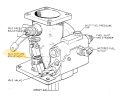
Dan explains it better than I could. While there is not a separate system, there is a separate mechanism to adjust. Bendix RSA for example:

Screenshot_20250428-103358.png
 
My CFI always had me lean the mixture “a knuckles width” while taxiing and go full rich on the runup. This was in a carbureted C172N.
My CFI taught me to put mixture at the U or R in the word Mixture. Now I put it at E. Mentally it feels superior now, haha, thanks!
 
Does it matter what you put the RPM at when you do the run-up? I’ve seen multiple checklists with different RPM settings anywhere from 1700-2300 RPM. What are thoughts on the different settings?

Also for prop cycle, any thoughts on the speed of prop cycling?
 
Dan explains it better than I could. While there is not a separate system, there is a separate mechanism to adjust. Bendix RSA for example:

View attachment 140444
What RPMs/MPs does the idle mixture adjustment affect? As with others I am very rarely actually operating at idle (IO-360 warmup RPM is more like 1400-1500). Is the idle mixture adjustment still having any effect at these RPMs?
 
What RPMs/MPs does the idle mixture adjustment affect? As with others I am very rarely actually operating at idle (IO-360 warmup RPM is more like 1400-1500). Is the idle mixture adjustment still having any effect at these RPMs?

I'm going to do a video showing EGT rise when leaning to ICO at various RPM to explore this question. I'll post it in next few days.
 
I don't -think- that there is a separate idle system as in a float type carburetor.
There isn't. All the fuel goes through the injectors. But the servo meters ALL the fuel going through those injectors, and at idle small differences in flow make big differences to the tiny idle flow. If the manufacturer makes no adjustment available, we will have engines that idle poorly or not at all.

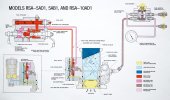
This is the typical injection system found on a Lycoming.

1745858572422.jpeg

The servo has the fuel control attached to it. It's the black-and-white thing at the bottom right of the servo. In this diagram it has been broken out and detailed at the top left of the picture. The idle control and mixture control are at opposite ends of the metering valve. Both the unmetered and metered fuel are run through the diaphragm-operated valve mechanism on the bottom left of the servo, and the left diaphragm is actuated by static pressure from ports in the venturi and dynamic pressure from the impact tubes. Static pulls, dynamic pushes. The other diaphragm is actuated between the metered and unmetered fuel pressures. There is a lot going on in there to make life easy for the pilot. All he has to do is fool with one mixture knob, and even that is made easier if the automatic mixture control is installed.

The idle mix adjustment is the link betweedn the throttle plate lever and the idle valve lever, seen as dotted lines in the blue section of the servo. It has a thumbwheel, detented by a small spring across the notches in the wheel, that has left-hand threads on one end and right-hand on the other so that turning the wheel changes the length of the link.
 
Last edited:
As promised, test of idle mixture circuit at typical ground ops setting.

AEIO-360 is currently adjusted for approx 50 RPM rise at idle cutoff. Idle speed is 700 RPM.

For this test, hot engine was set to 1000 RPM, then mixture was slowly leaned to cutoff.

 
Back
Top