GPS Navigator Usage and Confusion

DM48066

Filing Flight Plan
Joined
Jul 1, 2025
Messages
15
Display Name
CuriousPilot
Hello, I have a Garmin 430 W coupled with a Garmin 500 autopilot. While I have used this set up for a few months I from time to time am confused by the navigation commands fed to the autopilot and subsequent actions of the plane. While I don't feel that the internet is the best source of pilot training, where I live this equipment is new to most instructors. This means for me the source of information is via the Garmin Manuals, Garmin Video, or trial with a safety pilot by my side. In light of this I thought I would crowd source some SOP methods from pilots on the forum.

I recently read the article GPS Confusion published in FLYING September Magazine issue 962 hoping to pick up a few more pointers. The article covers the manual activation of a GPS approach and focuses on the behavior that directs the aircraft to fly direct to the IAF. It points out the issue associated with doing this while inside the IAF. However, other conditions are not addressed.

So, here are my questions to the group:

(1) What is your process when flying a GPS approach using a transition fix, (typically a T arrival)?
What I do - I select the approach,​
Select the Transition,​
and Load the approach only.​
(The GPS Navigator activates (or something) on its own when you pass the transition fix. The autopilot follows the navigation perfectly.) Are there conditions to watch our for here?​
​
(2) What is your process when flying a ILS or VOR?​
When using a transition fix, (Feeder).​
When using vectors to final.​
​
Thank you all in advance for considering my post.
 
I’ll try to do this as an overview, “Activate Approach” does one thing and one thing only - take you direct to whatever transition you chose, even if it’s behind you. OTHO, as you have learned, making any waypoint or leg in the approach sequence active, begins approach sequencing. How you choose to handle that is personal choice of technique, but my SOP is to not use the “Activate Approach” command at all. For me every approach begins with loading it with a logical transition based on my route of flight.

Every approach includes those which involve expected vectors to final. We getting into personal technique again, but in the case of vectors to final, I don’t use the “Vectors” transition and I don’t “Activate Vectors to Final.” Part of the reason is, as you have probably found, in your 430, VTF wipes out every approach waypoint before the FAF. I learned why the AIM cautions against using it long before they did - activating VTF and the ATC changes its mind and sends you to a waypoint you no longer have loaded. Knowing how to quickly reload the approach to remedy that is an important skill, but my SOP is, upon receiving the first vector, I scroll down to the FAF and activate the leg to final (Activate Leg is the first choice when you press the 430 Menu key). It does everything VTF does without removing anything. (If it’s an ILS, I also manually switch the CDI to VLOC at this point.)

A word of caution: there are very few people who can teach themselves modern avionics use, even with some excellent video courses out there. (I typically assign some when I do transition training.) Unless you are very unusual and the “logic” of these boxes make sense, you really want training for IFR use, even if you have to travel or pay extra for it.
 
Coincidentally, BoldMethod just published a short article about this very issue that may be of interest to you.
 
Newer navigators no longer wipe out all the points at VTF. 430 is long in the tooth and pretty poor logic - to me it’s a computer programmers’ box, not a pilots’ box like newer navigators. Hence a whole ecosystem of training on it has arisen. It’s 30 years old logic developed in a vacuum (no previous like boxes) and for non-precision approaches. A miracle in its day, but too many plies and no airways. Of course it is still a great piece of kit if installed and working.

You can learn newer navigators on your own if you understand the logic and flow from en route to approach. This is where things seem to break down for many pilots sadly.

Anytime an approach is loaded, select an IAF. If you’ve been already cleared to that IAF, then “load and activate;” if not, just “load.”

If approach was only loaded but not activated, direct to the IAF now in your flight plan will activate and sequence the approach. If there’s potential for some sort of reversal, that’s when you will be asked whether or not to include that. Then fly.

This works for the vast majority of RNAV approaches, where you navigate to an IAF. In busier terminals, vectors are more likely. No change - load the approach (you know which from ATIS most likely) with an IAF. When told “five from xyzab, flying heading xxx to intercept, clear RNAV 21” then activate vectors to final and fly the approach.

One reason to load the approach with an IAF even when you “know” you’ll be vectored is that sometimes for slower aircraft you’ll be asked to go direct to say some IF. So VTF from the outset is a bad idea.

Also, it is almost always faster to reload an approach from zero if any confusion arises or something is out of kilter with the already loaded approach, as opposed to scrolling messing with the loaded approach.
 
Newer navigators no longer wipe out all the points at VTF.
Newer Garmin navigators. It hasn't changed my SOP.
Also, it is almost always faster to reload an approach from zero if any confusion arises or something is out of kilter with the already loaded approach, as opposed to scrolling messing with the loaded approach.
Agreed. That happened within the past year or so on an instrument checkride. It was similar to a situation I created during a prep flight, so he just reloaded.

But the overall differences in our methods points out how much of this is is personal technique rather than requirement :yes:. I think understanding the difference is extremely important. My first commandment as an instructor is to never push a pilot to change a technique that works just because I like a different one better. At most, I will give a pilot a scenario to see if they handle it. If they do, great. If they don't, we have something to talk about on the ground.
 
Newer Garmin navigators. It hasn't changed my SOP.
To a first order, there are only Garmin navigators. That said, the few others work similarly, and you really only need to know how to build a flight plan, fly direct to a waypoint or join a leg, how to load and activate and/or an approach, and how to fly a missed approach. The new Garmin navigators with airways are really splendid in places like the east coast where direct isn't going to happen from A to B.
But the overall differences in our methods points out how much of this is is personal technique rather than requirement :yes:. I think understanding the difference is extremely important. My first commandment as an instructor is to never push a pilot to change a technique that works just because I like a different one better. At most, I will give a pilot a scenario to see if they handle it. If they do, great. If they don't, we have something to talk about on the ground.
Not sure personal technique cuts it per se, particularly for the vast majority of IFR pilots I see that really don't use the rating that much. Rather they adopt a set of known-to-work processes and procedures. But may be biased, since was taught by 121 guys who do pretty much nothing but fly by procedure, repeatedly and reliably. Guess not sold on "if it works, leave it alone" if what they are doing is really not the most efficient way, or the most common way even. But having said that, it's more important that somehow they get the importance of being ahead of the airplane in terms of what comes next. Can you calculate in your head when to ask for lower based on where you are and where you are going next? Can you calculate the correct VS and then establish it with the needle center on GS? Can you fly by hand in the clouds while going missed, talking to ATC, and setting up what is going to come next?

One thing that I agree is not easy to agree on is what to do with the #2 COM. I'm of the school it's to monitor 121.5 and ATIS only. Never to transmit. Others have a sort of back and forth between the radios, drives me crazy.
 
Guess not sold on "if it works, leave it alone
In the 121 world, it's all about standard procedures. And I'm willing to bet that if you switch carriers you might find they use a different one.

Guess not sold on "if it works, leave it alone" if what they are doing is really not the most efficient way

In terms of what's "better," sorry, if you are saying that your procedures are intrinsically more efficient for everyone and you will push someone to yours just because you like it better, I strongly disagree with you. My First Commandment is the result of my having been the victim of someone like that shortly after getting the rating. It literally took years to fix what they broke. When I became an instructor, I promised I wouldn't do that to someone else. I will, as I mentioned, set up a scenario where I think what they're doing isn't the best way. (I even use a list of common tasks pilots screw up.) If it turns out it works, leave it alone. If it doesn't, we have something to talk about.
 
NON overview SPECIFIC ADVICE for the OP:

(I have the same setup (Two GI 275s, G500 AP, KX 155 as NAV2). The following apply to precision (and VNAV, LNAV+V) approaches):

First, DO NOT engage "Approach mode" until your aircraft is with the 90 deg left 90 degree right 2-5 nm outside the IAF (the "FAN of engagement").
Second, as most ATO controllers will attempt to "squeeze you in close" don't allow that. If there is a fix outside of the IAF, always choose that as the "fly to fix" prior to activatng the approach. The window in which approach mode can be effectively engaged is very "specific". Tell ATO that you would like vectors to final but make sure he understands you want the last fix outside of the True IAF. HEAD for said fix just outside the IAF so you have time to get to the proper alititude, config. and speed. Now is the time to check the fixes on the loaded but not yet activated “fly plan” screen of the 430W, and not later.

Be flexible- you do not know until the system is engaged if you are going to see VNAV indications (of course you've already id'd the station and have checked NOTAMS, but it's never guaranteed in our airpsace system). You may have to fly NAV mode and fly the pitch/altitude aspects…be ready.

Do NOT fail (in the 430W+G500 configuration), to change to LOC from GPS mode, on the 430W. That is the one quirk about the 430W driven setup. Do so just inside the fix which lies outside the IAF. I do not engage the approach on the 430W until I am IN THE "FAN of engagement", and certainly do not yet select approach, on the G500.

When in the fan, at alitude and speed, then and only then engage Approach mode, be certain that your Secondary GI275 has the proper input for display or it will be very confusing (select by finger screen choice, mid lower cent of screen) - e.g, the correct input (GPS, Nav1 or Nav2) to display in the HSI mode.....Then and only then activate the approach on the 430W, and also then Engage "approach" on the G500.

Gear out at the FAF (ILS).

LEAVE it alone right through to the Missed (pay attention but no Button pushing!), and if you go to OBS (Missed) be sure to switch back to the Proper GPS display on your second GI 275. It took me about 30 practice approaches (VMC, instructor who understood this) to "understand" this adequtely so that it's become a memorized behavior. Or just hand fly the miss until/unless you are VERY VERY comfortable.

You have to walk before you can run. Get a routine you KNOW you can manage B4 you try something “tight”. Do not get flummoxed.


B
 
Last edited:
In terms of what's "better," sorry, if you are saying that your procedures are intrinsically more efficient for everyone and you will push someone to yours just because you like it better, I strongly disagree with you. My First Commandment is the result of my having been the victim of someone like that shortly after getting the rating. It literally took years to fix what they broke. When I became an instructor, I promised I wouldn't do that to someone else. I will, as I mentioned, set up a scenario where I think what they're doing isn't the best way. (I even use a list of common tasks pilots screw up.) If it turns out it works, leave it alone. If it doesn't, we have something to talk about.
I like and use your approach for scenario based learning - makes sense. I should have been a bit more specific - when working with a proficient pilot, say 150 to 200 hours/yr. in a decently equipped cross-country cruiser that has a system that works, it gets left alone. Where the struggle arises is with the 50 to 75 hours/yr. pilot who wants to improve or regain IFR capability. There, if their processes and procedures are admissible but not working that well, I am more inclined to suggest and cajole tried and true methods. Closer to a do-over anyhow. Lots of scenarios in those cases, watching faces trying to comprehend what just did not happen, with good repeats and debriefs subsequently.
 
There, if their processes and procedures are admissible but not working that well, I am more inclined to suggest and cajole tried and true methods
We agree on when it's not working that well. That's independent of how many hours the pilot happens to have. Where we seem to disagree is, I prefer to lead the pilot to decide that what they're doing isn't working.

I can be a little specific in terms of what's being discussed in this thread. If I have a pilot with a 430 or 530 who, when "expect vectors to final" is announced, loads vectors to final, I'll send them to a waypoint. If they hit the PROC key, reload the approach in such a way that the fix is now there, all is good. On the other hand, if the become the proverbial deer in the headlights, we have a discussion of the options and why one might be preferable to another.

Newer navigators no longer wipe out all the points at VTF.
I probably won't say that to a pilot who owns a GNS (or brand new Avidyne), but I can make it happen with a GTN too.
 
I can be a little specific in terms of what's being discussed in this thread. If I have a pilot with a 430 or 530 who, when "expect vectors to final" is announced, loads vectors to final, I'll send them to a waypoint. If they hit the PROC key, reload the approach in such a way that the fix is now there, all is good. On the other hand, if the become the proverbial deer in the headlights, we have a discussion of the options and why one might be preferable to another.
That's a nice 430 technique, sending them somewhere specific after they are set for VTF. And yes, you can flummox them with the GTN as well...
 
That's a nice 430 technique, sending them somewhere specific after they are set for VTF. And yes, you can flummox them with the GTN as well...
Nothing special. It happens all the time. There's a reason the AIM cautions against VTF.
 
…One thing that I agree is not easy to agree on is what to do with the #2 COM….
Different strokes.

ATIS, CD, Ground is my use for COM2. No reason to have a transceiver and not use the trans part. It also allows me to have both ground and departure loaded on the arrival in case of a go around. During cruise it usually flip flops between guard and next ATIS.
 
Different strokes.

ATIS, CD, Ground is my use for COM2. No reason to have a transceiver and not use the trans part. It also allows me to have both ground and departure loaded on the arrival in case of a go around. During cruise it usually flip flops between guard and next ATIS.
I do the same as you. One minor exception, which you might be doing as well, COM2 is used for AWOS (as opposed to ATIS) for a non-towered airport. When inbound, after getting the weather, COM2 is switched to CTAF in order to monitor what's going on there. But it's when it's time to communicate on CTAF, it goes into COM 1.
 
I do the same as you. One minor exception, which you might be doing as well, COM2 is used for AWOS (as opposed to ATIS) for a non-towered airport. When inbound, after getting the weather, COM2 is switched to CTAF in order to monitor what's going on there. But it's when it's time to communicate on CTAF, it goes into COM 1.

Yeah. ATIS/AWOS. I know words mean things…just lazy ob my part.
 
I’ll try to do this as an overview, “Activate Approach” does one thing and one thing only - take you direct to whatever transition you chose, even if it’s behind you. OTHO, as you have learned, making any waypoint or leg in the approach sequence active, begins approach sequencing. How you choose to handle that is personal choice of technique, but my SOP is to not use the “Activate Approach” command at all. For me every approach begins with loading it with a logical transition based on my route of flight.

Every approach includes those which involve expected vectors to final. We getting into personal technique again, but in the case of vectors to final, I don’t use the “Vectors” transition and I don’t “Activate Vectors to Final.” Part of the reason is, as you have probably found, in your 430, VTF wipes out every approach waypoint before the FAF. I learned why the AIM cautions against using it long before they did - activating VTF and the ATC changes its mind and sends you to a waypoint you no longer have loaded. Knowing how to quickly reload the approach to remedy that is an important skill, but my SOP is, upon receiving the first vector, I scroll down to the FAF and activate the leg to final (Activate Leg is the first choice when you press the 430 Menu key). It does everything VTF does without removing anything. (If it’s an ILS, I also manually switch the CDI to VLOC at this point.)

A word of caution: there are very few people who can teach themselves modern avionics use, even with some excellent video courses out there. (I typically assign some when I do transition training.) Unless you are very unusual and the “logic” of these boxes make sense, you really want training for IFR use, even if you have to travel or pay extra for it.
Hello midlifeflyer, thank you for your sharing you processes with me. I also agree with your comment re guarding professional help to understand the boxes. I started flying IFR when NDBs were a thing :), ha, how things have changed for the better. All the best.
 
Newer navigators no longer wipe out all the points at VTF. 430 is long in the tooth and pretty poor logic - to me it’s a computer programmers’ box, not a pilots’ box like newer navigators. Hence a whole ecosystem of training on it has arisen. It’s 30 years old logic developed in a vacuum (no previous like boxes) and for non-precision approaches. A miracle in its day, but too many plies and no airways. Of course it is still a great piece of kit if installed and working.

You can learn newer navigators on your own if you understand the logic and flow from en route to approach. This is where things seem to break down for many pilots sadly.

Anytime an approach is loaded, select an IAF. If you’ve been already cleared to that IAF, then “load and activate;” if not, just “load.”

If approach was only loaded but not activated, direct to the IAF now in your flight plan will activate and sequence the approach. If there’s potential for some sort of reversal, that’s when you will be asked whether or not to include that. Then fly.

This works for the vast majority of RNAV approaches, where you navigate to an IAF. In busier terminals, vectors are more likely. No change - load the approach (you know which from ATIS most likely) with an IAF. When told “five from xyzab, flying heading xxx to intercept, clear RNAV 21” then activate vectors to final and fly the approach.

One reason to load the approach with an IAF even when you “know” you’ll be vectored is that sometimes for slower aircraft you’ll be asked to go direct to say some IF. So VTF from the outset is a bad idea.

Also, it is almost always faster to reload an approach from zero if any confusion arises or something is out of kilter with the already loaded approach, as opposed to scrolling messing with the loaded approach.
Hello Steamflyer, thank you for the comments regarding my post. I agree with your evaluation of the 430 but it is still working for now but I am also looking at a replacement. All the best.
 
Hello midlifeflyer, thank you for your sharing you processes with me. I also agree with your comment re guarding professional help to understand the boxes. I started flying IFR when NDBs were a thing :), ha, how things have changed for the better. All the best.
You and me both.
 
NON overview SPECIFIC ADVICE for the OP:

(I have the same setup (Two GI 275s, G500 AP, KX 155 as NAV2). The following apply to precision (and VNAV, LNAV+V) approaches):

First, DO NOT engage "Approach mode" until your aircraft is with the 90 deg left 90 degree right 2-5 nm outside the IAF (the "FAN of engagement").
Second, as most ATO controllers will attempt to "squeeze you in close" don't allow that. If there is a fix outside of the IAF, always choose that as the "fly to fix" prior to activatng the approach. The window in which approach mode can be effectively engaged is very "specific". Tell ATO that you would like vectors to final but make sure he understands you want the last fix outside of the True IAF. HEAD for said fix just outside the IAF so you have time to get to the proper alititude, config. and speed. Now is the time to check the fixes on the loaded but not yet activated “fly plan” screen of the 430W, and not later.

Be flexible- you do not know until the system is engaged if you are going to see VNAV indications (of course you've already id'd the station and have checked NOTAMS, but it's never guaranteed in our airpsace system). You may have to fly NAV mode and fly the pitch/altitude aspects…be ready.

Do NOT fail (in the 430W+G500 configuration), to change to LOC from GPS mode, on the 430W. That is the one quirk about the 430W driven setup. Do so just inside the fix which lies outside the IAF. I do not engage the approach on the 430W until I am IN THE "FAN of engagement", and certainly do not yet select approach, on the G500.

When in the fan, at alitude and speed, then and only then engage Approach mode, be certain that your Secondary GI275 has the proper input for display or it will be very confusing (select by finger screen choice, mid lower cent of screen) - e.g, the correct input (GPS, Nav1 or Nav2) to display in the HSI mode.....Then and only then activate the approach on the 430W, and also then Engage "approach" on the G500.

Gear out at the FAF (ILS).

LEAVE it alone right through to the Missed (pay attention but no Button pushing!), and if you go to OBS (Missed) be sure to switch back to the Proper GPS display on your second GI 275. It took me about 30 practice approaches (VMC, instructor who understood this) to "understand" this adequtely so that it's become a memorized behavior. Or just hand fly the miss until/unless you are VERY VERY comfortable.

You have to walk before you can run. Get a routine you KNOW you can manage B4 you try something “tight”. Do not get flummoxed.


B
Hi bbchien thank you for sharing your SOP which includes an ILS or VOR approach. Sounds like you have a great setup. Thanks for sharing. All the best.
 
Oh… GFC 500 AP. One tip. “APR” when you hear the words, “cleared for the approach.” The only thing APR mode does is arm the glideslope/path.
Only thing? On a VOR approach, hitting the APR button switches a GFC autopilot to VAPP mode.
 
Which is why for a VOR approach I fly it in NAV MODE with Altitude by PIC. Selecting the next altitude via vert. Desc rate is easy….
 
Only thing? On a VOR approach, hitting the APR button switches a GFC autopilot to VAPP mode.
I’m not familiar with the term VAPP. But if you are talking about +V, I guess I should make my attempt to include all guided vertical modes longer :)
 
Last edited:
I’m not familiar with the term VAPP. But if you are talking about +V, I guess I should make my attempt to include all guided vertical modes longer :)
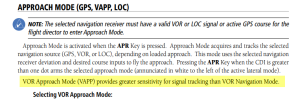
This is from the GFC700 AFMS. The description in the GI275/GFC500 pilots guide is even more brief (a simple one-liner saying "VAPP = VOR Approach")

1756735098575.png

To be honest, I have no idea what it really does. :)

Older autopilots had a different pilot-selectable sensitivity for VOR tracking en-route versus an approach, so my only guess is that this does something similar. But I do know that there is no vertical guidance whatsoever, +V or otherwise.
 
Hello Steamflyer, thank you for the comments regarding my post. I agree with your evaluation of the 430 but it is still working for now but I am also looking at a replacement. All the best.
430 is a good box, but when you upgrade to say a 650, you will be very pleased! The logic is much more intuitive.
 
To be honest, I have no idea what it really does. :)

Older autopilots had a different pilot-selectable sensitivity for VOR tracking en-route versus an approach, so my only guess is that this does something similar. But I do know that there is no vertical guidance whatsoever, +V or otherwise.
Thank you. I literally never heard the term until today. I guess that shows how often I worry about GPS on VOR approaches :D.

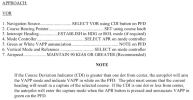
I managed t fined it, and, yes, your guess is correct. It stands for "VOR Approach" and like older autopilots with a "HI/LO" or similar setting, APR mode increases VOR tracking sensitivity. This is from an early Pilots Guide for the DA40 G1000 manual.

1756751151516.png
 
Thank you. I literally never heard the term until today. I guess that shows how often I worry about GPS on VOR approaches :D.

I managed t fined it, and, yes, your guess is correct. It stands for "VOR Approach" and like older autopilots with a "HI/LO" or similar setting, APR mode increases VOR tracking sensitivity. This is from an early Pilots Guide for the DA40 G1000 manual.

View attachment 144681
The Century II has a switch with settings labeled NAV and OMNI for that. If you asked me which one is which, I'd have to go look it up. :rofl:
 
Never, never, never use Vectors to Final. I did this during an IPC and ATC changed their mind at the last minute and sent me to a fix that VTF had of course deleted. Then it's the dance of the seven veils to reload the entire approach and call up the fix you need. Never again, not if ATC swears on a stack of Bibles they are going to vector me to final. Just load the approach and when you are actually going to intercept the final approach course, activate the appropriate leg. If you get redirected to another fix, it should be there in the box. For an ILS, make sure to switch to VLOC mode before intercept.

At my home field, with a HILPT (used to be a T-arrival) GPS approach I don't mind activating the approach, because you are always going to fly the approach as depicted from the IAF on your own nav. The only gotcha for my home airport GPS approach is that the 430 does not delete the hold when flying a NoPT sector to the IAF. I have to delete the hold manually.
 
Garmin really complicated the whole thing by creating the "Activate" option, didn't they?

In my work planes, with Collins Pro Line 21 or Collins Pro Line Advanced, there is no "Activate" option. They simply let you load whichever approach you from whatever transition you want, then it puts it at the end of your flight plan, after a "discontinuity". To proceed to the IAF and "activate" the approach, you then need to select the IAF and go direct to it, or at least clear the discontinuity.

It's very clear and obvious, and the Garmin navigators have the same logic and methodology, except they took the extra step of adding an "activate" function and thereby causing decades of confusion and training opportunities.
 
R
In my work planes, with Collins Pro Line 21 or Collins Pro Line Advanced, there is no "Activate" option. They simply let you load whichever approach you from whatever transition you want, then it puts it at the end of your flight plan, after a "discontinuity". To proceed to the IAF and "activate" the approach, you then need to select the IAF and go direct to it, or at least clear the discontinuity.
That's pretty much the same way the 480 works. Garmin really never flew IFR when they designed the 430/530 and later interfaces.
 
Never, never, never use Vectors to Final. I did this during an IPC and ATC changed their mind at the last minute and sent me to a fix that VTF had of course deleted.
I never use it. I stopped using it when I learned the consequences you describe on December 20, 2009. When Garmin added the retention of waypoints along the extended FAC in the GTN era, I simply saw no reason to change my SOP, aside from the fact there are situations where it won't help. All I need to do is send them to an approach fix that isn't in the straight line.

But ...
Then it's the dance of the seven veils to reload the entire approach and call up the fix you need.
That process should take no more than 6-10 seconds. And there are so many real world situations it applies to, we have to know how and when to do it. It joined my list of "GPS Tasks Pilots Don't Know How to Do" because (my analysis) of a fatal accident where the pilot was given a different approach than they originally loaded, apparently got flummoxed, and ultimately lost control, crashing into a wooded park on final.

On the other end, knowing how and when to do that 6-10 second reload saved at least one instrument checkride :) This is the full story I alluded to earlier. It wasn't my student, but I'm sometimes asked to do a checkride prep flights. In this one, we were heading toward a hold at the IAF/FAF, and I switched the pilot up to one of the T waypoints. The applicant had some difficulty so ground talked about reloading. Fast forward to the checkride. The applicant simply made a loading error. The DPE saw it right away. The applicant saw it almost too late. The applicant and the DPE expected a failure. Then, the applicant heard me... "just reload the approach." Passed.

I use some version of reload during recurrent IFR training almost every time. Including yesterday when, after the pilot loaded the approach without the hold at the IF (which was correct), "ATC" instructed, "There's an aircraft ahead of you on the approach. Expect to hold at [IF] as published."

Parenthetically, the necessity to know when and how to reload is the main reason I don't try to force a change to someone who does use VTF so long as they can recover from it easily. I think it's not as efficient as keeping the full approach, but if the pilot does the 6-10 reload, I'm happy.
 
Garmin really complicated the whole thing by creating the "Activate" option, didn't they?
Absolutely a GNS/GTN screwup on Garmin's part.

While we're at it: IMHO, a screwup on the GFC Autopilots is the labeling of the "APR" button... should have been GS/GP, 'cause ALL it does is arm for eventual capture of the glideslope/glidepath (OK, and it also arms NAV if you're in HDG mode). For example, that button has nothing to do with stepdowns outside the leg to the FAF (that's of course the VNAV button... also maybe poorly labeled??).

Two devices (navigator, autopilot)... two screwups that have created lots of confusion for IR pilots (both new students and those upgrading avionics).
 
Last edited:
Absolutely a GNS/GTN screwup on Garmin's part.

While we're at it: IMHO, a screwup on the GFC Autopilots is the labeling of the "APR" button... should have been GS/GP, 'cause ALL it does is arm for eventual capture of the glideslope/glidepath (OK, and it also arms NAV if you're in HDG mode). For example, that button has nothing to do with stepdowns outside the leg to the FAF (that's of course the VNAV button... also maybe poorly labeled??).

Two devices (navigator, autopilot)... two screwups that have created lots of confusion, for IR pilots (both new students and those upgrading avionics).
APR has always meant armed for GS capture which why I think they carried the term over from older autopilots like King made. The mode may also increase lateral sensitivity, but that's secondary. The last King APs were nice because they had two lines - the top being what it was doing at the moment, the bottom line being what was armed and hopefully coming next (and was then promoted up).

VNAV makes sense because you aren't on the approach yet. You are nav'ing with a vertical component.

As for the GTNs, don't think Garmin could have made it any easier. Very well designed, a pilot's box, the antithesis to the 430. You activate from the PROC page or go direct to an IAF - same result.
 
While we're at it: IMHO, a screwup on the GFC Autopilots is the labeling of the "APR" button... should have been GS/GP, 'cause ALL it does is arm for eventual capture of the glideslope/glidepath (OK, and it also arms NAV if you're in HDG mode). For example, that button has nothing to do with stepdowns outside the leg to the FAF (that's of course the VNAV button... also maybe poorly labeled??).
To some extent, that's because a lot of other autopilots work that way too. It's not something Garmin made up.
 
While we're at it: IMHO, a screwup on the GFC Autopilots is the labeling of the "APR" button... should have been GS/GP, 'cause ALL it does is arm for eventual capture of the glideslope/glidepath (OK, and it also arms NAV if you're in HDG mode).
I was corrected on this earlier. Apparently it also tightens deviations on VOR approaches, so there is at least some lateral component. That said, I do think it’s a little funny, that APR is in the lateral mode group when its primary (and almost exclusive) function is vertical.

But I don’t see labeling it APR as a screwup because that vertical component is tied to hearing the “cleared for the approach” instruction.
Isn't the switch from HDG to NAV when getting vectors also activated by the APR button? If so, that's a pretty common use case, at least in the airspace I fly. (East Coast)
 
I was corrected on this earlier. Apparently it also tightens deviations on VOR approaches, so there is at least some lateral component. That said, I do think it’s a little funny, that APR is in the lateral mode group when its primary (and almost exclusive) function is vertical.

But I don’t see labeling it APR as a screwup because that vertical component is tied to hearing the “cleared for the approach” instruction.
When autopilots were invented, most approaches were lateral(VOR, LOC), but the en route sensitivity was insufficient for the lateral accuracy needed to be aligned with the runway on an approach. So APR increased the sensitivity of the lateral coupling.

If you happened to be at the big city or county airport, served by an ILS which is LOC + GS, the autopilot would also look for the null in the GS signal, and if it found it (this assumes that the navigation receiver in use had a glideslope receiver installed - often only nav1 did), it would begin an initial pitch down of about 3 degrees and then attempt to follow both the LOC and the GS at the same time.

In fact, many autopilots needed an intercept of 30 degrees or less, so you might find yourself using HDG, NAV, and APR all on the same approach. There were over 1000 VORs, so often the feeder (think a leg of the "T" on a TAA approach) was a VOR radial to intercept the localizer. Later "all angle" intercept autopilots did away with this restriction for the most part.

All this was done with the SA in one's head since there were no moving maps of any kind - en route and approach charts and a pencil if needed. Having a DME was godlike since you didn't have to keep spinning an OBS for the crossing radials to know where you were along the LOC.

Today we have precision approaches to both ends of almost every runway, so have a much more precision approach mindset, with simultaneous lateral and vertical guidance all time.
 
Isn't the switch from HDG to NAV when getting vectors also activated by the APR button? If so, that's a pretty common use case, at least in the airspace I fly. (East Coast)
Yes (I think it fits into the, “of course it does” group), but you don’t have to press the APR button to go from HDG to NAV. For example, if I am in HDG mode, being vectored to final and get a “join” or “intercept the final” instruction, I think the proper button is NAV, not APR until I am cleared for the approach.
 
Back
Top