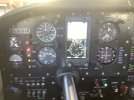
Glass cockpit vs steam gauges

I'm guessing you have a 650?
….

Yes, but I have about 50 hours behind a 750 as well.

…Another place I want to go fairly frequently is the VNAV page, and that is the one page in the entire interface that there's apparently no voice command for.
We may have telligence in the 172, but I’ve never messed around with it. Maybe I will one day. Anyways, when you speak of VNAV page, are you referring to configuring the point to VNAV to or are you referring to the set descent rate or angle VNAV page? For VNAV descent rates, I rarely change from 500fpm although I do understand the scenarios where that would happen more often.
 
We may have telligence in the 172, but I’ve never messed around with it. Maybe I will one day. Anyways, when you speak of VNAV page, are you referring to configuring the point to VNAV to or are you referring to the set descent rate or angle VNAV page? For VNAV descent rates, I rarely change from 500fpm although I do understand the scenarios where that would happen more often.
The "configuring the point to VNAV to" is just in the flight plan, so very easy to get to. I'm talking about Utilities -> VNAV. I usually need to lower the angle below the default because when the plane accelerates in the descent, the standard angle gets to be too quick of a descent.
 
Ive been flying 45 yrs. Owned 6 single engine planes small to large. Simple to complex.
I have many hours ifr in benign conditions way before gps existed and with no auto and with no problems at all. All approaches were vor or ils approaches.

I have a friend with an older cessna 210 worth about $100,000 before adding $70,000 of avionics to it. He never flys imc. He's a retired airline pilot.
I know of many other such cases.

Makes no sense to me.

I ask because Im looking to upgrade to a newer RV14 and they all have glass cockpits.
Ive never even used one. Call it my last hurrah.

Your thoughts? I respect and appreciate all responses.
This is not uncommon. I had a friend with a pressurized twin Cessna and he added a fantastic batch of goodies to the panel---but basically refused to fly through a cloud--even with ATC barking at him for deviations. It was a great plane in many aspects, but the fuel burn and general issues with cylinders and turbos and exhaust---very time consuming and pricey.
 
Sure, any tech does. Remember LORAN and VOR/DME based RNAV? Plus there are variation even without obselescence. But like analog, there are commonalities. You can look at almost any PFD from any company and the basic 6-pack emulation is pretty much the same.
I’m only going to point out something a lot of people don’t think about. I want bought a series SR 20, it was fully loaded and magnificent, all glass, all the goodies… software update for the MFD was $6000 and that was eight years ago. The software update was necessary to install ADS-B. AND ALL THAT GLASS NEEDS CONSTANT UPDATED DATABASES! Glass panels our gifts that keep on taking.

Don’t get me wrong, all glass just looks good, flying at night or instrument. It makes everything easy, and the transition from steam gauges was easy. So if the concern is a transition, do not be worried. But if this concern is whether or not it is justifiable on cost or your mission . . . .

That’s where I’m at right now. I am refurbishing a Luscombe and trying to decide if I want to spend money on avionics for a VFR only airplane. I’m sure one could shoot an instrument approach in a Luscombe, but that’s not why I bought it and it will not be my mission profile.
 
Avionics today remind me of PC's in the 90's. Improvements were so quick things became obsolete quickly. Bad idea to develop a system (in this case a plane) that was chained to certain technology.

Net net, IMHO don't put in any new glass avionics without a good plan on how to take them out in the future.

Today's Gamin Ultra 10,000 is tomorrow's Bendix King Collins LORAN whatnot.
 
I’m only going to point out something a lot of people don’t think about. I want bought a series SR 20, it was fully loaded and magnificent, all glass, all the goodies… software update for the MFD was $6000 and that was eight years ago. The software update was necessary to install ADS-B. AND ALL THAT GLASS NEEDS CONSTANT UPDATED DATABASES! Glass panels our gifts that keep on taking.
That's been true for more than 30 years. IFR GPS usage has always required database updates.
 
Avionics today remind me of PC's in the 90's. Improvements were so quick things became obsolete quickly. Bad idea to develop a system (in this case a plane) that was chained to certain technology.

Net net, IMHO don't put in any new glass avionics without a good plan on how to take them out in the future.

Today's Gamin Ultra 10,000 is tomorrow's Bendix King Collins LORAN whatnot.
True! IMHO, is the single smartest thing Avidyne ever did was build the IFD series Navigators on the same form factor as the GNS-430/530 making the upgrade an allen wrench, 2 minutes, and a log book entry . . . (assuming you already had a WAAS antena) but at least the box to box upgrade was simple.
 
Avionics today remind me of PC's in the 90's. Improvements were so quick things became obsolete quickly. Bad idea to develop a system (in this case a plane) that was chained to certain technology.

Net net, IMHO don't put in any new glass avionics without a good plan on how to take them out in the future.

Today's Gamin Ultra 10,000 is tomorrow's Bendix King Collins LORAN whatnot.

The difference is that unless you require new functionality, what new technology do you need? A G3X can do everything I can think of, the only negative is the long database update times.
 
I can’t tell you what things will be available / needed in the future, but I am certain it will be as different then compared to today as today compared to what was.

Nothing - even a G3X - is the last and final thing that anyone will ever need.

We no longer have the VORs and ILS approaches we used to have. Something will replace GPS. Things always change.

I wouldn’t worry about 2100 yet.
GPS was on the horizon the moment we started to launch satellites, 50 years later it’s still pinnacle of navigation tech.

There is nothing on the horizon to replace it and ditto for glass displays, they are standardized for a reason. We’ve leveled out in the technology improvements, there’s nothing significant on the horizon. Minor improvements yes.

Im willing to bet a beverage that 10 years from now there will be a G4X, but it won’t be jump in technology, like 650->650Xi
Heck, many are still flying with 430s with buttons for everything and appliances come with better screens today.
 
Define “standardized”?

What they do, PFD screen format, etc. If you look at the FAA instrument flying book, the screen shots are just like G3X or G1000 or etc.
The MFDs have changed , ADSB weather and traffic, Garmin has added georeferencing and dynamic charts.
EFBs have added some new features, but they are incremental changes, nice to have, but not needed or a game changer.
 
What they do, PFD screen format, etc. If you look at the FAA instrument flying book, the screen shots are just like G3X or G1000 or etc.
When you get more exposure to different glass cockpit systems, you’ll find that they are far from standardized.
 
I can’t tell you what things will be available / needed in the future, but I am certain it will be as different then compared to today as today compared to what was.

Nothing - even a G3X - is the last and final thing that anyone will ever need.

We no longer have the VORs and ILS approaches we used to have. Something will replace GPS. Things always change.
I'm sure that's true with respect to navigation. The changes will probably be relatively slow, though, just because of the cost and lag associated with swapping out the gear in airliners and the military. I think it's just jamming of GPS that has caused the FAA to maintain the almost functional VOR network.

But for just flying a piston single VFR, really just airspeed and altitude indicators are needed to fly, outside of compliance. A tach is a nice bonus, and for many you really don't even need airspeed and altitude, but they're handy. As far as I know, if they still work OK you could be using an airspeed indicator and altimeter from 1940 and be fine, if they still worked, that's 85+ years.

So back to navigation, now we have VOR/ILS and GPS, disparate systems, that manufacturers have been able to combine to let us navigate pretty seamlessly switching between the two. That a nearly 20 year old 430W can do that is pretty cool, and I think it means that any new navigation system would be something that could integrate with whichever is left of the other two. I'd kinda like to see inexpensive ILS added to the integration, but that's probably unrealistic.

Anyway, all of that should fit into a single display, and any of that is going to require the same updates they do now, as approaches and airports change, and as the routes/airways change.

I'm not sure if I had a point with all this rambling, except that I'm pretty sure we'll be able to fly VFR with simple stuff for a long time, and the current system isn't going to change any faster than the ability for old 737s and C-130s to fly around everywhere in the country IFR with their current equipment. That, and if I ever have any airplane, and it has glass, I'm going to probably want that analog ASI and altimeter, because I know they'll work even if I don't pay the electric bill.

 
Nothing - even a G3X - is the last and final thing that anyone will ever need.

We no longer have the VORs and ILS approaches we used to have. Something will replace GPS. Things always change.
Changes in navigation would only affect the radios. In theory, any new radio technology would just need to talk CANBUS, ARINC429 or RS232 and the G3x should be good with it after a possible firmware update.
 
When you get more exposure to different glass cockpit systems, you’ll find that they are far from standardized.
I guess that’s what one means about standardized. I’m completely unfamiliar with airline systems, but there seems to be some degree of standardization in the 6 pack sense. At least across the ones I’ve seen, airspeed tape on the left, altitude in the right, ADI over HSI. Maybe even the lack of a glideslope needle. Stuff like that. That may be what he is seeing as standardized. But a lot of that is really all about basic consistency with what has gone before. Switch the locations of the airspeed and altitude tapes, and you’d get a lot of confused pilots.

Beyond that, i agree with you. Skypointer vs roll pointer for the ADI. No “pink needles” on an Aspen. How you access other functions might be touch, button, or a combination. Even what functions are accessible changes within a manufacturer.
 
We put in dual GI-275s a few years ago, but kept the non-vacuum steam gauges until we finally took them out earlier this year. Nice to not have a vacuum system; nice to not worry about gyro drift.

But I do not like the speed tape.
I do not like it in the pattern,
I do not like it in the air.
I do not like it on final,
I do not like it anywhere.

I'm always over-correcting. I wish there was GI-275 analog airspeed indicator.
You paying too much of attention to the air speed indicator. Use your primary instruments more or look out the window, attitude controls air speed.
 
new radio technology would just need to talk CANBUS, ARINC429 or RS232 and the G3x should be good with it after a possible firmware update.
Maybe. Maybe not. For example, the GTNs require Ethernet because the GNS wiring doesn't have the needed capacity. But we'll deal with it whatever it is in the future. If we all get to buy something new because of changing avionics, we can just add it to the list of things we buy for these planes.
 
GTNs require Ethernet because the GNS wiring doesn't have the needed capacity.
Not sure what you're getting at. GTN can crossfill a GNS (WAAS) over serial.
 
You paying too much of attention to the air speed indicator. Use your primary instruments more or look out the window, attitude controls air speed.
he might be talking about IFR but even then, you don’t want to chase needles (or numbers). Makes no difference if analog or digital.
 
When you get more exposure to different glass cockpit systems, you’ll find that they are far from standardized.
The presentation of the "six pack" seems to be standardized. I've never seen anything that doesn't have airspeed tape on the left, altitude/VSI tape on the right, AI in the middle, HSI below. I'm learning the Pro Line 21 right now and the PFD is pretty well usable right out of the gate. The FMS portion is different of course, still finding some things there. Setting all the speed bugs is different. Other than that, it's just another PFD. :dunno:
 
I think the upgrade is worth it for reasons mentioned above, especially Martin. Personally, I think all pilots should initially train and obtain at least the private pilot license using steam gauges. When I got my multi add-on, I had to use a HSI for the first time. For something so simple, especially digital HSI's that auto-slew, I found the learning curve to be more than I thought.
 
We put in dual GI-275s a few years ago, but kept the non-vacuum steam gauges until we finally took them out earlier this year. Nice to not have a vacuum system; nice to not worry about gyro drift.

But I do not like the speed tape.
I do not like it in the pattern,
I do not like it in the air.
I do not like it on final,
I do not like it anywhere.

I'm always over-correcting. I wish there was GI-275 analog airspeed indicator.
I suspect the reason you have this issue is because you control pitch with the airspeed indicator instead of outside references VFR or the attitude indicator IFR. A pilot who does this chases the analog AS too, but when transitioning from steam to glass, the digital display magnifies the effect and it becomes quite objectionable to the pilot.
 
The presentation of the "six pack" seems to be standardized. I've never seen anything that doesn't have airspeed tape on the left, altitude/VSI tape on the right, AI in the middle, HSI below. I'm learning the Pro Line 21 right now and the PFD is pretty well usable right out of the gate. The FMS portion is different of course, still finding some things there. Setting all the speed bugs is different. Other than that, it's just another PFD. :dunno:
Four of the six pack are standardized, but that’s definitely not standardization of glass. You’re learning PL 21 in the Hawker, IIRC, which is different than PL21 in Citations. PL21 has significant differences from earlier versions of Collins EFIS…location of VS, colors (Magenta for altitude preselect and blue for VNAV altitude on PL4, the opposite in the Hawker PL21). In the Hawker you set “Baro” or “RA” minimums; PL4 calls them “MDA” and “DH.” And that’s just some of the surface differences on the PFD.

Depending on how rigid one is in their learning process, this can cause significant distress when changing airplanes systems.
 
The "configuring the point to VNAV to" is just in the flight plan, so very easy to get to. I'm talking about Utilities -> VNAV. I usually need to lower the angle below the default because when the plane accelerates in the descent, the standard angle gets to be too quick of a descent.
I changed the default VNAV angle. That’s the last time I opened that page. My “descend at cruise power” SOP was a bit rapid at the factory default of 3 degrees.
 
I suspect the reason you have this issue is because you control pitch with the airspeed indicator instead of outside references VFR or the attitude indicator IFR. A pilot who does this chases the analog AS too, but when transitioning from steam to glass, the digital display magnifies the effect and it becomes quite objectionable to the pilot.
No, I control airspeed with pitch. Same way the AP does.
 
No, I control airspeed with pitch. Same way the AP does.
I think you’ve gotten some unfortunate comments to your post. Let me try something else.

First, regarding the autopilot, yes, it uses pitch since that’s all it has for straight and level flight, climbs, and descents. But it also responds to the smallest deviations. Smaller than most pilots can even detect. So while I agree that sometimes we should watch how an AP does things as a guide for our actions, the comparison fails pretty quickly.

Your dislike (and I love the Dr Seuss rhyme) is probably just lack of experience. Even a small ADI like the GI275 allows for finer pitch control. So do altitude tapes. And, when the AP is flying, the way it locks onto the flight director is awesome. But for pilots, they are just another reason to bring back old overcorrecting habits. I do a lot of avionics training and see it all the time in analog to glass PFD transitions. Work on it and it goes away. I switch back and forth between analog and glass all the time and, while I have my preferences, I’m equally comfortable with either.

Airspeed in particular is a very bad thing to chase. When I have a client with airspeed control issues for landing, covering the ASI is my first step. Because it usually is the only step needed.
 
Last edited:
I’m only going to point out something a lot of people don’t think about. I want bought a series SR 20, it was fully loaded and magnificent, all glass, all the goodies… software update for the MFD was $6000 and that was eight years ago. The software update was necessary to install ADS-B. AND ALL THAT GLASS NEEDS CONSTANT UPDATED DATABASES! Glass panels our gifts that keep on taking.

Don’t get me wrong, all glass just looks good, flying at night or instrument. It makes everything easy, and the transition from steam gauges was easy. So if the concern is a transition, do not be worried. But if this concern is whether or not it is justifiable on cost or your mission . . . .

That’s where I’m at right now. I am refurbishing a Luscombe and trying to decide if I want to spend money on avionics for a VFR only airplane. I’m sure one could shoot an instrument approach in a Luscombe, but that’s not why I bought it and it will not be my mission profile.
No DB updates required for the PFD though (6-pack replacement instruments). Only for GPS-related instrument, which are required for any GPS being used for IFR (and even for that, only the Nav Data DB needs to be updated). I rarely update the others, although I don't fly IFR and to large unfamiliar airports as often as I used to.
 
Ive been flying 45 yrs. Owned 6 single engine planes small to large. Simple to complex.
I have many hours ifr in benign conditions way before gps existed and with no auto and with no problems at all. All approaches were vor or ils approaches.

I have a friend with an older cessna 210 worth about $100,000 before adding $70,000 of avionics to it. He never flys imc. He's a retired airline pilot.
I know of many other such cases.

Makes no sense to me.

I ask because Im looking to upgrade to a newer RV14 and they all have glass cockpits.
Ive never even used one. Call it my last hurrah.

Your thoughts? I respect and appreciate all responses.
I learned to fly with needles (we flew T-38s at 300 kts down low navigating with just an HSI) and find they are easier and faster for me to scan and interpret, which allows me to keep my eyes outside of the cockpit. When I redid the shotgun layout original panel on my 250 Comanche I used the six pack layout generally, with modern adaptations. It works very well for me. No vacuum system. I chose the Aspen for the ADI and HSI over the Garmin 275s because I could disable the tapes and have a cleaner display. The Aspen requires you to keep the steam ASI and ALT anyways, and I didn’t want two displays of the same info to be conflicting. I have never liked the T&B, so it is relegated to the side, under a AV-20S clock which also has a good attitude indicator for backup. I also replaced the old King NAV2 CDI with a 275 MFD which can display a lot of good data, besides the CDI which I have wired to be able to display on the CDI page either NAV1 VLOC, GPS, NAV2 VLOC, and internal VFR GPS. This is a good IFR panel that serves me well in the VFR flying I do. The Aspen works well with the Trio autopilot which fit in the stock 3” guage stack.

To make switching between the screens on the 275MFD I added a menu beside it. The page it usually stays on is traffic, but the touch screen moving map is also very useful. I can get the same info on the navigator, but that is pretty far to the right and out of my scan.
 

Attachments

  • IMG_1500.jpeg
    IMG_1500.jpeg
    2.3 MB · Views: 14
  • IMG_0543.jpeg
    IMG_0543.jpeg
    1.3 MB · Views: 15
Last edited:
I've owned my RV-9A for a little over six years and have put about 650 hours on it. It had steam gauges plus an IFR GPS. I regularly fly IFR. This spring, I updated the panel to all Garmin G3X Touch, ADS-B in/out, autopilot, IFR GPS. There was a very small learning curve. My instrument scan changed, and I had to get used to the tapes, especially on approaches. But it really was a small learning curve. After just a few approaches, everything fell into place. Now, I can't imagine going back. There is so much information at your fingertips. I truly believe I'm a safer pilot with all of this information, plus I do a better job at managing/monitoring my engine, too. The other unadvertised benefit is between the new avionics and a lithium battery, I saved 52lbs!
We have a G3X in a plane as well and it’s amazing. I completely agree it is way safer. The information and the situational awareness are incredible.

Adam I see another post of yours in the classifieds that you went to glass and are selllng your stuff. I’m new enough to this page I can’t comment on the ad or message you direct. I’m lookin for a JPi EDM 900.
 
We put in dual GI-275s a few years ago, but kept the non-vacuum steam gauges until we finally took them out earlier this year. Nice to not have a vacuum system; nice to not worry about gyro drift.

But I do not like the speed tape.
I do not like it in the pattern,
I do not like it in the air.
I do not like it on final,
I do not like it anywhere.

I'm always over-correcting. I wish there was GI-275 analog airspeed indicator.
I,ll second that and add the VSI, every thing else is great
 
No, I control airspeed with pitch. Same way the AP does.
“ I do not like the speed tape. I’m always over-correcting”.
So your autopilot chases airspeed like you do? Must be quite the set up.
 
Last edited:
he might be talking about IFR but even then, you don’t want to chase needles (or numbers). Makes no difference if analog or digital.
Again, attitude controls the air speed. A stable approach requires a constant air speed and therefore, a constant attitude, VFR OR IFR. If you’re trimmed out for a constant attitude, you don’t have to look at the speed. It’ll always stay the same.
 
Again, attitude controls the air speed. A stable approach requires a constant air speed and therefore, a constant attitude, VFR OR IFR. If you’re trimmed out for a constant attitude, you don’t have to look at the speed. It’ll always stay the same.
Not sure why that was in response to me since we agree completely.
 
Back
Top