Foreign accents on the radio

Here is something that happens way too often for me. Base turn is coming up, but pilot flying feels like he can't turn until he makes his "turning base" call, even if there is no conflict. I need to remind them to fly the airplane first, and talk later. This is not because they are being overly cautious - it is a habit. When every turn you have made had an associated radio call, one feels naked when making that turn and skipping the call.
I skipped a base turn call completely just the other day.
 
I skipped a base turn call completely just the other day.
Thread drift, I know, but a good opportunity to ask:

What is everyone's preferred practice for making calls in the pattern when you're the only one there?

Call every leg? Only call certain legs? Only call if other radio-capable traffic appears?

Just curious on opinions regarding the balance between not clogging up a shared frequency by calling every single leg for every circuit vs. getting out of the muscle-memory of associating every turn with a call.
 
What is everyone's preferred practice for making calls in the pattern when you're the only one there?

I prefer to make every appropriate call. Just in case there is someone out that that I haven't seen.

But I also -edit- don't drone on and on and on and on...especially in areas where the frequency is overused at other airports
 
Last edited:
Thread drift, I know, but a good opportunity to ask:

What is everyone's preferred practice for making calls in the pattern when you're the only one there?

Call every leg? Only call certain legs? Only call if other radio-capable traffic appears?

Just curious on opinions regarding the balance between not clogging up a shared frequency by calling every single leg for every circuit vs. getting out of the muscle-memory of associating every turn with a call.
So long as they can be kept short, I have a general preference for SOPs that reserve mental bandwidth for more important things. When I drive, I signal for turns at 3 am when there is no one around too. (I'm convinced that people who only signal for turns "when I need to" somehow never need to.)

If the pattern is full, it provides useful information to others. If the pattern is empty, you're not clogging anyhting.
 
What is everyone's preferred practice for making calls in the pattern when you're the only one there?
Pattern entry (or initial :devil:) and every "major" leg thereafter, also anything out of the ordinary like a go-around - same as if there's other well-behaved traffic in the pattern. I try to make calls brief and I've been criticized OTA for talking too fast. At least they heard me.

Nauga,
final36fullstop
 
I prefer to make every appropriate call. Just in case there is someone out that that I haven't seen.

Yes--I always presume there's someone around who isn't talking on the radio. Once, though, I had to fit my position calls into a conversation two guys fifty miles away were having about which airport restaurant has the hottest waitresses.

Tim
 
What is everyone's preferred practice for making calls in the pattern when you're the only one there?
10 miles (here I am and the runway I plan on using) , 5 miles (and the entry I plan) if the pattern is busy then downwind and final. If there is someone on a straight-in then I call base but I generally fly a tight pattern (yes, even in a Cirrus!) so I'm only wings level on base for a short time.
 
Depends on the airfield and situation.

At busy public airfields, I do it by the book even when nobody else seems to be there. 5 miles out, pattern entry, and legs.

At my home drome, a quiet grass strip that shares CTAF with two very busy local public airfields, I cut it down. On arrival I usually call pattern entry and midfield downwind. Takeoff gets a single call.
 
Last edited:
Probably it's my ancientness, but way back when I was told to call downwind and final, not base and crosswind. Tend to do that even today, except when the pattern is busy.

Ron Wanttaja
 
Probably it's my ancientness, but way back when I was told to call downwind and final, not base and crosswind. Tend to do that even today, except when the pattern is busy.

Ron Wanttaja

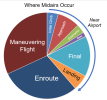
I'll just leave this right here.

Anecdotally, collision between aircraft turning base to final and aircraft on straight in final seems to be a common failure mode. I can think of several high profile accidents in the last year or two. IMO calling base can help avoid that. As can multiple final calls by straight in aircraft.

midairs.png
 
Anecdotally, collision between aircraft turning base to final and aircraft on straight in final seems to be a common failure mode. I can think of several high profile accidents in the last year or two. IMO calling base can help avoid that. As can multiple final calls by straight in aircraft.
ALWAYS look right/left and check before turning final! Groove clear was strongly enforced in the Navy and there are habits I've lost but not that one. Instructors need to make students do it.
 
This thread makes me miss Bob Gardner, author of the excellent "Say Again, Please" -- which I've bought dozens of to pass out to pilots. Instant level-up to comms and phraseology.

 
...Instant level-up to comms and phraseology.
Whatever you have to say, just say it with authority.

On a very gusty day in the midwest I heard someone making inbound calls to an untowered field, no other airplanes in the area. After several changes in landing direction they called "Heck, anyone over Hermann get outta my way, I'm comin' in!"

Nauga,
and his authoritah!
 
Thread drift, I know, but a good opportunity to ask:

What is everyone's preferred practice for making calls in the pattern when you're the only one there?

Call every leg? Only call certain legs? Only call if other radio-capable traffic appears?

Just curious on opinions regarding the balance between not clogging up a shared frequency by calling every single leg for every circuit vs. getting out of the muscle-memory of associating every turn with a call.
I know you specifically asked about making calls when you're the only one in the pattern, but the pattern can go from one solo plane to a zoo in short order.

It's really situation dependent. People need to remember it's Aviate, Navigate and THEN Communicate. The C doesn't come first, but too many CFIs are emphasizing talking on the radio without emphasizing situational awareness.

My biggest pet peave with GA pilots these days is that way too many are constantly broadcasting on the radio and not listening to what anyone else is saying! If you listen, you can frequently see the conflicts developing while those involved drone on with blind position reports oblivious to the situation unfolding. I've had 3 legit near misses/close calls in as many years with pilots constantly talking but not paying any attention to my position reports given in response.

Passive listening is an important element to building SA.

My home field is a nightmare. One runway. No tower and two flight schools based on the field plus we get ATP and Liberty U students flying in regularly for x-countries. On top of that, one of the two flight schools has an internal policy that requires all of their pilots do a radio check on CTAF before leaving the ramp. Everyone talking. No one listening. Sometimes you can't even get a word in on the freq.

From a comms standpoint - I deal with it by listening first - then using what I hear to correlate with ADS-B and visual ID. Depending on how crazy the freq is, my first call might be the initial entering the pattern call ie 'x miles out on the 45 for left downwind'. Further calls will be dictated by the situation and frequency congestion. And I have learned to fly defensively - like everyone out there is trying to kill me.
 
Last edited:
I served as an English-to-English translator for a couple of weeks while visiting a client's corporate headquarters in France 15 years ago. The people in the conference room were mostly native French speakers. The people on the phone were from the company's US headquarters and mostly spoke English with thick southern accents. I speak a little French & can understand the accent. I also speak Southern and can understand the accent.
They said it was the most productive meeting they had ever had!
Accents can be a serious barrier to communication.
 
Last edited:
Now I'm realizing that I can understand Boston English, Long Island English, most Southern English, most Cajun English, most British English, most Australian, most of whatever the Caucasian people from New Zealand speak, and generally those that learned English as natives from India. Sometimes I can even understand folks from Canada if they're sober. So that's pretty cool. But I think if you were in a plane and speaking Scottish English or hip-hop and needed me to talk you down, you maybe would die. (Apologies to an SNL skit where the former happened, more or less.)

The toughest are controllers trained in the NYC area, I think. Topeopleoutsidetheareaitprobablysoundsalotlikethisbutalotfaster.
 
That’s Canadian for 8, of course. Because E is the eighth letter of their alphabet.

final36fullstop
I stopped saying “full stop” on the radio a long time ago. It was the one sure prelude to bouncing badly and going around. Calling shots is for professional billiards.
 
I stopped saying “full stop” on the radio a long time ago
I’m okay with it if not overdone. In a busy training pattern, announcing “full stop,” “touch & go,” can help others with spacing. Otherwise, nah.
 
I’m okay with it if not overdone. In a busy training pattern, announcing “full stop,” “touch & go,” can help others with spacing. Otherwise, nah.
I will usually try to add "full stop" or "touch and go" for my downwind and final calls. In a busy pattern, I think it helps people to make a better guess on runway timing and I personally appreciate not needing to guess the intentions of others. If I need to do a go-around for some reason, oh well. From my perspective, every pilot knows that any landing attempt may terminate in a go-around, so that is just factored into the planning.
 
The one that makes me cringe the most is announcing a teardrop entry. I understand that it's supposed to be shorthand for the FAA's preferred cross-over-and-return-on-the-45 entry from the upwind side of the airport but I see waaaaay too many who fly it like a teardrop rather than go 2-3 miles from the runway before beginning the descent and return part of the maneuver.

Although I guess it does have a plus side - the cringe is the start of heightened vigilance so I can be aware and warn others of the the impending conflict when they descent toward an unseen airplane already on downwind.
 
Last edited:
The one that makes me cringe the most is announcing a teardrop entry. I understand that it's supposed to be shorthand for the FAA's preferred cross-over-and-return-on-the-45 entry from the upwind side of the airport but I see waaaaay too many who fly it like a teardrop rather than go 2-3 miles from the runway before beginning the descent and return part of the maneuver.

Although I guess it does have a plus side - the cringe is the start of heightened vigilance I can be aware and warn others of the the impending conflict when they descent toward an unseen airplane already on downwind.

At the Sebring aerobatic contest, we changed our entry from direct to teardrop. It worked very well in a crowded pattern. Cross over downwind, descend, turn back, 45 entry. IMO the potential conflict is exaggerated.
 
That’s Canadian for 8, of course. Because E is the eighth letter of their alphabet.


I stopped saying “full stop” on the radio a long time ago. It was the one sure prelude to bouncing badly and going around. Calling shots is for professional billiards.
I've only heard "full stop" used recently, when I started doing my instrument practice. Around here, tower will often or usually ask if it's going to be a full stop or something else, and we'll say "low approach" to help keep traffic moving. Not unusual to be on the approach and have an airliner waiting to take off, so I'm just happy they're accommodating our practice at all.

Agree on not calling my shots at an uncontrolled field most of the time. That said, I don't love touch and goes or do them much.
 
At the Sebring aerobatic contest, we changed our entry from direct to teardrop. It worked very well in a crowded pattern. Cross over downwind, descend, turn back, 45 entry. IMO the potential conflict is exaggerated.
There's nothing at all wrong with the cross-over-turn-back if done properly. The problem I see is that people take "teardrop" literally, as in the way the FAA uses the term (i.e., teardrop entry to a holding pattern or teardrop procedure turn). They do a descending turn way to close to the pattern. On flight reviews, I have flown with pilots who were either (a) taught it wrong or (b) say they avoid it because they think it's a bad idea ... because they see it done wrong all the time and think that's the way to do it. For me, this is one of those situations in which the semantics counts – what you say ends up being what you do.
 
I appreciate the "full stop" call from airplanes that are obviously flight school airplanes and obviously doing training including numerous touch and goes or stop and goes - especially when I am doing the same. Allows you to adjust the pattern size better if you know what the preceding airplane is planning on.
 
Although I fly an RV7A, I just announce "Cirrus on a straight in 25 mile final" and the pattern clears:po_O:)

**obviously kidding **


.
 
What does Asian sound like? Chinese, Korean, Indian, Pakistani?
 
Busy pattern, I like to know if the plane in front of me is full stop or touch-and-go. I'll tuck in closer behind if I know he's going to take off again, or give more room if he's going to be rolling out.

Ron Wanttaja
 
Busy pattern, I like to know if the plane in front of me is full stop or touch-and-go. I'll tuck in closer behind if I know he's going to take off again, or give more room if he's going to be rolling out.

Ron Wanttaja
Ever since the ground pickup gate broke, all landings at the gliderport have been full stop. :cool:
 
What does Asian sound like? Chinese, Korean, Indian, Pakistani?
I think I get what you're saying, but I don't know if there was any ill intent there... I'm remembering when a friend of mine offered to take me out for "real" Chinese food and of course I said sure. She grew up in Bejing and came here to finish her masters. Anyway, we went to a high end Chinese place near Saratoga, and she looks over the menu, then talks to the waitress. They spend about 3 minutes talking at each other, like two old 2400 baud modems syncing up. Then they both smiled, and she ordered. I asked her what that was about. She said she spoke one dialect or language well, and others not so much, and the waitress didn't speak her main one at all, but did some others. So it took a couple of minutes for them to find a common language, more or less, with both being native born from China. My understanding is that India is similar.
 
Here is something that happens way too often for me. Base turn is coming up, but pilot flying feels like he can't turn until he makes his "turning base" call, even if there is no conflict. I need to remind them to fly the airplane first, and talk later. This is not because they are being overly cautious - it is a habit. When every turn you have made had an associated radio call, one feels naked when making that turn and skipping the call.
Maybe you just fly with a bunch of overly sensitive pilots.
 
I'll tolerate a lot of accents until I hear the Alaskan Bush People accent....Then it's scorched earth
 
My pet peave are those...on a non-towered airport with a single 2,500-foot runway...who feel that the world needs to know they are taxiing to the fuel pumps, or to hangar row G, or whatnot. Look out the darn window, for heck's sake, and coordinate with other aircraft if necessary.

I suspect this is a holdover from operating from towered airports.

Ron Wanttaja
I make calls on the radio even when I think there's no one around for the same reason I use my blinker at 3am when there's (seemingly) no one else around: You're guaranteed to be informing anyone who needs to see/hear it whether you can tell that they're there or not.
 
My pet peave are those...on a non-towered airport with a single 2,500-foot runway...who feel that the world needs to know they are taxiing to the fuel pumps, or to hangar row G, or whatnot. Look out the darn window, for heck's sake, and coordinate with other aircraft if necessary.

I suspect this is a holdover from operating from towered airports.

Ron Wanttaja
I think it's the students that do that at my home field. I suspect they're teaching them how to operated in a towered field for something but when there are 4 folks in the pattern we sure don't need to hear it. I did fly out of a field that had a hump in the two-way taxiway so you couldn't see the other end. It made sense there.
 
And just how many people here do you think will have a clue what you're talking about if they don't look it up! :p
I estimate between 5 and 10%.

To me the most important thing in the rocket travel is the blast-off. I always take a blast before I take off. Otherwise, I would not go near that thing.
 
Back
Top