Commercial maneuvers - how much does the plane matter?

Did you also do the "choose only one pylon" thing?

Pick a pylon, fly around it clockwise, then straight and level. Count to 6 and look out the left window, Whatever you are looking at is the second pylon. Fly around it,

Yes, absolutely. Although I start counterclockwise.

I've even toyed with not even picking your first pylon, just roll and whatever's there, is it.

It's such a pointless maneuver.
 
To be honest, a lot of them are. None of them help with flying a twin jet in the IFR system, which is the goal of most who obtain their commercial.
In my experience, though, there seems to be a correlation between those who think the commercial is a waste of time and the twin jet pilots who treat the thrust levers like there’s an accelerator pump in the carburetor of the jet.
 
To be honest, a lot of them are. None of them help with flying a twin jet in the IFR system, which is the goal of most who obtain their commercial.

I won't go that far, but at least for most of the maneuvers I can at least pretend to link it to a practical skill, or at least an attempt at "mastering the controls" or "improving feel" or "improving understanding of aerodynamics" or something.

Not so with 8's on pylons.

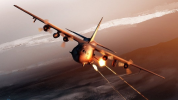
Unless, I suppose, the pilot is going on to fly an AC-130, maybe.

1770604362005.png
 
To be honest, a lot of them are. None of them help with flying a twin jet in the IFR system, which is the goal of most who obtain their commercial.
Tut, tut. The purpose of on-pylons is to be able to safely fly around a point of interest on the ground without crashing due to divided attention to the flight instruments. At pivotal altitude, you don't need the flight instruments. "Eights" on-pylons demonstrate both directions. I've done on-pylons at my house in a twin jet in order to check on my dog's well-being when I needed to leave him outside on a trolley while I flew a trip. :) Comes in handy.
 
It was quite some time ago, but I had an examiner that let my students do most of the Commercial checkride in my Citabria, then just do a couple patterns in an Arrow or such. I think the examiner enjoyed the change of pace. Don’t know if you could find one that would allow it now.
 
Tut, tut. The purpose of on-pylons is to be able to safely fly around a point of interest on the ground without crashing due to divided attention to the flight instruments. At pivotal altitude, you don't need the flight instruments. "Eights" on-pylons demonstrate both directions. I've done on-pylons at my house in a twin jet in order to check on my dog's well-being when I needed to leave him outside on a trolley while I flew a trip. :) Comes in handy.
And, of course, the moose stall is named for an activity where people get it wrong.
 
It was quite some time ago, but I had an examiner that let my students do most of the Commercial checkride in my Citabria, then just do a couple patterns in an Arrow or such. Don’t know if you could find one that would allow it now.
There’s no longer a complex requirement for the checkride.
 
I’m not sure I agree with the “high altitude “ comment. A bonanza can easily do an emergency engine out 180 to the runway from pattern altitude. I’ve done it on BFR and BPPP (beech proficiency) flights too. Now if the pilot is flying a ginormous wide pattern, probably not.

Don’t know about Bonanzas, but Mooneys recommends slow flight maneuvers be done above 6000’ AGL, with that requirement can all the commercial maneuvers be performed?
 
Is a recommendation a requirement?

Here’s the text:
118f5d99510e72e563fc14eee4388d78.png


“Should be” implies to me that it’s a requirement, and since it’s in the POH I would assume any pilot violating the safety recommendations of the POH would be an automatic failure.
 
Don’t know about Bonanzas, but Mooneys recommends slow flight maneuvers be done above 6000’ AGL, with that requirement can all the commercial maneuvers be performed?
Owned a M20J. Was told they lose 1K’ per turn. I don’t know.
 
LOL! Even at best glide, it's just looking out the window. The reason it struck me funny is that I learned to fly in a low wing. My first time in the pattern with a 172, I turned from downwind to base and said, "where did the runway go?"
LOL! First time ATC gave me a 5-mile straight in approach in my Starduster Too, I said, “Where did the whole airport go?”

I’ve petitioned to have all biplanes reclassified as view-limiting devices. Haven’t heard back from FSDO yet.
 
Here’s the text:
118f5d99510e72e563fc14eee4388d78.png


“Should be” implies to me that it’s a requirement, and since it’s in the POH I would assume any pilot violating the safety recommendations of the POH would be an automatic failure.

"Should", in legal lexicon, is not mandatory. "Shall" is mandatory. Although, yes, not following the recommendations in the POH is usually not good practice.

However, in this case I really have to wonder - 6000 feet? What kind of excessive CYA is this? I've stalled and recovered jets in much less than that. The M20J isn't anything special in the stall-recovery department - standard techniques work and recovery is typical of light airplanes.

I did teach a Commercial applicant in an M20J. I know I was not aware of this POH-ism, and I doubt he was either. And the examiner must not have been either, because he passed the checkride doing stalls at much less than 6000 AGL.
 
'Should' is quite ambiguous, until you know it's not.

Example: marriage


edit; btw, @RussR thanks for the addition to my screensaver.
 
Don’t know about Bonanzas, but Mooneys recommends slow flight maneuvers be done above 6000’ AGL, with that requirement can all the commercial maneuvers be performed?

There's no reason you couldn't just climb up to 6000 AGL to do the maneuvers, although it would certainly prolong the checkride. Unless of course other factors come into play - like that puts you into oxygen altitudes and you don't have the equipment, or puts you above 10000 and you don't have ADS-B out, etc.
 
Tut, tut. The purpose of on-pylons is to be able to safely fly around a point of interest on the ground without crashing due to divided attention to the flight instruments. At pivotal altitude, you don't need the flight instruments. "Eights" on-pylons demonstrate both directions. I've done on-pylons at my house in a twin jet in order to check on my dog's well-being when I needed to leave him outside on a trolley while I flew a trip. :) Comes in handy.

Sounds like you really just need to do turns about a point (level altitude) versus half of 8's on pylons (varying altitude). I still fail to see the value in this maneuver. (Let alone in slower aircraft with any wind you get low enough for it to be of questionable safety.)
 
Start approximately at the pivotal AGL altitude. If the pylon moves forward, push forward. If the pylon moves back, pull back. That's about all you really need to know to make 8's on pylons work. Rote application of this works just fine.

Usually I am pretty big on understanding the "why" of maneuvers, but I just can't get worked up about 8's on pylons. I see no practical application for just about anybody. So just do the push and pull and it works, you pass and move on.
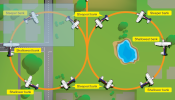
yep, the only challenging part is getting the roll out headings correct to hit the next point, especially with the relatively new requirement that the straight section only be 3-5 seconds long. The short straight time makes them look more like 2 circles rather than the elongated 8 show in the AFH.

with the short strait section the ground track with light winds the 8 on pylong ground track will look more like the 8's around pylons (shown below). The intent of 8's around pylons is different as 8's on pilots don't require constant radius.
1770652019638.png
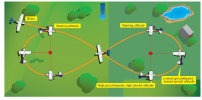
The 8's on pylon diagram (below) in the AFH is basically wrong now, in that if you fly it as shown the straight sections will take to long.
from the AFH page 7-16 " The distance between the pylons should allow for the straight-and-level flight segment to last from 3 to 5 seconds."
1770652163267.png
I had commercial applicant get an Unsat on his checkride because he flew the diagram shown shown for the 8's on pylons, He and I both missed that the new AFM added the 3-5 second requirement.

Brian
CFIIG/ASEL
 
Owned a M20J. Was told they lose 1K’ per turn. I don’t know.

Up to 2000’ can be required to recover from 1 turn spin (worst case), 1000’ is typical. Depends on W&B of course.
 
Last edited:
"Should", in legal lexicon, is not mandatory. "Shall" is mandatory. Although, yes, not following the recommendations in the POH is usually not good practice.

However, in this case I really have to wonder - 6000 feet? What kind of excessive CYA is this? I've stalled and recovered jets in much less than that. The M20J isn't anything special in the stall-recovery department - standard techniques work and recovery is typical of light airplanes.

I did teach a Commercial applicant in an M20J. I know I was not aware of this POH-ism, and I doubt he was either. And the examiner must not have been either, because he passed the checkride doing stalls at much less than 6000 AGL.

M20Js can be a bit twitchy and result in a wing drop if stalls aren’t done properly or the rigging is off. There are stories from test pilots that spin recovery was more exciting than they would like.
It’s the smaller tail/rudder I guess.

You’re probably be okay 3000-4000’, but I have a rule, if I use word “probably” it’s time to rethink my flying plans.
 
Last edited:
... I have a rule, if I use word “probably” it’s time to rethink my flying plans.
That sounds like a very good rule.

I was trying to remember the name of a VP at Republic Steel Corp. my boss knew. Being a Mooney-ite, you might be interested in an AI chat I just had while trying to find out: https://share.google/aimode/3ptJyjk4wDb7PBhQD

You'll need to scroll to the top for the start of it. This AI chat stuff is scary.
 
Last edited:
I'm starting to work towards the Commercial cert, and am curious about whether these maneuvers make sense in a Bonanza, or if I should spend a bunch of time getting back up to speed in a Cherokee/Archer.
There is no reason not to do your Commercial in your Bonanza. In fact, because you're used to how it flies, it'll be easier overall.

When you are a relatively low time pilot, sitting for your commercial for the first time, the easiest airplane is to do the maneuvers in is the one you are most comfortable with.
Fixed that for you.

However, in this case I really have to wonder - 6000 feet? What kind of excessive CYA is this? I've stalled and recovered jets in much less than that. The M20J isn't anything special in the stall-recovery department - standard techniques work and recovery is typical of light airplanes.
The owner of the first Mooney I flew, a long-ago member of this board, did an accelerated CFI course in his M20J. As I recall, they had been doing chandelles and got up over 10,000 feet, whereupon the instructor asked for a power-on stall demonstration. Right as the plane was stalling, the instructor, unbriefed, gave it a legful of left rudder... And 9,000 feet later, they managed to recover from the spin.

It's not that the plane can't be recovered from a spin quicker than that (or it wouldn't have been certified in the first place), but you'd best be ready to quickly execute the proper technique to recover.

In any case, there's no requirement in the ACS for stalls to be initiated close to the ground. Were I a DPE giving a commercial checkride and the applicant briefed me on the POH recommendation, I'd be giving them (imaginary, of course) bonus points.
 
Yes, the power-off 180 is not as simple in a Bonanza as compared to a basic trainer and the steep spirals will have to be conducted from a high altitude given the rate of descent you’ll have. Both of these statements are true imho. Not both maneuvers need to be high altitude.

I'll bite. What makes the power-off 180 less simple in a Bonanza iyho? Other than the obvious "I need to remember to extend my gear" if we're using "basic trainer" to mean C172/PA28 and not Cutlass/Arrow.

It does happen faster than the Cessnas, I'll grant. Wide patterns will be eye-opening the first time they fail to make that 180, then hopefully knocked off -- like any good checkout should do :)
 
Not sure if this has been said yet but I was planning on taking my commercial in my owned 182RG. I also took a few flights in the flight schools 172 as well for fun. I ultimately decided to finish and do the checkride in the flight school's 172 for this reason:

Since I own the aircraft if I take a checkride in it I am basically giving the FAA free reign to inspect my airplane inside and out. In fact my DPE turned out to be a former ASI. I didn't want to add the stress of a FAA rep tearing through my Airplane books looking for something, and god forbid finding something he doesn't like. I feel like using my own plane would have turned the checkride into a Commercial Pilot and an Airplane Ownership checkride. Now do I not only get to not take a checkride I absolutely have to fix whatever he found before I can fly the plane again and whatever that costs.

Ultimately I figured about $1,000 of total rental cost by the end of it was worth it to take the responsibility off my shoulder. My plane has missing logs books from forever ago which added to my decision making. I also hid the fact that I owned a plane from him so I didn't get grilled about systems or ownership during the oral.

I did as much training as possible in my 182 and then switched to the flight schools 172 for the last 3-4 flights.
 
As I recall, they had been doing chandelles and got up over 10,000 feet, whereupon the instructor asked for a power-on stall demonstration. Right as the plane was stalling, the instructor, unbriefed, gave it a legful of left rudder... And 9,000 feet later, they managed to recover from the spin.
Ack! That would be the last time I flew with that instructor!
 
Since I own the aircraft if I take a checkride in it I am basically giving the FAA free reign to inspect my airplane inside and out. In fact my DPE turned out to be a former ASI. I didn't want to add the stress of a FAA rep tearing through my Airplane books looking for something, and god forbid finding something he doesn't like. I feel like using my own plane would have turned the checkride into a Commercial Pilot and an Airplane Ownership checkride. Now do I not only get to not take a checkride I absolutely have to fix whatever he found before I can fly the plane again and whatever that costs.
True, but I used my Bonanza for my instrument ride just a few months ago. The DPE looked everything over and hopped right in for the flight.

The bigger pain in the rear is swapping yokes. I generally fly a single yoke. It can be fitted with a dual, but it's a pain to swap all the cables, buttons, iPad mount, etc.
 
I'll bite. What makes the power-off 180 less simple in a Bonanza iyho? Other than the obvious "I need to remember to extend my gear" if we're using "basic trainer" to mean C172/PA28 and not Cutlass/Arrow.
Getting the speed right?

The Bo is a slippery plane. I think I would want to keep it clean as long as possible, then drop the gear and use flaps to put it on the ground.

Keep in mind that the J35 has no intermediate flap settings, only clean and "falling object". That makes timing to hit the target spot a bit fiddly, at best.
 
Ack! That would be the last time I flew with that instructor!
My dad got his multi in a 310 back in the late ‘60s, before Vsse and a lot of safety stuff existed for multi training. His instructor had him doing a full power stall, and just before it stalled the instructor decided to pull a mixture. The maneuver turned rapidly into a split-S, and the way my dad told it the instructor wasn’t worth much on the way back to the airport.
 
Getting the speed right?

The Bo is a slippery plane. I think I would want to keep it clean as long as possible, then drop the gear and use flaps to put it on the ground.

Keep in mind that the J35 has no intermediate flap settings, only clean and "falling object". That makes timing to hit the target spot a bit fiddly, at best.

Implying you can get the speed wrong in any other plane on a commercial checkride?

I'd argue selecting the correct time to deploy the flaps/gear is the entire point of the maneuver. :) If you get a santa DPE maybe you can cheat with the prop RPM a bit.

Bonanza wing is a bonanza wing. You pretty much start a "U turn" at the abeam point when the motor fails. No time to finesse flap position in the preselect Bonanzas either IME.
 
Since spins are being mentioned, spin recoveries are practiced wrongly, I fear. At the point of breaking the stall when the plane is pointed straight down, how many pilots are thinking about getting that nose back up right away while their airspeed and upward turn radius are at the lowest? That ought to be the objective of the maneuver, imo. Until the airspeed reaches Va, it's impossible to overstress the wings with g-load, so make use of the fact to rotate the nose quickly upward so as to prevent excessive altitude loss and dangerously high airspeed during recovery, especially in clean planes like the Mooney. Of course, on the other hand, you want to avoid a secondary stall. And THAT is why we need to practice them — to use maximum g-load before reaching Va yet without inducing another stall. No?
 
Since spins are being mentioned, spin recoveries are practiced wrongly, I fear.
Most of us don't practice actual spin recoveries, because most of us don't fly airplanes approved for intentional spins.

At the point of breaking the stall when the plane is pointed straight down, how many pilots are thinking about getting that nose back up right away while their airspeed and upward turn radius are at the lowest? That ought to be the objective of the maneuver, imo. Until the airspeed reaches Va, it's impossible to overstress the wings with g-load, so make use of the fact to rotate the nose quickly upward so as to prevent excessive altitude loss and dangerously high airspeed during recovery, especially in clean planes like the Mooney. Of course, on the other hand, you want to avoid a secondary stall. And THAT is why we need to practice them — to use maximum g-load before reaching Va yet without inducing another stall. No?
No. You're saying to "rotate the nose quickly upward" while the "airspeed and upward turn radius are at the lowest", yet "you want to avoid a secondary stall". That's just the problem. If you've stalled and gotten pointed downhill like that, you're traveling downward. While you are correct that turn radius is the lowest when speed is the lowest, you still need to have a wing developing sufficient lift for that to be true. If you're spinning, you're also stalled and if you try to pull up right away you're not going to get anywhere.

There's certainly a balancing act there because you obviously can't just point the nose down forever either, but you need enough speed to avoid that secondary stall. That's why "PARE" (Power, Ailerons, Rudder, Elevator) is the go-to recovery technique. Power first - I think there's several reasons behind this, like avoiding gyroscopic effects on the prop flattening or aggravating the spin to the point where it may be unrecoverable, avoiding downward acceleration, and avoiding a possible pitch-up tendency, but regardless of the reasons, power isn't going to help you. Ailerons neutral second, because if you try to stop the spin with aileron, you're actually going to make it worse (think about induced drag and what airspeed each aileron will be subjected to during a spin). With those two things done you have a better chance of recovery, so go full Rudder against the spin to stop the spin.

Now, for the Elevator part and the "quickness" with which to use it: Keep in mind that up until this point you've been spinning, and again, if you're spinning you're also stalled. The moment you stop the spin, you're probably still just above stalling AoA and you may need to push the nose DOWN first - If you then try to get it back up quickly, you're just going to have a secondary stall. Since you're traveling downward and you're trying to get to level, your load factor will need to go to something above 1, and the quicker you try to recover, the higher above 1 the load factor will need to be and the higher your stall speed will be, at a moment when your airspeed is still quite low.

If you had to choose a single airspeed for recovery (which is, of course, impossible as you're accelerating), the optimum one would probably be around 1.4Vs which would allow you to make a 2G pull. That'll arrest the descent quickly without pulling your wings off or making you black out.

In reality, if you get back to 1G and Vs at the same time, any further pull will cause a secondary stall, and as you accelerate you can pull more and more. How can you tell how much? Well, use the stall horn! You want to pull smoothly and not too quickly until the instant you hear the stall horn, and then hold that amount of pull until the stall horn goes away, then slowly increase the pull to ride the edge of the stall horn. That will give you the quickest possible recovery, *IF* you don't pull too hard or fast and cause that secondary stall.

I really want an aerobatic airplane now. It's been far too long since my last dose of vitamin G.

Also... Mods, might want to make this a separate thread!

 
In reality, if you get back to 1G and Vs at the same time, any further pull will cause a secondary stall, and as you accelerate you can pull more and more. How can you tell how much? Well, use the stall horn! You want to pull smoothly and not too quickly until the instant you hear the stall horn, and then hold that amount of pull until the stall horn goes away, then slowly increase the pull to ride the edge of the stall horn. That will give you the quickest possible recovery, *IF* you don't pull too hard or fast and cause that secondary stall.
Vs is where I began my post, pointing straight down at zero g's with forward/neutral elevator and a low AoA. If you pull, you undo your recovery, so you don't want to do that. If you don't pull, you gain speed very fast. If you then pull and are above Va, you could overstress the wings. So, as speed is gained you should pull — just not enough "pull" to stall. Listening to the stall horn only tells you the angle of attack is close to the stalling angle, which is good as long as your speed is below Va. Once above Va, the same sound could bend the wings. So, above Va you need to release enough back pressure so as to not exceed the g-factor load limit. I'll bet that with careful practice most pilots can reduce altitude loss during recovery significantly. Does this sound like our common ground?
 
I'm starting to work towards the Commercial cert, and am curious about whether these maneuvers make sense in a Bonanza, or if I should spend a bunch of time getting back up to speed in a Cherokee/Archer.

IIUC, I need to demonstrate:

Chandelle
Lazy 8
8s on pylons
Accelerated stall
E-descent (steep spiral)
Short-field landing at tighter tolerance

Have I got this correct? It seems that the 8s on pylons would greatly benefit from a slower, smaller plane, right? Or, would I be better off sticking with the plane that I have the most time in?

I may be over-thinking this, but I don't want to set myself up for failure with a plane that makes these checks difficult or worse, improbable....
I did my commercial in a thro over yoke bonanza. I’d argue it was easier in a bo.
 
Vs is where I began my post, pointing straight down at zero g's with forward/neutral elevator and a low AoA. If you pull, you undo your recovery, so you don't want to do that. If you don't pull, you gain speed very fast. If you then pull and are above Va, you could overstress the wings. So, as speed is gained you should pull — just not enough "pull" to stall. Listening to the stall horn only tells you the angle of attack is close to the stalling angle, which is good as long as your speed is below Va. Once above Va, the same sound could bend the wings. So, above Va you need to release enough back pressure so as to not exceed the g-factor load limit. I'll bet that with careful practice most pilots can reduce altitude loss during recovery significantly. Does this sound like our common ground?
I doubt most pilots could/would pull hard enough to hit 3.8G. For your average human who's not used to Gs, that's approaching GLOC territory and they'll probably be unable to be browning out and pulling that hard at the same time.

Also, if you're at "Vs" for level flight in whatever configuration your'e in, and you're at 0 G, pulling will *not* undo your recovery. Pulling to a load factor of less than 1 at that point won't stall you, so it's possible to begin your recovery right away.

I'd bet that if you started at Vs and 0G pointed straight down, and kept it on the edge of the stall, you'd recover before Va for most small airplanes. Maybe I'll do the math one of these days.
 
I doubt most pilots could/would pull hard enough to hit 3.8G. For your average human who's not used to Gs, that's approaching GLOC territory and they'll probably be unable to be browning out and pulling that hard at the same time.
Actually, that's my point — that most pilots aren't using the g's afforded them and are missing the opportunity to substantially reduce altitude loss during the recovery.
Also, if you're at "Vs" for level flight in whatever configuration your'e in, and you're at 0 G, pulling will *not* undo your recovery.
If we are talking about the instant the stall has been broken (I am) by sharply moving the stick forward, then instantly moving it all the way back again will stall it again. Maybe I wasn't clear enough, sorry. There's a range of movement available before that second stall, though, that I think a lot of us aren't using to our advantage because of your comment above — not used to the g-load.
Pulling to a load factor of less than 1 at that point won't stall you, so it's possible to begin your recovery right away.
Yes, it's what I was trying to say all along.
I'd bet that if you started at Vs and 0G pointed straight down, and kept it on the edge of the stall, you'd recover before Va for most small airplanes. Maybe I'll do the math one of these days.
Mentioning "g" forces and Va is for theoretical purposes only, though. This is a seat of the pants thing, imo. No time to reference airspeed and g-meters. But until developing a feel for the optimum technique, having them available would be nice. We need somebody with a Citabria and a penchant for experimentation. :)
 
My commercial checkride was a bit different than what you see today. In 1985, of course, a complex airplane was still required.

My first add-on rating was A:MEL, not the instrument rating like most do. My mother worked on base so I was able to join the Air Force Aero Club in high school. Saved a ton of money. Paid $23/hr for a C-152, $37/hr for a Beech Sierra, and $78/hr for a 1960 C-310E.

My instrument checkride was done in the C-310 and that covered both SEL and MEL. For the Commercial checkride I flew all the maneuvers in a C-152 then we got into the C-310 for the complex airplane tasks and, IIRC, an engine-out instrument approach under the hood.
 
True, but I used my Bonanza for my instrument ride just a few months ago. The DPE looked everything over and hopped right in for the flight.

The bigger pain in the rear is swapping yokes. I generally fly a single yoke. It can be fitted with a dual, but it's a pain to swap all the cables, buttons, iPad mount, etc.
Oh then you're set then. I suppose I would do it if I was familiar with the DPE and knew he was a chill guy.
 
Back
Top