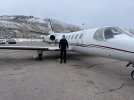
Citation 550 down at SVH

I don’t know that it was ever there, but I’ve been doing it for less than 30 years.
I'll be a son of a gun; I looked through my old FARs and the single engine approach and landing wasn't a spelled-out requirement, although I used to make the prospective SIC end with one after simulating an engine failure. Once again, my interpretation of the spirit of the regulation doesn't apparently square with today's versions, same as the way to fly the Mount Vernon Visual into DCA in the crash thread. In this case, I must have figured once you "maneuver with an engine out while executing the duties of a pilot in command" it must mean approaching and landing that way too. Maybe the FAA assumes the poor incapacitated PIC will make a full recovery in order to land the plane. :dunno:
 
I'll be a son of a gun; I looked through my old FARs and the single engine approach and landing wasn't a spelled-out requirement, although I used to make the prospective SIC end with one after simulating an engine failure. Once again, my interpretation of the spirit of the regulation doesn't apparently square with today's versions, same as the way to fly the Mount Vernon Visual into DCA in the crash thread. In this case, I must have figured once you "maneuver with an engine out while executing the duties of a pilot in command" it must mean approaching and landing that way too. Maybe the FAA assumes the poor incapacitated PIC will make a full recovery in order to land the plane. :dunno:
For me it kind of depended on whether i thought it would have a positive effect on the SIC. Too many of them were overwhelmed by a target thrust setting and an aiming point.
 
Well, who knows exactly why any of their rules are in effect.. Mostly, it isn’t a huge stretch to show how they MITIGATE this or that, not SOLVE the issue.

Why won’t they allow two highly experienced multi but not current or experienced in a small this or that, to fly together? Can go alone….

They are administrative, that’s it. I have no problem breaking their rules when TRUE safety requires it, or I have it mitigated better than they do. However, I do so knowing the consequences, from which I won’t retreat.

I also have the skills required to make that determination. THAT is a double edged sword… I don’t generally recommend that. And I freely admit I’m as prone as anyone to mistakes. I break the chain more than operate perfectly…

This was a mishap. LOTS of things went wrong. The crew issue is likely an issue, but not from a legality standpoint other than maybe a trend of operating rogue, which is NOT well established.

I question the AUTOMATIC belief in the career airline guy, or lack of faith in someone who doesn’t have alphabet soup…

Unless fate ELIMINATED a safe return, SOMEONE didn’t have the skillset required for this, or didn’t have the ability to manage an incorrect startle response. You can be perfectly qualified and still just basically freak out. USUALLY very very good training is what manages that. We ALL KNOW crashing is bad. And falling out of the sky due to lack of airspeed is bad, but can we overcome muscle memory of pitching to what we were taught in another plane?

Ever fly big airbus on one engine? It flies better max gross weight on one than my lightly loaded S-3 ever flew on two…. Got my A330 type flying the single engine approach and miss ON THE AUTOPILOT.

 
No tight visual approaches… and basically nothing hand flown. None of my type ratings would prepare me to deal with what they were likely dealing with.

My 2000 hrs military FAR MORE useful than 10,000 airline.
 
No tight visual approaches… and basically nothing hand flown. None of my type ratings would prepare me to deal with what they were likely dealing with.

You trained under the old 121 rules and not AQP. The "basically nothing hand flown" is not exactly correct as there were a few items that were required under 121 such as hand flown inside the FAF in order to check a box.

Training and checking doesn't cover each and every possible scenario. It does enforce standardization, ADM, CRM, Threat and Error Management and checklist usage.

My 2000 hrs military FAR MORE useful than 10,000 airline.

An I flew with 2000 hour military types that, well let's be nice since it's Christmas, had their own unique problems (flying ability being one).
 
  • Like
Reactions: Jdm
Flew pre AQP, hybrid AQP and AQP, all at delta. I’ve done 20 part 121 schools at American Eagle, American, Delta, Everts and USA Jet.

The Airbus program pre Air France was basically zero hand flying, circa 2016?

Military wasn’t end all be all, but I did do MUCH more just visual flying and of course not a single minute on an auto pilot or with a flight director. Didn’t even have a CDI in the Navy. So just different, but was (back in the day) more prepared for what I think these guys had to face than what I got at part 121 training. Line flying at Eagle was fairly tactical, as was Everts (bush flying MD80s, night circling in Mexico).
 
No tight visual approaches… and basically nothing hand flown. None of my type ratings would prepare me to deal with what they were likely dealing with.

My 2000 hrs military FAR MORE useful than 10,000 airline.
My question is whether or not a tight visual was necessary.

Seems like the prevailing theory is the baggage door wasn’t latched, the engine ate a couple bags and **** the bed. Looks like the door wasn’t present at the crash site…

Sounds like a standard engine failure. Why not wind the watch, run the checklist and pick the most favorable runway for a SE approach?

Since everyone here is throwing out theories like textual diarrhea, I’ll join the circle:

Split second decision to stay below the clouds and immediately return ****ed everyone. Taking a breath and following procedure would have made this an expensive embarrassment, not a fatal crash.

I think you underestimate the value of those type ratings.
 
It means I can be out of currency and fly solo to get it, but I cannot take another "out of currency" pilot with me, because ... unsafe?
Then two non current pilots are leaning on eachother. At least that's what popped into my head landing at my home drome which is barely lit and has edge lights 50 yards from runway. Last time at night I had to go around cuz I was lined up with right edge lights to the left of me. Another pilot could have chimed in....yo dummy, centerline is 150' left.
 
Flew pre AQP, hybrid AQP and AQP, all at delta. I’ve done 20 part 121 schools at American Eagle, American, Delta, Everts and USA Jet.
The AQP program had you do quite a bit of hand flying depending on which phase you were in.
Got my A330 type flying the single engine approach and miss ON THE AUTOPILOT.
I think you are alluding to the LOFT portion (checkride) of AQP. Not sure why that scenario had you on one engine, but whatever. But I am sure during other phases you had ample opportunity to hand fly.

The Airbus program pre Air France was basically zero hand flying, circa 2016?

AF447 crashed in 2009. When I attended Airbus training we hand flew different scenarios as a part of demonstrating we could identify problems and back off the automation as needed. We had scenarios of hand flying approaches with missed approaches with minimum or no automation.

To my knowledge Airbus never had a training program of zero hand flying.

Military wasn’t end all be all, but I did do MUCH more just visual flying and of course not a single minute on an auto pilot or with a flight director.
Entirely different flying from civilian commercial. Kinda like comparing crop dusting to airline flying, yea it's both flying, but........

Didn’t even have a CDI in the Navy.
Not sure what the correlation this has with the discussion, but ok.

So just different, but was (back in the day) more prepared for what I think these guys had to face than what I got at part 121 training. Line flying at Eagle was fairly tactical, as was Everts (bush flying MD80s, night circling in Mexico).

The discussion at hand is a part 91 Cessna Citation 550 being flown corporate.
 
Split second decision to stay below the clouds and immediately return ****ed everyone.

My thought through all of this is why not CCC? Climb, confess, comply.

If sufficient single engine power was available, go on instruments and go up into the goo and get some air beneath your wings while at the same time SIC is on the radio contacting ATC and declaring.

Yeah, you might get a call from your local friendly FISDO, but it sure beats being dead.
It generally goes without saying that if a pilot believes that doing X will result in death, that he won't do X. So the answer to the question of, "Why didn't the dead pilot do Y instead of X, which resulted in his death," is always that he didn't believe that doing X would result in his death.
 
It generally goes without saying that if a pilot believes that doing X will result in death, that he won't do X. So the answer to the question of, "Why didn't the dead pilot do Y instead of X, which resulted in his death," is always that he didn't believe that doing X would result in his death.
The next question that suggests is "why didn't the pilot know that X would be fatal?" And I'll speculate that this often falls into 2 categories. 1 - They've done it before, and it worked out OK, even if unsafe. Flying VFR into bad weather could be an example. 2 - They've never actually done it, but they're pretty sure they can. This one seems more likely as a response to an emergency situation. The impossible turn in a single engine aircraft could be an example.

It maybe suggests that when choosing between two things, consider doing the opposite of Mae West and pick the one you've done. And that if you're in a bad spot and neither option is something you've done before you might be in a very bad spot.

No idea if any of this applies to this Citation incident.
 
This video contains CTAF audio that sounds like they had engine issues:
Just watched that myself. Listening to the audio coinciding with the flight track, I can’t help but think they were going for 10 for which they likely had plenty of altitude and energy, but upon learning of the (alleged) Aztec preparing to depart 10 they opted to enter downwind at the last minute and drag it around for 28. Could explain the low altitude and the close downwind leg.

This may have already been hashed out here.
 
So, 2 pilots, only one Type Rated,
and a student pilot.

If that isn't crazy enough,
You put your entire family on board.

My opinion of Mr Biffle has changed.
Only one pilot was required to be type rated, and both of the pilots up front were certificated pilots. There's certainly not enough evidence yet to say that the pilots weren't properly qualified.

Aviation and golf share a lot of things.

Personal integrity is high on the list.

Improve the lie of your ball?
Who's gonna know?
You will.

Fly your plane out of annual,
and/or expired medical without incident?
Who's gonna know?
You will.

These guys are a black eye on aviation.
They knew that they were illegal.

And for Greg to put his wife and children in this situation,
Shame on him.
That's quite a stretch... And congratulations, I'm pretty sure yours is the first 10x-downvoted post in the history of PoA. Wow.

No legal SIC onboard.

You think they didn't know?

Stop it.
Oh please. How do YOU know?
 
As little as two hours’ worth of effort vs a two week initial course. It’s fogging a mirror.
Sure, so ignoring the requirement makes perfect sense. I guess I stand corrected. So, what other legal requirements for flight do you see fit to ignore?
 
Listening to the audio coinciding with the flight track, I can’t help but think they were going for 10 for which they likely had plenty of altitude and energy, but upon learning of the (alleged) Aztec preparing to depart 10 they opted to enter downwind at the last minute and drag it around for 28. Could explain the low altitude and the close downwind leg.

Makes sense. Positioning for entering the left downwind for 10, rather than the realization he was high and fast to land on 28 seems logical.

My WAG - The Citation was still carrying 200 kts and high when the gear was lowered in close proximity to the approach end of 28, and showing a ground speed in the high 100's when the right turn and descent into the tight tear-drop began. Seems to be a nearly acrobatic tight left turn that before rolling out onto final was when the pilot unexpectedly realized as too low and slow. Visual, stick and rudder, minus enough energy remaining to clear the approach lights.

I wonder if the pilot had enough familiarity in this model of Citation to understand that when loaded up near gross, and dirtied up for landing, a missed approach was not an option. Either he didn't have enough visibility to widen both the downwind and teardrop out for a more comfortable circle to land maneuver with lower bank angles (and less altitude loss) that would provide some wings level time on final from a higher altitude, BEFORE lowering gear and flaps.

And/or he didn't realize how drastic the configuration changes and tight turns would affect his plan (and descent rate) with one engine out. Just a guess based upon what we know so far....
 
It generally goes without saying that if a pilot believes that doing X will result in death, that he won't do X. So the answer to the question of, "Why didn't the dead pilot do Y instead of X, which resulted in his death," is always that he didn't believe that doing X would result in his death.
He also may have heavily favored X because doing Y could have gotten him in serious trouble. In other words perhaps it wasn’t a straightforward decision for some reason. Like knowingly being not legal for some reason.
 
It's quite obvious that the baggage door came open after takeoff and fodded out the right engine.

The question is why didn't they take the time to get to altitude while troubleshooting and determine the best course of action? It appears they rushed to get back on the ground ASAP for no good reason.

This is going to be CFIT and pilot error with other things mixed in.

Well, if that’s the case, should be fairly clear in the preliminary report. Seems like it would be evident with debris on the runway, then there’s the reported call about ‘leaving things on the runway’.
 
It's quite obvious that the baggage door came open after takeoff and fodded out the right engine.

The question is why didn't they take the time to get to altitude while troubleshooting and determine the best course of action? It appears they rushed to get back on the ground ASAP for no good reason.

This is going to be CFIT and pilot error with other things mixed in.

Pictures showed a missing elevator, add that to list of possible problems.
 
Yes, 100% the kid was on the radios. What is troubling is that he was attempting to avoid saying what was going on. The text that "we are in trouble" from Biffle's wife says a lot more than "we left some things on the runway". I bet his dad was telling him what to say to keep it on the down and low.

I've been met by crash trucks a few times and sometimes not. Everytime, the CP or AVI was putting calls out in plain English what was going on (we have lost our primary hyd system/we have a TR chip light, etc) and declaring priority/mayday.

The CVR, if it was working, will be telling
 
Back
Top