FlightmechH3
Line Up and Wait
- Joined
- Dec 30, 2021
- Messages
- 528
- Display Name
- FlightmechH3
Was Dutton's son a qualified SIC or not for this flight?

So the field was VFR?I can see the Aztec wanting to get out of the way ASAP as a natural reaction.

Didn't see Dan on-site stealing parts of the wreckage.According to Gryder, he knows everything about everything. You know what they say about the difference between theory and reality..... Of course Gryder does know a thing or two about crashing single engine planes that can't climb with the flaps down, so there's that. But it sounds like his theory isn't different from what some have postulated in this thread.

And your basic premise is all wrong.So, 2 pilots, only one Type Rated,
and a student pilot.
If that isn't crazy enough,
You put your entire family on board.
My opinion of Mr Biffle has changed.
Then how could he possibly know what happened?Didn't see Dan on-site stealing parts of the wreckage.
Lack of ratings might explain a failure to perform, but a lack of ratings didn't bring this plane down.So, 2 pilots, only one Type Rated,
and a student pilot.

Three pilots, all of which had a private or better. The PIC was an ATP with more ratings than most of us will ever have (including the Citation).Lack of ratings might explain a failure to perform, but a lack of ratings didn't bring this plane down.
You're still wrong. Jeff was not a student pilot. He was a university student (Auburn) but he'd already received his private and instrument rating.2 pilots and a student.
I'll bet Greg was up front.

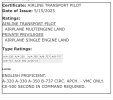
You lost me at “according to Gryder”.According to Gryder's "Probable Cause" YouTube presentation last night, single pilot ops are a "waiver" on some Citations, including the accident aircraft. He showed the single pilot notation on his own paperwork. Unless the deceased pilot had recently added the single pilot waiver (not yet in the FAA register), the pilot likely didn't have one.
He also aired an audio recording taken off the unicom speaker inside the FBO of the radio announcements from the Citation. The voice was of the son (confirmed by people who know him) who was in the right seat, with his Father flying. The son announced they were returning to the airport with an engine issue, and warned an Aztec waiting to take off not to do so. Amazingly (and allegedly), the Aztec pilot took off, then landed shortly afterwards, with the Citation burning on the runway.
According to Gryder, he himself is very familiar with various models of Citations, and claims this particular model is under-powered on one engine, and will not hold altitude with gear and flaps deployed while loaded up approaching gross weight.
Said the turn around was crazy, as climbing on runway heading to 3 or 4 thousand feet, engaging the autopilot, declaring an emergency, and landing at Charlotte was in his opinion the only safe solution. Compared the total mileage flown while turning around with the mileage needed to fly to Charlotte, and it was a little longer, but very comparable.

Not necessarily.Just a thought...given that the PIC was a Delta Airlines Captain, I'm willing to bet he was more than capable of handling a Citation. Regardless of all this bickering about SIC.

You're still wrong. Jeff was not a student pilot. He was a university student (Auburn) but he'd already received his private and instrument rating.

Just a thought...given that the PIC was a Delta Airlines Captain, I'm willing to bet he was more than capable of handling a Citation. Regardless of all this bickering about SIC.
1. The airplane was certified for two pilots and was setup for more than 6 passengers, so it is required to have a CVR.
2. Having SIC required on a C500 pilot type does not stop the pilot from acquiring a SP exemption.
3. SP exemptions do not show up on the FAA pilot base search site.
4. YOU DO NOT NEED A SIC TYPE TO FLY SIC IN THE UNITED STATES.

A 20,000+ hour airline pilot gear up’d a mooney at my home field a coupl’a years ago.
Interesting how often that’s not true.Just a thought...given that the PIC was a Delta Airlines Captain, I'm willing to bet he was more than capable of handling a Citation.

He didn't strike me as the kind of person that needed to prove his manliness by sitting in the right seat of his airplane. I'll bet he was in the back with his wife and children.2 pilots and a student.
I'll bet Greg was up front.
It’s well beyond PPL—IR-multi and ability to fog a mirror:Depends on your definition of short, I guess.
So you’ve solved it! You should let the NTSB know.Sort of a rabbit hole here about SIC and type. The crash wasn't due the wrong person sitting in the right seat. It was a crippled airplane or pilot, basic aerodynamics and power. At some point, all planes fly the same. Keep the wind over the wings and high enough to glide to the runway. If the plane was unable to do that, having someone sitting next to the PIC doesn't matter one bit.
There is a lot of confusion on the CE-500 type on the SIC required limitation, and it has changed over the years. There was a discussion a couple of years ago on this. https://www.pilotsofamerica.com/com...quire-a-single-pilot-exemption-waiver.142479/Re #3:
But if one received an exemption would the "SIC required" disappear from their online certificate info?
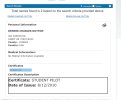
That is what Gryder showed in his video. His online certificate does not state "SIC required"(he showed his paper exemption certificate from Flight Safety) - and Dutton's does.
(guess - he tested as single pilot in the 501/551 which are single pilot certified, and therefore no limitation was placed on his certificate. But he needed the waiver for the 550 because he never tested in it with a SIC or didn't at all)
I am not arguing, just trying to understand if that matters, if it means Dutton didn't have an exemption, or if he is getting something incorrect.

The elevation doesn't really change much, even for flying the ILS to 24. But, yeah, if they couldn't maintain altitude (which would be surprising) they only had one real option.Closer to HKY, yes, but there's more terrain to avoid as you go West. KHKY gets into the foothills, so you might have trouble if you can't maintain altitude comfortably.
As little as two hours’ worth of effort vs a two week initial course. It’s fogging a mirror.It’s well beyond PPL—IR-multi and ability to fog a mirror:
(b) Except as provided in paragraph (e)of this section, no person may serve as a second-in-command of an aircraft type certificated for more than one required pilot flight crewmember or in operations requiring a second-in-command unless that person has within the previous 12 calendar months:
(1) Become familiar with the following information for the specific type aircraft for which second-in-command privileges are requested—
(i) Operational procedures applicable to the powerplant, equipment, and systems.
(ii) Performance specifications and limitations.
(iii) Normal, abnormal, and emergency operating procedures.
(iv) Flight manual.
(v) Placards and markings.
(2) Except as provided in paragraph (g) of this section, performed and logged pilot time in the type of aircraftor in a flight simulator that represents the type of aircraft for which second-in-command privileges are requested, which includes—
(i) Three takeoffs and three landings to a full stop as the sole manipulator of the flight controls;
(ii) Engine-out procedures and maneuvering with an engine out while executing the duties of pilot in command; and
(iii) Crew resource management training.
Closer to HKY, yes, but there's more terrain to avoid as you go West. KHKY gets into the foothills, so you might have trouble if you can't maintain altitude comfortably.
Yet!Didn't see Dan on-site stealing parts of the wreckage.

Are there any remaining scheduled commercial flights at HKY? I thought they were down to GA only.....?Also, HKY has Class A Fire & Rescue capabilities, which I believe are only available when a commercial scheduled airliner is landing or taking off. Choosing CLT as the go to airport would likely have Fire and Rescue availability 24/7/360.

I say the rain did it. Just my opinion, but have seen a lot of shortcuts when it is raining.
First car delivered their passengers to the plane, then drove to the right side, unlatched the cargo hatch, and deposited their load.
Meanwhile, the second car arrives, and deposited their passenger. First driver sees the second, closes the hatch, unlatched, to keep rain out, and drives away.
Second driver also loads his cargo, and leaves the hatch as found, unlatched.
When the PIC finishes programming all the neat automation, it is raining harder, he had done his walkaround when he arrived, so he fires up the turbines, and starts his departure check lists.
The hatch remains closed until the nose is raised for takeoff, and the airflow is at an upward angle. Merely opening is not dangerous initially, but as the contents fly out, the hungry engine has a feast, and quits.
Without rain falling, the drivers most likely would have left the cover open until the last bag was stowed, then closed, latched and locked it.
If they did not close and secure it, the PIC would have seen it.
I do not expect the CVR will have any finger pointing about who left the cover unlatched, only dealing with the challenges of a failed engine at very low altitude and airspeed.

Are there any remaining scheduled commercial flights at HKY? I thought they were down to GA only.....?


Don't know. I spoke with a retired Control Tower Operator (for our tower) today and asked him about what can be expected regarding emergencies at Class A Fire and Rescue rated airports.
He said our Class Delta airport, with the Tower operated between 6:00am and 12:00 midnight daily, is only required to have Fire and Rescue staffed and ready to roll for the airlines (in our case, 2 flights per week).
However, a number of airport employees (electrician, building and grounds maintenance, vehicle mechanics, snow plowing, runway checks, etc.) are also trained and certified fire fighters. Therefore, some of them (not sure how many) need to be present, sober, and on duty with emergency equipment close on hand whenever the airline (Breeze Air) is scheduled in and out.
Apparently smaller non-airline type aircraft will receive emergency response when available, but no guaranty.