Ed Haywood
Final Approach
Murphy's Law says the chances of having an engine out on a gusty crosswind day are 100%, ESPECIALLY if you haven't practiced it.


Oh, yeah, big thumbs up. Excellent detail, reminded me of some of the final technical details that I had forgotten in ~45 years. My own presentation is slanted toward how they flew.


The load factor is a result of the turn rate. If you reduce it, you reduce the turn rate rather than increase it.Need a tighter turn? Let the nose drop to reduce the load factor, let the airspeed increase a bit, once done level off and re-stabilize things before descending again.

Only at a constant altitude, right? What about descents? Might you say load factor is actually a function of bank angle and power?The load factor is a result of the turn rate. If you reduce it, you reduce the turn rate rather than increase it.

No, you still need to pull on the yoke to tighten up the turn. If you bank 60 degrees at a load factor of 1, the nose will drop, but you're not gonna turn very tight either... At least, until the accelerating downward vertical speed causes an increase in airspeed and trim starts increasing the load factor for you.Only at a constant altitude, right? What about descents? Might you say load factor is actually a function of bank angle and power?
The load factor is a result of the turn rate.
No, you still need to pull on the yoke to tighten up the turn. If you bank 60 degrees at a load factor of 1, the nose will drop, but you're not gonna turn very tight either.
Sorry, not buying it. Changing the direction of your momentum induces a "g" force. A continuous change gives a continuous load factor. Lessening the rate of change reduces that load. I think you're overthinking it.Making a level turn at 45* AoB I will have a ground turn radius (at some particular airspeed and no winds, for ease of the conversation) of let's say 2nm. If I change nothing but the bank angle (let's say to 60*), I redirect that lift vector so that more of it gets used to turn the plane and less of it fights gravity. Now my turn radius will decrease because of a couple factors. One, more of my lift is directed towards the turn. Two, my turn is not in a level plane, my turn is now having a vertical component as well. Assuming (again, for ease of math) that my turn now takes a path that has a downward angle of 30*, I have just reduced the ground turn radius by [1-cos(30)], or about 13%. Increase that turning plane angle to 45*, and you've reduced your ground turn radius by 30%.
Yes, my vertical speed will increase and it's not sustainable for a full 360* turn, but we're only talking about the final tightening of the turn that people do when they auger it in base to final. I'm not pulling the 2Gs I would need to in order to hold a level turn at 60*, I'm still pulling the 1.4Gs of the 45* turn. Yes, not ideal choice of words on my side, but I did "lower" the load factor while banking to 60* by not increasing the backpressure on the yoke to maintain level flight. And then got the extra benefits of my turn not being in a horizontal plane anymore.
If you have the results post 'em here. My Citabria is long gone along with the g-meter.Try this experiment: trim the plane for a standard rate turn in level flight. Then increase the angle of bank by 15 degrees, without changing anything else. Observe the results. Helps if you also have a g-meter in the panel and if you can record your ground track for later analysis.
I know one pilot that has survived two impossible turns. Ergo, they're not impossible. Ed did it. Bob Hoover could probably do it while pouring tea. Definitely an aerobatic maneuver, though.
Looking for some good rules of thumb if you absolutely, positively have to turn back to a runway, or descend fast over a point. Without looking at instruments.
Don't stall. That's the rule. If you have to maneuver aggressively without power, let your nose drop and trade altitude for airspeed.
Tight spiral in a dirty configuration with sideslip.Fastest (maybe safest) way to get on the ground without pulling the wings off.
Fastest (maybe safest) way to get on the ground without pulling the wings off.
Yes, but only on a very transient basis. Since you no longer have the vertical component of lift, you will be *accelerating* downwards, and airspeed increasing, which increases the turn radius.Making a level turn at 45* AoB I will have a ground turn radius (at some particular airspeed and no winds, for ease of the conversation) of let's say 2nm. If I change nothing but the bank angle (let's say to 60*), I redirect that lift vector so that more of it gets used to turn the plane and less of it fights gravity. Now my turn radius will decrease because of a couple factors. One, more of my lift is directed towards the turn.
This... Does not help you. You're trying to carve a path over the ground that gets you to a runway. Vertical component gives you less time to do the turn. If you're high it could be advantageous, but it's a lot easier to fix things when you're high than when you're low.Two, my turn is not in a level plane, my turn is now having a vertical component as well. Assuming (again, for ease of math) that my turn now takes a path that has a downward angle of 30*, I have just reduced the ground turn radius by [1-cos(30)], or about 13%.
Best rule of thumb if you're going to be in a situation where the runway is the only survivable place to put it down: Buy a twin. (And it'll need to be a long runway.)Looking for some good rules of thumb if you absolutely, positively have to turn back to a runway, or descend fast over a point. Without looking at instruments.
Try this experiment: trim the plane for a standard rate turn in level flight. Then increase the angle of bank by 15 degrees, without changing anything else. Observe the results. Helps if you also have a g-meter in the panel and if you can record your ground track for later analysis.
I am always up for some flight testing. GI275 will record attitude (bank), altitude, airspeed, normal acceleration (g), and ground track.If you have the results post 'em here. My Citabria is long gone along with the g-meter.
I don't know about a general solution, but in spite of being a very slippery bird, my Mooney can fall out of the sky like a rock using the book emergency descent procedure: Pop the speed brakes (which can be done up to Vne) and even pitch up a little to get down to Vloe of 140 KIAS, drop the gear, then push to accelerate to Vle of 165 KIAS. In fact, now that I mention it, I'm gonna do this when I do the turn testing above. I haven't done a good emergency descent since I got the GI275, and the rate of descent was far higher than I could measure previously. I'll even do both the dive and the spiral. No spins though.Just an academic exercise for me at this stage but might be useful to somebody. Fastest (maybe safest) way to get on the ground without pulling the wings off. Dive, spiral, or spin? Here comes bank angle and load factor again. I have a hunch there's some commonality.
Oh good, someone did the math in that Aviation Stack Exchange link above. Follow it for all the gory details, but this was the conclusion:(Too late in the day for that kind of math.)
For the setup: In a level turn, 30 degrees would equate to 1.15G and increase the stall speed by 7%. What are these values if at the initiation of the turn, the aircraft was in a stable (call it 600 fpm) descent, and the airspeed was kept constant (relaxing back pressure to not decrease or increase the speed)?


X-Plane has very accurate aerodynamic modeling. It is used in certified commercial simulators, and can be certified when used with "home-built" sims as well for those that choose to drop the coin.Hence why I was asking earlier about simulator options. An earlier poster mentioned X-Plane, but I was thinking something a bit more immersive with accurate approximations of the physics. The Part 121 guys use sims to train all kinds of emergencies and uncomfortable scenarios that they hope to never encounter in real life. Are there any FFS or FTD options for piston singles? If so, where are they and how much does it cost to get time in them? I'm not talking BATDs. I know Aircraft Simulator Training in TX has pretty realistic Twin Cessna sims.
Got a chance to try this a few days ago with relatively calm winds, and managed to take a pretty poor video, but it was enough to take a couple screenshots.If you have the results post 'em here. My Citabria is long gone along with the g-meter.
You don't think the 22% higher groundspeed in the 45° bank explains this? Btw, I love that you did this no matter who's right.Got a chance to try this a few days ago with relatively calm winds, and managed to take a pretty poor video, but it was enough to take a couple screenshots.
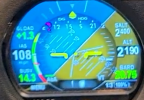
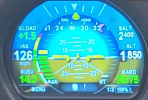
Exhibit A, entry into the turn, 45 degree AoB, about 500fpm rate of descent - typical of a base to final turn, minus the angle of bank, but that made the G-loads more evident. The plane was trimmed for this turn to ensure there wouldn't be any change in the pitch of the elevator during the maneuver.
View attachment 139964
Note the 1.3G in the maneuver, pretty typical of a turn at that bank angle. Counting frames in the video, it took about 15 of them (half a second) to turn 5 degrees, or about 10 degrees per second. Theoretical value should be 11 degrees per second, so I'd say we're where we need to be for the entry conditions.
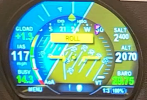
Exhibit B, bank angle increased to 60 degrees, without applying any additional backpressure. This screenshot was taken a few seconds later. Now it only took 5 frames to turn 5 degrees, we're at a turn rate of 30 degrees per second. Note that the G-meter still indicates 1.3G, the same as we had when we were banked at 45 degrees. The pitch dropped from level to 20 or so degrees nose down, and the vertical speed increased to about 1800fpm.
View attachment 139966
Exhibit C, rolling wings level, and keep in mind that the airplane is still trimmed for almost a level turn at 45 degrees AoB. So it will want to pull up, plus the extra speed increases that tendency. Even so, the G-meter only indicates 1.5G. A couple maneuvers went up to 1.7 if no forward pressure was applied on the yoke. Still, less than the 2Gs of a level turn at 60 degrees AoB.
View attachment 139967
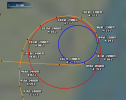
And now for the conclusion, the actual ground track:
View attachment 139968
Compare the initial turn radius at 45 degrees AoB with the turn radius of the descending turn at 60 degrees AoB. I'd say there is a pretty significant difference. Yes, it's not sustainable, you can't do it for more than 10-15 seconds or so, but that is more than enough to tighten a turn without potentially stalling the aircraft. We actually get the turn rate (and radius) of a 60 degree AoB turn but without the G-load.
You can argue about how it actually happens, but I think the conclusion is pretty evident - you can safely tighten a turn (albeit for a short time only) by increasing the bank angle but without the increase in elevator backpressure. Enough to salvage a base to final turn that could otherwise result in a stall/spin accident. I completely agree that going around is still the safest way to handle that situation, followed by overshooting final and then correcting, but in a pinch, increasing the bank angle and letting the nose drop will get you in less trouble than trying to tighten that turn in a (mostly) level attitude.
Cool! Thanks for sharing your results. Fun stuff!Got a chance to try this a few days ago with relatively calm winds, and managed to take a pretty poor video, but it was enough to take a couple screenshots.
Keep in mind that you trim for speed, not pitch. When you lower that vertical lift component, speed will increase and the trim will "pull" to compensate.Exhibit A, entry into the turn, 45 degree AoB, about 500fpm rate of descent - typical of a base to final turn, minus the angle of bank, but that made the G-loads more evident. The plane was trimmed for this turn to ensure there wouldn't be any change in the pitch of the elevator during the maneuver.
Perhaps more importantly, airspeed increased... That will increase your turn radius, and your load factor, unless you re-trim and/or push.Exhibit B, bank angle increased to 60 degrees, without applying any additional backpressure. This screenshot was taken a few seconds later. Now it only took 5 frames to turn 5 degrees, we're at a turn rate of 30 degrees per second. Note that the G-meter still indicates 1.3G, the same as we had when we were banked at 45 degrees. The pitch dropped from level to 20 or so degrees nose down, and the vertical speed increased to about 1800fpm.
I feel like you missed something between B and C - The drastic increase in vertical speed, then airspeed, then turn radius. How long can you hold 60º bank with less than 2 load factor? How does the shape of the curve change?Exhibit C, rolling wings level
This.You don't think the 22% higher groundspeed in the 45° bank explains this?
The lower groundspeed at the higher angle of bank is because the maneuver became 3-dimensional. The actual airspeed increased as the bank angle increased and the nose dropped.You don't think the 22% higher groundspeed in the 45° bank explains this?
Airspeed did increase, but because of the nose pitching down, the horizontal component (ground speed) of the lift vector was less than the value in level flight (82kt vs 104kt)Perhaps more importantly, airspeed increased... That will increase your turn radius, and your load factor, unless you re-trim and/or push.
Oh, I am well aware that the maneuver isn't sustainable. I'd say you get 10-15 seconds or so before you have to do something about it.I feel like you missed something between B and C - The drastic increase in vertical speed, then airspeed, then turn radius. How long can you hold 60º bank with less than 2 load factor?
The whole point of this conversation was that if you find yourself overshooting your base to final turn, instead of trying to tighten that turn in level flight (or worse, stomping on the rudder), with the net effect being a base to final stall/spin, you can just let the nose drop and allow the turn to become a 3-dimensional maneuver, which will increase the turn rate and decrease the turn radius, but without the significant increase in load factor.I'm having trouble remember what on earth we were trying to accomplish when we started down this path...
I forgot what my numbers were. But it doesn't really matter, it's like arguing how lift is generated, with all the fun of Newton vs Bernoulli and a sprinkle of equal transit theory.The change in speed would have resulted in a 32% reduction while the change in bank angle would have resulted in 18%.
Uhhh... I don't think so. If you were going 102 knots and level, for the speed to drop to 84 knots solely because of the descent, your descent rate would be over 5800 feet per minute even without an increase in airspeed.The lower groundspeed at the higher angle of bank is because the maneuver became 3-dimensional. The actual airspeed increased as the bank angle increased and the nose dropped.
OK. Using the 1.414 load factor of a perfect 45º banked level turn, if we increase to 60º of bank we'll increase the rate of turn by 22.5% but we'll lose enough of our vertical lift to cause a 9.42 ft/s^2 downward acceleration.That's the whole point I was trying to make, a 3D turn will allow you to keep the same load factor while allowing an increase of the the rate of turn and a decrease of the turn radius. I achieved what a 60 degree AoB turn would do with the G-loading of 45 degree turn.
If you started level at 1000 feet, you would hit the ground in 14 seconds. On a base to final turn at 400 AGL that you started at 500 fpm, 8 seconds. At the 1.414 load factor and 60º bank your turn rate would be 13.3º/sec so it would take almost 7 seconds to do a 90º turn. That means you have a bit over a second to recover before you hit the ground.Oh, I am well aware that the maneuver isn't sustainable. I'd say you get 10-15 seconds or so before you have to do something about it.
Within reason, and for a very short period of time, maybe.The whole point of this conversation was that if you find yourself overshooting your base to final turn, instead of trying to tighten that turn in level flight (or worse, stomping on the rudder), with the net effect being a base to final stall/spin, you can just let the nose drop and allow the turn to become a 3-dimensional maneuver, which will increase the turn rate and decrease the turn radius, but without the significant increase in load factor.
A few people disagreed with the statement above. Yet we can clearly see that the load factor stayed the same as the bank angle increased, while the rate of turn increased and the turn radius decreased.
The actual airspeed increased as the bank angle increased and the nose dropped.
...a 3D turn will allow you to keep the same load factor while allowing an increase of the the rate of turn and a decrease of the turn radius. I achieved what a 60 degree AoB turn would do with the G-loading of 45 degree turn. And because the airspeed increased (despite the lower ground speed) the aircraft is less likely to stall during this maneuver as well.
...
At the end of the day, the original statement I made stands - if you need to tighten a turn, let the nose drop to keep a lower load factor and avoid a stall. You can't use this to make 360s, all you get is a 10 second get out of jail free card.

I'm trying to think about how I want to test this, which will hopefully be Monday. I do want to test more than the 45-60 version and see how it all works out.I appreciate what you've done here, which is made me think about an old conviction in a new way. Thanks for that. I don't know engineering well enough to comment on @flyingcheesehead 's math, but I revisited my old thought-experiment of "turning off gravity" and then turning the plane to a new heading. So, I concede that fighting the force of gravity accounts for a portion of the load factor generated by the AoA, whether in curving flight or not. If you surrendered to gravity completely, you would be in a vertical diving barrel roll, wouldn't you? Performing any portion of that maneuver approaching to land, I cannot advocate. Still, it was worthwhile to think about. Thanks again.

I'm trying to think about how I want to test this, which will hopefully be Monday. I do want to test more than the 45-60 version and see how it all works out.
You can "turn off gravity" at least in terms of load factor by doing a 90-degree bank. If you then pull the 3.8G normal limit, you'd have quite a turn rate... But you'd also have the vertical acceleration as if your wings had fallen off.
I'll pray for you...I'm trying to think about how I want to test this, which will hopefully be Monday. I do want to test more than the 45-60 version and see how it all works out.
You can "turn off gravity" at least in terms of load factor by doing a 90-degree bank. If you then pull the 3.8G normal limit, you'd have quite a turn rate... But you'd also have the vertical acceleration as if your wings had fallen off.
I'll pray for you...


Yeah, but then there's only a door latch between you and the ground.You can generate lift with the side of your fuselage in a 90 degree bank. Takes plenty of airspeed and top rudder, but knife edge flight is a staple of the airshow world. Sean Tucker is particularly known for it.

That is what I speculated from the photos.Pure speculation. Looking in the direction of flight, a wingtip hit first, ruptured the tank, the airplane flipped and burned.
OK... I got my turn to test! I didn't take any pretty pictures, but I did download the data off the GI275 and upload it to FlySto. I also didn't get any pretty ground track pictures because I did not have calm winds aloft and since this was about bank angle I wanted to keep a constant bank rather than do turns around a point.Got a chance to try this a few days ago with relatively calm winds, and managed to take a pretty poor video, but it was enough to take a couple screenshots.
Exhibit A, entry into the turn, 45 degree AoB, about 500fpm rate of descent - typical of a base to final turn, minus the angle of bank, but that made the G-loads more evident. The plane was trimmed for this turn to ensure there wouldn't be any change in the pitch of the elevator during the maneuver.
View attachment 139964
Note the 1.3G in the maneuver, pretty typical of a turn at that bank angle. Counting frames in the video, it took about 15 of them (half a second) to turn 5 degrees, or about 10 degrees per second. Theoretical value should be 11 degrees per second, so I'd say we're where we need to be for the entry conditions.
Exhibit B, bank angle increased to 60 degrees, without applying any additional backpressure. This screenshot was taken a few seconds later. Now it only took 5 frames to turn 5 degrees, we're at a turn rate of 30 degrees per second. Note that the G-meter still indicates 1.3G, the same as we had when we were banked at 45 degrees. The pitch dropped from level to 20 or so degrees nose down, and the vertical speed increased to about 1800fpm.
View attachment 139966
Exhibit C, rolling wings level, and keep in mind that the airplane is still trimmed for almost a level turn at 45 degrees AoB. So it will want to pull up, plus the extra speed increases that tendency. Even so, the G-meter only indicates 1.5G. A couple maneuvers went up to 1.7 if no forward pressure was applied on the yoke. Still, less than the 2Gs of a level turn at 60 degrees AoB.
View attachment 139967
And now for the conclusion, the actual ground track:
View attachment 139968
Compare the initial turn radius at 45 degrees AoB with the turn radius of the descending turn at 60 degrees AoB. I'd say there is a pretty significant difference. Yes, it's not sustainable, you can't do it for more than 10-15 seconds or so, but that is more than enough to tighten a turn without potentially stalling the aircraft. We actually get the turn rate (and radius) of a 60 degree AoB turn but without the G-load.
You can argue about how it actually happens, but I think the conclusion is pretty evident - you can safely tighten a turn (albeit for a short time only) by increasing the bank angle but without the increase in elevator backpressure. Enough to salvage a base to final turn that could otherwise result in a stall/spin accident. I completely agree that going around is still the safest way to handle that situation, followed by overshooting final and then correcting, but in a pinch, increasing the bank angle and letting the nose drop will get you in less trouble than trying to tighten that turn in a (mostly) level attitude.