

flyingcheesehead
Taxi to Parking
- Joined
- Feb 23, 2005
- Messages
- 28,184
- Location
- UQACY, WI
- Display Name
- iMooniac
- Home Airfield
- KUES/KMKE
Went up the other day to do some fun flight testing, exploring parts of the envelope that we don't normally do. There were three parts of the mission:
1) Practice an emergency descent to landing and see how long it actually takes to get the Mooney down when sufficiently motivated.
2) Do @Brian Schiff's "The Possible Turn" to get a starting point for when the impossible turn might become possible. There's a lot more testing I'd like to do with this later.
3) Test some of the theories from the "Cirrus down 9A5 south of Chattanooga" thread.
Emergency Descent
The emergency descent was the first one I've practiced in a while. It was definitely the first one I've gotten up to full Vle speed. At the end of the day, I got from 14,000 feet in cruise down to wheels on the ground in exactly four minutes.
The emergency descent procedure in the Mooney is to slow to Vlo(ext) of 140 KIAS, drop the gear, shove the nose down and accelerate to and hold Vle of 165 KIAS. Speed brakes are mighty useful as well. Get all that drag out there and go fast, and she falls out of the sky at an impressive rate.
The entry portion (slowing, dropping gear, speeding up and getting the descent to full rate) took 27 seconds. The main portion of the descent took 2:10. Peak vertical speed was -7,131 fpm; average for this middle portion of the maneuver was -4,756 fpm (13,501 down to 3196 MSL). The lowest pitch was -21º and the highest bank 54º - I mostly did the maneuver as a steep spiral similar to the commercial checkride but focused much more on getting down quickly than meeting ACS standards for the maneuver.
Remember that this is a very slippery airplane; the speed brakes and landing gear combined with the high speed is what makes it work. After dropping out of the sky at an ear-popping rate, it felt like it took interminably long to slow down and land, even with all the available drag and an aggressive slip it was another 1:23 from initiating the level-off at 3196 MSL until touching down.
Conclusion: Even from my FL200 service ceiling I could probably put the plane on the ground in 5 minutes provided it's VMC and there's a safe place to put it down.
The Possible Turn
For those of you who don't want to click a link, here is Brian's procedure:
I did this at Vy, it's so rare for me to do anything at Vx that I don't see the point. The 5-second reaction time worked out pretty well for me, even keeping the nose up it got me down just about from Vy (105) to Vg (91). My Observed Altitude Loss was 600 feet.
So, per the instructions, my Turnback Height is 900 feet and my minimum height at the departure end of the runway is 400 feet. The latter is not something I'd normally meet. I usually keep the plane accelerating during the initial climb, all the way up to my cruise climb speed. Taking off from a 4500' runway today and keeping it to Vy, I still was only at about 200 AGL, not 400. It looks like I got to 400 AGL in about 6700' laterally, so apparently Brian would say that I shouldn't turn back, ever, unless the runway is that long... And on a more normal takeoff for me, it took 8200' to hit 400 AGL. So, I'm gonna have to think about how I take off a bit.
However, I've been thinking about this a lot lately, and I think while Brian Schiff's technique is a good starting point, there are a lot of variables involved and I'd like to explore those as well:
Headwind: Generally speaking, more headwind is good because I'd be higher at the departure end of the runway and moving back toward the runway throughout the turn. Too much headwind, however, or flying a plane that climbs at a higher angle (slower climb speed and/or higher climb rate) might mean overshooting the runway after the turn back.
Crosswind: If done right, more crosswind helps. If you turn into the wind upon an engine failure, and then don't point straight at the runway after the turn-back but point somewhat upwind with a constant heading and let the wind blow you back toward the centerline, you don't need to turn as far as you would otherwise.
Gross weight & DA: Obviously, the higher your gross weight or the higher the DA, the longer your ground roll and the slower your climb rate, so you'll generally be in a worse position at a higher weight.
Runway length: A long runway gives you more opportunity to chop and drop and land straight ahead after an early failure, and also means you'll be higher before the runway ends. It'll also forgive a lot of sloppiness on a turnback.
So, it would be interesting to collect enough data to understand how each of those individually affects things, and possibly even combine them into a spreadsheet or an app that would give you an idea of what the best course of action is in any given situation.
That other thread:
An assertion was made that increasing bank without increasing load factor may increase turn rate enough to decrease turn radius and get pointed back towards the runway quicker. I disagreed, but it's a fun thought experiment as well as a fun thing to test in flight!
The idea was that if you increased bank without increasing pitch, you would increase turn rate without increasing load factor, in exchange for accelerating downwards due to the loss of vertical lift component.
So, I did this by starting with power on and trimming for a 45º bank, then pulling power and keeping the 45º bank so I could get it stabilized in that configuration, with as close to a constant descent as I could manage, and then increased bank to around 60 degrees without any pulling on the yoke.
In the stabilized descending 45º bank, I averaged:
94 KIAS (91.5)
1389 fpm descent (1340)
1.82º pitch down (1.12)
44.48º bank (44.9)
1.37G load factor (1.38)
10.1º/s turn rate (9.2º/s)
The values in parentheses above are the exact values at the last second before increasing bank. Below, I've repeated those values before the slash, and after the slash represents two seconds later, the time it took me to increase to 60º bank:
91.5 / 91.3 KIAS
1340 / 1318 fpm descent
1.12º / 2.86º pitch down
44.9º / 59.91º bank
1.38G / 1.33G load factor
9.2º/s / 10.6º/s
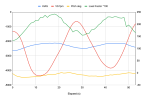
So, not much change yet. But whoo boy, was it a wild and fun ride afterwards! The turn continued, of course, with a vertical acceleration that naturally increased airspeed, which increased pitch and load factor and developed into a phugoid oscillation with a period of about 27 seconds. You can watch a representation of the fun part here, as well as explore other aspects of the flight - Watch the attitude indicator at the bottom center: https://www.flysto.net/logs/do8u6y5...3.6063,43.5425&t=3911&profile=on&check=o2b78s
Here's a graph of IAS, VS, pitch, and load factor*100 for the phugoid. This is the entire 60º portion of the turn:
Anyone who wants to see the raw data for the turn portion, I put it on Google Sheets here: https://docs.google.com/spreadsheets/d/1IXmAxHsR4RjUNG9n7Kvrvo3kgVMlrd76lj7BC-OGONM/edit?usp=sharing
The key bit of information: Load factor stayed at or below the 1.41 that would be expected of a perfect 45º bank for only two seconds, and within just 7 seconds had exceeded the load factor of 2 that would result from a vertically unaccelerated 60º bank turn, peaking at 2.42G after 18 seconds. In that same 7 seconds it took for the load factor to get high anyway, airspeed increased from 91.3 KIAS to 112.5 KIAS, which increases the turn radius. Turn rate averaged 16º/s, so definitely an improvement, but still slow enough that a 180 would take 11.25 seconds instead of 17, and to avoid the load factor/stall issues you'd have to start getting out of the turn after maybe 4 seconds at best.
I'm not going to get into the rest of the math here in this OP because this post is already plenty long and I've delayed posting the thread for too long. It seems that there's a possibility that maybe rolling into a 60º bank for the first few seconds, while still climbing and minimizing the distance traveled from the field, could be advantageous, but also carries significant risk of hurting overall glide performance. I definitely intend to do some more testing of the ways to make the impossible turn possible in the future.
1) Practice an emergency descent to landing and see how long it actually takes to get the Mooney down when sufficiently motivated.
2) Do @Brian Schiff's "The Possible Turn" to get a starting point for when the impossible turn might become possible. There's a lot more testing I'd like to do with this later.
3) Test some of the theories from the "Cirrus down 9A5 south of Chattanooga" thread.
Emergency Descent
The emergency descent was the first one I've practiced in a while. It was definitely the first one I've gotten up to full Vle speed. At the end of the day, I got from 14,000 feet in cruise down to wheels on the ground in exactly four minutes.
The emergency descent procedure in the Mooney is to slow to Vlo(ext) of 140 KIAS, drop the gear, shove the nose down and accelerate to and hold Vle of 165 KIAS. Speed brakes are mighty useful as well. Get all that drag out there and go fast, and she falls out of the sky at an impressive rate.
The entry portion (slowing, dropping gear, speeding up and getting the descent to full rate) took 27 seconds. The main portion of the descent took 2:10. Peak vertical speed was -7,131 fpm; average for this middle portion of the maneuver was -4,756 fpm (13,501 down to 3196 MSL). The lowest pitch was -21º and the highest bank 54º - I mostly did the maneuver as a steep spiral similar to the commercial checkride but focused much more on getting down quickly than meeting ACS standards for the maneuver.
Remember that this is a very slippery airplane; the speed brakes and landing gear combined with the high speed is what makes it work. After dropping out of the sky at an ear-popping rate, it felt like it took interminably long to slow down and land, even with all the available drag and an aggressive slip it was another 1:23 from initiating the level-off at 3196 MSL until touching down.
Conclusion: Even from my FL200 service ceiling I could probably put the plane on the ground in 5 minutes provided it's VMC and there's a safe place to put it down.
The Possible Turn
For those of you who don't want to click a link, here is Brian's procedure:
1. Establish aircraft in a stabilized climb halfway between VX and VY on a cardinal heading.
2. Upon reaching a safe cardinal altitude, retard throttle.
3. Do nothing for 5 seconds and hold the nose up without stalling.
4. After these 5 seconds, simultaneously roll the aircraft into a 45º-banked turn and pitch for no faster than best glide speed (or slightly slower).
5. Continue this maneuver until completing a 360-degree turn.
6. Roll out of the turn.
7. Perform a moderately aggressive flare to simulate a landing.
8. Note altitude when vertical speed becomes zero.
9. Subtract this altitude from the cardinal altitude at which the throttle was retarded.
10. The result is the altitude lost during a 360O gliding turn. This is the OBSERVED ALTITUDE LOSS.
11. Increase the altitude lost in a 360O maneuver by 50% to arrive at the TURNBACK HEIGHT.
12. Add the TURNBACK HEIGHT to the airport elevation to determine the minimum TURNBACK ALTITUDE.
13. Do not consider turning around unless 1) the aircraft has reached at least 2/3 of the OBSERVED ALTITUDE LOSS when passing over the departure end of the runway, and 2) it has reached at least the minimum TURNBACK ALTITUDE.
I did this at Vy, it's so rare for me to do anything at Vx that I don't see the point. The 5-second reaction time worked out pretty well for me, even keeping the nose up it got me down just about from Vy (105) to Vg (91). My Observed Altitude Loss was 600 feet.
So, per the instructions, my Turnback Height is 900 feet and my minimum height at the departure end of the runway is 400 feet. The latter is not something I'd normally meet. I usually keep the plane accelerating during the initial climb, all the way up to my cruise climb speed. Taking off from a 4500' runway today and keeping it to Vy, I still was only at about 200 AGL, not 400. It looks like I got to 400 AGL in about 6700' laterally, so apparently Brian would say that I shouldn't turn back, ever, unless the runway is that long... And on a more normal takeoff for me, it took 8200' to hit 400 AGL. So, I'm gonna have to think about how I take off a bit.
However, I've been thinking about this a lot lately, and I think while Brian Schiff's technique is a good starting point, there are a lot of variables involved and I'd like to explore those as well:
Headwind: Generally speaking, more headwind is good because I'd be higher at the departure end of the runway and moving back toward the runway throughout the turn. Too much headwind, however, or flying a plane that climbs at a higher angle (slower climb speed and/or higher climb rate) might mean overshooting the runway after the turn back.
Crosswind: If done right, more crosswind helps. If you turn into the wind upon an engine failure, and then don't point straight at the runway after the turn-back but point somewhat upwind with a constant heading and let the wind blow you back toward the centerline, you don't need to turn as far as you would otherwise.
Gross weight & DA: Obviously, the higher your gross weight or the higher the DA, the longer your ground roll and the slower your climb rate, so you'll generally be in a worse position at a higher weight.
Runway length: A long runway gives you more opportunity to chop and drop and land straight ahead after an early failure, and also means you'll be higher before the runway ends. It'll also forgive a lot of sloppiness on a turnback.
So, it would be interesting to collect enough data to understand how each of those individually affects things, and possibly even combine them into a spreadsheet or an app that would give you an idea of what the best course of action is in any given situation.
That other thread:
An assertion was made that increasing bank without increasing load factor may increase turn rate enough to decrease turn radius and get pointed back towards the runway quicker. I disagreed, but it's a fun thought experiment as well as a fun thing to test in flight!
The idea was that if you increased bank without increasing pitch, you would increase turn rate without increasing load factor, in exchange for accelerating downwards due to the loss of vertical lift component.
So, I did this by starting with power on and trimming for a 45º bank, then pulling power and keeping the 45º bank so I could get it stabilized in that configuration, with as close to a constant descent as I could manage, and then increased bank to around 60 degrees without any pulling on the yoke.
In the stabilized descending 45º bank, I averaged:
94 KIAS (91.5)
1389 fpm descent (1340)
1.82º pitch down (1.12)
44.48º bank (44.9)
1.37G load factor (1.38)
10.1º/s turn rate (9.2º/s)
The values in parentheses above are the exact values at the last second before increasing bank. Below, I've repeated those values before the slash, and after the slash represents two seconds later, the time it took me to increase to 60º bank:
91.5 / 91.3 KIAS
1340 / 1318 fpm descent
1.12º / 2.86º pitch down
44.9º / 59.91º bank
1.38G / 1.33G load factor
9.2º/s / 10.6º/s
So, not much change yet. But whoo boy, was it a wild and fun ride afterwards! The turn continued, of course, with a vertical acceleration that naturally increased airspeed, which increased pitch and load factor and developed into a phugoid oscillation with a period of about 27 seconds. You can watch a representation of the fun part here, as well as explore other aspects of the flight - Watch the attitude indicator at the bottom center: https://www.flysto.net/logs/do8u6y5...3.6063,43.5425&t=3911&profile=on&check=o2b78s
Here's a graph of IAS, VS, pitch, and load factor*100 for the phugoid. This is the entire 60º portion of the turn:
Anyone who wants to see the raw data for the turn portion, I put it on Google Sheets here: https://docs.google.com/spreadsheets/d/1IXmAxHsR4RjUNG9n7Kvrvo3kgVMlrd76lj7BC-OGONM/edit?usp=sharing
The key bit of information: Load factor stayed at or below the 1.41 that would be expected of a perfect 45º bank for only two seconds, and within just 7 seconds had exceeded the load factor of 2 that would result from a vertically unaccelerated 60º bank turn, peaking at 2.42G after 18 seconds. In that same 7 seconds it took for the load factor to get high anyway, airspeed increased from 91.3 KIAS to 112.5 KIAS, which increases the turn radius. Turn rate averaged 16º/s, so definitely an improvement, but still slow enough that a 180 would take 11.25 seconds instead of 17, and to avoid the load factor/stall issues you'd have to start getting out of the turn after maybe 4 seconds at best.
I'm not going to get into the rest of the math here in this OP because this post is already plenty long and I've delayed posting the thread for too long. It seems that there's a possibility that maybe rolling into a 60º bank for the first few seconds, while still climbing and minimizing the distance traveled from the field, could be advantageous, but also carries significant risk of hurting overall glide performance. I definitely intend to do some more testing of the ways to make the impossible turn possible in the future.
Last edited:


