Doc Holliday
En-Route
Where is it written it needs to have an "original" signature?Wouldn't be the A&P's original signature, if that matters.

Where is it written it needs to have an "original" signature?Wouldn't be the A&P's original signature, if that matters.
Can you? Interesting concept. Back in whatever year it was, the government said that scans (and faxes) were acceptable documentation. So I never thought about it, but I don't see any reason as far as the FAA is concerned if you scan the sticker.Folks, you do realize that you can scan the sticker, shrink it in ppt or word, then print it onto your own blank sticker paper, right?


 www.avery.com


Except maintenance signatures follow different guidance due to the airworthiness connections per ICAO and other international agreements. So if you look at the signature definitions within that FAA guidance a mx signature is handwritten or part of an FAA acceptable electronic or digital signature process. One guidance example is an AC 120-?? which shows these basic definitions.E-signatures have been valid for commerce under federal law for 26 years. There is absolutely no reason why they shouldn’t be acceptable for logbooks.
Am I missing something? Where do you find "handwritten" "pen" "ink" or anything like that in 91.147? There is (a) (1) (iii) that states: "The signature, and certificate number of the person approving the aircraft for return to service." But in no way does that imply it must be an original hand written signature.However, only those signature records per 91.417 are required to be retained in their original handwritten, ie. pen and ink, condition.

And even if I did miss it, I'm pretty sure AC 120-78B supersedes anything in 91.417 or any other FAR as far as digital records go.


Except, in general, thats not how the regulations work by providing all inclusive info. Its the underlying FAA guidance that provides those details as I stated above and that guidance comes in many levels: ACs, Orders, Policy Letters, etc. So where you only see "signature" in the rule, the FAA has provided additional guidance in defining that term.Am I missing something? Where do you find "handwritten" "pen" "ink" or anything like that in 91.147? There is (a) (1) (iii) that states: "The signature, and certificate number of the person approving the aircraft for return to service." But in no way does that imply it must be an original hand written signature.
Ummm.... It's called the Electronic Signatures in Global and National Commerce (ESIGN) Act, which became law on June 30, 2000.An AC has no legal weight and cannot supercede a regulation.

I'm not saying you can't use a handwritten signature. My point is that it is no longer required in any department of the US Government.Except, in general, thats not how the regulations work by providing all inclusive info. Its the underlying FAA guidance that provides those details as I stated above and that guidance comes in many levels: ACs, Orders, Policy Letters, etc. So where you only see "signature" in the rule, the FAA has provided additional guidance in defining that term.
As I stated , if you want to use an electronic mx signature system it needs to meet certain FAA requirements to be legit. There are international aviation agreements at play that those other govt depts dont have. And even though Part 91 ops do not require any formal acceptance of an e-sign system, if your personal selected system does not meet the same key items of an accepted system, those records will be invalidated per the guidance.I'm not saying you can't use a handwritten signature. My point is that it is no longer required in any department of the US Government.
No... It needs to meet the Electronic Signatures in Global and National Commerce (ESIGN) Act standards. Which the FAA must comply with.it needs to meet certain FAA requirements to be legit.
Exactly. And if you were to read the existing guidance you'll find the E-Sign Act and other similar Acts all allow goverment agencies to develop policy and performance standards to comply with those Acts within their oversight. And for electronic signature and records applicable under 14 CFR the FAA has that authority.It's not rocket science.
Those examples tend to be from enforcement actions and if it doesnt raise to the Admin level there would be no public examples to link to. However, there are several public legal LOIs that address that topic should you choose to look for them.Can anyone point to an example of where the FAA ever said a record was not acceptable because it had an electronic signature?
So that would be a “no”.Those examples tend to be from enforcement actions and if it doesnt raise to the Admin level there would be no public examples to link to. However, there are several public legal LOIs that address that topic should you choose to look for them.
As I recall, that would be a yes as the electronic records in question did not meet the requirements of AC 120-78 or 8900.1 guidance. Follow the guidance and your golden.So that would be a “no”.
I'm not the one saying you can't use electronic signatures. I believe I'm also the first one to reference AC 120-78B.Exactly. And if you were to read the existing guidance you'll find the E-Sign Act and other similar Acts all allow goverment agencies to develop policy and performance standards to comply with those Acts within their oversight. And for electronic signature and records applicable under 14 CFR the FAA has that authority.

Heck, I bought the plane with an E signature on a contract, I bought a house with an e signature. I'm sure an A&P or IA's electronic signature on a printed sticker would be fine. Heck, a PDF copy printed out would be fine for the FAA or anyone else, so no, I think the days of needing a "wet" signature with a different color ink pen are behind us.
True, you cannot send a scan or copy. You must send the original ***OR*** a true Digital Signature. (Same as you can't send a scan of a check, but you can send an ACH.To clarify, I couldn’t take original signed affidavits (and such) and get certified true and correct copies to submit. Had to send the originals which made me nervous…
 )
So whomever told you it could ONLY be wet ink was incorrect
I mentioned 120-78 in Post 48 but had forgotten the dash number on it. You acknowledged my reference in Post 49 and added the proper dash number. But to note, I’ve been signing off mx under that AC guidance since its original issuance in 2002 as my former day job was an early adopter of electronic mx records and signatures.I'm not the one saying you can't use electronic signatures. I believe I'm also the first one to reference AC 120-78B.
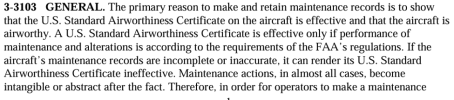
It seems you are taking my use of 91.417 out of its original context so let me try this way. In order for me to affix my signature to a mx task per 43.9 or 43.11, I have two options: handwritten or via an AC 120-78 acceptable electronic signature process (see reference #1 below). My use of 91.417 in this context was to illustrate only those mx records are required to maintain their original legal signatures, as noted above, and that not all signatures have this same requirement.I'm fully aware of how you can use different means. But getting back to my original question... Please show me where it says "per 91.417 are required to be retained in their original handwritten, ie. pen and ink, condition" as you stated. I sure don't see it anywhere.
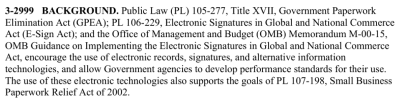
While you continue to believe those congressional acts superseded the FAA guidance, you’ll find in fact AC 120-78 was actually written to provide current policy and standards in CFR Title 14, ie., the FARS, for the congressional acts you reference with the latest revision dated Dec 2024. So the guidance was not superseded but augmented those congressional acts (ref. #3 below).And even if it were there, that has since been superseded by a Congressional Act, but for reference, I'd still like to to know why you think (or thought) pen and ink are/were required.






No, you’re supposed to have an annual sign off for each item (airframe, engine, prop).


You guys will argue over anything.

That's a negative ghost rider. AC's are NOT regulatory in nature UNLESS a FAR cites one directly.I'm pretty sure AC 120-78B supersedes anything in 91.417 or any other FAR as far as digital records go
I'll take the bait - it was a little cool, but not nearly as cool as watching the Hawkins and Powers radial piston powered beasts work out of Greybull, WY in the mid-90s. Nothing cooler than a Jet-A fuel turbojet assisting some tired radials pull tons of retardant into the air. C-54, c-118, C-82, C-123, etc. Now that's cool.On the final departure he did a high speed pass along the runway past all of us. Something I watched and experienced naked eye with no phone or camera in hand and if you want to convince me it wasn't cool I'll take that argument.
Very true, they may not be a get out of jail free card. But typically ACs that are published AFTER the Reg are taken into consideration.That's a negative ghost rider. AC's are NOT regulatory in nature UNLESS a FAR cites one directly.
A quick read of 91.417 does NOT cite 120-78B so no, relying on it will not keep you out of 'FAA jail'.
From what I understand (pecking order of sorts):Very true, they may not be a get out of jail free card. But typically ACs that are published AFTER the Reg are taken into consideration.
It's much easier to publish an AC than it is to rewrite the Regs, and changes happen with over time. A Legal Interpretation is even better, but there isn't one I can find, so hopefully I'll get one in about a year.
I don't believe this is the reason. Say for example I have a stack of 'Super Duper A&P #1233456' signed pre-preinted forms (labels or for a printer).A scan or photo of those 91.417 signatures is considered a photo-copy and is not considered a legal mx signature by the FAA .
Yes, that's basically what I heard. A lot of times the FAA will release the ACs vs trying to change the Reg, which is a pain.AC is a 'best practice' and has no weight unless a FAR cites it. Although I'm told that FSDO's give AC's the weight of FARs in most matters, unless a legal opinion conflicts.
There's a letter saying that you can do it either way - just airframe, or all logbooks. Both are valid. QED.
U.S. Code Title 49 is the law.From what I understand (pecking order of sorts):
FAR is law
Legal Interpretation are how the FAA would interpret a law/FAR.
AC is a 'best practice' and has no weight unless a FAR cites it. Although I'm told that FSDO's give AC's the weight of FARs in most matters, unless a legal opinion conflicts.
InterestingWell… not so fast. I was told that was an absolute no by the feds when it came to a recent registration issue. Absolutely had to have original wet ink…. Arg
To clarify, I couldn’t take original signed affidavits (and such) and get certified true and correct copies to submit. Had to send the originals which made me nervous…
Interesting
I used these folks for escrow, closing, and registration. They have been doing this for many years, and are a substantial "real" company. I never sent a wet signature to anyone when we bought and registered the aircraft.
Aerospace Reports
www.aerospacereports.com