Air India 787 Crashes in Western India

Now someone can explain to me why in the current day (not 50 years ago) a few simple video feeds- especially the cockpit, but also the cabin- have not been incorporated into the realm of mishap data that needs to be retained? Why are we just listening to audio, rather than actually being able to see a video record of events??
Unions
 
A camera won’t tell you what’s going on inside someone’s head. It might help with “what”, but still has limitations on “why”.

There might still be more info on the transcripts that haven’t been released yet.
 
Unless the pilot who said “why did you do that” was the one who shut off the fuel, knowing the CVR would pick that up and put blame on the other guy.


In this video you get the timeline as well as a nice view of the cut off levers. Odd, at 5:10 the phrase used was “why did he …”, not “why did you ..”.

It would be more natural to say “why did you” if you’re speaking to the other pilot. You might be lead to say “why did he” instead if you had a mind set of speaking to the CVR.

We don’t know for sure if he said why did he or why did you. That looks like a summary of what was said not exact transcript right?
 
Last edited:
We don’t know for sure if he said why did he or why did you. That looks like a summary of that was said not exact transcript right?
I’ve heard two different accounts where the word used was “he”. I’m assuming that is the word indeed used. You’re right though - the exact recording and transcript would be needed to substantiate this.
 
Are cockpit operations in English or Hindi?
I would guess Hindi in this case. Again, translated transcript would be needed. Maybe in that language “he” is used as “you”. A good translation should sort that out.
 
Why are we just listening to audio, rather than actually being able to see a video record of events??
That one's easy. Because it is not required.

The NTSB has had an open recommendation for flight deck cameras for some time.

Are cockpit operations in English or Hindi?
That's up to the individual airlines and pilots.
 
A few weeks ago, I was flying my 182 back home. I always leave a little power in until I’m in ground effect, then I pull to idle. I land and roll down the runway, and notice suddenly my engine stops. I look over and my mixture is full idle. I have zero literally zero memory of pulling the mixture. I was on the runway saying how did that happen I pulled the throttle. I still don’t believe I pulled the mixture, but the engine says otherwise.

With that said, this seems hard to do like that since it has to be done one by one
The difference is that you cannot just accidentally shut off the fuel flow on turbine engines. I could make the argument that you can’t accidentally do it in a 182 either, but the systems are much more dummy proof in turbine aircraft where it has to be an intentional move to get over the detents.
 
...only if we had video of the cockpit we would have known for sure....hopefully 260 lives will be enough to make the changes
 
and utility.

Nauga,
and his singing porcupine
Agreed utility is marginal given voice and data , but in this particular mishap it appears it may have been the only way to provide further clarity.
That said, movement of the switches was intentional. As mentioned above, we will never know whether it was nefarious intent or misfiring of synapses...
 
...only if we had video of the cockpit we would have known for sure....hopefully 260 lives will be enough to make the changes

Pilot unions would challenge it based on privacy concerns.
 
  • Like
Reactions: cdb
I’ve heard two different accounts where the word used was “he”. I’m assuming that is the word indeed used. You’re right though - the exact recording and transcript would be needed to substantiate this.
I probably missed it;

Was there a third person in the cockpit?
 
We need the answer to who said what, which I’m sure voice analysis will reveal.

But what I am thinking about a lot. If it was accidental, the other pilot who said “why did you do that” .. that wouldn’t have been his immediate one second later thought. It would have been “wtf is going on fuel flow is dropping, thrust is dropping etc “. He immediately jumped to “why did you do that”.. which to me says he saw from the corner of his eyes it happening. He was aware that is what happened.. there was no startled WTF is happening response and then realization fuel switches are on cut off

Totally agree. You wouldn't be that specific if you weren't looking at it with your own eyes
 
no, but it can definitely help prevent next one
How?

Cameras don't tell you why a pilot took an action, only that he did. We know from the preliminary DFDR data that a pilot moved both switches to CUTOFF. Through the CVR, they will very likely be able to determine which pilot did it. What else would a camera show us?

Maybe wait for the final report to see what they are able to determine and what they are not.
 
I would guess Hindi in this case. Again, translated transcript would be needed. Maybe in that language “he” is used as “you”. A good translation should sort that out.
It would be distinguishable - it’s not the same phrase in Hindi
 
I don't know where the dfdr gets the on off indication from. Is it actually the mechanical switch itself or from some place downstream of the switch. Those switches now are just electrical, controlling another box downstream. It's possible, but not probable that some sort of electrical problem or programming error caused the switches to register cutoff without physically moving the switches. Then when the rat deployed and electrical system reset, the engines tried to relight.

Conjecture only on my part.
 
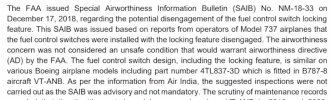
Is the SAIB not relevant? Seems like if the switch gates were known to be suspect it makes things a little more straightforward if no less tragic.

1752346435148.jpeg
 
If it was just one engine, I could buy the faulty switch theory, but both engines, almost simultaneously, at that phase of flight? It had to have been a deliberate act by one of the crew members, either intentionally, or just a huge mistake.
 
If it was just one engine, I could buy the faulty switch theory, but both engines, almost simultaneously, at that phase of flight? It had to have been a deliberate act by one of the crew members, either intentionally, or just a huge mistake.
Not to mention the explicit question “ why did you do it ?” … obviously, the other guy saw him turn it off.
 
I don't have wiring diagrams but is there any point in the routing we're they may be in the same bundle?
 
I don't know where the dfdr gets the on off indication from. Is it actually the mechanical switch itself or from some place downstream of the switch. Those switches now are just electrical, controlling another box downstream. It's possible, but not probable that some sort of electrical problem or programming error caused the switches to register cutoff without physically moving the switches. Then when the rat deployed and electrical system reset, the engines tried to relight.

Conjecture only on my part.


Anything, but to believe the simple answer.
 
Please describe how having a camera would have made the flight safer.
By that logic why bother having CVRs and FDRs?

Obviously such devices don’t make a difference for the crashing plane. They give us information so we can understand what happened and try and improve. A camera with audio can provide more information than audio alone. Anyone not being intentionally obtuse knows this.
 
Obviously such devices don’t make a difference for the crashing plane. They give us information so we can understand what happened and try and improve.
Which 121 accidents remain unsolved which a camera would have solved?
A camera with audio can provide more information than audio alone. Anyone not being intentionally obtuse knows this.
More information is not useful information. Perhaps you're being unintentionally obtuse.
 
Elsewhere, I have read that the panel those switches are on was completely replaced approximately a year ago on this 787. The 2016 service bulletin is no longer relevant.

I have a lot of personal experience operating that type of switch, They are rugged, inconvenient to move, reliable and expensive. We purchased ordinary high quality toggle switches by the hundred, but those by the each.
 
Back
Top