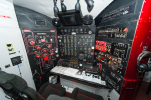
Air India 787 Crashes in Western India

It’s been over a year and we’ve heard nothing about the Challenger double flame out in Tampa, but y’all expect this one solved in a month.

With all the recording devices on board I would think they would have a good idea.
Now that Naples crash is a mystery. My WAG? Pilots high on right base, grabbed the power levers and yanked them back. Lever gates were worn and they pulled them into fuel shutoff. End of story.
Again we may never know.
 
So…. It’s possible to shut the fuel off that abruptly that it kills both engines - and the electrical power thus deploying the RAT? Assume that wouldn’t be simply pulling the throttles back to idle. Should also assume killing the fuel would require a few extra steps - not like just pulling the wrong lever because it was confused with the flaps, etc???

I have no idea what the cockpit of that airliner looks like.

Boeings have start levers, which are physically separate from the thrust levers/throttles. They are at the bottom of the throttle quadrant. As mentioned above, they are somewhat "guarded", in that you have to pull them up/out from the idle position to select cutoff. But absolutely, you can shut the motors off that quickly. That's exactly how you shut them off when you park at the gate and set the parking brake. This is IMO potentially relevant "info" (inasmuch as it isn't verifiable at this point). The procedure in a "dual engine failure" checklist involves putting both start levers to cutoff, and then back to idle to get a relight. So the crew, potentially thinking they had suffered a dual engine failure, could have conceivably taken this step.
 
Not a 787 guy, but 777.

Just because it was deliberate, doesn’t mean it was nefarious.

Here’s the immediate action items for DUAL ENGINE FAILURE, on the B777.
View attachment 142719
The very first step is FUEL CONTROL switches (both)… CUTOFF, then RUN.

So, if they did have a dual engine failure and started the immediate action items, it would have had someone physically putting the switches to CUTOFF.

I’m sure the FDR will show explicitly if the switches were moved, and if they were moved when they were moved (before or after any power loss).

All of the above is assuming that the procedures on the 787 are similar to the 777, which I have absolutely no idea if they are.

Thanks.
Curious, what would be the reason for toggling the shutoff switches in a dual engine-out scenario? Some sort of controller reset?

If they did indeed toggle the cutoff switches per the checklist, the FDR will support that as well as the switches themselves being found in the "on" position (assuming the console survived).
Not familiar with turbines, but I'm sure that attempts to re-light them would have also been recorded.

Checklist or not, in this scenario at 400' agl is there any possibility even one engine could have been restarted and develop enough thrust in time to arrest the descent?

In GA, we always (or SHOULD always) cover this exact "what if" of power loss immediately after take-off, including the subset of not enough runway to set it back down and too low to attempt the impossible turn- knowing ahead of time where the best possible location to attempt an emergency landing would be (if there even is such a spot). Is this part of the takeoff briefing with airliners?
 
In GA, we always (or SHOULD always) cover this exact "what if" of power loss immediately after take-off, including the subset of not enough runway to set it back down and too low to attempt the impossible turn- knowing ahead of time where the best possible location to attempt an emergency landing would be (if there even is such a spot). Is this part of the takeoff briefing with airliners?
Especially for those flying a recip. Since so many folk like to put blower juice in 'em.
 
So some of the multitudinous causes discussed are two that have gained attention here for me prior to the actual data being revealed (Preliminary Report Today???) . One, for some once in a Billion times, both engines failed at the same time and the cutoff switch(es) on engine(s) were engaged prior to an attempted restart. Two, one engine failed and the Pilot Flying or Pilot Monitoring misidentifies the wrong engine failed and cuts off the good engine.

Since you can seemingly place a bet somewhere on anything these days, I know where my money would be.
To me, a very plausible scenario: V1, Vr, V2, one engine fails, one pilot tries to restart the wrong one, now you're 400ft AGL with one engine failed and one that was just cutoff, with no altitude to restart it.

EDIT: Not a 787 pilot here.
 
Curious, what would be the reason for toggling the shutoff switches in a dual engine-out scenario? Some sort of controller reset?
It will cycle the engine and spar values closed then open again.

This is not a procedure which was intended to be accomplished 200' above the runway on takeoff. When confronted with a non-normal situation (there are no "emergency" checklists), the steps we take are:

1. Fly the airplane
2. Silence the warning
3. Confirm the emergency

You don't do memory items, or non-normal checklists, until those three steps have been completed.

The Confirm the emergency step is very important, and may prove a factor in this accident, as it is how you avoid going in the wrong direction and taking the wrong actions.

At 200' on takeoff, you don't have time for anything other than flying the airplane.

I've never flown the 787, I fly the 737. On the 737, the same steps are memory items on the Loss of Thrust in Both Engines checklist. One small difference is that you don't return the engine start switches to IDLE (RUN in the 787) until EGT starts to decrease.

I say that this isn't intended for 200' on takeoff because the checklist has 30 steps with multiple decision points. It is intended for when you have enough altitude to accomplish the steps on the checklist.

With the information currently available, I have no idea if the crew performed those memory items.
 
  • Like
Reactions: cdb
To me, a very plausible scenario: V1, Vr, V2, one engine fails, one pilot tries to restart the wrong one, now you're 400ft AGL with one engine failed and one that was just cutoff, with no altitude to restart it.

EDIT: Not a 787 pilot here.
I'm not a big-iron pilot, but if only one engine failed immediately after rotation, don't you just fly the plane?
 
To me, a very plausible scenario: V1, Vr, V2, one engine fails, one pilot tries to restart the wrong one, now you're 400ft AGL with one engine failed and one that was just cutoff, with no altitude to restart it.
If they did, they did not follow procedure.

With an engine failure at, or after, V1, you;

1. Accelerate on the runway to Vr
2. Rotate to an appropriate single-engine attitude (7° - 10° nose-up on my airplane)
3. Retract the gear when a positive rate of climb is confirmed
4. Maintain runway track
5. At 400', engage the appropriate lateral mode and fly the applicable engine-out ground track
6. At acceleration altitude, lower the pitch attitude and retract the flaps on schedule
7. At clean maneuvering speed, set Max Continuous Thrust on the operating engine
8. Accomplish either the "Engine failure or shutdown checklist" or the "Engine fire or engine severe damage or separation" checklist.

The Engine failure or shutdown checklist is the only one that gives an option for restarting and it is on step 14. At that point, it refers you to the Engine Start--Inflight checklist. You will be several minutes into the flight before you reach that point.

Again, I've not flown the 787 but the checklist philosophy will be similar.

Could they have gone against all of their training and done as you suggest? Of course. Could a driver driving down the freeway see an accident up ahead and decide to shift the car into park at 70mph? Also, yes. But, how likely is it?

BTW, the Engine Start--Inflight checklist has 14 steps and no memory items.

 
I'm not a big-iron pilot, but if only one engine failed immediately after rotation, don't you just fly the plane?
Yes since with one engine operating, so that leaves the one in a billion odds that both fail at the same time since the airplane had no thrust to climb or even maintain altitude.
 
Since you can seemingly place a bet somewhere on anything these days, I know where my money would be.
As observers we have the luxury of holding our bets until the all the cards are turned over. Anything else is just a guess.

Nauga,
who guesses so
 
To me, a very plausible scenario: V1, Vr, V2, one engine fails, one pilot tries to restart the wrong one, now you're 400ft AGL with one engine failed and one that was just cutoff, with no altitude to restart it.

EDIT: Not a 787 pilot here.
It's not plausible at all, you don't try to restart an engine below 400 feet.
 
Yes since with one engine operating, so that leaves the one in a billion odds that both fail at the same time since the airplane had no thrust to climb or even maintain altitude.
According to Google, there were 35 million commercial airline flights worldwide in 2023. If the odds of a dual engine failure were actually 1:1,000,000,000, then we should expect it to happen only once every 29 years. I can think of several dual-engine flameouts off the top of my head in that span, and not all 35 million were large jet airliners, so the actual rate is way more than one in a billion. Now, of course we know that statistics don't actually work that way and extremely unlikely events will likely occur more frequently than the odds indicate, but I still wouldn't say it's a one in a billion occurrence.

ETA: This article list more than dozen dual failures in jet airliners in the past 30 years, the majority due to fuel/fuel system issues.
 
Last edited:
The reason to cycle the fuel control switches in a modern airliner is almost all ECU, EEC or FADEC controls have two different channels. Both channels are identical. Cycling the fuel control switches the electronic engine control to the other channel. As far as losing a engine and shutting down the wrong one it would go against all training the pilots ever received. More important than that however is the video shows zero yaw at any point.
 
So…. It’s possible to shut the fuel off that abruptly that it kills both engines - and the electrical power thus deploying the RAT? Assume that wouldn’t be simply pulling the throttles back to idle. Should also assume killing the fuel would require a few extra steps - not like just pulling the wrong lever because it was confused with the flaps, etc???

I have no idea what the cockpit of that airliner looks like.

Lots of blinkenlights and chirpy noises.
 
I'm not a big-iron pilot, but if only one engine failed immediately after rotation, don't you just fly the plane?
Well, on the PA-23-160 you just fly. Think about the effect your W&B and hours SMOH has on the POH's blistering 180 fpm at 95 mph single-engine climb rate . . . consider feathering . . . Recall that any rats onboard are of the order Rodentia, so if the gyros work, it means the gear are staying down for a while. (Aviate, commemorate, navigate, re-evaluate, communicate . . ..)
 
Last edited:
PF in left seat, PM in right seat guarding thrust levers, lift off, "positive rate, gear up", PM slides hand down and unknowingly karate chops both fuel shutoffs as he is starting to go for the gear lever? Engines are winding down as he puts the lever up. Hand hit switches at just the right angle to lift over the detent?
 
I found this to be interesting- covers all of what has already been posited here. Reiterates that there's no way, that both of these switches could have been "accidentally" moved to the off position- not possible.

At around 32-33 minutes discusses Sluggo 63's post #641 above; which puts it back to simultaneous dual engine failure which is seemingly beyond any realistic possibility.
If the report comes out tomorrow, perhaps we'll learn more.

<iframe width="560" height="315" src="
" title="YouTube video player" frameborder="0" allow="accelerometer; autoplay; clipboard-write; encrypted-media; gyroscope; picture-in-picture; web-share" referrerpolicy="strict-origin-when-cross-origin" allowfullscreen></iframe>
 
PF in left seat, PM in right seat guarding thrust levers, lift off, "positive rate, gear up", PM slides hand down and unknowingly karate chops both fuel shutoffs as he is starting to go for the gear lever? Engines are winding down as he puts the lever up. Hand hit switches at just the right angle to lift over the detent?

Nope. Just wild speculation.
 
PF in left seat, PM in right seat guarding thrust levers, lift off, "positive rate, gear up", PM slides hand down and unknowingly karate chops both fuel shutoffs as he is starting to go for the gear lever? Engines are winding down as he puts the lever up. Hand hit switches at just the right angle to lift over the detent?

Not a chance you can karate chop them into the off position.
 
Not a chance you can karate chop them into the off position.
I guess we need a 787 driver to simulate guarding and sliding hand back and down the quadrant and see if he could catch both switches in a way that would pull them up over the detent. Sim switches would be the ones to try because they would have the most wear. Maybe they put out a timeline tomorrow. If fuel is shutoff at the likely gear up call my wild speculation just becomes speculation. :)
 
I found this to be interesting- covers all of what has already been posited here. Reiterates that there's no way, that both of these switches could have been "accidentally" moved to the off position- not possible.

At around 32-33 minutes discusses Sluggo 63's post #641 above; which puts it back to simultaneous dual engine failure which is seemingly beyond any realistic possibility.
If the report comes out tomorrow, perhaps we'll learn more.

<iframe width="560" height="315" src="
" title="YouTube video player" frameborder="0" allow="accelerometer; autoplay; clipboard-write; encrypted-media; gyroscope; picture-in-picture; web-share" referrerpolicy="strict-origin-when-cross-origin" allowfullscreen></iframe>
So a clickbait "update" of updated speculation?
 
I guess we need a 787 driver to simulate guarding and sliding hand back and down the quadrant and see if he could catch both switches in a way that would pull them up over the detent. Sim switches would be the ones to try because they would have the most wear. Maybe they put out a timeline tomorrow. If fuel is shutoff at the likely gear up call my wild speculation just becomes speculation. :)
There are guards on the outside of each switch. In addition there is no procedure to guard the throttles.
 
Who knows why she swallowed the fly? In startle response mode REALLY WEIRD stuff is kinda normal….

In the A-4 a 30 deg bomb drop has you accelerate from 250 to 350 kts 30 deg nose low. At pickle altitude you hit the button, pause then pull for the horizon.

Know a guy who reached up and put the gear down! Paused, then pulled for the horizon. D’oh!!

The gear simply went three down and locked, turned out to not really be a problem… but WHY? The pickle switch and gear are in WAAAAY different places.

One of a million examples. Something caused whatever caused the loss of thrust… presumably. That isn’t really that interesting, it was likely in startle response mode. WHAT put them in that mode? THAT is closer to root cause, and something from which we can learn something.
 
So a clickbait "update" of updated speculation?

1752201108300.png​

"He's sick. My best friend's sister's boyfriend's brother's girlfriend heard from a guy who knows a kid who's going with the girl who saw him pass out at 31 Flavors last night. I think it's serious."​

 
There are guards on the outside of each switch. In addition there is no procedure to guard the throttles.
I believe some airlines have a procedure to guard the thrust levers. Yes, I've seen the guards. Somehow, someway could a hand guarding the thrust levers slide back and catch both worn switches when going to put the gear up? Tomorrow we may know if the fuel switches being turned off corresponded to a point where gear up was commanded. Or not.
 
PF in left seat, PM in right seat guarding thrust levers, lift off, "positive rate, gear up", PM slides hand down and unknowingly karate chops both fuel shutoffs as he is starting to go for the gear lever?
Captain's hands are on the thrust levers from when the power is set until V1, regardless of who's takeoff it is.

At V1, the Captain removes his hand from the thrust levers and there are no hands there through rotation.

After liftoff, the flying-pilot's hands go back to the thrust levers. The pilot-monitoring never guards them.

The engine start switches have to be pulled out of their detent to be moved from Run to Cutoff. Hitting them, no matter how hard, won't do it.
But, but, but…………the internet sleuths have it all figured out.
 
Not a chance you can karate chop them into the off position.
Reference the 767 in your moniker, I have a hazy memory of my Captain shutting down and not liking how easy one switch went to cutoff. Wrote up the switch.
 
According to the interim report just published by the Indian AAIB both fuel selector switches went to cutoff within 1 second. One pilot queried the other why he set both fuel selectors to cutoff with the other denying he had done so. Both fuel selectors went to run again and the engines were relighting but unable to recover adequately before the crash.
 
According to the interim report just published by the Indian AAIB both fuel selector switches went to cutoff within 1 second. One pilot queried the other why he set both fuel selectors to cutoff with the other denying he had done so. Both fuel selectors went to run again and the engines were relighting but unable to recover adequately before the crash.
Welp
 
According to the interim report just published by the Indian AAIB both fuel selector switches went to cutoff within 1 second. One pilot queried the other why he set both fuel selectors to cutoff with the other denying he had done so. Both fuel selectors went to run again and the engines were relighting but unable to recover adequately before the crash.
Wow . . ..
 
According to the interim report just published by the Indian AAIB both fuel selector switches went to cutoff within 1 second. One pilot queried the other why he set both fuel selectors to cutoff with the other denying he had done so. Both fuel selectors went to run again and the engines were relighting but unable to recover adequately before the crash.
If that happened right after the gear up command my wild speculation becomes less wild. I would ask any of you active 787 flyers to check if you can shutdown without pulling the switches up next time you block in. I'm guessing there is some ergonomic investigating happening in some sims also. They should publish CVR transcript with timeline.
 
If that happened right after the gear up command my wild speculation becomes less wild. I would ask any of you active 787 flyers to check if you can shutdown without pulling the switches up next time you block in. I'm guessing there is some ergonomic investigating happening in some sims also. They should publish CVR transcript with timeline.

Part of our after start flow where I work, involves gently checking that the start levers are securely over the detents. Unknown if this is a thing in the 787, but they are very similar switches in the later NG and MAX 737s.
 

This has been my thinking all along (as I indicated in post # 541 & 614) as there seemed to be no reasonable explanation why both engines would fail simultaneously ...

From the CVR it appears that it wasn't intentional.
 
Last edited:
Back
Top