ADF noise interference question

William Pete Hodges

Line Up and Wait
PoA Supporter
Joined
Mar 6, 2020
Messages
852
Location
Virginia
Display Name
Petehdgs
Home Airfield
KCJR
A couple of years ago I flew through a GPS hole. I switched to other navigation methods to remain on course and then about 30 minutes later the GPS systems started working again. Following this I started looking at more ground based navigation systems to learn and use as a backup. This led me to ADF, which the FAA has decided is dead. While that is technically true, there are over 100 AM radio stations in Virginia, and Ohio, and Michigan, all of which ADF can use at zero cost to the FAA infrastructure. I personally think the FAA's decision to abandon NDB's is short sighted, but most people would just say I am a dinosaur. Perhaps they are correct.

So I have reinstalled an ADF in my bird. I am running into an unforseen problem in that the ADF is picking up noise from my CGR-30P engine monitor. The noise is severe enough to render the ADF unusable. I have had EI modify my Engine Data Module but that has not resolved the problem.

Is anyone here familiar enough with ADF equipment to help me resolve this? I am based in Culpeper Virginia KCJR.

I have an audio recording of the noise but I was unable to attach it here.
 
Last edited:
Damaged antique antenna / cable or poor quality installation would be my thoughts.

Its unimaginable the engine monitor manufacturer modified the product in any way for you because the CGR-30P is fully complaint with RTCA DO-160, the FAA EMI standard, and complies with several TSOs including TSO-C43c, TSO-C44c, TSO-C45b, TSO-C47a, TSO-C48a, TSO-C49b, and TSO-C55a.

I am curious of where you are obtaining the locations of the commercial broadcast antennas you intend to use for navigation. Even when FAA NDBs were supported, we weren’t using them for enroute navigation. That’s what VORs are for. You are at risk of an airspace incursion using an ADF as a back up in this fashion.
 
Last edited:
the ADF is picking up noise from my CGR-30P engine monitor.
Not close enough to help you in person, but here are a few things to check (besides the antenna and cable):

- Is the noise present with the engine off? (Coupled on the EGT/CHT leads and radiated under the panel)
- Is the noise changing when the alternator is switched on and off? (If it does, it's probably caused by the 30P's power supply, more on that later)
- If you cover the ADF antenna with metal tape, does the noise go away? (That would point to the noise radiating to the antenna itself)
- If you cover the 30P with metal foil/tape (including the screen, be careful not to scratch it), does the noise go away? (The box itself might radiate noise)
- if you wrap the 30P harness with metal tape, does the noise go away? (Again, it would point to a power supply issue.)
- does the noise change amplitude/character on different ADF frequencies? (would point at the power supply again)

Now, expanding a bit on this - typical power supplies in modern electronics will use switching frequencies in the ADF band. Because they adjust the output voltage by changing the duty cycle of the switching frequency (the on to off ratio), this means they don't generate just one interference point, but a slew of "harmonics" that dance around as the input voltage and output load change.

At these relatively low frequencies, the signal is usually not radiated (those wavelengths are in the hundreds of feet, you don't have conductors that long that can act like antennas), but instead conducted through the power (and ground) wires to other equipment.

So I suspect that's what is happening to you. The usual fix is to run a two-conductor twisted shielded power wire, that runs power and ground together (to the 30P). The ground should be connected as close as possible to the circuit breaker, and the shield should be grounded at both ends.
Additionally, wrapping the power cable two or three turns around a noise suppression ferrite choke (the big bulge you find on high quality power or video cables) located as close as possible to the 30P will also prevent a lot of that noise from coming out.

Hope this helps.
 
This led me to ADF, which the FAA has decided is dead. While that is technically true, there are over 100 AM radio stations in Virginia, and Ohio, and Michigan, all of which ADF can use at zero cost to the FAA infrastructure. I personally think the FAA's decision to abandon NDB's is short sighted, but most people would just say I am a dinosaur. Perhaps they are correct.

Fello dinosaur here who decided following a panel upgrade to keep the ADF for your reasons, and also to listen to right wing radio shows while progressing across the nation.

It’s too bad VFR charts no longer display commercial AM station antennas. The only ones that made sense (other than showing obstacles) were the high power stations that at low altitudes have longer reception ranges than high power VOR’s. I can listen to and navigate to (in a pinch) NYC’s high power (50kW) WABC (770kHz) transmitting from the Meadowlands in NJ as far away as ME, NH, and Buffalo in western upstate NY.

There’s probably at least a few high power commercial AM stations in Virginia, I’d recommend (for listening or navigation) using only the high powered 50kW ones.

A simple triangulation using only two AM stations with give a reasonable location of your position. Don’t bother with the low powered local AM stations, as their ranges are short, and you’re in and out of their reach fairly quick (just like the old NDB’s).

Here’s a list of the high powered 50kW stations across the nation:
https://en.wikipedia.org/wiki/List_of_50_kW_AM_radio_stations_in_the_United_States
 
So I have reinstalled an ADF in my bird. I am running into an unforseen problem in that the ADF is picking up noise from my CGR-30P engine monitor. The noise is severe enough to render the ADF unusable.
What did the re-installation consist of: antenna, indicator, wires, coaxes, etc?
In what manner was this equipment stored after removal?
Did you turn off the 30P, to check if all the noise stopped from the ADF?
 
w
Fellow dinosaur here who decided following a panel upgrade to keep the ADF for your reasons, and also to enjoy really poor audio receiving right wing radio shows while progressing across the nation.

It’s too bad VFR charts no longer display commercial AM station antennas. The only ones that made sense (other than showing obstacles) were the high power stations that at low altitudes have longer reception ranges than high power VOR’s. I can listen to and navigate to (in a pinch) NYC’s high power (50kW) WABC (770kHz) transmitting from the Meadowlands in NJ as far away as ME, NH, and Buffalo in western upstate NY.

There’s probably at least a few high power commercial AM stations in Virginia, I’d recommend (for listening or navigation) using only the high powered 50kW ones.

A simple triangulation using only two AM stations with give a reasonable location of your position. Don’t bother with the low powered local AM stations, as their ranges are short, and you’re in and out of their reach fairly quick (just like the old NDB’s).

Here’s a list of the high powered 50kW stations across the nation:
https://en.wikipedia.org/wiki/List_of_50_kW_AM_radio_stations_in_the_United_States
FIFY
 
AV8 has some good troubleshooting tips. I'd expand it to say that you can run the sensor inputs into it through ferrite, too. Any wires going in or out of it can act as an antenna. And it makes sense that this unit would cause problems. Not positive, but pretty sure that testing for lower frequency unwanted emissions isn't much of a thing anymore, so cheaper designs leak RF.

Anyway, another thought is just to put the engine monitor on a switch. You probably don't need it at all to fly, so when you're in a GPS degraded area/time just turn it off.

And yeah, the FAA is absolutely right on the VOR's marginally operational network, lets keep pretending that's an actual plan, as is the military on playing around with GPS, as can easily be attested by the surviving Mexican crew of that medivac flight. They're quite happy with the whole thing. What color is sarcasm?
 
What did the re-installation consist of: antenna, indicator, wires, coaxes, etc?
In what manner was this equipment stored after removal?
Did you turn off the 30P, to check if all the noise stopped from the ADF?
To clarify, I bought a bench tested KR86 from Bennett Avionics with antenna and coax, I had it installed by my AI 2 years after he installed my CGR-30P. Troubleshooting is difficult because the CGR-30P is wired to turn on with the master switch and the breaker is not a manual disconnect type. The turn coordinator is the same way but it is located on the opposite side of the panel while the ADF and CGR-30P are next to each other.
 
Not close enough to help you in person, but here are a few things to check (besides the antenna and cable):

- Is the noise present with the engine off? (Coupled on the EGT/CHT leads and radiated under the panel)
- Is the noise changing when the alternator is switched on and off? (If it does, it's probably caused by the 30P's power supply, more on that later)
- If you cover the ADF antenna with metal tape, does the noise go away? (That would point to the noise radiating to the antenna itself)
- If you cover the 30P with metal foil/tape (including the screen, be careful not to scratch it), does the noise go away? (The box itself might radiate noise)
- if you wrap the 30P harness with metal tape, does the noise go away? (Again, it would point to a power supply issue.)
- does the noise change amplitude/character on different ADF frequencies? (would point at the power supply again)
- Is the noise present with the engine off?
Yes. Engine on or off is no difference.

- Is the noise changing when the alternator is switched on and off? I haven't tried this, and I haven't wrapped different items in foil. I spoke with Josh Haubold at EI. He said "This noise, based on the audio sample, is correlated with the RS232 data transmission from the EDC (three data squirts per second)." His reply is rather long and detailed and I confess I don't understand most of it.

Based on what we have done so far, this is not an easy fix, and I am hoping to find the right person to help resolve it.

Thank you in advance for any help or suggestions you have.
One Miracle at a time!
 
Last edited:
From Josh Haubold:

This noise, based on the audio sample, is correlated with the RS232 data transmission from the EDC (three data squirts per second).

First, if not already done, I recommend verifying that the noise is not present on any other audio source (e.g. intercom), to ensure that it actually is the ADF antenna or receiver picking it up, and not an audio amplifier somewhere.

Then verify that the noise occurs on the ground in a repeatable setup. (it'll be extra hard to fix this if it only happens in the air!)

Finally, to identify the source (EDC-33 vs the transmission line from EDC to CGR): De-pin the RS-232 output from the EDC's top connector and power the system. The top connector cannot simply be disconnected, as it also provides power and ground to the EDC. The CGR will show COM errors while the EDC communication line is disconnected, but the EDC will still convert input signals and generate the data output.

  • If the noise is still audible on the ADF receiver, the interference is propagating via a common-mode ground coupling (most likely) or radiating directly from the EDC chassis (unlikely)
    • Implement a star grounding system. For the ADF, EDC, CGR, and any grounded EDC accessories, ground/DC return wires must be physically/electrically bonded to the same bonding point (i.e. a single terminal, not just to the airframe).
    • Electrically isolate the EDC chassis from the airframe to prevent ground loops
    • Determine if the ADF receiver's ground input is electrically bonded to it's chassis. If so, isolate it from the airframe electrically. If not, ground it to the airframe.
    • Install isolation power supplies for the ADF and/or the EDC/CGR
  • If the noise is no longer audible:
    • Replace the RS-232 signal wire with shielded cable. Ensure the shield braid is grounded at the CGR-30 end only, or the shield itself can take on the role of transmission antenna.
    • Add ferrite chokes (type 75 or 77, not standard aviation type 43) to the RS-232 line between the EDC and CGR, as close to the EDC as possible.
Best regards,

Josh Haubold
Electronics International Inc.
 
This noise, based on the audio sample, is correlated with the RS232 data transmission from the EDC (three data squirts per second).
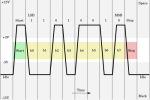
RS-232 noise is fixable. It usually stems from people not implementing it properly anymore (by design, slew rate should not exceed 30V/us, making the signal look like the image below, instead of straight edges), but shielding the RS-232 line should help a lot.
1782818585077.png

One thing where I slightly disagree with EI is shield grounding. While single-ended grounding is standard practice for audio applications to avoid ground loops and the audio noise they induce, for RF interference the shield should be grounded at both ends, otherwise the shield itself can still behave like an antenna. You can experiment and select the method that gives you the best results.
 
The turn coordinator is the same way but it is located on the opposite side of the panel while the ADF and CGR-30P are next to each other.
As noted in the email, perhaps disconnect the cable at the antenna and see how it affects the noise. Also, are you positive that antenna was properly grounded to the airframe at installation?
 
Damaged antique antenna / cable or poor quality installation would be my thoughts.

Its unimaginable the engine monitor manufacturer modified the product in any way for you because the CGR-30P is fully complaint with RTCA DO-160, the FAA EMI standard, and complies with several TSOs including TSO-C43c, TSO-C44c, TSO-C45b, TSO-C47a, TSO-C48a, TSO-C49b, and TSO-C55a.

I am curious of where you are obtaining the locations of the commercial broadcast antennas you intend to use for navigation. Even when FAA NDBs were supported, we weren’t using them for enroute navigation. That’s what VORs are for. You are at risk of an airspace incursion using an ADF as a back up in this fashion.

That might be today, but we used NDB navigation off the east coast from ILM to Virginia Key to get from JFK to MIA In a 727.
 
the CGR-30P is fully complaint with RTCA DO-160
DO-160 Categories 20 and 21 (conducted/radiated emissions) have different levels of compliance. I've seen stuff qualified to lesser levels still put out enough interference to cause issues.

While they do reference an enenvironmental qualification form in their install manual, I couldn't find it anywhere. Could well be that they tested to a lesser spec.
That tracks with a quick google of that spec, that emissions aren't specified at all below 100 MHz. I think that's a European aviation spec, again from Google, but I believe current FCC specs are similar. They just ignore the lower frequency emissions, perhaps partly because "nobody cares" but I'd guess equally likely because of manufacturer pushback. It's more difficult to design things properly, and I'd characterize things that operate as unintentional transmitters in the HF bands as not designed properly.

We ran into a sortof similar problem locally a few years ago, where local fire departments still running VHF low band, 50 MHz or so, were finding their radios and pagers completely unusable in some areas because of random RF interference saturating part of their band. That, from what I've seen, is more unusual, because you have to almost be some sort of combination of clever and clueless to design a system that passes the VHF high band tests but fails low band at just half the frequency or so.
 
Here’s a list of the high powered 50kW stations across the nation:
https://en.wikipedia.org/wiki/LiList_of_50_kW_AM_radio_stations_in_the_United_States
I just spent some time looking over the 50kW AM radio list. It is pretty comprehensive. Looking at the list now is a bit premature since my ADF is not usable yet, but thank you for the list. I know where to find it when the time comes.

I have asked a young aviation mechanic to look at my airplane. His name is Joel and he owns an older Mooney C that he bought out of annual after years not flying. He has brought it back to airworthiness and flies it regularly now. He works for a firm near CHO and is possibly interested in helping me. He did the last VFR transponder check on my bird so he is familiar with it. I have shared this thread with him and invited him to have a look or join POA. I am hoping that he takes an interest in this and possibly reaches out to some of you as he researches my problem. I think this is a good community and am proud to be associated with it. Thank you all.

I'll keep you posted. Pete
 
I personally think the FAA's decision to abandon NDB's is short sighted, but most people would just say I am a dinosaur. Perhaps they are correct.
Fellow dinosaur here....you are not alone.

I see beauty in the simplicity of the NDB system. The only hard parts of using it back in the day as I recall, were
a) the mental gymnastics required when shooting approaches to airports with off-field NDB's...especially ones that were offset from the final approach course
2) the mental gymnastics required to triangulate a position from multiple NDB's using a single receiver and all while trying to aviate in IMC with the examiner yelling at you and throwing distractions your way....

I've posted on this forum before how I see ADF as a possibly decent choice as a ground-based backup.
With modern electronics what they are
seems like it would be cheap and easy to have very small, low-powered NDB transmitters that are easy to install, easy to maintain, and very low demand. You could put them at any/every airport
Seems like it would be easy and low-cost with modern electronics to bake an ADF receiver into navcom units, or to have very small stand-alone receivers. Seems like these could even be automated using database information to do a lot of the triangulation for you.

And if there were enough of these low-powered NDBs around, a pilot would never be very far from an on-field beacon to very easily navigate to.
 
We had one in ours (don't know if the flight school that owns it now kept it).
We tuned in to 700 WLW Cincinnati; one thing to note is that the broadcast site is more than 15 NM from the city! We knew the area, so no problem, and we'd not be using it in IMC.
Most of the other stations were closer to their nameplate city.
Denver's KOA tower is within the KAPA Class D footprint just about 5 NM from the center of the airport. (It was just outside the Class D when I was based there). KOA is one of those super stations and we used to use it to fly home from the ABQ/SAF area, about 250 NM away, listening to Broncos games.
 
Someone keeps playing the Stones, Frampton, and Billy Joel on my ADF... .
 
Fellow dinosaur here....you are not alone.

I see beauty in the simplicity of the NDB system. The only hard parts of using it back in the day as I recall, were
a) the mental gymnastics required when shooting approaches to airports with off-field NDB's...especially ones that were offset from the final approach course
2) the mental gymnastics required to triangulate a position from multiple NDB's using a single receiver and all while trying to aviate in IMC with the examiner yelling at you and throwing distractions your way....

I've posted on this forum before how I see ADF as a possibly decent choice as a ground-based backup.
With modern electronics what they are
seems like it would be cheap and easy to have very small, low-powered NDB transmitters that are easy to install, easy to maintain, and very low demand. You could put them at any/every airport
Seems like it would be easy and low-cost with modern electronics to bake an ADF receiver into navcom units, or to have very small stand-alone receivers. Seems like these could even be automated using database information to do a lot of the triangulation for you.

And if there were enough of these low-powered NDBs around, a pilot would never be very far from an on-field beacon to very easily navigate to.
Today with all the antennas sticking up no way. Now VOR Rnav with station nearby yes.
But vor’s are extremely expensive to maintain and test too. Loved my KNS 80.
 
Today with all the antennas sticking up no way. Now VOR Rnav with station nearby yes.
But vor’s are extremely expensive to maintain and test too. Loved my KNS 80.
do you mean adding the transmit antennas would be a problem?


this is just stupid/pointless far-fetched what-if-ing, but
I was thinking low-power, short-range stations...basically strong enough for an approach, maybe a 20-mile or so range...so very small/low antennas is what I was thinking....cheap and easy. I think that would put the antenna maybe <20ft AGL for line-of-sight 20-mile reception at 1,000ft AGL??

Anyway, I reckon that if there was something like that at most airports of any significance, then a low-level pilot could hop from airport to airport across much of the country and never be far from receiving a signal and figuring out where they are. Get a little more altitude and they could probably receive multiple NDBs for some sort of automated triangulation if the box was smart enough.

I'm not a radio guy so I could be all wet on capabilities and requirements.....maybe it would have to switch to vhf or some other band for such a short antenna to work...and maybe this "new" signal could be digital so that location and identifying info could be piggybacked. On that note, a more elegant solution would probably be something similar to this idea but installed on cellular antennas...completely digital data transmission
but
I appreciated the simplicity of analog NDB's
 
Get a little more altitude and they could probably receive multiple NDBs for some sort of automated triangulation if the box was smart enough.
Easier and cheaper to install a DME. While VORs are being decomissioned, DMEs seem to be left behind.
DME-DME RNAV is already well-established and (relatively) easy to implement.
 
These days, direction finding would probably be easier to do via commercial FM stations. They're all over the place, they're high power, line of sight, constant carrier signals and the antennas are usually on the high ground in hilly areas. The whole country might not have complete coverage everywhere, but I'd bet of the Mississippi does from 1000' up.

@William Pete Hodges - for your tech, another possibility, there could be noise somewhere in a higher band than ADF is listening to that it's still susceptible to, in terms of front end overload of the receiver. If you or he can track down a ham, maybe one has some form of spectrum analyzer and they can take a look at what the various systems in your aircraft are doing, in terms of making electrical noise, one by one. Wish you the best!
 
Back in the day, there was a little brown book called Flight Guide (as I recall). It had all the necessary info for every airport including the local AM radio stations and there bearing either To or From the airport. So if you were having Navigation problems enroute, you could look up Airports in front of you (or behind) and find a station to dial in to use your ADF.

I used it more to listen to on the long XC flights, but nice to know I could have used it to get close to an Airport if necessary.
 
Easier and cheaper to install a DME. While VORs are being decomissioned, DMEs seem to be left behind.
DME-DME RNAV is already well-established and (relatively) easy to implement.
What does the transmitter and antenna look like for a stand-alone ground-based DME?
Is it small, cheap, and simple?
I used to use it a lot, but I remember nothing about the technology behind it. Pretty much just always thought of it being part of a big cone-head VOR station
 
Back
Top