Visual Approaches

Flying_Goat

Filing Flight Plan
Joined
Oct 8, 2025
Messages
15
Display Name
Flying_Goat
Newly rated instrument pilot flying my first IFR flight plan in the wild today. I felt well ahead of the plane and was mentally primed for RNAV approach. Instead I was cleared for the visual and it quickly dawned on me that I didn't cover this at all in my training or checkride. A few questions:

1. Does getting the visual basically clear me direct from my current position and altitude to the touchdown zone? In this case I'm thinking I would load the visual approach, go D-> V3NM, and descend at my discretion.

2. If I already have an IAP loaded is there any reason I couldn't/wouldn't/shouldn't just fly it anyway? Or give myself my own vectors to final? Are they expecting me to point the plane toward the field immediately?

3. If I'm already at an IF when I get cleared visual, which is what happened today, how would I fly that any differently than just flying the approach? I ended up just flying the RNAV as I couldn't think of any reason to fly the approach differently.
 
It is likely the controller is giving you a visual approach to relieve themselves of ifr separation requirements. They will probably not care if you continue the instrument approach. Though if this is dramatically different than the path you would fly visually, you need to confirm your intentions with the controller.
 
Newly rated instrument pilot flying my first IFR flight plan in the wild today. I felt well ahead of the plane and was mentally primed for RNAV approach. Instead I was cleared for the visual and it quickly dawned on me that I didn't cover this at all in my training or checkride. A few questions:

1. Does getting the visual basically clear me direct from my current position and altitude to the touchdown zone? In this case I'm thinking I would load the visual approach, go D-> V3NM, and descend at my discretion.

2. If I already have an IAP loaded is there any reason I couldn't/wouldn't/shouldn't just fly it anyway? Or give myself my own vectors to final? Are they expecting me to point the plane toward the field immediately?

3. If I'm already at an IF when I get cleared visual, which is what happened today, how would I fly that any differently than just flying the approach? I ended up just flying the RNAV as I couldn't think of any reason to fly the approach differently.
1. No
2. Third sentence, no. Second sentence, that’s fine. First sentence, depends, are you presently so far off to the side and so far out, that it would be ridiculous.
3. See 2.
 
It is likely the controller is giving you a visual approach to relieve themselves of ifr separation requirements. They will probably not care if you continue the instrument approach. Though if this is dramatically different than the path you would fly visually, you need to confirm your intentions with the controller.
Yup.
 
didn't cover this at all in my training or checkride
I'd be surprised if it wasn't covered in your training, at least once. So a couple of notes, but go read up on it (not that it's all that complicated).

- You won't get the Visual unless the Wx is basically VMC from your position to the airport. But you must still keep clear of the clouds and keep the Airport in sight. (It's not a Contact Approach.)
- YOU ARE RESPONICBLE FOR TRAFFIC AVOIDANCE! One of the reasons ATC likes the visual is that it lets them move on to other aircraft and they don't need to call out traffic for you.
- If it is a Towered Airport, go ahead and setup for a Straight In, unless the Twr tells you to do something else.
- If a Non Towered Airport, you can start to set up for a Straight In, but remember you have NO priority over people in the pattern. So if your Straight In affects their flight, you need to go join the Pattern.
- Like any Approach Clearance, you still need either a Twr Landing Clearance or to Self Announce and coordinate with the traffic at a Non Towered Apt.

Basically just a way to simplify things for both you and the Controller.

Check these out:
https://www.boldmethod.com/learn-to-fly/navigation/how-to-transition-and-land-from-a-visual-approach-through-touchdown/
https://www.boldmethod.com/learn-to-fly/regulations/go-around-from-visual-approach-and-contact-atc/
https://www.boldmethod.com/learn-to-fly/safety/how-to-fly-visual-approaches-at-night-sa/
 
I've been given visual approaches from some really awkward angles, where upon receiving the approach clearance, I've had to turn away from the airport first, e.g. to fly downwind farther.
 
It is likely the controller is giving you a visual approach to relieve themselves of ifr separation requirements. They will probably not care if you continue the instrument approach. Though if this is dramatically different than the path you would fly visually, you need to confirm your intentions with the controller.
They are not relieved of IFR separation requirements.
 
You won't get the Visual unless the Wx is basically VMC from your position to the airport
In theory yes, but ATC doesn't know for sure that it's VMC. You can always refuse the visual and ask for an instrument approach. I've had to use "unable visual" a few times when there are clouds between me and the runway that weren't there when the last plane accepted the visual.
 
Except that you don’t need to maintain full VFR cloud clearances, treat it like a student pilot on a solo cross country. Just normal maneuvering to the runway from your current position unless instructed otherwise.

Instrument: where we try to complicate the simple.
 
Except that you don’t need to maintain VFR cloud clearances
I guess this got skipped in my IR training. So as a hypothetical, if there's a low cumulus cloud between you and the runway and you get "cleared for the visual", I can fly around it without worrying about 5,1,2? Could I also go through it?
 
I guess this got skipped in my IR training. So as a hypothetical, if there's a low cumulus cloud between you and the runway and you get "cleared for the visual", I can fly around it without worrying about 5,1,2? Could I also go through it?
Visual approaches get skipped regularly in IR training. Basically they don’t count. You’ll never get one on a checkride. It doesn’t count as an approach on the dual cross country. It doesn’t really count as “instrument training.”

So, have a good read of AIM 5-4-23. Here’s how it starts.

5–4–23 ​

a. A visual approach is conducted on an IFR flight plan and authorizes a pilot to proceed visually and clear of clouds to the airport. The pilot must have either the airport or the preceding identified aircraft in sight.​
 
Last edited:
Thanks for the responses. I understand the overall idea of visual approaches and I'm familiar with what the AIM says. I've received plenty of straight in clearances to land VFR, so the concept is not foreign or unheard of for me. I'm really trying to capture visual approach nuances as they apply to IFR clearances:

- How does this change/amend my lateral and vertical clearance? Is it pretty much "own navigation" to the pavement? From a lateral clearance perspective, is it current position direct threshold? From a vertical clearance perspective, I gather it's pilot responsibility for obstacle avoidance.

- Again, if you find yourself already on, or near, the final approach course when you are cleared visual, how does that change the way you will fly the approach? In other words, if I already have an IAP loaded, how/why would I fly it any differently if given the visual?
You're overthinking it, like most do when visuals are first introduced, because in training we're in this rigid environment of courses and altitudes.

Basically, once you report the airport in sight, and are then cleared for the visual, you can do whatever you want, within reason, to proceed to the runway. Unless ATC gives some alternate direction. So, you want to head straight to the threshold, okay. You're on downwind and want to make a single turn to final, okay.

What you can't do is anything unexpected. Don't make a 360 to lose altitude (without telling anybody).

Just do normal maneuvers to set up for final and you'll be fine.

And yes, if you're already straight-in, for example on an RNAV approach, then it doesn't make any difference whether you continue the approach or just fly visual. Nobody will know or care. In fact, many operators will require that visuals be "backed up" by the RNAV or ILS, which means essentially just flying it anyway.
 
Thanks for the responses. I understand the overall idea of visual approaches and I'm familiar with what the AIM says. I've received plenty of straight in clearances to land VFR, so the concept is not foreign or unheard of for me. I'm really trying to capture visual approach nuances as they apply to IFR clearances:

- How does this change/amend my lateral and vertical clearance? Is it pretty much "own navigation" to the pavement? From a lateral clearance perspective, is it current position direct threshold? From a vertical clearance perspective, I gather it's pilot responsibility for obstacle avoidance.

- Again, if you find yourself already on, or near, the final approach course when you are cleared visual, how does that change the way you will fly the approach? In other words, if I already have an IAP loaded, how/why would I fly it any differently if given the visual?
As opposed to doing what? A couple of chandelles? Perhaps fly away from the airport to make a coupe of extra turns before returning to where you already were? I'm trying to picture what you are visualizing.

I'll repeat:
treat it like a student pilot on a solo cross country. Just normal maneuvering to the runway from your current position unless instructed otherwise.
And yes, although without the words "cleared visual approach," I sort of got one on my long student solo cross country into a Class C primary.

Approach Report the 737 in sight.
Me: 727 in sight.
Approach: Follow the 37. Contact Tower.

It's really not any more complicated than that. There really aren't any "nuances" to overthink about.
 
It is likely the controller is giving you a visual approach to relieve themselves of ifr separation requirements. They will probably not care if you continue the instrument approach. Though if this is dramatically different than the path you would fly visually, you need to confirm your intentions with the controller.
ATC is still providing traffic and IFR sep until visual separation is applied. There’s less work in that the clearance is easier but a visual can still tie up a non towered field because you can’t clear anyone in or out until they cancel.
 
As a new instrument pilot, I'd recommend references what the FARs, AIM, Instrument Flying Handbook, and Instrument Procedures Handbook have to say about airport operations and visual approaches. Those are also good references to check when other questions come up as you gain experience operating under IFR.

Do you know where the Instrument Flight Rules (IFR) are found? Don't throw those on a shelf just because you have your rating. Use them regularly as a reference.
 
I guess this got skipped in my IR training. So as a hypothetical, if there's a low cumulus cloud between you and the runway and you get "cleared for the visual", I can fly around it without worrying about 5,1,2? Could I also go through it?
Yes on a visual you can fly around clouds without having to maintain the separation. What you can't do is fly through a cloud.
While normally you will be cleared for a Visual if you have the airport in sight you can also be cleared for a Visual without seeing the airport. That will happen if you report seeing traffic that is going to that airport. You will be told cleared the Visual and follow the traffic. One thing to remember is at no time do you have to accept a Visual Approach and once accepted you can't go missed back into IMC.
If atis is reporting visual approaches ask for instrument approach early if you want it.
 

Thanks for the responses. I understand the overall idea of visual approaches and I'm familiar with what the AIM says. I've received plenty of straight in clearances to land VFR, so the concept is not foreign or unheard of for me. I'm really trying to capture visual approach nuances as they apply to IFR clearances:

- How does this change/amend my lateral and vertical clearance? Is it pretty much "own navigation" to the pavement? From a lateral clearance perspective, is it current position direct threshold? From a vertical clearance perspective, I gather it's pilot responsibility for obstacle avoidance.

- Again, if you find yourself already on, or near, the final approach course when you are cleared visual, how does that change the way you will fly the approach? In other words, if I already have an IAP loaded, how/why would I fly it any differently if given the visual?
Obstacle avoidance is pilots responsibility. You are expected to maneuver to a straight in to the runway or to follow another plane if that’s what the clearance said. You are not expected to continue flying away from the airport if that’s the direction you were going, like on a downwind. You are not expected to fly direct to threshold and cross it in a bank. A reasonable turn to final. Using
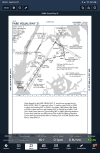
Localizers, Radials and RNAV Approaches to assist is just fine. It is not all that uncommon for ATC to clear a plane direct to a Fix on final to have them turn final farther out than usual to achieve spacing. They know that many pilots have Approaches loaded. I think many airlines require their pilots to have an Approach to the runway loaded. There are Charted Visual Approaches. Some of them include the above.

1792601979159.png
 
If atis is reporting visual approaches ask for instrument approach early if you want it.
Agreed. Expanding on what you said, there are a few more pieces to this.
1. If you want anything other than advertised on the ATIS , ask for it early. That doesn't just apply to asking for an IAP when they advertise the visual. It also applies if ATIS advertises the ILS and you want the RNAV.​
2. The same applies to an "expect" from a controller, whether the airport is towered or non-towered. It may be different than the ATIS. That's not unusual when it's a multi-runway Class C or B. They'll often use a different runway for light GA traffic.​
3. Going into a nontowered airport and you plan to cancel IFR? Don't wait for Approach to go through the "report in sight"..."in sight"..."cleared visual approach"..."cancel IFR" dentistry.​
​
 
You are expected to maneuver to a straight in to the runway... You are not expected to continue flying away from the airport... You are not expected to fly direct to threshold and cross it in a bank.
I'm not sure where those expectations come from. To paraphrase the AIM, you should proceed to the airport in a normal manner or follow the preceding aircraft; establish a safe landing interval behind the aircraft you were instructed to follow; and maintain wake turbulence separation. If "normal manner" has to be defined for us by the time we hold an instrument rating, we probably shouldn't be flying at all.
 
I'm not sure where those expectations come from. To paraphrase the AIM, you should proceed to the airport in a normal manner or follow the preceding aircraft; establish a safe landing interval behind the aircraft you were instructed to follow; and maintain wake turbulence separation. If "normal manner" has to be defined for us by the time we hold an instrument rating, we probably shouldn't be flying at all.
The expectations come from Controllers. Is it in print somewhere? Not that I’ve seen, but that does not change the fact. Spend some time looking at flows of traffic on Flight Aware and similar Apps. You’ll see the results that bear this out. I was a Controller and have given hundreds, probably thousands of Visual Approaches and seen many more.
 
The expectations come from Controllers. Is it in print somewhere? Not that I’ve seen, but that does not change the fact. Spend some time looking at flows of traffic on Flight Aware and similar Apps. You’ll see the results that bear this out. I was a Controller and have given hundreds, probably thousands of Visual Approaches and seen many more.
Maybe. I can buy "the most expeditious safe path to the runway," which to me means the same as the AIM's "proceed to the airport in a normal manner." But not "straight in to the runway." regardless of the aircraft's position. Unless it's obvious from my location when cleared - I'm on extended final, I'm in position to tun right base - I've typically received an instruction, if not from Approach, then from Tower. I'm having trouble picturing being abeam thge numbers for runway 18 and being expected to go "straight into the runway" to land on 36. I'm guessing that doing the FlightAware bit along with Live ATC would bear that out.
 
Visual approaches get skipped regularly in IR training. Basically they don’t count. You’ll never get one on a checkride. It doesn’t count as an approach on the dual cross country. It doesn’t really count as “instrument training.”

So, have a good read of AIM 5-4-23. Here’s how it starts.

5–4–23 ​

a. A visual approach is conducted on an IFR flight plan and authorizes a pilot to proceed visually and clear of clouds to the airport. The pilot must have either the airport or the preceding identified aircraft in sight.​
...and don't forget 5-5-11 which discusses pilot and controller responsibilities.
 
As opposed to doing what? A couple of chandelles? Perhaps fly away from the airport to make a coupe of extra turns before returning to where you already were? I'm trying to picture what you are visualizing.
Sure, I'l throw in a couple not-all-inclusive examples since you can't visualize it. Maybe I'm several miles out on a T-leg of an RNAV approach and I can turn in to the field or continue on the published approach path. Maybe I'm on a vectored downwind and pointed away from the field. Maybe I'm with a safety pilot for instrument currency and I want to fly the published approach path.

Perhaps I've articulated the question poorly. I understand my portion of doing a visual approach and how to get an airplane to a runway. Maybe the more accurate question is: what is tower/approach expecting to see when they issue the visual? Surely they issue it for some reason of timing or separation, so I'm trying to mentally map my range of options in this scenario.
 
The expectations come from Controllers. Is it in print somewhere? Not that I’ve seen, but that does not change the fact. Spend some time looking at flows of traffic on Flight Aware and similar Apps. You’ll see the results that bear this out. I was a Controller and have given hundreds, probably thousands of Visual Approaches and seen many more.
It's always interesting to get a controller's perspective. No, it's not in print anywhere except post #21. If I were a controller, I would limit my expectations to the guidance that pilots are given in AIM 5-5-11. Visual Approach. As a pilot who has flown hundreds, and probably thousands, of visual approaches, at airports nationwide and in certain foreign countries in which visuals are authorized and practiced, I would remind controllers of this fact: while they know their little slice of the universe better than the backs of their hands, many pilots operating within their airspace (or groundspace) may be completely unfamiliar. Therefore, controllers should adjust their expectations accordingly. When you, as a controller, clear me for a visual approach, I have no way of knowing what your expectations are. My primary focus is maintaining situational awareness, keeping traffic and the runway in sight, and maneuvering as necessary to make a normal approach and landing. Captain Obvious might point out that anything else merits a negotiated solution between pilot and controller.
 
Last edited:
What you can't do is anything unexpected. Don't make a 360 to lose altitude (without telling anybody).

As an example, two or three decades ago, I flew IFR to Camarillo from the north in night VFR conditions. The route I had planned and was given took me overhead the field at 5,000 MSL, IIRC. I saw the airport below me, so I asked for and was granted a visual approach. Since I couldn't see the surrounding mountains, I spiraled down overhead the field and made a downwind entry. When I landed the controller asked me to call him on the phone. I did so, and explained my concerns about terrain clearance. The conclusion of the conversation was that I should have told him what I was planning to do. At the time, it didn't occur to me to ask him what flight path he was expecting to see. Later, I came to the conclusion that for night flights to that destination, it would be more efficient, whether VFR or IFR, to plan my route to pass through an IAF, thus making terrain avoidance a simple matter of following the charted route.

Recently, I finally figured out, after all these years, that I had probably spiraled down through the final approach course for Oxnard!

 
Last edited:
Visual approaches get skipped regularly in IR training. Basically they don’t count. You’ll never get one on a checkride. It doesn’t count as an approach on the dual cross country. It doesn’t really count as “instrument training.”

So, have a good read of AIM 5-4-23. Here’s how it starts.

5–4–23 ​

a. A visual approach is conducted on an IFR flight plan and authorizes a pilot to proceed visually and clear of clouds to the airport. The pilot must have either the airport or the preceding identified aircraft in sight.​
They get skipped by the “I use the ACS as a syllabus” crowd, but the applicant must have logged #3.

(c) Flight proficiency. A person who applies for an instrument ratingmust receive and log training from an authorized instructor in an aircraft, or in a full flight simulator or flight training device, in accordance with paragraph (g) of this section, that includes the following areas of operation:

(1) Preflight preparation;

(2) Preflight procedures;

(3) Air traffic control clearances and procedures;

The visual is an ATC clearance and IFR procedure and an AIM Section required to be covered in a ground class or self study in 61.65(b)(2).

The OP is lucky he did fail the practical under Area of Operation III: Air Traffic Control (ATC) Clearances and Procedures
 
Last edited:
They get skipped by the “I use the ACS as a syllabus” crowd, but the applicant must have logged #3.

(c) Flight proficiency. A person who applies for an instrument ratingmust receive and log training from an authorized instructor in an aircraft, or in a full flight simulator or flight training device, in accordance with paragraph (g) of this section, that includes the following areas of operation:

(1) Preflight preparation;

(2) Preflight procedures;

(3) Air traffic control clearances and procedures;

The visual is an ATC clearance and IFR procedure and an AIM Section required to be covered in a ground class or self study in 61.65(b)(2).
I think visual approaches get skipped by far more than that crowd. And, based on the questions I see from already-rated plots, both old and new, I feel very comfortable saying that the visual approach is not the only "Air traffic control clearances and procedures" that only gets mentioned in passing or not at all.
 
I think visual approaches get skipped by far more than that crowd. And, based on the questions I see from already-rated plots, both old and new, I feel very comfortable saying that the visual approach is not the only "Air traffic control clearances and procedures" that only gets mentioned in passing or not at all.
I agree. What’s sad is executing a visual is one of the most used IFR procedures.
 
They get skipped by the “I use the ACS as a syllabus” crowd, but the applicant must have logged #3.

(c) Flight proficiency. A person who applies for an instrument ratingmust receive and log training from an authorized instructor in an aircraft, or in a full flight simulator or flight training device, in accordance with paragraph (g) of this section, that includes the following areas of operation:

(1) Preflight preparation;

(2) Preflight procedures;

(3) Air traffic control clearances and procedures;

The visual is an ATC clearance and IFR procedure and an AIM Section required to be covered in a ground class or self study in 61.65(b)(2).

The OP is lucky he did fail the practical under Area of Operation III: Air Traffic Control (ATC) Clearances and Procedures
Hey man, you don't have to be like this about it. Yes, I'm sure it was covered in ground training and in conversation with my CFII. It certainly was not a thing that we practiced from various positions in the airspace with high traffic density.

It's just a question that came up in my mind when I had an IAP loaded, I was at the IAF, and was given the visual. I was asking myself why I shouldn't just fly the approach as published, which is what I did uneventfully.
 
I guess this got skipped in my IR training. So as a hypothetical, if there's a low cumulus cloud between you and the runway and you get "cleared for the visual", I can fly around it without worrying about 5,1,2? Could I also go through it?
You are still "IFR" unless you cancelled for some reason when they gave you the Visual Approach. So yes, you just need to not go into the clouds if you were "Cleared for the Visual Approach." But "VFR" cloud separation is not a concern since you're still IFR.

Similar to a Contact Approach, but with the Visual, you must see the Airport, not just the ground or the aircraft in front of you.
 
Maybe I'm several miles out on a T-leg of an RNAV approach and I can turn in to the field or continue on the published approach path. Maybe I'm on a vectored downwind and pointed away from the field. Maybe I'm with a safety pilot for instrument currency and I want to fly the published approach path.
You can do either. One is not more expected than the other. If the controller wanted to restrict your flight path, then they wouldn't have given you a visual approach. That said, doing something unusual such as overflying the airport or flying away from it for 20 miles would not be prudent.
 
The funny to me is that, while visual approaches are not on the instrument rating checkride, they are on every one of my Part 135 initial and recurrent checkrides in the sim. They usually get combined with a flaps failure and a PAPI failure for some reason, but they are a checkride item every time.
 
Sure, I'l throw in a couple not-all-inclusive examples since you can't visualize it. Maybe I'm several miles out on a T-leg of an RNAV approach and I can turn in to the field or continue on the published approach path. Maybe I'm on a vectored downwind and pointed away from the field. Maybe I'm with a safety pilot for instrument currency and I want to fly the published approach path.

Perhaps I've articulated the question poorly. I understand my portion of doing a visual approach and how to get an airplane to a runway. Maybe the more accurate question is: what is tower/approach expecting to see when they issue the visual? Surely they issue it for some reason of timing or separation, so I'm trying to mentally map my range of options in this scenario.
Proceed to the runway in a normal matter based on where you are. Why is that confusing? On the T? You are now visual. Turn toward the runway in a way that gives you enough time to configure for a normal landing. No need for an 8 mile base leg. Why complicate it?
 
Proceed to the runway in a normal matter based on where you are. Why is that confusing? On the T? You are now visual. Turn toward the runway in a way that gives you enough time to configure for a normal landing. No need for an 8 mile base leg. Why complicate it?
Who said anything about being confused? Who said anything about complicating it? The question is what tower/approach expecting to see so that I may fly predictably in the context of other IFR and VFR traffic out there.
 
Back
Top