The NTSB does in fact do a pretty good job, I was referring to the Database of “Those that are here to help us” How many people rush to provide those folks with the most updated data on a homebuilt? There are a few that build fly and don’t even have a pilots license.Then you're going to have to point me at a better source of data. BTW, "data" is not the plural of "anecdote."
My data source is the National Transportation Safety Board.
Now, there are some folks on this board that have pointed out problems with NTSB investigations they've been involved in (the Other Ron, for one). But whatever flaws there are in the NTSB's process, it still beats using a company's marketing department as the source of information.
Ron Wanttaja

You are using an out of date browser. It may not display this or other websites correctly.
You should upgrade or use an alternative browser.
You should upgrade or use an alternative browser.
Viking 130 engine failure at 1150 hours
- Thread starter MarkH
- Start date
With this getting to the “I know you are, what am I” level. I’m done defending my statement that Viking has almost 500 videos on YouTube. (Within these videos are “how to’s” “testing” “customer installs” and “many, many more than just the 3 “customer flying” videos I provided. If you don’t want to learn about a great product and just want to continue to take things out of context, feel free post on my deaf ears.@Capt321 I refer you to my first Post Script, 'Found the post. You initially refused to provide... a single flying example. I called that out. After that, you provided three flying examples.'
Attachments

MauleSkinner
Touchdown! Greaser!
I think I speak for many when I say,I’m done defending my statement
THANK YOU!!!!

I don’t actually know if my statement of “most” is correct or not. However the folks I know that have bought recently have all not been Hondas. And furthermore I struggle to understand why the animosity about it. Seriously in the context of my post, why does it matter? Not all Vikings are Hondas. Which is what I was attempting to bring up to Ron.Also not true…. are these Ron’s Wantadatabase facts derived from poor sources of information or just something you heard?

wanttaja
Final Approach
- Joined
- Jun 7, 2008
- Messages
- 5,667
- Location
- "War-Torn" Portland
- Display Name
- Ron Wanttaja
- Home Airfield
- Twin Oaks Airpark
Forgot to mention my other data source: The FAA aircraft registry:My data source is the National Transportation Safety Board.
Did take another look, and found that some people were registering their aircraft with "Honda" as the engine manufacturer and Viking as the model. Modified my Access query to look for "*VIK*" in either the engine manufacturer or model columns, and got another ~15 aircraft. Active total rises to 184.
I also ran a similar search in the Deregistered aircraft list, and found twenty aircraft that had been removed from the registry. The registry provides little information...the aircraft were deregistered because they crashed, the owner disassembled them due to safety or liability concerns, they were exported to another country, or the owner just didn't respond to the FAA's re-registration request.
I've attached PDFs with both the Active and Deregistered aircraft.
I'd previously posted a summary of Viking-engined aircraft accidents where the engine had failed.
Ron Wanttaja
Attachments
wanttaja
Final Approach
- Joined
- Jun 7, 2008
- Messages
- 5,667
- Location
- "War-Torn" Portland
- Display Name
- Ron Wanttaja
- Home Airfield
- Twin Oaks Airpark
And if you note, I did acknowledge that (post 103). Ultimately, it was just a labeling error. Didn't change the accident data, since I was already accessing Viking engines regardless as to whether the FAA or NTSB included the word "Honda" in the engine column. As I mentioned in my last post, searching the FAA registry for "Viking" engines turned out to be insufficient because some owners didn't list it as the engine manufacturer, so I picked up another ~20 Viking-powered aircraft in the registry. Still fewer than 200. Still fewer than 500. Still fewer than 1500.Not all Vikings are Hondas. Which is what I was attempting to bring up to Ron.
Ron Wanttaja
wanttaja
Final Approach
- Joined
- Jun 7, 2008
- Messages
- 5,667
- Location
- "War-Torn" Portland
- Display Name
- Ron Wanttaja
- Home Airfield
- Twin Oaks Airpark
Databases are organized collections of information. Collections, not just a few random anecdotes. If you've got a database of flying Viking-powered aircraft, post it. I have.The NTSB does in fact do a pretty good job, I was referring to the Database of “Those that are here to help us” How many people rush to provide those folks with the most updated data on a homebuilt? There are a few that build fly and don’t even have a pilots license.
Ron Wanttaja

Half Fast
Touchdown! Greaser!
- Joined
- May 7, 2016
- Messages
- 21,190
- Location
- Central Florida
- Display Name
- Half Fast
- Home Airfield
- KGIF


wanttaja
Final Approach
- Joined
- Jun 7, 2008
- Messages
- 5,667
- Location
- "War-Torn" Portland
- Display Name
- Ron Wanttaja
- Home Airfield
- Twin Oaks Airpark

Ron Wanttaja
wanttaja
Final Approach
- Joined
- Jun 7, 2008
- Messages
- 5,667
- Location
- "War-Torn" Portland
- Display Name
- Ron Wanttaja
- Home Airfield
- Twin Oaks Airpark
"Oh, sorry, is this a five minute argument or the full half-hour?"
Ron "No it isn't" Wanttaja
Ron "No it isn't" Wanttaja

- Joined
- Jun 13, 2008
- Messages
- 9,173
- Location
- Marietta, GA
- Display Name
- Drake the Outlaw
- Home Airfield
- Cartersville, GA
You're not arguing. You're just disagreeing."Oh, sorry, is this a five minute argument or the full half-hour?"
Ron "No it isn't" Wanttaja
No he’s not.You're not arguing. You're just disagreeing.
moparrob66
Pre-takeoff checklist
- Joined
- Mar 31, 2024
- Messages
- 491
- Display Name
- Moparrob
- Home Airfield
- S75
Four pages in, I'd consider a Viking but I'm surprised nobody has mentioned Veloce Planes and their Aerovolare engine. Not a bad idea, but their marketing does not inspire confidence in anything they claim. Theryre charging $30k for a $6k engine, $6k psru and no prop or engine mount so maybe their target market is people who cant do any internet research?

tsts4
En-Route
That’s because most builders want kit manufacturer supported FWF solutions that have verifiable track records of performance, reliability, and support. The community is littered with dozens of engine manufacturers/builders, some of which are good, but most are either vapor ware or have some significant issue or issues and never have gained mainstream acceptance. Auto conversions on the whole remains a niche segment.Four pages in, I'd consider a Viking but I'm surprised nobody has mentioned Veloce Planes and their Aerovolare engine. Not a bad idea, but their marketing does not inspire confidence in anything they claim. Theryre charging $30k for a $6k engine, $6k psru and no prop or engine mount so maybe their target market is people who cant do any internet research?

Cap'n Jack
Final Approach
JOOC, do auto-conversions need preheat when it is very cold outside? After all the original car engine didn't.
wanttaja
Final Approach
- Joined
- Jun 7, 2008
- Messages
- 5,667
- Location
- "War-Torn" Portland
- Display Name
- Ron Wanttaja
- Home Airfield
- Twin Oaks Airpark
In places where it *truly* gets cold, a lot of cars have block heaters. The one in my old Willys replaced one of the head bolts.JOOC, do auto-conversions need preheat when it is very cold outside? After all the original car engine didn't.
In those areas, you'll see outlets on short poles so you can plug your car in.
My air-cooled VW didn't need one....
Ron Wanttaja

Daleandee
Final Approach
- Joined
- Mar 4, 2020
- Messages
- 8,354
- Display Name
- Dale Andee
My air-cooled VW didn't need one....
I own a '74 Beetle. Here is one answer to the question @Cap'n Jack asked in post # 136 in regards to a VW ...
wanttaja
Final Approach
- Joined
- Jun 7, 2008
- Messages
- 5,667
- Location
- "War-Torn" Portland
- Display Name
- Ron Wanttaja
- Home Airfield
- Twin Oaks Airpark
If y'all don't mind an old fogey maundering a little bit....
I learned to fly in North Dakota; first solo on the 10 of December and passed my Private exam in October. So my very first flying year was FILLED with cold-weather experience. Transitioned to a Citabria right after solo. I know I flew in sub-zero weather then; it was either that, or not fly at all.

Oddly enough, I don't recall too many details about flying in a cold North Dakota winter. Probably because everything was just matter-of-fact. I recall phoning the FBO to have them put pre-heat on the airplane a half-hour before I showed up. I recall the agonizingly slow rotation of the prop with a cold starter. I recall how the Citabria's fabric had no insulating properties and the cold drafts shooting in.
It's what we had to do, flying in the winter back then.
The positive? The absolute sharpness of the air. No haze. Blue sky would meet snowy horizon in a razor-sharp line. You could trace roads and whatnot right to the edge of the sky, where they cut off abruptly.
Ron Wanttaja
I learned to fly in North Dakota; first solo on the 10 of December and passed my Private exam in October. So my very first flying year was FILLED with cold-weather experience. Transitioned to a Citabria right after solo. I know I flew in sub-zero weather then; it was either that, or not fly at all.
Oddly enough, I don't recall too many details about flying in a cold North Dakota winter. Probably because everything was just matter-of-fact. I recall phoning the FBO to have them put pre-heat on the airplane a half-hour before I showed up. I recall the agonizingly slow rotation of the prop with a cold starter. I recall how the Citabria's fabric had no insulating properties and the cold drafts shooting in.
It's what we had to do, flying in the winter back then.
The positive? The absolute sharpness of the air. No haze. Blue sky would meet snowy horizon in a razor-sharp line. You could trace roads and whatnot right to the edge of the sky, where they cut off abruptly.
Ron Wanttaja
Wow. This whole thread reminds me of the old viking forum where the owner would go on there pretending to be a friend or customer and try and convince people of how good the product was. This was back during the yahoo group days and before facebook really took off. The only difference seems to be that nobody is getting blocked or their posts deleted here. I will say that viking has survived as a company longer than I thought it would. I considered one for my sonex years ago but decided against it after I read about what happened with the subaru conversions. It may be a great engine but I just don't trust the owner due to his missteps in the past.
Daleandee
Final Approach
- Joined
- Mar 4, 2020
- Messages
- 8,354
- Display Name
- Dale Andee
Wow. This whole thread reminds me of the old viking forum where the owner would go on there pretending to be a friend or customer and try and convince people of how good the product was. This was back during the yahoo group days and before facebook really took off. The only difference seems to be that nobody is getting blocked or their posts deleted here. I will say that viking has survived as a company longer than I thought it would. I considered one for my sonex years ago but decided against it after I read about what happened with the subaru conversions. It may be a great engine but I just don't trust the owner due to his missteps in the past.
It does make one wonder ...

wanttaja
Final Approach
- Joined
- Jun 7, 2008
- Messages
- 5,667
- Location
- "War-Torn" Portland
- Display Name
- Ron Wanttaja
- Home Airfield
- Twin Oaks Airpark
Posted some pictures of a person (post #44), did not directly identify them as himself. A name is visible in one shot. That person lives in South Carolina and does own a Zenith CH-750 with a Viking 110 engine. So the picture could be of him. Or, of course, he's hiding behind Stephen's name. For now, let's assume it's him.I believe he posted pictures of himself up thread did he not?
The aircraft builder is listed as another person (aircraft listed as completed in 2013), so Apparently-Stephen likely had nothing to do with the installation of the engine. No fault there (I didn't build my homebuilt, either) but he probably has no experience actually installing a Viking engine.
Looks like Apparently-Stephen bought the airplane in 2022, the certificate shows November in that year. He had the N-Number changed the next year, looks like September. Same numerals, just the last two characters to match his last name.
But then, Apparently-Stephen says key word searches are worthless, so what do I know.....
Ron Wanttaja
Last edited:
wanttaja
Final Approach
- Joined
- Jun 7, 2008
- Messages
- 5,667
- Location
- "War-Torn" Portland
- Display Name
- Ron Wanttaja
- Home Airfield
- Twin Oaks Airpark
For those still keeping track, Cap might be Steven's son, Spencer. That seems to be the person in the picture Cap posted.Posted some pictures of a person (post #44), did not directly identify them as himself. A name is visible in one shot. That person lives in South Carolina and does own a Zenith CH-750 with a Viking 110 engine. So the picture could be of him. Or, of course, he's hiding behind Stephen's name. For now, let's assume it's him.
Also, the plane was upgraded to another Viking model ~18 months ago, so they would have some installation experience.
Ron Wanttaja
Cap'n Jack
Final Approach
Yeah- I saw those poles in Alaska. I was thinking about cold as seen generally in the lower 48 states.In places where it *truly* gets cold, a lot of cars have block heaters. The one in my old Willys replaced one of the head bolts.
In those areas, you'll see outlets on short poles so you can plug your car in.
My air-cooled VW didn't need one....
Ron Wanttaja
Perhaps my question was answered indirectly- you both showed the engine in a car didn't need pre-heat. I read the replies as "The engine didn't need pre-heat in a car so the same engine doesn't need it when placed on an airplane". Did I understand what you meant correctly?I own a '74 Beetle. Here is one answer to the question @Cap'n Jack asked in post # 136 in regards to a VW ...
Daleandee
Final Approach
- Joined
- Mar 4, 2020
- Messages
- 8,354
- Display Name
- Dale Andee
Perhaps my question was answered indirectly- you both showed the engine in a car didn't need pre-heat. I read the replies as "The engine didn't need pre-heat in a car so the same engine doesn't need it when placed on an airplane". Did I understand what you meant correctly?
I never meant to suggest that conversion engines don't need preheat but rather that auto engines (air cooled) were designed to work in cold temps quite well. Of course, just like aircraft engines there are ways to help the engine maintain heat when operating in the cold. These would include mixture, cowl flaps, oil cooler doors/covers, reducing the cowling inlet opening, etc.
wanttaja
Final Approach
- Joined
- Jun 7, 2008
- Messages
- 5,667
- Location
- "War-Torn" Portland
- Display Name
- Ron Wanttaja
- Home Airfield
- Twin Oaks Airpark
I had a Webinar today on homebuilt accident rates, as part of the EAA Homebuilt Week.
I had to laugh. When I got done, the FIRST question was about Viking.
I'll get you, Russell....
Ron "on the spot" Wanttaja
I had to laugh. When I got done, the FIRST question was about Viking.
I'll get you, Russell....
Ron "on the spot" Wanttaja

pfarber
Pattern Altitude
- Joined
- Jun 20, 2021
- Messages
- 1,653
- Display Name
- pfarber
three things:
first:
the original issue is the Viking engine was modified (lower octane and custom tune) and can in no way whatsoever be blamed on Viking. If someone were to run a certificated engine off of the wrong gas and tweaked the magneto timing out of spec no one would yell that lycoming is to blame.
So lets all agree that for OPs video, Viking is not the issue. Tinkering is.
Second, the NTSB database is a source of data, but it seems to be flawed. First, not all engine failures are going to be the subject to an NTSB report because not all engine failures will be reported. Also the NTSB is not under any obligation to issue a report on an accident (ie engine failure) if they don't think its necessary. IE bugsmasher 1234 pops a cylinder an lands without injury ain't gonna trigger an NTSB investigation. I am not sure if the incident is still included in stats. The NTSB web site seems to exclude single engine faulure without injury:
Substantial damage means damage or failure which adversely affects the structural strength, performance, or flight characteristics of the aircraft, and which would normally require major repair or replacement of the affected component. Engine failure or damage limited to an engine if only one engine fails or is damaged, bent fairings or cowling, dented skin, small punctured holes in the skin or fabric, ground damage to rotor or propeller blades, and damage to landing gear, wheels, tires, flaps, engine accessories, brakes, or wingtips are not considered “substantial damage” for the purpose of this part.
Third:
As I correctly stated in my previous post every car motor install is a one off and the quality of the install is directly related to the skill/wisodom of the installer. There are many SeaBees running LS1 motors for decades. https://www.seabee.info/seabee_engine_conversions.htm DO NOT click on v8seabee.com
Lastly, you have to admit that major failures of certificated engines are have been normalized as long as no one dies. Its just so common to have to replace a jug or two, or wipe a cam due to spalling or break a magneto (gee mags are so reliable that they must be instpected every 500 hours. so reliable! much safety!) that no one bats an eye... it's just the cost of owning an airplane lol

Dan Thomas
Touchdown! Greaser!
- Joined
- Jun 16, 2008
- Messages
- 12,389
- Display Name
- Dan Thomas
Just so common to have to replace jugs or cams or break a magneto.Lastly, you have to admit that major failures of certificated engines are have been normalized as long as no one dies. Its just so common to have to replace a jug or two, or wipe a cam due to spalling or break a magneto (gee mags are so reliable that they must be instpected every 500 hours. so reliable! much safety!) that no one bats an eye... it's just the cost of owning an airplane lol
Still on that OWT stuff, I see. In my years as a mechanic I seldom ever had to touch a cylinder. Never had to replace a cam, never had to send an engine out for a new cam. Never had a magneto "break," except for the 60-year-old Case magneto on my 1946 A-65. And that was due to shrinkage of the resin that the coil was covered in, a normal phenomenon for ancient plastics that old, subjected to heat and vibration for a long time.
I took the mags off an engine built in 1976. Those mags were 40 years old and had 1700+ hours on them and had never been off that engine. They were still sparking just fine, but I sure wasn't going to leave them that way. Too often, things fail due to the old mentality of "if it ain't broke, don't fix it." That attitude doesn't work in aviation. At all. It's stupid.
Magnetos have breaker points and condensers in them, just like all cars did before the early 1970s. Those cars needed new points and condensers about every year or 12,000 miles. 12,000 miles at an average of, say, 50 MPH is 240 hours. 40 MPH average is 300 hours. And you are complaining that 500 hours is a short period? Wake up and read the history.
Electronic mags are gaining traction, but they're not cheap and the early ones had failures that soured some of the community on them. Even now we're still hearing of difficulties with them. Magnetos are sturdy and have no delicate electronic components that fail when they're shaken and heated constantly. Electronic mags sometimes don't do wo well on aircraft engines, then. Even the automakers had their electronics mounted off the engine to avoid such factors, and when they did put the stuff on the distributor, like Ford did with the TFI-III system, they had failures.
I really get tired of certain folks constantly condemning the way things are. Their limited knowledge and experience are clearly revealed. They take a rare failure and turn it into a widespread problem.
And they take owner mistakes and blame them on the engine manufacturers. Mistakes like going to the airport, starting the engine and running it without flying it, then shutting it down and going home, leaving that engine's crankcase full of new moisture that reacts with the oil, catalyzed by the metals, forming acids that then eats those lifters and cams and cylinder walls. Even though the engine manufacturers try to tell owners not to do that! Unbelievable. https://www.lycoming.com/content/low-time-engine-may-not-mean-quality-and-value
An excerpt from that:
The point of this discussion is simple. A low-time engine may not add value to an aircraft, and the buyer should be aware of all factors which may affect the condition and value of the engine. An engine which is not flown frequently is subject to deterioration as a result of inactivity. When the engine does not achieve flight operating temperatures on a regular basis, the moisture and acids that form as a result of combustion and condensation are not vaporized and eliminated through the exhaust and crankcase breather. As moisture and acids collect in the engine, they contribute to the formation of rust on the cylinder walls, camshaft and tappets.
As the engine is run after rust has formed, the rust becomes a very fine abrasive causing internal engine wear, particularly to the camshaft and tappets. As these components wear, they make more metal which attacks the softer metals in the engine. Piston pin plugs are examples of parts that may wear rapidly when rust becomes an abrasive inside the engine. This wear could eventually lead to failure.
And from https://www.lycoming.com/content/frequency-flight-and-its-affect-engine
Some operators are running the engines on the ground in an attempt to prevent rust between infrequent flights. This may harm rather than help the engine if the oil temperature is not brought up to approximately 165˚ F because water and acids from combustion will accumulate in the engine oil. The one best way to get oil temperature to 165˚ F is to fly the aircraft. During the flight, the oil normally gets hot enough to vaporize the water and most acids and eliminate them from the oil. If the engine is merely ground run, the water accumulated in the oil will gradually turn to acid, which is also undesirable. Prolonged ground running in an attempt to bring oil temperature up is not recommended because of inadequate cooling that may result in hot spots in the cylinders, baked and deteriorated ignition harness and brittle oil seals which cause oil leaks.
Water and other contaminants are a problem with aircraft engines because they do not have PCV systems like cars do. And they don't have them because PCV systems don't work at high manifold pressures, which is where aircraft engines spend at least 90% of their lives.
I have seen too many engines ruined this way. And even when you tell that owner not to ground-run the thing, he'll still do it because his buddies do it. Or some other non-aircraft-mechanic owner on the 'net says so. Auto mechanics are famous for thinking aircraft engines are no different from car engines.
wanttaja
Final Approach
- Joined
- Jun 7, 2008
- Messages
- 5,667
- Location
- "War-Torn" Portland
- Display Name
- Ron Wanttaja
- Home Airfield
- Twin Oaks Airpark
I pretty much agree with this.three things:
first:
the original issue is the Viking engine was modified (lower octane and custom tune) and can in no way whatsoever be blamed on Viking. If someone were to run a certificated engine off of the wrong gas and tweaked the magneto timing out of spec no one would yell that lycoming is to blame.
So lets all agree that for OPs video, Viking is not the issue. Tinkering is.
Second, the NTSB database is a source of data, but it seems to be flawed. First, not all engine failures are going to be the subject to an NTSB report because not all engine failures will be reported. Also the NTSB is not under any obligation to issue a report on an accident (ie engine failure) if they don't think its necessary. IE bugsmasher 1234 pops a cylinder an lands without injury ain't gonna trigger an NTSB investigation. I am not sure if the incident is still included in stats. The NTSB web site seems to exclude single engine faulure without injury:
Substantial damage means damage or failure which adversely affects the structural strength, performance, or flight characteristics of the aircraft, and which would normally require major repair or replacement of the affected component. Engine failure or damage limited to an engine if only one engine fails or is damaged, bent fairings or cowling, dented skin, small punctured holes in the skin or fabric, ground damage to rotor or propeller blades, and damage to landing gear, wheels, tires, flaps, engine accessories, brakes, or wingtips are not considered “substantial damage” for the purpose of this part.
Third:
As I correctly stated in my previous post every car motor install is a one off and the quality of the install is directly related to the skill/wisodom of the installer. There are many SeaBees running LS1 motors for decades. https://www.seabee.info/seabee_engine_conversions.htm DO NOT click on v8seabee.com
Lastly, you have to admit that major failures of certificated engines are have been normalized as long as no one dies. Its just so common to have to replace a jug or two, or wipe a cam due to spalling or break a magneto (gee mags are so reliable that they must be instpected every 500 hours. so reliable! much safety!) that no one bats an eye... it's just the cost of owning an airplane lol
However, note that most of it applies to traditional aircraft engines used in homebuilts as well. People tinker with their Lycomings; failures of Continentals that don't meet the NTSB Part 800 reportability criteria aren't listed in the records, and every installation of a Continental is at the mercy of the ability of the person building the aircraft.
The trouble is, the conversion of a non-aviation engine for use on an aircraft can be far more complex than the simple installation of a traditional engine.
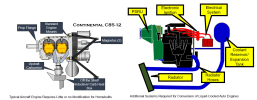
The more successful conversions...Volkswagens and Corvairs...minimize the amount of conversion required. No propeller speed reduction units (PSRUs), air-cooled. Equipment NOT installed on the aircraft cannot fail.
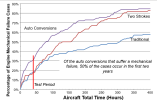
Statistics certainly can be flawed, but I believe there are lessons there nonetheless. Let's look, for instance, at WHEN auto engines and traditional engines fail.
This plot shows the homebuilt aircraft's total hours at the time of an accident resulting from the mechanical failure of the engine. There's a lot more "infant mortality" in the auto-engine world. About 30% of the accidents occur during the aircraft's 40-hour test period, vs. ~18% for the traditional engines.
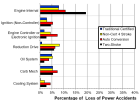
What's failing? Pretty much as you expect.
To me, the overall statistical look is the most telling:
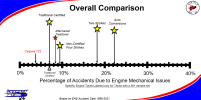
For homebuilt aircraft powered by traditional engines that suffered an accident in the 1998-2021 time period, the engine was the cause about seven percent of the time. For homebuilts with an auto-engine conversion, over 20% of the accidents were due to issues with the powerplant.
"But many of these failures are due to builder errors, it's not the fault of the engine!"
I agree with the first half of the statement. The second half is more problematical. The statistics seem to indicate that many accidents could have been avoided if the builder had installed a simpler powerplant, an engine DESIGNED FROM THE GROUND UP to power an aircraft. Unless the auto-engine-conversion companies institute testing so that only sufficiently-qualified builders are allowed to buy their product, the accident rate for these engines is going to be higher. And we know that ain't gonna happen.
"The battle may not go to the strong, nor the race to the swift....but that's the way to bet."
The irony here is that solutions ARE available. As Stephen/Spencer posted, companies like Viking do provide assistance to maximize the chance that the engine is installed correctly. The irony is that many people opt for auto engines to save money...and this option costs more.
Ron Wanttaja
Dan Thomas
Touchdown! Greaser!
- Joined
- Jun 16, 2008
- Messages
- 12,389
- Display Name
- Dan Thomas
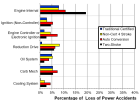
Plenty of homebuilt engine failures have been due to fuel supply system issues. I don't see that here. Is it considered an airframe rather than engine problem? It still kills the engine.
Fuel system venting has been a big one, IIRC. Use of sealants that plug stuff is another.
wanttaja
Final Approach
- Joined
- Jun 7, 2008
- Messages
- 5,667
- Location
- "War-Torn" Portland
- Display Name
- Ron Wanttaja
- Home Airfield
- Twin Oaks Airpark
Yes, fuel-system problems are not included in the graph. In my database, I have that category split into two parts, with one part covering fuel issues within the engine compartment, and the other covering the system outside the engine compartment.Plenty of homebuilt engine failures have been due to fuel supply system issues. I don't see that here. Is it considered an airframe rather than engine problem? It still kills the engine.
Fuel system venting has been a big one, IIRC. Use of sealants that plug stuff is another.
It's a relatively rare issue, and the differences aren't that major. About 1.9% of accidents involving traditional-engined homebuilts are due to issues with the fuel system within the compartment, vs. 2.5% of auto-engine cases. But the rate for what I call "aftermarket traditional" engines (Superior, Mattituck, etc.) is 3.%, vs. 7% for turbine-powered homebuilts. Problems with fuel systems is an issue, but I don't think the choice of engine is driving it significantly.
[Edit: See next posting]
Ron Wanttaja
Last edited:
wanttaja
Final Approach
- Joined
- Jun 7, 2008
- Messages
- 5,667
- Location
- "War-Torn" Portland
- Display Name
- Ron Wanttaja
- Home Airfield
- Twin Oaks Airpark
I realized after I posted this that the base percentages were different: The plot Ed referred to gives the percentages of the LOSS OF POWER accidents for each cause, while the numbers in my follow-up were the percentages of the TOTAL accidents.Yes, fuel-system problems are not included in the graph. In my database, I have that category split into two parts, with one part covering fuel issues within the engine compartment, and the other covering the system outside the engine compartment.
It's a relatively rare issue, and the differences aren't that major. About 1.9% of accidents involving traditional-engined homebuilts are due to issues with the fuel system within the compartment, vs. 2.5% of auto-engine cases. But the rate for what I call "aftermarket traditional" engines (Superior, Mattituck, etc.) is 3.%, vs. 7% for turbine-powered homebuilts. Problems with fuel systems is an issue, but I don't think the choice of engine is driving it significantly.
The percentages of the loss-of-power accidents due to issues in the fuel system inside the cowling are:
Traditional engines: 6.6%
Aftermarket Traditional: 13%
Auto Conversions: 4.7%
Turbine: 21.7%
Ron Wanttaja
pfarber
Pattern Altitude
- Joined
- Jun 20, 2021
- Messages
- 1,653
- Display Name
- pfarber
Just so common to have to replace jugs or cams or break a magneto.
Still on that OWT stuff, I see. In my years as a mechanic I seldom ever had to touch a cylinder. Never had to replace a cam, never had to send an engine out for a new cam. Never had a magneto "break," except for the 60-year-old Case magneto on my 1946 A-65. And that was due to shrinkage of the resin that the coil was covered in, a normal phenomenon for ancient plastics that old, subjected to heat and vibration for a long time.
I took the mags off an engine built in 1976. Those mags were 40 years old and had 1700+ hours on them and had never been off that engine. They were still sparking just fine, but I sure wasn't going to leave them that way. Too often, things fail due to the old mentality of "if it ain't broke, don't fix it." That attitude doesn't work in aviation. At all. It's stupid.
Magnetos have breaker points and condensers in them, just like all cars did before the early 1970s. Those cars needed new points and condensers about every year or 12,000 miles. 12,000 miles at an average of, say, 50 MPH is 240 hours. 40 MPH average is 300 hours. And you are complaining that 500 hours is a short period? Wake up and read the history.
Electronic mags are gaining traction, but they're not cheap and the early ones had failures that soured some of the community on them. Even now we're still hearing of difficulties with them. Magnetos are sturdy and have no delicate electronic components that fail when they're shaken and heated constantly. Electronic mags sometimes don't do wo well on aircraft engines, then. Even the automakers had their electronics mounted off the engine to avoid such factors, and when they did put the stuff on the distributor, like Ford did with the TFI-III system, they had failures.
I really get tired of certain folks constantly condemning the way things are. Their limited knowledge and experience are clearly revealed. They take a rare failure and turn it into a widespread problem.
And they take owner mistakes and blame them on the engine manufacturers. Mistakes like going to the airport, starting the engine and running it without flying it, then shutting it down and going home, leaving that engine's crankcase full of new moisture that reacts with the oil, catalyzed by the metals, forming acids that then eats those lifters and cams and cylinder walls. Even though the engine manufacturers try to tell owners not to do that! Unbelievable. https://www.lycoming.com/content/low-time-engine-may-not-mean-quality-and-value
An excerpt from that:
The point of this discussion is simple. A low-time engine may not add value to an aircraft, and the buyer should be aware of all factors which may affect the condition and value of the engine. An engine which is not flown frequently is subject to deterioration as a result of inactivity. When the engine does not achieve flight operating temperatures on a regular basis, the moisture and acids that form as a result of combustion and condensation are not vaporized and eliminated through the exhaust and crankcase breather. As moisture and acids collect in the engine, they contribute to the formation of rust on the cylinder walls, camshaft and tappets.
As the engine is run after rust has formed, the rust becomes a very fine abrasive causing internal engine wear, particularly to the camshaft and tappets. As these components wear, they make more metal which attacks the softer metals in the engine. Piston pin plugs are examples of parts that may wear rapidly when rust becomes an abrasive inside the engine. This wear could eventually lead to failure.
And from https://www.lycoming.com/content/frequency-flight-and-its-affect-engine
Some operators are running the engines on the ground in an attempt to prevent rust between infrequent flights. This may harm rather than help the engine if the oil temperature is not brought up to approximately 165˚ F because water and acids from combustion will accumulate in the engine oil. The one best way to get oil temperature to 165˚ F is to fly the aircraft. During the flight, the oil normally gets hot enough to vaporize the water and most acids and eliminate them from the oil. If the engine is merely ground run, the water accumulated in the oil will gradually turn to acid, which is also undesirable. Prolonged ground running in an attempt to bring oil temperature up is not recommended because of inadequate cooling that may result in hot spots in the cylinders, baked and deteriorated ignition harness and brittle oil seals which cause oil leaks.
Water and other contaminants are a problem with aircraft engines because they do not have PCV systems like cars do. And they don't have them because PCV systems don't work at high manifold pressures, which is where aircraft engines spend at least 90% of their lives.
I have seen too many engines ruined this way. And even when you tell that owner not to ground-run the thing, he'll still do it because his buddies do it. Or some other non-aircraft-mechanic owner on the 'net says so. Auto mechanics are famous for thinking aircraft engines are no different from car engines.
A data point of ONE is not significant. Your personal experience is a moot point as jugs do go bad and cams do get wiped. There are 300,000 - 320,000 aircraft registered in the FAA database. You've seen all of them? 1%? That's still 30,000 aircraft. Bottom line, your personal antidote is just that.
Didn't Lycoming and ECI have an AD for bad cylinders? That must be false because YOU never replaced one... right? RIGHT? AD 2008–19–05? That's ONE complete recall.. .wanna bet I can find more?????
And AGAIN, trying to condemn all car motors are unreliable is just inexperience being shown. SDS for example? Might want read up on them.
One would think that in 50+ years Lycoming and Cont. would have PERFECTED the aero engine. But we both know that they don't care enough to put the money into doing that. The have the FAA than simply force owners to pay for their products own shortcomings.
Are car motors perfect for airplanes? Sure, it depends on the design. I'm perfectly willing to lose 50-100lbs of payload to install a car motor. PSRUs are not new, they have been around since the 30's. There are many well designed ones available now.
For every fault in a car motor you list I can find either a solution or a comparable issue in certifiacted motors.
pfarber
Pattern Altitude
- Joined
- Jun 20, 2021
- Messages
- 1,653
- Display Name
- pfarber
"But many of these failures are due to builder errors, it's not the fault of the engine!"
I agree with the first half of the statement. The second half is more problematical. The statistics seem to indicate that many accidents could have been avoided if the builder had installed a simpler powerplant, an engine DESIGNED FROM THE GROUND UP to power an aircraft. Unless the auto-engine-conversion companies institute testing so that only sufficiently-qualified builders are allowed to buy their product, the accident rate for these engines is going to be higher. And we know that ain't gonna happen.
"The battle may not go to the strong, nor the race to the swift....but that's the way to bet."
The irony here is that solutions ARE available. As Stephen/Spencer posted, companies like Viking do provide assistance to maximize the chance that the engine is installed correctly. The irony is that many people opt for auto engines to save money...and this option costs more.
Well this is where I see the disagreement. Simplicity is not the issue. Design is. How many of those car motor installers knew about safe piston speeds and bearing rotational speed limits? An EFI has 1 moving part... a magneto has wear items (points/condensor/springs/gears). A battery has zero moving parts, the magneto's generator has more (bearings, shafts) the generator could lose is magnatism and need to be reflashed. So statistically (parts count) EFI is a clear winner. But its up to the person designing the system and installing it to ensure its done properly. And there is way less to go wrong in an EFI than a magneto. One problem I see (and it obvious) is that there is only one electrical source. RATs are not unheard of on GA airplanes, or even a second small alternator, also done on GA airplanes... how many car motor installs do this? None? 1%. See, its not the system per se, but the implimentation.
I will agree that dropping a stock car motor into a E/AB is foolish. But the design corrections are not difficult. Electric water pumps, second alternator/RAT, derating the motor, dry sump lubrication, a sane EFI tune and a few others. Its not hard to do, and its not terribly expensive. But you gotta give up some useful load. In a 172 that might not be a good choice... in say a Stintson? I'd make that trade every day and twice on sunday. A BD-4B I have 1000lbs useful (well the design is). Would I trade 100lbs for a well planned car motor? Again, every day and twice on sunday.
- Joined
- May 15, 2020
- Messages
- 7,765
- Display Name
- Ernie
- Home Airfield
- C81
Pretty sure @Dan Thomas has worked on way more than 1 engine across his career in maintenance.A data point of ONE is not significant. Your personal experience is a moot point as jugs do go bad and cams do get wiped. There are 300,000 - 320,000 aircraft registered in the FAA database. You've seen all of them? 1%? That's still 30,000 aircraft. Bottom line, your personal antidote is just that.
Didn't Lycoming and ECI have an AD for bad cylinders? That must be false because YOU never replaced one... right? RIGHT? AD 2008–19–05? That's ONE complete recall.. .wanna bet I can find more?????
And AGAIN, trying to condemn all car motors are unreliable is just inexperience being shown. SDS for example? Might want read up on them.
One would think that in 50+ years Lycoming and Cont. would have PERFECTED the aero engine. But we both know that they don't care enough to put the money into doing that. The have the FAA than simply force owners to pay for their products own shortcomings.
Are car motors perfect for airplanes? Sure, it depends on the design. I'm perfectly willing to lose 50-100lbs of payload to install a car motor. PSRUs are not new, they have been around since the 30's. There are many well designed ones available now.
For every fault in a car motor you list I can find either a solution or a comparable issue in certifiacted motors.
Airplanes aren't cars. They aren't flown 4 times a day every day. Start up a car for 10 minutes and let it sit a few months. Repeat as necessary until something fails. It will.
- Joined
- Jun 13, 2008
- Messages
- 9,173
- Location
- Marietta, GA
- Display Name
- Drake the Outlaw
- Home Airfield
- Cartersville, GA
Is anyone else bothered by the 3 errors in this post?A data point of ONE is not significant. Your personal experience is a moot point as jugs do go bad and cams do get wiped. There are 300,000 - 320,000 aircraft registered in the FAA database. You've seen all of them? 1%? That's still 30,000 aircraft. Bottom line, your personal antidote is just that.
Dan Thomas
Touchdown! Greaser!
- Joined
- Jun 16, 2008
- Messages
- 12,389
- Display Name
- Dan Thomas
I have enough years of experience to know what I'm talking about. How many failed camshafts have you, personally, been involved with as a mechanic? How many cylinders have you removed or replaced? And no, the stuff you might have done in A&P school doesn't count. I'm talking real-world maintenance experience, not fables you've picked up here and there. Hearsay evidence doesn't stand up in court and it has little value here.A data point of ONE is not significant. Your personal experience is a moot point as jugs do go bad and cams do get wiped. There are 300,000 - 320,000 aircraft registered in the FAA database. You've seen all of them? 1%? That's still 30,000 aircraft. Bottom line, your personal antidote is just that.
Oh, and by the way, "antidote" is not the word you want. It's "anecdote."
There have been several ADs for bad cylinders and crankshafts. Most of it was due to the engine manufacturers deciding to get contractors to build the stuff instead of doing it in-house. Those contractors screwed up by cheating on the metallurgical specifications. They were not aviation-trained people and did not see the potential for serious failures. There are a lot of people like that. The engine people had to take back the work and do it in-house again.Didn't Lycoming and ECI have an AD for bad cylinders? That must be false because YOU never replaced one... right? RIGHT? AD 2008–19–05? That's ONE complete recall.. .wanna bet I can find more?????
Lets see: recalls for car stuff. Jeep has had a real problem with their Pentastar engines. The valve trains are failing, big-time. Big class-action lawsuits over it. Their clutches in the manual-shift vehicles have been catching fire, forcing a recall, and the replacement second-generation version catches fire, too. GM had headlight switches catching fire. They had truck differentials failing in relatively new trucks. Diffs are normally one of those things that outlast the vehicle. All of the auto manufacturers have had recalls of many sorts. Yes, they pay for it, while Lyc and Continental will, at most, grant some credit toward repair. They should foot the whole thing.
As a mechanic I had to spend a lot of time doing AD reviews on the flight school airplanes (every two weeks another batch) and later, on owner's airplanes. Only once did I come across an engine AD (out of thousands) that applied to any airplane I was in charge of, and in that case the AD simply had a thousand-hour limit on the cylinders, and there were over 700 hours to go yet before required replacement. On that engine, there were only one or two cylinders (out of six) affected by the AD. The problems are not nearly as widespread as you assume.
The engines are about as perfect as they're going to get. It's the owners and operators that aren't perfect. I have come across many engines that have been in service for 40 and 50 and 60 years, still on the original TBO since new or since last overhaul, and they're still working just fine. Biggest problem, besides oil leaks from ancient and tired seals and gaskets, is getting the owners to look after the things. Get those old hoses replaced. Get those mags inspected (NOT OVERHAULED, which is a different thing altogether). Stop ground-running it. I did a bunch of work on a Lake Amphib that was over 40 years old, still on the original engine, and there was no internal corrosion even though the airplane was often on the water. The owner didn't ground-run it. The airframe was what needed the work, with all the hydraulic seals and hoses shot. Airframe cracks due to pounding on the water. Wheel bearings all corroded from water getting past the seals.One would think that in 50+ years Lycoming and Cont. would have PERFECTED the aero engine. But we both know that they don't care enough to put the money into doing that. The have the FAA than simply force owners to pay for their products own shortcomings.
Many well-designed ones. Well, give us a list, since there are so many homebuilders that have been looking for reliable redrives for a long time now, and there have been too many failures. It's simply not that easy, and we have an actual transmission engineer over on homebuiltairplanes.com who spent many years in university studying this stuff and had a long career with the auto manufacturers. He'll tell you that it's not simple.PSRUs are not new, they have been around since the 30's. There are many well designed ones available now.
You think that electronic circuitry never fails? How many computers suffer fatal component failures? Batteries sulfate, and then they fail. A magneto's magnet losing its magnetism? Since when? Like those 40-year old mags that had never been off, old mags still have strong magnets. My 60-year-old Case mags still make a really strong spark, their magnets are just fine. Actually, they're 80 years old now. Bearings last the full engine TBO; I never had to replace any bearings except for ones in an ancient Bendix mag that hadn't been inspected for decades, and was on an engine that had been ground-run. The crankcase moisture got at the bearings and corroded them. ONE magneto, dude. 500-hour inspections catch the worn points and other parts and they get fixed. Never had to replace anything more than the points and occasionally a condenser that was a little outside the capacitance specs. I did replace a couple of distributor blocks in Slick mags due to a factory screwup. They sent out an SB on it.An EFI has 1 moving part... a magneto has wear items (points/condensor/springs/gears). A battery has zero moving parts, the magneto's generator has more (bearings, shafts) the generator could lose is magnatism and need to be reflashed.
Not true at all. Very complex electronics in which the failure of one tiny component can kill it. They have to be robustly designed, as all the auto manufacturers found out. Failures were common on the early systems.And there is way less to go wrong in an EFI than a magneto.
And another thing: EFI is fuel injection. Magnetos are ignition. Don't confuse them.
How many cars crash and burn when the alternator fails on the highway?or even a second small alternator, also done on GA airplanes... how many car motor installs do this? None? 1%. See, its not the system per se, but the implimentation.
So now you have to do it and make it work and then you MUST report back to us. No hiding the difficulties and and the griefs over the steep learning curve. Until then, it's all just boasting.But you gotta give up some useful load. In a 172 that might not be a good choice... in say a Stintson? I'd make that trade every day and twice on sunday. A BD-4B I have 1000lbs useful (well the design is). Would I trade 100lbs for a well planned car motor? Again, every day and twice on sunday.
So how many engine cylinders have to had to replace? How many failed cams? How many magnetos have you had off and inspected in accordance with the magneto service manuals? Have you ever replaced points and adjusted the E-gap? How often do you time a mag to an engine? How many alternators have you opened up for internal inspection?
pfarber
Pattern Altitude
- Joined
- Jun 20, 2021
- Messages
- 1,653
- Display Name
- pfarber
Don't move the goalposts. The statement was that since you personally have not done X, then X is not true. That is an objectively false statement. Have you ever birthed a white rhino? No? Then that must mean white rhinos never existed.I have enough years of experience to know what I'm talking about. How many failed camshafts have you, personally, been involved with as a mechanic? How many cylinders have you removed or replaced? And no, the stuff you might have done in A&P school doesn't count. I'm talking real-world maintenance experience, not fables you've picked up here and there. Hearsay evidence doesn't stand up in court and it has little value here.

I've conceeded many times typing and spelling are not my stong suit. ANd if a typo is your only critique, that's some pretty weak sauce.Oh, and by the way, "antidote" is not the word you want. It's "anecdote."
None of that matters. I proved that there was an INDUSTRY WIDE RECALL of the same cylinders you never said failed because you said you never worked on any. Thank you for proving my point.There have been several ADs for bad cylinders and crankshafts. Most of it was due to the engine manufacturers deciding to get contractors to build the stuff instead of doing it in-house. Those contractors screwed up by cheating on the metallurgical specifications. They were not aviation-trained people and did not see the potential for serious failures. There are a lot of people like that. The engine people had to take back the work and do it in-house again.
Wait, you just claimed above that we can't hold lycoming responsible for 3rd party parts, yet now you claim Stellantis/Dodge CAN be held responsible for 3rd party parts? lol wut? I've had lifters fail in my 2004 F150 and my 2014 Caravan. SO what. Many cars suffer from bad designs. My F-150 was a subject of a class action suit due to spark plugs. So what. By YOUR logic since you haven't changed a lifter or a spark plug in either vehicle its not a problem, right? I mean YOU never did it, so IT never happened. right?Lets see: recalls for car stuff. Jeep has had a real problem with their Pentastar engines. The valve trains are failing, big-time. Big class-action lawsuits over it. Their clutches in the manual-shift vehicles have been catching fire, forcing a recall, and the replacement second-generation version catches fire, too. GM had headlight switches catching fire. They had truck differentials failing in relatively new trucks. Diffs are normally one of those things that outlast the vehicle. All of the auto manufacturers have had recalls of many sorts. Yes, they pay for it, while Lyc and Continental will, at most, grant some credit toward repair. They should foot the whole thing.
Airtrikes. EPI, Northwest Aviation, https://www.aerosportengineering.no/psru for a start.As a mechanic I had to spend a lot of time doing AD reviews on the flight school airplanes (every two weeks another batch) and later, on owner's airplanes. Only once did I come across an engine AD (out of thousands) that applied to any airplane I was in charge of, and in that case the AD simply had a thousand-hour limit on the cylinders, and there were over 700 hours to go yet before required replacement. On that engine, there were only one or two cylinders (out of six) affected by the AD. The problems are not nearly as widespread as you assume.
The engines are about as perfect as they're going to get. It's the owners and operators that aren't perfect. I have come across many engines that have been in service for 40 and 50 and 60 years, still on the original TBO since new or since last overhaul, and they're still working just fine. Biggest problem, besides oil leaks from ancient and tired seals and gaskets, is getting the owners to look after the things. Get those old hoses replaced. Get those mags inspected (NOT OVERHAULED, which is a different thing altogether). Stop ground-running it. I did a bunch of work on a Lake Amphib that was over 40 years old, still on the original engine, and there was no internal corrosion even though the airplane was often on the water. The owner didn't ground-run it. The airframe was what needed the work, with all the hydraulic seals and hoses shot. Airframe cracks due to pounding on the water. Wheel bearings all corroded from water getting past the seals.
Many well-designed ones. Well, give us a list, since there are so many homebuilders that have been looking for reliable redrives for a long time now, and there have been too many failures. It's simply not that easy, and we have an actual transmission engineer over on homebuiltairplanes.com who spent many years in university studying this stuff and had a long career with the auto manufacturers. He'll tell you that it's not simple.
EFI/ECU is the same thing these days. Its all one big piece of Silicon.. If you're gonna pick nits then yes, I incorreclty typed EFI.... yah got me... I must be compeltely obvlivious to everyting becuase a typo. Lets try and wade throught your diatribe:You think that electronic circuitry never fails? How many computers suffer fatal component failures? Batteries sulfate, and then they fail. A magneto's magnet losing its magnetism? Since when? Like those 40-year old mags that had never been off, old mags still have strong magnets. My 60-year-old Case mags still make a really strong spark, their magnets are just fine. Actually, they're 80 years old now. Bearings last the full engine TBO; I never had to replace any bearings except for ones in an ancient Bendix mag that hadn't been inspected for decades, and was on an engine that had been ground-run. The crankcase moisture got at the bearings and corroded them. ONE magneto, dude. 500-hour inspections catch the worn points and other parts and they get fixed. Never had to replace anything more than the points and occasionally a condenser that was a little outside the capacitance specs. I did replace a couple of distributor blocks in Slick mags due to a factory screwup. They sent out an SB on it.
Not true at all. Very complex electronics in which the failure of one tiny component can kill it. They have to be robustly designed, as all the auto manufacturers found out. Failures were common on the early systems.
And another thing: EFI is fuel injection. Magnetos are ignition. Don't confuse them.
Properly designed circuits last as long as they are designed to. With proper heat management and vibration isolation and weather proofing they are basically bullet proof. ECU issues are just not a concern. OP's first post clearly stated that the Viking engine failed becuase of the bad tune... that's not the ECUs fault. The ECU in my 2014 caravan has lasted well over 230k miles. Thats over 3500 hours over operation if you assume 65MPH average speed at temps from -10F to well over 150F. Magentos output voltage is garbage compared to a modern COP. A magneto might put out 12-15kV a COP is 25kV. And a magneto uses a generator. Generators have to be flashed to have magnitism. If you care to read the services that many overhaul shops perform, reflashing the magnets is a standard service.
ALso your magneto-fu is weak. "500-hour inspections catch the worn points and other parts and they get fixed. Never had to replace anything more than the points and occasionally a condenser that was a little outside the capacitance specs." The 500 hr inspection is related to the impulse drive only and currently only applies to a very few motors. AD 2005-12-06 lol There is no requirement to check anything other than the impulse coupling LOL much mechanic, such knowledge HAHAHAHAHAHAHA
ALso reflashing the field at overhaul is done by most reputable shops and would be a cause of weak/no output. https://www.aircraftmagnetoservice.net/500-hour-inspection-details
How many cars crash and burn when the alternator fails on the highway?
So now you have to do it and make it work and then you MUST report back to us. No hiding the difficulties and and the griefs over the steep learning curve. Until then, it's all just boasting.
So how many engine cylinders have to had to replace? How many failed cams? How many magnetos have you had off and inspected in accordance with the magneto service manuals? Have you ever replaced points and adjusted the E-gap? How often do you time a mag to an engine? How many alternators have you opened up for internal inspection?
These are just plain blather. If an airplane (or car) loses an alternator the battery takes over until depleted. Do YOU think alternators explode? wow. just wow. I can link to some 'how alternators work' youtube videos if you need a refresher.
I am working on a car motor. Its a 3.6L Pentastar with electric water pumps, dry sump and all the other things I posted earlier. If you want to help I can send cash... I hoenstly have no use for any of your 'adivce', but thanks for the offer.
You said there are no cylinder and cam issues becuase YOU haven't changed any. LOLOLOLOLOLOOL So I never had to change any either HAHAHAHAHAHAHAHAHAHAHA thank you for saving the world from bad cylinders and cams HAHAHAHAHAHAHAHAHAHAHA
- Joined
- May 15, 2020
- Messages
- 7,765
- Display Name
- Ernie
- Home Airfield
- C81
Math is hardIs anyone else bothered by the 3 errors in this post?