Viking 130 engine failure at 1150 hours

Auto engine conversions have proven unreliable in aircraft applications. Frankly, I wouldn’t want to fly behind any of them.
Ages ago, Porsche and Mooney came together---I thought it would be match made in heaven---but apparently such was not the case.
 
No, I didn't miss the point. These posts aren't defending Viking engines very well. The supporting data is cherry-picked, and no one suggested the engines come from "digging through junk yards". However, the engines were from salvage cars as suggested in another post.

What about the rest of them? This is only 25 engines. I'm sure there are more than 25 Viking engines sold. I'm also sure the majority have more than 5 miles on them. What would be more helpful is to explain how Viking chooses used engines, and how they bring them to a condition usable for aircraft. Is there a milage limit? What is the warranty? What do they do if there is a problem with the engine?
Ue
No, I didn't miss the point. These posts aren't defending Viking engines very well. The supporting data is cherry-picked, and no one suggested the engines come from "digging through junk yards". However, the engines were from salvage cars as suggested in another post.

What about the rest of them? This is only 25 engines. I'm sure there are more than 25 Viking engines sold. I'm also sure the majority have more than 5 miles on them. What would be more helpful is to explain how Viking chooses used engines, and how they bring them to a condition usable for aircraft. Is there a milage limit? What is the warranty? What do they do if there is a problem with the engine?
yes, reading between the lines it was suggested these are sketchy engines when in fact they are from late year model, low mileage cars. Yes they have limits, and they completely stand behind their product. There are many stories of how they’ve gone above and beyond taking care of their customers. I’m not at liberty to share them except for what they’ve done for me before I ever made a purchase from them nor will I take the time right now to type out a few hundred words. All your the specific questions can be asked face to face at the link I posted below but making assumptions make you look bad, I have given specific examples you haven’t. Will everyone get an engine with less than 5 miles on the car’s odometer of course not but it is possible, its luck of the draw but Viking has very high standards and along with all the years of Honda’s engineering you get a huge amount of bank for your buck.


Attachments

  • IMG_8271.jpeg
    IMG_8271.jpeg
    497.8 KB · Views: 11
Auto engine conversions have proven unreliable in aircraft applications. Frankly, I wouldn’t want to fly behind any of them.
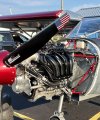
Completely untrue.. these 1500 people would argue they are not unreliable….
 

Attachments

  • IMG_8273.jpeg
    IMG_8273.jpeg
    178 KB · Views: 14
  • IMG_8272.jpeg
    IMG_8272.jpeg
    250.6 KB · Views: 13
I flew about 200 hours over 4 years behind the Mosler half VW in my Fisher 404. Other than valves that needed grinding (which has also happened on my Lycoming), the only engine related troubles I had was with the Slick magneto. The guy in the hangar next to me had a Corvair powered Zenith CH601, and he flew it a lot. Now I'm sharing a hangar with another guy with a Corvair powered Rebel. I don't see it flying because we're on different schedules, but I know he recently finished his 40 hour test period.
I don’t think this post aged well frankly. My opinion has evolved since then.
Salty, I’m not bashing you sir but here is proof they do fly a lot…. If you add my time in with trips to Sun and fun and Oshkosh that’s more than 400hrs on an auto conversion engine in a 3 year period.
 

Attachments

  • IMG_8710.jpeg
    IMG_8710.jpeg
    2.6 MB · Views: 25
  • IMG_6650.jpeg
    IMG_6650.jpeg
    3.3 MB · Views: 25
  • 2DE2687D-1F48-4047-B250-3D8D94CC8633.jpeg
    2DE2687D-1F48-4047-B250-3D8D94CC8633.jpeg
    789.2 KB · Views: 23
  • IMG_6458.jpeg
    IMG_6458.jpeg
    673 KB · Views: 25
Completely untrue.. these 1500 people would argue they are not unreliable….
There are 168 aircraft on the FAA register that are listed as having Viking engines. If one opens the search parameters to both Viking and Honda, it increases to 211. There are an additional 18 Viking-powered aircraft in the deregistered aircraft list.

Sure, about 3,400 homebuilts are registered with the generic engine name AMAT/EXP. I once ran a process to estimate how many are given engine types. I estimated 20 of those 3,400 aircraft had Viking engines.

The list admittedly covers the US, but America has the lion share of aircraft in the world. I believe Canada is in #2, and they have a tenth of the planes the US has.

In short, Viking may have 1500 customers, but only a small proportion of those customers are contributing to reliability data.

I've attached a PDF with the list from the January 2026 FAA registry for airplanes with "Viking" or "Honda" listed as their engines (with appropriate wild cards).

Ron Wanttaja
 

Attachments

@wanttaja , silly question, but do you have any data on the reliability of Pietenpol’s Model A conversion, or the Henderson motorcycle conversions of the 1920s & 1930s?
 
@wanttaja , silly question, but do you have any data on the reliability of Pietenpol’s Model A conversion, or the Henderson motorcycle conversions of the 1920s & 1930s?
I've got 51 Pietenpol accidents on my 1998-2024 database. Don't have any data before 1998.

Of the 51 accidents, eight had Ford engines. One was due to the failure of a connecting rod, another was due to a fouled spark plug (owner-built electronic ignition system). Two were due to carb ice (one included builder error... owner said the carb heat system was inadequate). The cause of one engine failure couldn't be determined, one prop failure, one bad flare or bounce (Ford Escort engine, not Model A or B), one landing gear failure.

None of the accidents was listed as having a Henderson engine.

Ron Wanttaja
 
All your the specific questions can be asked face to face at the link I posted below but making assumptions make you look bad, I have given specific examples you haven’t. Will everyone get an engine with less than 5 miles on the car’s odometer of course not but it is possible, its luck of the draw but Viking has very high standards and along with all the years of Honda’s engineering you get a huge amount of bank for your buck.
I can't go to Florida to the workshops- this isn't on-line. I don't live anywhere near Florida.

What assumptions have I made? I asked questions. I'd like to know more about this engine but you really haven't given me anything useful. As a customer, you probably have asked some of the questions I'm asking and gotten answers that you can share.

What examples am I supposed to give? I'm asking about the engine and I only get vague answers. As a customer, you certainly can answer the question about the warranty, if nothing else.

I'm not against auto conversions on planes. I think there are many VW conversions flying, but I think these were modified so that at least some of the bearings can take the thrust from the propellor (@Bell206 or @Dan Thomas , I'd appreciate a correction if I'm not understanding this properly. I'm thinking of the AeroVee and Revmaster engines).
 
Always hard to establish the safety record of auto-engine conversions, because FAA records don't reliably establish the number of specific engines in the fleet. About 15% of Experimental Amateur-Built aircraft are merely listed as having "AMAT/EXP" engines. There's nothing to prevent a company selling conversions as claiming the majority of those are theirs. It should be noted that one company, at least, claims an installed base that is ten times higher than the US records reflect (although non-US engines can mess up such comparisons).

In addition, there is no standardization for identifying the auto engine types. An FAA (or NTSB...) record saying the aircraft has a Great Plains conversion is pretty definite, but if the record says Volkswagen that DOESN'T mean it's NOT a Great Plains conversion.

I use two methods to examine engine safety statistics. The first completely ignores the installed base, and uses exclusively NTSB accident reports. This method computes the percentage of accidents that were caused by engine mechanical failures:
View attachment 122616

Note, again, the percentages is the percentage of ACCIDENTS, not the percentage of the entire installed fleet. This plot DOES NOT MEAN that 22% of auto engines suffer a mechanical issue, just that 22% of the known accidents were due to engine issue.

And for homebuilts, the "known accidents" issue can be important, because homebuilts are much more suited to disassembly and removal from the crash site before the local gendarmerie arrives....

Anyway, as the above shows, when accidents happen, it's about three times the likelihood that an auto-engine had an issue than a conventional engine.

However, this sort of statistic messes people up a bit. They expect to see an accident rate for the entire fleet...hence my capitalized reminders above.

I have made a stab at estimating the number of installed engines. As I mentioned, about 15% of the homebuilts don't list a specific engine. However, NTSB reports are a bit better. I cross-referenced the list of AMAT/EXP engines in the FAA registry with the NTSB reports, and got the engine types for about 150 AMAT/EXP engines. I use that data compute the estimated percentage of the AMAT/EXP fleet that are particular engine types. It's done for both the active aircraft as well as the de-registered ones.

Here's what the auto-engine conversion numbers look like:
View attachment 122618
About 10.24% of the AMAT/EXP engines in the crosslisted NTSB list were VWs, so I applied that percentage to the number of AMAT/EXP engines in both the active and deregistered aircraft list to compute the estimated total number of installed engines. Note that there have been about four times the number of homebuilts with VW engines than the current registry reflects. Other types do not see as much of an increase.

For comparison, here's the same data for Lycoming:
View attachment 122619

With that, I can estimate how often a given type of engine fails in a given year (for homebuilts):
View attachment 122620
It's not on the graphic, but the worst-case I saw was a common two-stroke engine, with an installed base of ~780 engines and a 0.245% annual failure rate.

Now, consider how "serious" the failure rates are. The Honda, for instance, has a ~0.15% annual failure rate...ZERO point 15 PERCENT. That's one accident each year for ~600 aircraft. My 22-year accident database shows only 9 accidents where the Honda engine was a causal factor. That's really not that bad.

Of course, my processes have their issues. I examine homebuilt accidents from 1998-2021, for example, and the aircraft in the deregistered list may come from far before that time period...makes the results a bit better.

Also, based on the percentage of the number of accidents (the first graphic), the Rotax 912 and the Continental O-200 come out about the same. But as you can see in the last graph, the 912 is higher than the O-200. The Rotax fleet size is difficult to determine, since not only are there engines listed as AMAT/EXP, there are listings showing generic "Bombardier" or "Rotax" engine types without a specific model. These could be 912s, and equally could be two-stroke 582s. I have run a similar process to try to identify the Bombardier or Rotax engine types.

Ron Wanttaja

This should be a AVbrief article. BTW, the thousandaire article was great.
 
I'd appreciate a correction if I'm not understanding this properly.
The only aircraft VW engines I'm familiar with had reduction gearboxes and a special crank. So I would assume there would also be different bearing installed as well.
 
The only aircraft VW engines I'm familiar with had reduction gearboxes and a special crank. So I would assume there would also be different bearing installed as well.
I thought they were direct drive. I thought they run at a higher RPM but used a smaller propellor too. Thanks for the information.
 
I'm interested to see if Kawasaki ever comes up with something tangible.

 
I thought they were direct drive. I thought they run at a higher RPM but used a smaller propellor too. Thanks for the information.
Backing up Dana (again :-) ) *most* were direct drives, but there are some reduction systems for VWs.

This is a photo of a Canadian biplane Fly Baby with a VW engine and a reduction drive.
1768517943920.png
Word was it could just barely take off (Fly Baby biplanes are generally pretty heavy). Last I heard, a new owner was installing a Lycoming.

Ron Wanttaja
 
Salty, I’m not bashing you sir but here is proof they do fly a lot…. If you add my time in with trips to Sun and fun and Oshkosh that’s more than 400hrs on an auto conversion engine in a 3 year period.
I have to be salty when even people I’m agreeing with bash me. Lol
 
we looked hard at auto conversions failure stats and tried to track down reasons as best we could. bumegore starting off on our c172 V8 engine project and FAA cert. I spoke with more than a few car engine pilots for both good and bad, and came to conclusion some automotive engines CAN be a great solution, as NASA also concluded.

don't really want to get into the nerdy details, but will say this ...

the biggest failure point of autocoversions is that almost all are one-offs, with little engineering basis or customization specific to airplane mission. the devil is in the details. for sure. Designing, testing and durable manufacturing is way too expensive for a one off (trust me, I know). For any conversation to meet the reliable level really needed, it takes engineering knowledge in multiple areas and resources. most projects simply hung a junk yard donor engine on a plane mechanically and off they went.

I believe, and stats back me , that auto engines are way more reliable than GA pistons....I discussed this some years back but a few just wanted to argue the point based on their experiences without any data....but I am a firm believer in imperical data. when was last time you saw a car broke down and mentally compared with the tens of thousands other car passing it every hour or consider how many cars are out there? Then consider most cars get minimum to no reoccurring service or car until there is a problem, and most problems still allow it to drive.....few car engine simply stop.

same argument for components...when was last time your cell phone compass or accelerometer failed? no think about in terms of numbers and conditions if use.

here's the deal ...car engines are not mission perfect, but considering the cost benefit relationship, I argue they can even be better.

our beat up 1969 C172 with GM aluminum V8 engine has about 800 hours on it. it's been used as a trainer for both private and commercial pilots (no glide slope/precision apch capabilities), including successful FAA check rides. An initial CFI is currently using it for training and scheduled to take CFI check ride in it in a few weeks.

the cost to fly it is now less than $20/hr with now local $2/gal car gas and engine reserves. it cost less than $4k to get your private pilots licence in it with check ride fee and 30 hours dual....

last month a young pilot that was struggling to pay for his commercial pilots training and check ride used it and passed his ride last month in it... otherwise, his finances would have caused him to draw the time line out for another 3 months to afford it.

same goes for my financially struggling CFI candidate....the most expensive part for 15 hours dual and airplane cost will be the $2500 check ride fee. ...otherwise he could not afford it for another 4 months. I was in the same boat as these guys at one time and struggled to pay for training as I'm sure many here can relate.

my cost to operate the same c172 with original engine would be about $80/hour.... it's $20 now. So as many solutions are not technically the perfect solution, it may be the most practical considering mission.
 
Your GM V8 must weigh more than the air cooled engine it replaced. Did you increase your gross weight, and how did you offset the heavier nose?
 
when was last time you saw a car broke down and mentally compared with the tens of thousands other car passing it every hour or consider how many cars are out there? Then consider most cars get minimum to no reoccurring service or car until there is a problem, and most problems still allow it to drive.....few car engine simply stop.
Failures that allow a car to limp home will cause a plane crash.
Case in point: a coil or plug failure. You can limp home on three (or even two) cylinders. You're crashing if that happens on a plane, especially with a fixed pitch prop. A cooling failure on a modern engine is something that you can deal with and get off the highway.
An electric fuel pump failing on a car is an inconvenience, even if rare. On a plane it turns into a crash most of the time.
Stuff that can injure or kill people needs an MTBF of at least 10 million flight hours for transport category aircraft. Yes, part 23 isn't as stringent, but still...
Statistics are meaningless until you become one.
I have nothing against auto conversions, but when I see packages with a single fuel pump, single engine management computer, single fuel injector/cylinder, single ignition system (some with a coil pack firing two cylinders), and, most importantly, single power source feeding it all, I don't get any confidence in them.
 
Again,the conversion must be engineered for the aircraft mission and redundancy ….. our engine was designed to part 33 standards, but this takes a Lot of resources that most experimenters don’t have and, as such, conversions got a bad rep from the exp world since the 1970’s, and likely so. Remember that certified diesels, such as the continental, are auto conversions.
 
There are 168 aircraft on the FAA register that are listed as having Viking engines. If one opens the search parameters to both Viking and Honda, it increases to 211. There are an additional 18 Viking-powered aircraft in the deregistered aircraft list.

Sure, about 3,400 homebuilts are registered with the generic engine name AMAT/EXP. I once ran a process to estimate how many are given engine types. I estimated 20 of those 3,400 aircraft had Viking engines.

The list admittedly covers the US, but America has the lion share of aircraft in the world. I believe Canada is in #2, and they have a tenth of the planes the US has.

In short, Viking may have 1500 customers, but only a small proportion of those customers are contributing to reliability data.

I've attached a PDF with the list from the January 2026 FAA registry for airplanes with "Viking" or "Honda" listed as their engines (with appropriate wild cards).

Ron Wanttaja
“Customers contributing to reliability data”- your words.. So as a customer where do I report reliability data so that you can find it?
 
I can't go to Florida to the workshops- this isn't on-line. I don't live anywhere near Florida.

What assumptions have I made? I asked questions. I'd like to know more about this engine but you really haven't given me anything useful. As a customer, you probably have asked some of the questions I'm asking and gotten answers that you can share.

What examples am I supposed to give? I'm asking about the engine and I only get vague answers. As a customer, you certainly can answer the question about the warranty, if nothing else.

I'm not against auto conversions on planes. I think there are many VW conversions flying, but I think these were modified so that at least some of the bearings can take the thrust from the propellor (@Bell206 or @Dan Thomas , I'd appreciate a correction if I'm not understanding this properly. I'm thinking of the AeroVee and Revmaster engines).
Viking has a one year, 100 hr warranty on there engines and can provide many examples where they have gone well beyond this basic warranty when the didn’t have to.

If you truly want to educate yourself on what Viking has to offer, A Viking Workshop is all online. Do a YouTube search for the Experimental Aircraft Channel’s review of “Viking Aircraft’s Engine workshop” - Brian Walstrom filmed most of the gathering from start to finish.
 
Last edited:
Viking has a one year, 100 hr warranty on there engines and can provide many examples where they have gone well beyond this basic warranty when the didn’t have to.

If you truly want to educate yourself on what Viking has to offer, A Viking Workshop is all online. Do a YouTube search for the Experimental Aircraft Channel’s review of “Viking Aircraft’s Engine workshop” - Brian Walstrom filmed most of the gathering from start to finish.
Yes it is online……

 
“Customers contributing to reliability data”- your words.. So as a customer where do I report reliability data so that you can find it?
*You're* the one who claimed that such reliability data existed.
Completely untrue.. these 1500 people would argue they are not unreliable….
So... present the data. Your claim that there are 1500 people able to give information as to reliability is ludicrous; there are, at most, about 20% of that number of people with flying aircraft. As I posted earlier, the FAA Registry shows only 168 aircraft in the US with Viking engines. I'll grant that there are ~50 or so additional ones where the owners decided, for what ever reason, to NOT list their aircraft as having a Viking engine.

Foreign-registered aircraft? Certainly there are some. But the US is overwhelmingly the main market for aftermarket engines like this. It's got ten times as many homebuilts as the next-closest country.

So...maybe...at most, another 168 aircraft flying in other countries. I consider this a very generous estimate. But it still leaves us ~80% short of your claim that there are 1500 people generating reliability data.

So let us turn to the NTSB data for our reliability information. Between 1998 and 2024, there were 21 EAB accidents involving aircraft with Viking engines. Six of the accidents involved mechanical failure of the engine. Two additional accidents were due to unexplained loss of engine power.

Here's my data...where's yours?
1769135608304.png
Certainly, the NTSB ruled that a couple of these were pilot error...but if the engine hadn't quit, there wouldn't have been the opportunity for a botched forced landing.

So....just for S&Gs, let's compare the results to another aircraft engine. Take the Continental O-200, for instance. 134 accidents involving O-200-powered homebuilts in the same time frame. Seven of them involved mechanical failure of the engine. Note that this is just about the same number of failures as the Viking, but with SIX TIMES the number of engines involved. About 5.2% of the O-200-powered aircraft accidents were due to mechanical failure of the engine, vs. 28% of the Vikings.

Now, I've got no dog in this hunt. Normally, I'd place some of the blame for the bad figures on the small sample size...21 total accidents. The problem is, people keep claiming that there have been thousands of these engines *flying*. Roughly 50% of homebuilt accidents have nothing to do with the engine, just basic pilot error. There are 1800 RV-6s in the US registry as of the first of this month, and over the 1998-2024 period of my accident database, almost 300 of them have had an accident. If there were 1500 homebuilts flying with Viking engines, we'd have seen ten times as many accidents, even without engine reliability issues.

1500 customers? I have no way of refuting that. No way to tell what's happening in home workshops. But 1500 flying engines producing reliability data, as you claim? Let's see the data. Post the N-numbers.

Ron Wanttaja
 
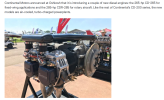
Remember that certified diesels, such as the continental, are auto conversions.
Not all of them. From Plane and Pilot, July 2017:

1769137920763.png

These engines were developments of the French SMA SR305-230 engine, with which I have some maintenance experience. Continental bought the technology from SMA. It was a clean-sheet aircraft engine design, not a conversion of any auto engine. It was STC'd for some Cessna 182s.
 
*You're* the one who claimed that such reliability data existed.

So... present the data. Your claim that there are 1500 people able to give information as to reliability is ludicrous; there are, at most, about 20% of that number of people with flying aircraft. As I posted earlier, the FAA Registry shows only 168 aircraft in the US with Viking engines. I'll grant that there are ~50 or so additional ones where the owners decided, for what ever reason, to NOT list their aircraft as having a Viking engine.

Foreign-registered aircraft? Certainly there are some. But the US is overwhelmingly the main market for aftermarket engines like this. It's got ten times as many homebuilts as the next-closest country.

So...maybe...at most, another 168 aircraft flying in other countries. I consider this a very generous estimate. But it still leaves us ~80% short of your claim that there are 1500 people generating reliability data.

So let us turn to the NTSB data for our reliability information. Between 1998 and 2024, there were 21 EAB accidents involving aircraft with Viking engines. Six of the accidents involved mechanical failure of the engine. Two additional accidents were due to unexplained loss of engine power.

Here's my data...where's yours?
View attachment 149168
Certainly, the NTSB ruled that a couple of these were pilot error...but if the engine hadn't quit, there wouldn't have been the opportunity for a botched forced landing.

So....just for S&Gs, let's compare the results to another aircraft engine. Take the Continental O-200, for instance. 134 accidents involving O-200-powered homebuilts in the same time frame. Seven of them involved mechanical failure of the engine. Note that this is just about the same number of failures as the Viking, but with SIX TIMES the number of engines involved. About 5.2% of the O-200-powered aircraft accidents were due to mechanical failure of the engine, vs. 28% of the Vikings.

Now, I've got no dog in this hunt. Normally, I'd place some of the blame for the bad figures on the small sample size...21 total accidents. The problem is, people keep claiming that there have been thousands of these engines *flying*. Roughly 50% of homebuilt accidents have nothing to do with the engine, just basic pilot error. There are 1800 RV-6s in the US registry as of the first of this month, and over the 1998-2024 period of my accident database, almost 300 of them have had an accident. If there were 1500 homebuilts flying with Viking engines, we'd have seen ten times as many accidents, even without engine reliability issues.

1500 customers? I have no way of refuting that. No way to tell what's happening in home workshops. But 1500 flying engines producing reliability data, as you claim? Let's see the data. Post the N-numbers.

Ron Wanttaja
Then why would 1500 people buy a Viking if they thought for any reason there was a reliability problem? Let’s put it this way these 1500 people “believe” the Viking is a reliable engine.
 
Then why would 1500 people buy a Viking if they thought for any reason there was a reliability problem? Let’s put it this way these 1500 people “believe” the Viking is a reliable engine.
Gracious. Personally, I don't equate the quality of the marketing campaign with the quality of the product itself. If that were the case, we'd all be flying around in nifty little BD-5s.

Advertisers must *love* you.....

People always forget the second half of P.T. Barnum's famous saying: "....and two to take him."

But of course, I have no basis to question Viking's claims about their sales. But on the same note, I have no insight into what they really mean. Does 1500 customers equate to 1,495 information packets and five engine systems?

Eighteen aircraft with Viking engines were added to the registry in 2025. The number for 2024 was six. Remains to be seen whether the increase is arithmetic, geometric, or temporary. At the rate for 2025, it'll take ~80 years to build those other 1,482 airplanes.

Ron Wanttaja
 
Viking has a one year, 100 hr warranty on there engines and can provide many examples where they have gone well beyond this basic warranty when the didn’t have to.
That's not much of a warranty (and 1 year).

A new UL Power engine has a warranty of 2000 hours or 36 months (https://ulpower.com/en/warranty )
Jabiru has 500 hours or 3 years ( http://www.flylightning.net/engines-.html )
Rotax has 18 months or 200 hours (non-certified; https://www.flyrotax.com/p/service/warranty )
Lycoming warrants 2 years or TBO ( https://www.lycoming.com/sites/defa...-Limited_Warranty_New_and_Rebuilt_Engines.pdf)
Continental has the same warranty as Lycoming ( https://continental.aero/warranty-terms-of-sale/)

Aerotech does overhauls (Viking engines need some kind of overhaul) have 4 years or 500 hours ( https://aerotecengines.ca/resources/warranty/)
 
Gracious. Personally, I don't equate the quality of the marketing campaign with the quality of the product itself. If that were the case, we'd all be flying around in nifty little BD-5s.

Advertisers must *love* you.....

People always forget the second half of P.T. Barnum's famous saying: "....and two to take him."

But of course, I have no basis to question Viking's claims about their sales. But on the same note, I have no insight into what they really mean. Does 1500 customers equate to 1,495 information packets and five engine systems?

Eighteen aircraft with Viking engines were added to the registry in 2025. The number for 2024 was six. Remains to be seen whether the increase is arithmetic, geometric, or temporary. At the rate for 2025, it'll take ~80 years to build those other 1,482 airplanes.

Ron Wanttaja
1500 relates to how many engine sales they have had. Not everyone has a completely built airplane to hang an engine on it most are building and getting close to finishing as that’s normally when you buy an engine, not all of these sales were pulling off an old engine and replacing it with a Viking. So yes it will take some time for all of them to be flying, 80 years ? No, usually people finish a kit well inside their lifetime, some never do and the kit gets sold to someone else. You don’t see registrations because generally people do the registration along with the airworthiness application just before the first flights. Another variable that you haven’t noticed are some who pull certified aircraft engines or other non certified like Rotax off their builds and replace it with a Viking engine, many for performance reasons and they say this on the customer YouTube installation videos that are shared as promotional tools. Where are your numbers on that? Exactly, you don’t have any……. At least half a dozen or more have which is a huge testament to this engine, a big number no but in percentages it is. There are almost 500 YouTube videos many showing actual customers that have Viking visiting people and doing custom installations at their homes, very unlikely will you see negative statistics from an installation done by the company itself. Which once again shows my earlier point the engine can be fine but the builder’s electrical system and/or fuel system is 90% the reason there is an accident. If you stray from what Viking recommends including the plug and play electrical and fuel system/header tanks they offer and elect to not follow the video installations practices they offer you may not get near perfect results. Common sense says it’s not the manufacturers fault when you elect to go with no redundancy or you use cheap Chinese parts to save a buck. Your numbers don’t separate these facts? Well that’s on you then if you don’t dive into the details….


There are almost 500 YouTube videos many showing actual customers that have Viking visiting people and doing custom installations at their homes, very unlikely will you see negative statistics from an installation done by the company itself.

Ignoring the grammar, do you have the 'almost' 500 N numbers?
 
Five hundred installation videos....odd, you'd expect more airplanes flying, then.

1500 Viking engines sold in ten years. That's almost as many RV-6s that Van's sold in 30 years. Seems high to me.

And as for Viking doing installations, sure, I'll agree that's a more reliable process. But people install Rotax 912s themselves all the time, and the 912 has a good safety record. Auto conversions appeal because they're cheaper; having to pay the company to do the installation reduces that appeal.

There's only two unequivocal sources of information here: The FAA registry, and the NTSB accident database. Anything else is tainted with marketing hype.


Ron Wanttaja
 
Ignoring the grammar, do you have the 'almost' 500 N numbers?
Ah, but that's the problem, isn't it? I wouldn't expect Viking to release that data, both because of customer privacy and market protection. Beyond the FAA registry, it's just hand-waving. What's the ratio of flying engines vs. YouTube videos? Beats the heck out of me.

I keep getting flashbacks to Jim Bede. He had his defenders during the BD-5 era. Flying Magazine published a critical article on the BD-5, and one outraged reader wrote them, "What are you going to do when the BD-5 is a big success?"

Flying answered: "We will cheer Jim Bede."

Of course, they never had to.

There are other unfortunate parallels, here. Like the Viking folks, Bede came back from a famously failed project that garnered him a lot of ill will (the BD-5) with a brand-spanking-new airplane....the BD-12.

I remember talking to Kitplanes editor Dave Martin in that period. There was no way in hell that he was going to publish more than occasional press releases about what Jim Bede was doing; he wasn't going to help hype the airplane. Dave Martin did not like Jim Bede.

And, of course, the BD-12 failed, too. Prototype crashed due to CG issues, even though a bunch of weight had been added to attempt to bring it into range. And that, as they say, was that.

Personally, I don't believe the Viking folks are anything but sincere. But I also believe Jim Bede was sincere, too, not a con man, just overly optimistic and, probably, a bit blind to the real world. But he *was* capable. The BD-4 was a genuinely good aircraft, and his BD-1 morphed into the American Yankee/Grumman Trainer. I actually had supper with Bede once (mutual friend invited us both). Seemed a reasonable, nice guy, not prone to bombast. Then again, my friend probably had told him I wrote for Dave Martin....

Ron Wanttaja
 
Five hundred installation videos....odd, you'd expect more airplanes flying, then.

1500 Viking engines sold in ten years. That's almost as many RV-6s that Van's sold in 30 years. Seems high to me.

And as for Viking doing installations, sure, I'll agree that's a more reliable process. But people install Rotax 912s themselves all the time, and the 912 has a good safety record. Auto conversions appeal because they're cheaper; having to pay the company to do the installation reduces that appeal.

There's only two unequivocal sources of information here: The FAA registry, and the NTSB accident database. Anything else is tainted with marketing hype.


Ron Wanttaja
I never said 500 “installation” videos, I said there are almost 500 videos explaining the product, so that you could better your ignorance of auto conversion engines rather than look at data base search words for generalizations on your part.
 
Ignoring the grammar, do you have the 'almost' 500 N numbers?
N numbers are generally granted when you are registering the A/c and getting an airworthiness certificate. If you reserve an N number you can can get it before you finish your build.
 

Attachments

  • IMG_8407.png
    IMG_8407.png
    1.4 MB · Views: 3
That's not much of a warranty (and 1 year).

A new UL Power engine has a warranty of 2000 hours or 36 months (https://ulpower.com/en/warranty )
Jabiru has 500 hours or 3 years ( http://www.flylightning.net/engines-.html )
Rotax has 18 months or 200 hours (non-certified; https://www.flyrotax.com/p/service/warranty )
Lycoming warrants 2 years or TBO ( https://www.lycoming.com/sites/defa...-Limited_Warranty_New_and_Rebuilt_Engines.pdf)
Continental has the same warranty as Lycoming ( https://continental.aero/warranty-terms-of-sale/)

Aerotech does overhauls (Viking engines need some kind of overhaul) have 4 years or 500 hours ( https://aerotecengines.ca/resources/warranty/)
Yes grand warranties are posted until they say it was the operators fault and claim this action voided the warranty. I’m not at liberty to say what I’ve seen Viking do for several customers but I’ll go with their pledge to back their product over any listed year and hourly amount you can share from another engine supplier.
 
N numbers are generally granted when you are registering the A/c and getting an airworthiness certificate. If you reserve an N number you can can get it before you finish your build.

So your answer is 'no.' Therefore we (on this forum) have only your word. Even accepting your number ('almost 500'), you cannot even claim any of those are flying.
 
I never said 500 “installation” videos, I said there are almost 500 videos explaining the product, so that you could better your ignorance of auto conversion engines rather than look at data base search words for generalizations on your part.
Tsk, tsk. Getting tetchy, are we?

What I do is a bit more complex than database search words. I take the NTSB accident database, merging it with the most-recent FAA registry to extract the certain data like the year of manufacture and certification of the aircraft. I then extract about 40 key parameters for each accident, including the aircraft make/model and the engine make/model. I add a few computed parameters as well, such as the age of the aircraft and whether the aircraft was on its maiden flight.

The NTSB doesn't follow any standards for either aircraft or engine designation, so for each accident, I add two columns for a standardized designator for each. So "Joe's RV6" gets standardized as "Vans RV-6", and similar designators are selected for the engines.

This allows me to quickly extract summary data, using standard Excel commands such as DCOUNT or COUNTIFS. I set up pages that let me just enter the standardized name for the aircraft (or engine) and automatically display comparisons side-by-side.

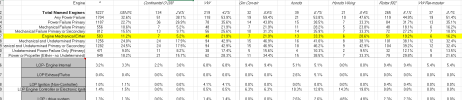
Here's a quick screen shot, showing the comparison of a number of engines on homebuilt aircraft.
1769218859841.png
Note that one column lists Honda Viking (the standardized listing I selected) and the next set is the Rotax 582 two-stroke engine. Compare the two.

So, no, it's not just looking up key words.

Ron Wanttaja
 
Back
Top