Too much airplane for you

The problems caused by failing to push the red knob forward are the same on a retract vs straight leg. You just get to add retract problems on top of that with an RG.

Apples to apples, a retract vs a straight leg is going to have more maintenance. The 182 retract is even more so. Additional maintenance, additional inspections. Additional Repairs will be needed. Saddles on the main gear will crack (club spent over $30,000 to get used parts from Canada). Same plane last December had a nose gear that didn't want to come down. Between the repairs to the plane, new prop, engine tear down, it was out for over six months. And even with the insurance, was expensive.
I guess, I have only operated 182RG airplanes for the last 30 years and have over 1000 hours in them. The gear system is not high maint. I own one today.
 
I guess, I have only operated 182RG airplanes for the last 30 years and have over 1000 hours in them. The gear system is not high maint. I own one today.
Congrats on your successful hours on the 182 RG.

Maybe we just got an older and/or more problematic 182 RG. Seems to always have more going on vs the Skyhawks and the fixed gear Skylane, and it’s always gear related.

Oh, and now we have a problem with the nose gear door not closing properly.
 
I remembered moving from Green Bay to Eau Claire back in the 70s
Off topic. Eau Claire, oddly comes up in my life a lot!

My boss grew up there and his parents still live there. I bought a Cessna 140 from a guy there. I ferried a Pitts from there. I print a lot of photos for my hangar... from Sharp Prints in Eau Claire, and my girlfriend's company has a location there. Maybe I'm destined to live there someday!
 
Congrats on your successful hours on the 182 RG.

Maybe we just got an older and/or more problematic 182 RG. Seems to always have more going on vs the Skyhawks and the fixed gear Skylane, and it’s always gear related.

Oh, and now we have a problem with the nose gear door not closing properly.
It’s the most simple door system in landing gear - a bar that rides on the nose gear and connected to the doors by turnbuckles. Unless somebody damaged the door exceeding VLE there should be zero issues with the gear door. How you do that on a plane with a 140 KIAS gear speed…..

If you end up needing a door, PM me. I located one for a friend and have a source.
Thanks! I’ll ask our maintenance chief if he needs it. Door problem probably relate to the nose gear collapse landing last year.
 
I think you can get used to anything. When I first flew the Lance I was afraid I screwed up. Couldn't see anything with that big nose, and everything seemed to happen so fast. Now it feels completely normal, and when I get into a Skyhawk or Archer it feels like slow motion. I presume that stepping up to even bigger/faster aircraft would go about the same.
That was my experience transitioning from the Archer to the Lance. The landing gear/CS prop and heavier controls weren’t a big deal. The real transition was just getting used to everything happening at a faster pace in the pattern.
 
…The real transition was just getting used to everything happening at a faster pace in the pattern.
Funny. I think things happen too slow in the pattern with a 172.
 
@SixPapaCharlie how was it going from the Comanche to a E175? That's an actual big transition. Do you think your twin time was valuable, or is the jet completely removed from piston planes?
I can’t speak for Bryan, but I teach a similar transition. First and foremost, people struggle with the fact that a jet is still an airplane, and can be treated as such. I spend a lot of time trying to get people to use basic instrument skills and understand what the flight instruments are telling them. And why when they’re at 15 or 20 degrees of pitch, they end up too slow when the target in the profile is 10 degrees for the proper speed. Stuff like that.

Same with twin time, the value is in understanding the principles involved and why we do what we do, so they can be applied to the jet (or not, as appropriate.) since most pilots haven’t had an engine failure in a twin, the muscle memory for controlling the airplane isn’t really any better at 100 hours of multi time than it is at 10 hours of multi time.

 
I can’t speak for Bryan, but I teach a similar transition. First and foremost, people struggle with the fact that a jet is still an airplane, and can be treated as such. I spend a lot of time trying to get people to use basic instrument skills and understand what the flight instruments are telling them. And why when they’re at 15 or 20 degrees of pitch, they end up too slow when the target in the profile is 10 degrees for the proper speed. Stuff like that.

Same with twin time, the value is in understanding the principles involved and why we do what we do, so they can be applied to the jet (or not, as appropriate.) since most pilots haven’t had an engine failure in a twin, the muscle memory for controlling the airplane isn’t really any better at 100 hours of multi time than it is at 10 hours of multi time.
Would you say that the transition to working as a crew is a bigger adjustment than the actual flying?
 
I wont speak for racerx, but in my personal opinion, there is a much smaller menu of ways to maim/kill yourself in a car than an airplane. Though probably much more commonly ordered, in a car.
I think it’s exactly the opposite. In a car, you can be driving a safe, well-maintained vehicle, observing the speed limit, following all the rules of the road, be alert, well-rested and focused, and get nailed by a teenager texting. Or a drunk driver. Or any manner of idiot. There are a zillion ways to go in a car that have absolutely nothing to do with you and that you can’t do a blessed thing about.
 
Not universally the case, but in my case yes, driving commute home every weekend is easily the most dangerous thing I do all week, which is a statement given what I do at work all week. Flying the commute home would increase my costs 10 fold, but would drastically decrease my actuarial risk of injury significantly, given my pilot demographic and use case (VMC/MVFR IMC deck pushes, no forced LIFR or convective).
 
Maybe initially, but for the most part with training and experience I got there in anything I've had the opportunity to fly. New taildraggers probably give me the most hesitation, because there is so much variety in how they can handle. Nothing tricycle gear usually gives me heartburn.

I remember my first time in a "high-powered" experimental aerobatic aircraft, I was careful putting in the power to ensure I had enough rudder to keep it straight, but I was in the air before I got anywhere near full throttle.
 
Would you say that the transition to working as a crew is a bigger adjustment than the actual flying?
It’s a different mindset, and it can be a bigger adjustment, particularly for a PIC as he is responsible for “delegating” rather than “doing everything.”
 
One of the reasons I like that new $70k single-person spirit airplane so much is because of that kind of mission. While it ain't that involved to pull the Arrow out of the hangar and get it going, I find the idea pretty enchanting of a cheaper, easier-to-move, 3gph, low+slow, fly 1k AGL, taildragger for those sorts of missions.

Even for going some place like my routine flights to MI. Even though my current plane isn't a speed demon, there's times where I get to Michigan and I feel almost disappointed because I only got an hour of flight time.
You must live in Toledo, Ohio!
 
Off topic. Eau Claire, oddly comes up in my life a lot!

My boss grew up there and his parents still live there. I bought a Cessna 140 from a guy there. I ferried a Pitts from there. I print a lot of photos for my hangar... from Sharp Prints in Eau Claire, and my girlfriend's company has a location there. Maybe I'm destined to live there someday!
I lived there five years and liked it very much. We moved a lot, from Eau Claire to western New York, to Michigan, then Minnesota, then back to Michigan and now central Wisconsin.
 
I think it’s exactly the opposite. In a car, you can be driving a safe, well-maintained vehicle, observing the speed limit, following all the rules of the road, be alert, well-rested and focused, and get nailed by a teenager texting. Or a drunk driver. Or any manner of idiot. There are a zillion ways to go in a car that have absolutely nothing to do with you and that you can’t do a blessed thing about.

Part of what makes I-4 so deadly are all the $#%^&*$%^#!!!!! construction zones. I've yet to fly through an area where crews were trying to rebuild or widen the sky.
 
I remember my first time in a "high-powered" experimental aerobatic aircraft, I was careful putting in the power to ensure I had enough rudder to keep it straight, but I was in the air before I got anywhere near full throttle.

Most of those planes have so much rudder authority you could damn near take off at a right angle to yourself.
 
Most of those planes have so much rudder authority you could damn near take off at a right angle to yourself.

Exactly what I trying to avoid! :rofl:

My first takeoff in a twin turbine started to go that way. Once those PT6s spooled, the torque and P-factor came on quick! I was no rookie on using rudder pedals, but it sure looked like it. Luckily I quickly recovered and it was just my instructor and I in the plane.

Fortunately...
1759455458485.png
 
Often times you'll hear people thinking about upgrading aircraft and say things like "I want more speed, more seats, more useful load, a turbo..."

I'm curious about the reverse. Have you ever flown in an airplane and been like "this is TOOOOO fast" or "this is too big!" or "TOOOOO complicated!" or "too dangerous".

I know it goes against everything in the Y chromosome to admit it. But I'm wondering if anyone's hopped in a prospective aircraft and decided "noooooo way, this is too much".
i wasn't hopping into it, but just this morning I was looking at a picture of a little Bede jet and had that very thought. "Nope, that thing is way too much for me". I'm very rusty these days, and maybe it's that doing the talking for me.... but I can't see myself hopping into one of them for a flight, even if I was current and proficient.
 
Often times you'll hear people thinking about upgrading aircraft and say things like "I want more speed, more seats, more useful load, a turbo..."

I'm curious about the reverse. Have you ever flown in an airplane and been like "this is TOOOOO fast" or "this is too big!" or "TOOOOO complicated!" or "too dangerous".

I know it goes against everything in the Y chromosome to admit it. But I'm wondering if anyone's hopped in a prospective aircraft and decided "noooooo way, this is too much".
The first time I strapped into a T-38 I thought it might be a bit too fast. The second time, I realized I was mistaken.

@SixPapaCharlie how was it going from the Comanche to a E175? That's an actual big transition. Do you think your twin time was valuable, or is the jet completely removed from piston planes?
I also can't speak for him but I go back and forth often between several different airframes and missions. They are all similar in small ways and different in many others. I hear people at work say stuff like "they wouldn't know what to do with a 172" but in reality, they would. They would be fine after a lesson or two to get the sight picture back. It's not rocket surgery.

Would you say that the transition to working as a crew is a bigger adjustment than the actual flying?
I realize you weren't asking me either..... but hey, it's the interweb. Transitioning to a crew from flying single seat fighters wasn't nearly as big of an issue as people make it out to be. The crew concept fits the "mission" of the airlines very well so it makes sense. I never thought it was awkward to have a crew in big airplanes and a single pilot in small ones. If we tried a crew concept in the Supercub, that might be strange though.
 
If we tried a crew concept in the Supercub, that might be strange though.
I'm trying to wrap my head around that one. All you've got in the back is the stick and rudder, throttle, and brakes. I guess the rear seater could fly and the front seater could just run the radios, adjust mixture, flaps, and carb heat when told, and watch the gauges and switch fuel tanks.
 
Every plane I’ve bought or flown that was a little bigger than the last felt a little overwhelming at first, but it goes away super quickly, sometimes within just an hour or two depending on the type. I’ve kinda decided that retracts aren’t a good fit for me, though. I’m pretty confident eventually I’d forget that lever and then…
 
I think it’s exactly the opposite. In a car, you can be driving a safe, well-maintained vehicle, observing the speed limit, following all the rules of the road, be alert, well-rested and focused, and get nailed by a teenager texting. Or a drunk driver. Or any manner of idiot. There are a zillion ways to go in a car that have absolutely nothing to do with you and that you can’t do a blessed thing about.

Your point is valid. But I’d also submit that these things are entirely predictable or observable for an attentive driver. Drunk driver driving wrong way with lights out is maybe a different story. But regular bad driving is pretty easy to spot. There are a lot of subtle clues people exhibit before they do stupid stuff in cars. If you are paying real attention, you spot them and given enough experience on the road, know what is coming. That being said, most drivers on the road should have their licenses revoked and their cars impounded for pure idiocy (especially all long haul truckers in the state of WY on I-80). So i feel your concern.
 
Your point is valid. But I’d also submit that these things are entirely predictable or observable for an attentive driver. Drunk driver driving wrong way with lights out is maybe a different story. But regular bad driving is pretty easy to spot. There are a lot of subtle clues people exhibit before they do stupid stuff in cars. If you are paying real attention, you spot them and given enough experience on the road, know what is coming. That being said, most drivers on the road should have their licenses revoked and their cars impounded for pure idiocy (especially all long haul truckers in the state of WY on I-80). So i feel your concern.
In the air, fate is the hunter. On the road, millions of other drivers are hunting you, some of them with 50-ton missiles with faulty brakes and a methed-up guidance system.
 
@cowtowner told me a similar story. He bought a Columbia 400 for business travel. Loves the plane, but said he misses having a cheaper, less thirsty plane for those breakfast runs.

"There are no solutions, only tradeoffs"
Yup. 10000%
 
@cowtowner told me a similar story. He bought a Columbia 400 for business travel. Loves the plane, but said he misses having a cheaper, less thirsty plane for those breakfast runs.

"There are no solutions, only tradeoffs"

That is why everyone needs at least two airplanes. One go fast hauler for travelling, and another low and slow for buzzing around the patch or the occasional flight breakfast.

Kind of like owning a truck and a sportscar.
 
GA is 9 to 14 times more dangerous than driving.

100% true. I think it's closer between motorcycles and light aircraft. But even with that, I'd rather the most significant risk be "me doing something wrong" than "teenager turns left in front of me". Even if it's not true, I want to believe that I'm not going to do the stupid thing that kills me, and trust that I'm pretty good at risk management...probably like every pilot, ever, also thinks...and I'm unlikely to trust the complete stranger headed at me as much.

Back to original question, I wouldn't want to fly something small and not-slow without a lot of experience. Thinking like a lancair or RV or something. I'm used to aircraft that are pretty stable in all three axis, and something that's more "twitchy" than that, for lack of a better way to put it, I'd be cautious of. Maybe that's my ignorance, but for the second time today thinking about RC compared to full size....pretty much everyone can fly a scale model cub. Not everybody can fly a scale model P-51. They're fun to fly, but they will absolutely do things you don't want them to do if you're not on top of it.
 
I had a guy call me once and asked if I would provide instruction/checkout in the Cessna 340 he just bought; I guess the FBO told him I was MEI. Talked to him for a bit and found out he was a student pilot with about 20 hours. I declined.
I’ve flown with a couple of people who were too much student for me.
 
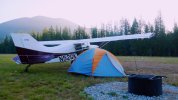
I never tried an airplane that made me think I overstepped my abilities as a pilot, but I consciously shopped for a slower plane as I aged up. I now fly a Maule and it certainly doesn't fly faster than I can think. It's a good 50 knots slower than the fastest plane I ever flew regularly (a Mooney M-20E) but it is great in the back country and still takes me everywhere I want to fly. I just have to be more patient getting there. Since I'm retired now, the slower pace isn't an issue. There is no place I actually have to be at any specific time. When flying cross country to see my kids and grandkids this year, thunderstorms delayed my arrival by 2 days. A faster plane wouldn't have fixed that, and these storms were serious enough that there was never any consideration of filing IFR to get through them. With the Maule's back country chops, I was able to do some airplane camping on the way home at sweet little grass strips tucked into the mountains. There are lots of upsides to low and slow.
Sunrise-Sullivan-Lake.jpeg
 
Back
Top