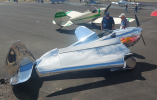
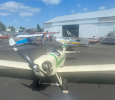
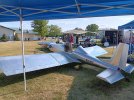
The new Spirit SE 1: What are your thoughts?

Not necessarily. It's more about the CG's location (horizontal and vertical) relative to the main wheels.
I wonder how the CG is on the SE-1 in that regard. Ultimately my question is whether what happened was specifically more likely to occur with this plane than another, larger and heavier taildragger like a Cub, Citabria, Champ, C140, etc. And even larger/heavier ones like a Maule or C170/C180.
 
I've done it and it's not a hassle at all. And we have our own vehicles to haul the containers. Do you not?
Believe he's referring to what you have to do if you're on a cross-country, if you can *only* use car gas.

As long as use of 100LL is *allowed*, it's no problem. Drink autofuel at the home airport, get avgas from the pumps while on a trip.

Moved to a new home a year ago, when spring came this year, I figured out where the gas stations were that had zero-alcohol auto gas. Haven't put in 100LL since. I run 100LL in the winter months due to less flying and the fuel's better stability.

And if I go on a trip, big deal. My C-85 has no problem with 100LL.

Ron Wanttaja
 
I wonder how the CG is on the SE-1 in that regard. Ultimately my question is whether what happened was specifically more likely to occur with this plane than another, larger and heavier taildragger like a Cub, Citabria, Champ, C140, etc. And even larger/heavier ones like a Maule or C170/C180.
I don't think so.
 
specifically more likely to occur with this plane than another, larger and heavier taildragger like a Cub, Citabria, Champ, C140, etc.
Depends. The early Cessna 120/140 had a pretty light tail - some people resorted to extenders to move the wheels forward. Later models had the gear moved a bit. The tradeoff is between how hard it is to pick up the tail and resistance to ground loop - the further forward you put the gear the harder it is to stop rotation once it is started.
Drink autofuel at the home airport, get avgas from the pumps while on a trip.
That's what I do.
 
I wonder how the CG is on the SE-1 in that regard. Ultimately my question is whether what happened was specifically more likely to occur with this plane than another, larger and heavier taildragger like a Cub, Citabria, Champ, C140, etc. And even larger/heavier ones like a Maule or C170/C180.
Still doesn't matter. A very light plane like the Spirit has less weight on the tail, but also less momentum trying to overturn the plane when the brakes are applied. The two cancel out so it's the geometry that matters.
 
Still doesn't matter. A very light plane like the Spirit has less weight on the tail, but also less momentum trying to overturn the plane when the brakes are applied. The two cancel out so it's the geometry that matters.
In that case, could the geometry of the SE-1 contribute to being easier to plant the nose with than other, more traditional tailwheel planes? For instance the main gear legs seem pretty close together which I could see contributing to what happened.
 
I wonder how the CG is on the SE-1 in that regard. Ultimately my question is whether what happened was specifically more likely to occur with this plane than another, larger and heavier taildragger like a Cub, Citabria, Champ, C140, etc. And even larger/heavier ones like a Maule or C170/C180.
My Jodel was terribly light in the tail. Empty weight of 766 lb., tail so light I could pick it up and wheel it around like a golf cart. One simply has to learn how to fly, that's all. No different than anything else in flying. Had to hold elevator full up during the runup, for instance. I have seen the pilots of other, heavier taildraggers not do that, and that tailwheel is off the ground a bit. They seem blissfully unaware that the thing is thinking of nosing over.

One can brake fairly heavily if you're modulating that elevator control to keep the tail down. As the airspeed drops off, the elevator authority disappears and you have to ease up on the brakes. Anyone taking taildragger training should be schooled in this.

One of the fastest ways to stop a taildragger is to raise the tail a whole bunch right after touchdown, then brake heavily and use the elevator and brakes to keep it from nosing over. Lifting the tail way up kills the lift as the AoA is reduced, and adds traction for the wheels. But the Jodel was a little too light in the tail to risk this. I did it in the Citabrias and 185, though. Steering with the brakes.
 
In that case, could the geometry of the SE-1 contribute to being easier to plant the nose with than other, more traditional tailwheel planes? For instance the main gear legs seem pretty close together which I could see contributing to what happened.
The gear width doesn't affect the tendency to nose over, only its fore and aft position does. A narrow gear can be an issue in crosswind landings, though.
 
Currently at OSH….i had the pleasure of chatting with a company employee and we kinda did a walk around with a great narrative on the plane……all the skin seems/joints are perfect, riviting is excellent and attention to detail is awesome! Modern tech equipment to design and manufacture…….ive seen and flown multi million dollar jets that we “sloppier” build quality!

Its not by any means a high tech digital all weather cross country machine! Its a well designed afternoon hamburger getter!

This looks like it would be a blast to hop around to your local fly-ins & grabbing that $100 hamburger!
 
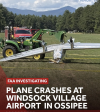
Whoops - my local airfield community today. Nothing hurt but ego and some sheet metal.

Screenshot 2026-08-12 at 3.39.13 PM.png
 
I've wondered just how one would get out of the thing if this happened. If you know, please share. Or is that what the tractor was for?
Word is tractor lifted the tail and he self extracted
 
I've wondered just how one would get out of the thing if this happened.
Pete Bowers claimed the Fly Baby vertical tail was tall enough to hold the cockpit off the ground far enough for the pilot to slither out. I have my doubts.
1786570381462.png
It's fortunate the Spirit accident happened with people nearby. Probably a worse outcome (for both Spirits and Fly Babies) if it's a forced landing out in the toolies somewhere.

BTW, should mention that the pilot in the above accident wasn't even in the plane when it happened. Fly Baby got loose while hand-propping.

Ron Wanttaja
 
looking forward to the SE-1.1 with a rollbar to allow pilot egress when inverted :D

I was initally worried about insurance rates since it has to still be a small risk pool for the SE-1, but then I remembered these things are 60k so it might be a crumple-toss-get-another situation? I hope this incident doesn't doom the builder.
 
looking forward to the SE-1.1 with a rollbar to allow pilot egress when inverted :D
Not so easy, with an SE-1 or any other single-seat low-wing airplane

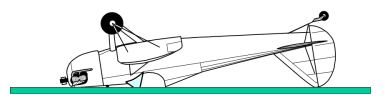
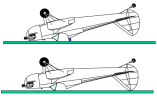
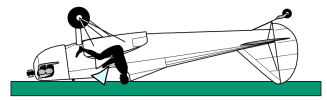
Let me illustrate the problem using the Fly Baby. Here's a normal Fly Baby on its back:
1786575352797.png
The windshield has crushed, the weight of the engine plants the nose firmly on the ground.

Note that the headrest behind the pilot is shown as just barely touching the ground. The headrest on a stock Fly Baby is not a structural element, either, so if the plane flips over on soft ground, the vertical stabilizer will tend to dig in and the pilot has even less space.

There's obviously a bit of a gap there...but that's in a direction the human body is not really designed to bend.

Rollbars will help...top diagram shows the effect of a roll bar behind the cockpit, the bottom one shows one built into the windscreen.
1786576253298.png
A bit more room, but still not that all that generous.

It's funny, I rarely hear of turnover accidents in Fly Babies. Perhaps those are the fatal cases, and the fact that the plane flipped doesn't come through that clearly in the reports.

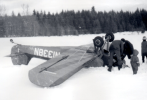
I've posted this photo several times, but it shows a Story Special (immediate ancestor of the Fly Baby) on its back on a snowy field. The pilot (a small man) had to tunnel out through the snow to get clear.
1786576463463.png
Ron Wanttaja
 
FTFY. Current version already has a rollbar....
View attachment 154319
That thing is adorable. I'm guessing our rollover pilot was happy to have it, but... I mean, my hotel shower ADA wheelie bar is like 3x that size. :D

Looking again, I guess that little dude did its job. Kudos to Spirit on that bit of thoughtfulness.
 
“Don’t assume the only way out in an emergency is through the normal doors”. Is the fuselage side or bottom thin enough it can be broken through by an adrenaline filled pilot? (Or a severely injury pilot?). My home built’s seat isn’t rigidly attached, enough for normal operations (especially with pilot belted on top of it), but can be yanked away exposing an area of only cloth covering more than big enough to egress through quickly if it went belly up.
 
“Don’t assume the only way out in an emergency is through the normal doors”. Is the fuselage side or bottom thin enough it can be broken through by an adrenaline filled pilot? (Or a severely injury pilot?). My home built’s seat isn’t rigidly attached, enough for normal operations (especially with pilot belted on top of it), but can be yanked away exposing an area of only cloth covering more than big enough to egress through quickly if it went belly up.
Fly Baby has structure below the seat, as well as the tubing associated with the control system.
1786589087215.png
Cockpit is above the two spar carry-throughs.

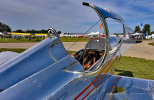
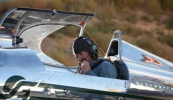
The Spirit also concerns me a bit as it has a throw-over cockpit section.
1786589177567.png
That'll tend to get in the way of inverted egress.

Ron Wanttaja
 
Well, right wrong or indifferent, I put a deposit on one after Oshkosh. Estimated delivery time in about 18 months.
I’ll be curious to hear your real-world review! My friend who bought one sold it before I got a chance to fly it!
 
Why did he sell it?
They had a lot of engine issues early on, but I think they sorted those out. It really came down to the plan of training people in a Luscombe, then transitioning them into the SE-1 wasn’t something he wanted to take on. I’ve heard from other high-time tailwheel pilots that it comes in a little hot and maybe too much for a low-time pilot. All hearsay on my part… I’d still like to fly one!
 
This might be a bit of a thread drift, but wouldn't it make sense to add a tailwheel lock capability to help low timers transition?
 
This might be a bit of a thread drift, but wouldn't it make sense to add a tailwheel lock capability to help low timers transition?
Depends on what they're having problems with. The issue could be the lack of forward visibility, the landing gear being too "springy", distraction in an open cockpit, abrupt stalls in the flare, uneven operation of the landing gear oleos, etc.

Even if the issue is ground-looping, it may not be an issue with the tailwheel itself. Dick Starks and Tom Glaser built two WWI Nieuport replicas, and had ground-looping problems. Steerable tailwheel, but wasn't the castering type and thus didn't break free and swivel with side loads. Their problem turned out to be the landing gear geometry itself; they moved the main gear back a foot or so and the problems went away.

Hesitate to mention this, too, but the Spirit is probably appealing to a broader market who have no background in taildraggers.

Like the Spirit, the Fly Baby is a single-seater and thus a traditional checkout is impossible. I haven't heard a lot of ground-loop stories, though I've had one or two close calls myself.

Ron Wanttaja
 
Not so easy, with an SE-1 or any other single-seat low-wing airplane

Let me illustrate the problem using the Fly Baby. Here's a normal Fly Baby on its back:
View attachment 154320
The windshield has crushed, the weight of the engine plants the nose firmly on the ground.

Note that the headrest behind the pilot is shown as just barely touching the ground. The headrest on a stock Fly Baby is not a structural element, either, so if the plane flips over on soft ground, the vertical stabilizer will tend to dig in and the pilot has even less space.

There's obviously a bit of a gap there...but that's in a direction the human body is not really designed to bend.

Rollbars will help...top diagram shows the effect of a roll bar behind the cockpit, the bottom one shows one built into the windscreen.
View attachment 154323
A bit more room, but still not that all that generous.

It's funny, I rarely hear of turnover accidents in Fly Babies. Perhaps those are the fatal cases, and the fact that the plane flipped doesn't come through that clearly in the reports.

I've posted this photo several times, but it shows a Story Special (immediate ancestor of the Fly Baby) on its back on a snowy field. The pilot (a small man) had to tunnel out through the snow to get clear.
View attachment 154324
Ron Wanttaja

You'd also need enough room in the inverted cockpit to be able to turn sideways.
 
You'd also need enough room in the inverted cockpit to be able to turn sideways.
Yup. That's what I meant by "There's obviously a bit of a gap there...but that's in a direction the human body is not really designed to bend."

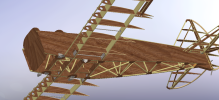
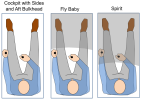
This illustrates the problem. The left diagram shows the pilot in the cockpit, with the bulkhead behind his back, and the sides. Note that rotating left and right is difficult....one's legs get in the way. One has to pull them way, way back to be able to twist out sideways.

The middle and right diagrams have shaded areas showing where the top of the fuselage blocks access. The Fly Baby's cockpit opening ends just forward of the controls, about where the forward bulkhead sits. The Spirit has that throw-over cover that makes the cockpit more snug in flight, but even more restricts the room one has to get out.

*If* that throw-over cover could be released when inverted, it's probably light enough to get shoved out of the way.

1786640996221.png

Of course, there STILL ain't much room to get out, even in a Fly Baby...
1786641740676.png
The other factor, of course, is the issues with being upside down in the cockpit. One's legs are probably going to be resting on the bottom of the instrument panel. This is going to complicate matters to an additional extent.


Ron Wanttaja
 
Last edited:
I've been upside down in a car before. Not fun to get out, hanging by the seatbelt, crawling out a window. These planes would be much more difficult with no where near the same amount of interior room as a car.
 
Yup. That's what I meant by "There's obviously a bit of a gap there...but that's in a direction the human body is not really designed to bend."

This illustrates the problem. The left diagram shows the pilot in the cockpit, with the bulkhead behind his back, and the sides. Note that rotating left and right is difficult....one's legs get in the way. One has to pull them way, way back to be able to twist out sideways.

The middle and right diagrams have shaded areas showing where the top of the fuselage blocks access. The Fly Baby's cockpit opening ends just forward of the controls, about where the forward bulkhead sits. The Spirit has that throw-over cover that makes the cockpit more snug in flight, but even more restricts the room one has to get out.

*If* that throw-over cutter could be released when inverted, it's probably light enough to get shoved out of the way.

View attachment 154334

Of course, there STILL ain't much room to get out, even in a Fly Baby...
View attachment 154335
The other factor, of course, is the issues with being upside down in the cockpit. One's legs are probably going to be resting on the bottom of the instrument panel. This is going to complicate matters to an additional extent.


Ron Wanttaja
We had a Spezio Tuholer when I was a kid…never thought much about being upside down in it when I was flying it regularly, but when I was going to check my brother out in it in my mid-20s it suddenly occurred to me that it would be a very bad thing. Fortunately I didn’t fit in the front cockpit….couldn’t get my knees under the panel. I have no idea how my dad sat up there for 10 hours checking me out!
 
I’m guessing here, but it’s short length, low weight (less inertial), and swings a prop that is probably proportional heavier to the airframe weight than most pilots are used to to. I would not be surprised to here it has veering tendencies as the tail comes up and or goes down..
 
I’m guessing here, but it’s short length, low weight (less inertial), and swings a prop that is probably proportional heavier to the airframe weight than most pilots are used to to. I would not be surprised to here it has veering tendencies as the tail comes up and or goes down..
Wood prop. Not THAT much of an issue, I would think.
 
Here's my thoughts, and I think it is a great looking little airplane. I like that it's affordable in an already overpriced industry. I think it's great that their engine is new, and I look forward to seeing them grow as a company because believe it or not, this is what people have been asking for. So it looks cheap to "some" people? Great, don't fly/buy one. And that's a great way to isolate yourself being an a** to people who are just as proud as you are to be able to finally get in the air. Seriously, crapping on the little guy? It's got great ramp appeal, and despite "Some" peoples opinions, it's built well. We're supposed to be ambassadors of this hobby, right? I wouldn't want to share the ramp with people like that. My advice, if you see something you're jealous of, keep it to yourself, or turn your nose up elsewhere. People are going to buy and fly the crap out of this, and then maybe move on to more complicated/expensive aircraft. It's not supposed to be some glass panel/ifr/high performance aircraft. It's meant for fun, and it looks great. If and when I see one of these on the ramp, I'm going to walk right up to the pilot and say, "Wow, that's a nice looking airplane!" And give them a high five. I did that just the other week to a young gentleman who had a old Cub with yellow duct tape on the side. He told me he was saving up to recover it and put a 90hp up front. There's no reason to hate on any plane. Now the FAA... that's a different story. ;)
 

Attachments

  • 137.jpg
    137.jpg
    2.5 MB · Views: 7
Back
Top