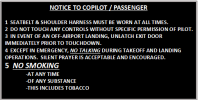
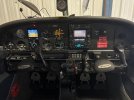
This is my typical briefing for a non-pilot passenger, especially one who has little or no experience in small planes:
This is how your seatbelt works (as I demonstrate). Keep it on and keep the shoulder straps snug, but you can loosen them a bit after we level off in cruise.
You open the door by rotating this handle down (demonstrating). We’ll close the door before starting up and keep it latched.
There’s a fire extinguisher in that pouch by your right leg. Don’t put anything else in that pouch so you don’t accidentally pull the trigger on it and make a mess, although it does have a little plastic tie on it to protect it. (Shows them the location and operation of the extinguisher without saying we could have an in-flight fire.)
You can adjust the seat with this lever. Let’s get it set for you now. Go ahead and leave it there. And just in case it comes unlatched, just let go and let it slide back - don’t grab anything.
There’s a vent up here. Pull it out for fresh air.
If you start to feel motion sickness - and it’s okay if you do, because it’s a common thing for a lot of folks - there are airsickness bags right here. Please use that if you have to, because upholstery cleaning is expensive. Also use the vent to get fresh air, and look as far ahead forward as possible - that usually helps.
I’ll be using the radio to talk to other planes and Air Traffic Control. If the radio is going, I need to hear what they’re saying. And from when we take off until leveling off, and then when we start descending to land, those are times when I have more things to do, so I probably won’t be saying much. I will try to explain everything we’re doing, though.
You’ll see me using this checklist. It isn’t directions on how to fly the plane, but just a way to make sure that important switches are set where they need to be. We can make mistakes, and every pilot - airline pilots, fighter pilots, even astronauts - uses a checklist.
You can help me by pointing out other planes. Let’s see how many you can spot.
If we need to change our plan for any reason, I’ll tell you and keep you aware of what we’ll be doing. (Instead of saying “in the event of an emergency”.)
Any questions?
If you have any questions while we’re flying, want to see something on the ground, or how the plane works, definitely ask.
———-
During the flight, one thing I like to do is to start circling some particular point of interest on the ground while talking about it, typically entering the orbits at 2500 AGL. As we’re circling, I slowly reduce power to idle and pitch for Vg. After a minute or so, I tell the passenger that we’re just idling and to see how the plane still flies perfectly fine, and that it’s a regular training event to handle a power loss.
Many first-timers have said that it really helped them understand and be more comfortable with small planes, as they of course thought that we’d plummet if the engine quit, rather than gently flying and only losing a thousand feet over a couple minutes.