Pending cost of FAA mandates for legacy aircraft

Except a lot of parts on certificated aircraft are common parts. The door locks are locks for cabinets. Auto alternators. All sorts of off the shelf, non-aviation parts.
Like the interior door handles on my 1960 Cessna. $250+ for a well-used official gen-u-ine aviation certified handle, if you can even find one, and close to $300 for a new “better” one from McFarlane. Or $26 for a 1960-63 Ford Falcon door handle, which is what Cessna used.
 
I have a bunch of hours behind the Rotax. I like them.
An acquaintance is trying to put a Rotax 912 (100 hp) in a Taylorcraft. The FAA is throwing up a new roadblock every week.
 
An acquaintance is trying to put a Rotax 912 (100 hp) in a Taylorcraft. The FAA is throwing up a new roadblock every week.
Interesting. What process is he using to install the engine? Usually, its during the initial meetings with the FAA that all the "roadblocks" are defined and agreed to by both parties. And typically, its the installer who has to make changes later on vs the FAA as the defining regulations are basically locked in before work starts.
 
Interesting. What process is he using to install the engine? Usually, its during the initial meetings with the FAA that all the "roadblocks" are defined and agreed to by both parties. And typically, its the installer who has to make changes later on vs the FAA as the defining regulations are basically locked in before work starts.
Dont they have certified versions of Rotax engines ?
 
Dont they have certified versions of Rotax engines ?
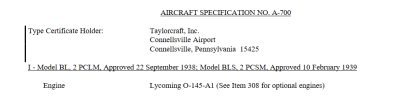
Sure they do, but that does not grant the right to put one in any certified airplane. The Type Certificate for a Taylorcraft, like any other certified airplane, will list the engines approved for it. Let's look at the Type Certificate Data Sheets for the T-Craft. For the really early ones such as the BL-65, the TCDS lists the 65-HP Lycoming O-145-A1 as the only approved engine:

1782598113896.png
For the popular BC-65 of 1939 and later, it was the Continental A-65-8:

1782598804524.png
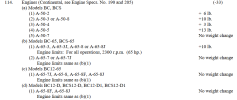
Let's see those optional engines mentioned there, for several different models:

1782598931924.png


For the Model 19 of 1951 it was the C85-12 or 12F 85-HP Continental:

1782598200904.png

For the F19 of 1980 is was the Lycoming O-235-L2C.

1782598270235.png

Note the very specific engine models. One cannot, for instance, stick a C85-8 or C85-12J in that Model 19. Any departure from these engines for these airframes requires further certification, usually in the form of an STC. a Supplemental Type Certificate. Money and time for that, of course. If someone else has already stuck a 100-HP Rotax in the same model that you want to do that to, you could buy the STC from him.
 
Last edited:
Im struck by the "it'll never work" themes popping up in a thread started by a guy who made it work and, but for the FAA, would likely sell dozens. If the revenuers wont let you put that on a Cessna, I hope you can sell your proprietary components for use on experimentals. Have you discussed creating a "hold harmless" of sorts to sell your V8 cessna as-is? If thats not feasible, I'd be interested in your one-off FWF.
 
Im struck by the "it'll never work" themes popping up in a thread started by a guy who made it work and, but for the FAA, would likely sell dozens. If the revenuers wont let you put that on a Cessna, I hope you can sell your proprietary components for use on experimentals. Have you discussed creating a "hold harmless" of sorts to sell your V8 cessna as-is? If thats not feasible, I'd be interested in your one-off FWF.
"Except for the FAA" is a red herring.The rules are written in black and white. It is very expensive and time consuming to comply with the rules in the certified world for something as significant as a new engine and an engine swap (STC) into an existing certified airplane. That's the beauty of the certified world in that when you buy a certified aircraft/engine combo, you know what you're getting has been thoroughly vetted.

If you don't want to pay that price, Experimental is the path forward.
 
I can only hope the FAA doesnt ruin that also. Call it what you will, the regulations are what is killing single engine piston GA.
 
I can only hope the FAA doesnt ruin that also. Call it what you will, the regulations are what is killing single engine piston GA.
Regulations (IMO) are one of the lesser issues. Interest in the hobby is the biggest issue. The fascination with flying/space/adventure ended with Apollo 11 or thereabouts. Before that all forms of aviation were big news. Since then, not so much. In addition, the improvements in automobiles and roads have largely taken away the justification that "It'll be easier to fly 200 miles to my next appointment than to drive so I'm gonna buy an airplane." There are a host of other reasons GA is suffering. But it survived and grew with most of the current regulations already in place.
 
Call it what you will, the regulations are what is killing single engine piston GA.
Which regulations? You mean Part 23 that was rewritten in 2017 which removed 1000+ prescriptive regulations and replaced them with performance standards listed in ACs? Those same performance standards also apply to STC approvals as well.

But if the rules were actually killing GA, why did Beech and Cessna develop two clean-sheet aircraft since 2017? Even GE developed a new engine to power the Beech model and Part 33 wasn’t rewritten. And if the FAA was really trying to kill the recreational single engine piston market, why did they spend millions to develop and implement MOSAIC for that same market?

The only group killing anything are the recreational owners themselves. And if they allow MOSAIC to fail as well, I think the entire recreational market will implode sooner than later. Or at least until eVTOLs enter the recreational market with their new owner demographics.
 
I wouldnt suggest that the FAA is passing new regulations with the intent to kill GA. I do think that the old regulations are a big part of the high parts and repair cost of the aging fleet of GA planes. I'm also not convinced that it keeps us any safer. My FAA-PMA Timken wheel bearings cost triple the same brand and spec wheel bearings from the local bearing and hydraulic shop. In any other business its absurd, but we tolerate it in aviation, "cuz safety n stuff". The difficulty changing these rules Corsair V8 story, for one) seems to discourage development of new engines or engine parts which would help with costs.

If a .010 under crank for an O-300 costs $10k, that's a problem. For those of you who are well versed in the FARs, how could the FAA change the regs to help, if they were willing?
 
Which regulations? You mean Part 23 that was rewritten in 2017 which removed 1000+ prescriptive regulations and replaced them with performance standards listed in ACs? Those same performance standards also apply to STC approvals as well.

But if the rules were actually killing GA, why did Beech and Cessna develop two clean-sheet aircraft since 2017? Even GE developed a new engine to power the Beech model and Part 33 wasn’t rewritten. And if the FAA was really trying to kill the recreational single engine piston market, why did they spend millions to develop and implement MOSAIC for that same market?

The only group killing anything are the recreational owners themselves. And if they allow MOSAIC to fail as well, I think the entire recreational market will implode sooner than later. Or at least until eVTOLs enter the recreational market with their new owner demographics.
There must be some structural reason why GA in this country resembles the automotive market in Cuba, where the vast majority of people drive 50+-year-old cars and the streets look like a postcard from the 1950s—just like many GA airports over here.
 
There must be some structural reason why GA in this country resembles the automotive market in Cuba, where the vast majority of people drive 50+-year-old cars and the streets look like a postcard from the 1950s—just like many GA airports over here.
Lack of demand.

I've posted many times that if someone came out with a new airplane for 200k would people sign up and buy one. The answer comes back "Well no, I would wait until some used ones hit the market". That sums up where the market is.

It's a fact of life many owners are in a hobby they can't afford and thus we see the 60 and 70 year old planes around the airport, many in poor condition with the $200 annual signoffs. These same owners still expect factory support on parts for these old airplanes and can't figure out why parts are so expensive on a plane that was produced in the 1950's or 1960's.

Back in the 1970's when the manufacturers were cranking out thousands of new airplanes there was a market to support them. That began dying off in the early 1980's and has never recovered to previous levels.

Recreational aviation is a niche hobby.
 
There must be some structural reason why GA in this country resembles the automotive market in Cuba,
There is, but it has zero to do with Cuba and everything to do with ICAO and its 190+ members who share the same core regulatory structure. And within this membership, the FAA system is the most flexible with the least cost by a factor of 10. Its also the reason you see 1000s of private aircraft with an N reg domiciled overseas. Regardless, as stated numerous times, the majority of GA is blowing and going with new aircraft models released every other year. Its only the private recreational portion of the market that has been declining since the 1980s.
 
These same owners still expect factory support on parts for these old airplanes and can't figure out why parts are so expensive on a plane that was produced in the 1950's or 1960's.
In a larger segments as automotive with far less regulations, the high price point and availability of OE parts is far mitigated by aftermarket parts that significantly reduce ownership cost and remain available new for decades after production (I’m restoring a 1989 car and most parts still available new)

The rub being that market size attracts such aftermarket manufacturers, with a fundamental factor being servicing vehicle models that have/had a long production run so that one part will fit many models over a long production run. A c172 is materially the same spec over a decades long run so a part as a brake calibre (likely same used on even other makes and models as piper ) tooling and cert cost make sense (case in point Mcfarlend aviation parts). However, ga is just too small now to attract the ROI needed to invest for most. Ga has been supported over last couple of decades by experimemtal (that don’t need far less high cost items) or more recently the flight training segment that triggered new production runs of the same legacy designs to owners willing to pay more for support but still relatively small.

This shrinkage of ga manifest problems via fundamental economics as well… less customers = less need for product = less interest in innovation = Less regulatory influence = less competition , ECT… Compounded by increase overall cost of collateral support items as, in ga case, less airports, less hangers, less insurance carriers (not agents, but carriers), less shops, slower or non existence supply chains, ECT… basic supply vs demand economics.

I know some here argue that ga demise is due mostly to lack of interest of newer generation, which I agree to a point, but cost and convenience remain the heavy hitters as it’s been for decades. I also concluded that the lack of new tech and “ vintage” state of majority of fleet play a major role. We did a fair market analysis of who would buy a c172/c182 engine kit that reduces ownership and operating cost by 50% as our kit did, and concluded most would (some converting asap , others at TBO, and for different reasons)…. With clubs and schools often stating if a c172 could rent for about $60-70 wet (which it viably could), they wouldn’t be able to grow fast enough to meet demand.

Who is to blame for recreational ga current state? I have voiced my opinion and tired of arguing it based on my experience . Either way, It’s a moot point as ga size now too small for any significant change, at least the certified segment, to a continuing shrinking that further exasperate cost factors as mentioned above, as well as pending inspection and repair cost as the now average 50+ year age of the fleet struggles to remain airworthy and fuel cost and availability issues loom. New lsa certainly will be a welcomed addition, but cost remains high and production numbers won’t replace the retiring legacy fleet anytime soon.
 
We did a fair market analysis of who would buy a c172/c182 engine kit that reduces ownership and operating cost by 50% as our kit did, and concluded most would (some converting asap , others at TBO, and for different reasons)….
Interesting. So you thought a potential market of 9000+ aircraft was not sufficient to complete your STC? What STC price did you use when you conducted that market survey?
 
With clubs and schools often stating if a c172 could rent for about $60-70 wet (which it viably could), they wouldn’t be able to grow fast enough to meet demand.

How should that number work?

If a flight school rents out an aircraft, there are literally only two options: the flight school owns the aircraft or the aircraft is on a lease-back. If the aircraft is owned by the flight school the hourly rate has to cover depreciation and interest paid or some ROR. If it is on lease-back, flight schools usually add at least a margin of 10 %, sometimes more. Flight schools will not give up this share of the wet lease.

The going rate today for a C172 is somewhere between 150 and 250 $/h, depending on the location, the age of the airframe and the avionics, take or give a little. So in order to achieve the goal of he miraculous $ 60-70 wet lease,you have to find potential savings somewhere between 70 and 180 $/h. Not an easy task in the real world.

The initial investment into the aircraft and the operating costs for the hangar or tie-down, insurance, database updates, tires, inspection and maintenance of the airframe and propeller are not decreasing with the proposed conversion. The only differences are the lower costs for fuel and (perhaps) maintenance of the engine.
 
I’m restoring a 1989 car and most parts still available new
Cars are not airplanes. Never were, never will be. I've said this dozens of times here. They appeal to people in totally different ways that airplanes do. You can park them in your driveway or garage. You can go out and drive it instantly. Insurance and maintenance are far cheaper, usually. And the big factor? There were vast numbers of them built.

A 1989 car. Hm. Let's see: Chev built 1989 Camaros in the following numbers:

1782835358222.png
https://www.nastyz28.com/camaro/camaro89.html

How many light airplanes were built in 1989? Almost none. But of those 110,739 '89 Camaros, I'd bet that at least a third of them are still around somewhere. They're not that old. There are many companies making aftermarket stuff for them, and there will also be a broad commonality of parts between Camaros and other GM vehicles.

I'm restoring a 1980 Ford F-150. I can't find an accurate number, but one website says "hundreds of thousands were produced." Yes, lots of aftermarket stuff out there, for guys like me. Lots of those trucks still around.

Now, the owner of a 1980 Cessna 172 can find parts without much difficulty, even though there aren't a lot of those airplanes. For a 1960 172, that's a lot harder. Not many of them still flying. They were never collectibles. A 1980 Cessna 180 is a different animal and in heavy demand, so more have survived and are worth more. More parts available. More STCs, too.

I don't see anything wrong with the availability of parts for old airplanes. When I learned to fly over 50 years ago, there were a lot of airplanes from the 1930s and '40s still flying. Many of the manufacturers of those were long gone, and OEM parts nonexistent. Nevertheless, the owners made out ok as long as they could. We still see people flying those old J-3s and Luscombes and Taylorcrafts and Champs and so on. A good range of aftermarket stuff for them now. But nowhere near the range of parts available for old cars, see? Millions of old cars, but how many light airplanes of any age? Less than 200,000, maybe?
 
How should that number work?
So in order to achieve the goal of he miraculous $ 60-70 wet lease,you have to find potential savings somewhere between 70 and 180 $/h. Not an easy task in the real world.
Miraculous has a significant meaning, not sure reducing cost to operate a simple 50 year old c172 at $70 ish per hour would be a miracle …. But I suppose compared to what we have been to conditioned to accept over the last 20 years may seem to perceive it as such. I also would suggest that your disbelief may be in the misunderstanding of how many equity based flying clubs financially operate and how fixed support function type expenses are not entirely part of plane operating cost.

Somewhere on our website we had a detailed cost breakdown of op cost….its old #’s when car gas was hovering around $2.25/gal….and TBR cost is certainly higher, but our current cost is less than $30 including overhaul and fuel. It’s not used anything like a rental so cost of wear and tear items would be higher and figured about direct op cost of $40 which should cover 100 hour inspections and more frequent oil changes (about $35 with synthetic oil and new filter every 150-200 hours for engine and psru….another $40 for analysis report). Not bad for high performance EFIS rental, but not a miracle by any measure….about same as most experimentals in class. Fuel cost can be reduced by buying ethanol regular car gas in bulk and getting highway tax rebates , as well.

The savings is mostly in fuel, oil servicing, parts cost (use of non certified/exp upgrades as EFIS, interiors, spark plugs, filters, oil, ECT) and engine reman reserves which is likely about $5/hr by now but have not looked it up recently. Cost likely decreases with additional conversions…..we have a c182 design that would make a great club plane.

The local flight school got the exp club formed and has a twin exp ready to go, now haggling with insurance.

So miraculous? No, actually do able I think depending on club structure and how overhead is paid . Even if cost is $95/hr, still a good deal and significant savings with greater margin to club if some overhead included. With high cost of ownership now, there is a couple of Rv owners interested in putting their plane into the club, as well.

Private ownership of ga piston planes is becoming more difficult each year and clubs will be a practical alternative, and experimental clubs will be especially attractive. Both AOPA and EAA have published guidance in forming exp clubs and support the effort. I know others here state FAA rules prohibiting or requiring rental LODAs but not an issue depending on club structure. I expect reman cost on a c172 OE engine is over $30k by now, which is mind blowing in that you could by a new hybrid car for less….especially considering you are just getting the same engine with same fuel and performance and a few new parts and labor….. so you get desensitized to the absurd cost regardless of how many here will passionately argue such margins are mandatory and reasonable due aircraft mission, market size, labor, etc…regardless of said time capsule and compliance or use of new metallurgical upgrades or other ridiculous basis. So even the savings of a rotax compared to is antique certified counter part my seem a miracle.

Again, I don’t proclaim the legacy designs are not good, just that their evolution, and lack of interest and/or requirement to evolve, is a deep reason why piston ga continues its demise….. just the example of considering one here would see the cost to fly a 50 year old c172 for less than $100 as “miraculous “ proves the point we accepted this fate too long and now is the reality. I remember a study from a psychology class wherein a baby elephant is shackled to a large enough steak in the ground that it couldn’t pull out; and the same steak is used when it’s full grown and could easily pull it out of the ground but doesn’t even try as it’s been conditioned to believe it still can’t over the years and doesn’t even try.

We are waiting to see what our cost structure will look like before committing our exp c172. We are also concerned bout liability….this is a one off design (2nd c172 but different engine design) that was intended to be used as a test plane for about a year and not a rental so we would need to do some updating on paint, interior, radios, and have a few more spare proprietary parts available like prop, spinner, etc as new parts would take time to get if needed. It’s been used to train and for check rides for several pilots over last couple of years and it needs some updating.

But it’s not flying much now and we would likely part it out otherwise, although I enjoy flying it for the occasional $100 hamburger flight and helping some local new pilots train or build time that get cash strapped…. We recently loaned it to a marine for his CFI training and successful check ride, which was the plane’s first CFI training and checkride, so that was cool…..he had run low on $ and had to fly 4 hours for a check ride which was way cost prohibitive at his school’s $165/hr rental rate.

So, I think anyone coming up with anything worth developing to lower ga cost or make is safer can make a real difference…and there’s a lot that want to try given the opportunity so simple solutions become the norm rather than a miracle.

 
Lower costs are nice, but in the end, think it’s more of a lack of interest coupled with high fuel and powerplant/maintenance costs that is driving decline of GA. Coupled with continual loss of airports at the periphery of the country; the middle seems a bit better in this regard.

Expect it will bifurcate further; those with the need and resources to travel on demand will have turboprop or jet mounts while those with a passion for aviation but less means will fly small two and four seat aircraft mostly locally. Some declining proportion will be legacy aircraft, some will be smallish LSA/MOSAIc aircraft, and some experimental.

I.e. like in Europe today.
 
The difference in Europe is that it’s VFR only microlights that most people fly, and they are geographically limited as a result of being nationally certified. Also in many cases they are restricted to uncontrolled airspace. Imagine if you could fly your plane in your home state and maybe one state over by bilateral treaty, but longer flights required approvals and a hassle. We are very lucky in this way to have the FAA regulation, and for that reason and others the US situation for utility GA will not devolve to the extent that it has devolved in Europe, especially because FAA MOSAIC will promote the low end of aviation, continent wide, FAA medical free.

Experimentals in the sense of private individuals operating aircraft that have no government or government-delegate design approval do not exist either in Europe. The main reason Europe has kit built aircraft is because their designs were fully developed by individuals under US law, then ‘approved’ by European national authorities after the fact, minus IFR approval - which also isn’t allowed for homebuilts in Europe, further limiting the utility of accessible GA.
 
Last edited:
So, I think anyone coming up with anything worth developing to lower ga cost
True. But while hourly operating costs are important so is the acquisition/installation cost which must be compared as well. So with the mention of a market study above, what was the V8 kit purchase cost used for that market study that resulted in "most" 172/182 owners wanting to install it?
 
our target price point was to be about same as factory reman....for c172 FWF kit was about $40k....we had a program with a overhaul Co that would buy the OE core for about $12k if solid.... also oe prop, mount, ect was typically worth additional $3-5k. ...so most would be out of pocket something like $25k....instal was 40 man hours so total acquisition was about $30-32k at prevailing rates...we had a lot of dealer installer interest with labor rates then $95-125/hr I think. again. thing info is on www. corsairv8.com

price point wasn't a barrier for most....op cost savings had most recovering the total cost well before TBR, but specics should be on website still. essentially, it paid for itself in the 50% plus op cost and parts cost within the TBR time.

this recent concern over avgas and alternative gas cost and availability has caused increase in inquires.... especially from those with higher compression engines. so contemplated reigning STC or forcing faa hands on written finding about converting cert to exp by kit into exhibition category without issue. ..it's a considered different than just a one off when sold as kit. I doubt they will be favorable and continue their efforts to make us go away.

got a warm initial couple of discussions with certifation office last year and submitted what's was asked and got acknowled it was received and I will be scheduled for a meeting....but nothing since and no response to emails or calls. SOP for last 5 years once the project makes it up the hierarchy at policy level.

I did exchange emails with faa administrator over our experience last 5 years and he said he would get back to me in near future....that was over 5 months ago and nothing. SOP again. at least this administrator responded, last one didn't.

early on we had our plane at an airshow and met a retired faa manager in ga ACO....he told us we would get nowhere with faa....they don't have a ga budget and the legacy manufacturers want old planes scrapped as they sold them 50 years ago but get sued for millions every crash, and they hold the influence with faa....he was dead right. he went on to say he had a consulting Co and could get me meetings with powers that be, but we didn't think needed them. that was biggest mistake we made ... we didn't have nor budgeted much money after building plane for what we perceived as buying influence with public servants that were required per their job description to work with us in any event...we learned a lot over the last 5 years how wrong we were and heard from others with same experiences. my past experience as a DER for part 25 airliners was a completely different experience but those products were well funded from influencal applicants.

anyway, with all the fuel and ADs in near future may feel out if there's enough interest still in converting to exp then seek formal letter of finding with faa head counsel. we have the tooling and jigs in storage still but it's a lot of work and to sell at the reman price point., it would take a lot of kits to begin breaking even now.. the next 12-16 months will tell what avgas situation will be and if there's still enough recreational/non renting owners that want to convert to exp.

there's a reason why ga is stuck in the 1950s at ridiculous costs, and it's not due to absence of many trying to make a change.
 
our target price point was to be about same as factory reman....for c172 FWF kit was about $40k....
instal was 40 man hours so total acquisition was about $30-32k at prevailing rates...we had a lot of dealer installer interest with labor rates then $95-125/hr I think.
So if I read this right, the FWF Kit gives you a new, properly modified V8 with gearbox, prop, mount, cowling, controls and all the required accessories for use. And without including the core discounts and using $100/hr for the install labor, gives an up-front cost of about $80K. Was this your proposed Exp/Exh kit price or your proposed STC kit price?
 
Interesting. What process is he using to install the engine? Usually, its during the initial meetings with the FAA that all the "roadblocks" are defined and agreed to by both parties. And typically, its the installer who has to make changes later on vs the FAA as the defining regulations are basically locked in before work starts.
I don't have all the details.
The FAA agreed to the plan to swap in a Rotax. After the engine was in, a totally different person from the FAA came in and inspected it all and said "The engine mount is illegal. You need to replace it."
When they showed the FAA rep the plans, the part numbers, all the sign offs, they said "Mr. XXXX was mistaken, the engine mount is not authorized. Replace it."
He went through 3! iterations of this before the FAA signed off on it.
Now they don't like the wiring harness. The harness is direct from the factory, but it has somehow offended this latest inspector.
The saga continues. A different inspector is coming in next week.
 
When they showed the FAA rep the plans, the part numbers, all the sign offs, they said "Mr. XXXX was mistaken, the engine mount is not authorized. Replace it."
Still don't follow. With the engine installed he must be into Phase 3 and if someone is changing the certification plan at the field level, your buddy should have called the certification project manager or officer at that point. Sounds more like a pizzing contest between DERs if he has multiple people looking at it. Or you're missing a lot of the details as the STC process simply doesn't work that way.
 
So if I read this right, the FWF Kit gives you a new, properly modified V8 with gearbox, prop, mount, cowling, controls and all the required accessories for use. And without including the core discounts and using $100/hr for the install labor, gives an up-front cost of about $80K. Was this your proposed Exp/Exh kit price or your proposed STC kit price?
Not sure what new math you are using but straight retail would be $40k for kit +$ 4k labor for total of about $44k without core trade-in or misc parts that have resale value about $3-5k…… (subtract about 14k with a good core)…. that would have got you a factory new complete kit with prop, digital display, redundant EFI system, even a cool start button that lite up when no faults were detected on power up. Last I looked the continental c172 diesel was $105k with install and proposed red hawk kit about same, which isn’t a great proposition considering airframe values and little if any op cost savings. So, there is still room for a new engine solution repower option, but full standard cert not likely, but ASTM or similar basis it’s certainly possible.

Repowering old legacy airframes w/standard AWC with cheaper engine solutions not likely on wide scale, but this would best method considering the mass numbers of airplanes and decreasing value with higher time OE engines, and not possible with clean sheet design part 33 design.

Our Kit was designed to be bolt off and bolt on using same stock mounting bolts, fuel o ring and seal kit for ethanol gas , OBD2 port, firewall pass thru rubber boot for wire harness, and even a fancy new colored fuel selector placard to reduce install time cost. Also, engine was software controlled and could be programmed for other airframes up to about 350 hp, increasing utility to multiple airframes with same engine to further reduce costs.

So again, initial acquisition with in was typical same neighborhood as reman of oe engine. Our reasoning always to be a viable option at TBO. Price elasticity likely increasing with time but our goal was to find a viable and practical solution to reduce ga to a practical cost for mid middle class incomes … price point strategy was based on some 1970 and 1980 era marketing stats of income levels allowing for ga participation from some trade groups.

All this is irrelevant now, but LSA needs to be at similar op costs to capture more than just career minded new pilots whom most would never fly a piston again after landing airliner job. …in fact, most young pilots I talk to never want to experience ga again and resentful of the cost, ancient airplanes and things like FAA DPE monopoly. I’d also advocate for supporting pre made AB kit planes which can fill some of the recreational private certified fleet as it fades out. It is NOT unreasonable to develop a simple new experimental kit planes professionally built have a direct hourly op cost of $50 ish plus $30 for margin and non scheduled reserves, yielding a rental rate of $80/hr. A buddy bought an 1948 aero coupe and saved a significant amount of money cruising at 60 kts in arguable the cheapest certified plane built…..I expect you will see more younger pilots going into partnerships on exp aircraft and constantly changing partners as they get hired somewhere and a new pilot takes the place. …this is likely the cheapest way to go for career minded.
 
Not sure what new math you are using but straight retail would be $40k for kit +$ 4k labor for total of about $44k
My bad. Had an extra zero on the labor cost. So is the $44K your Exp/Exh kit price or STC kit price?
 
Not to derail the thread, but @pfarber I am curious about your comment about the 172s being out of patent. What is the impact of that - does it mean that someone could copy the design? If they did, would it automatically be FAA approved? Or would it have to go back through the approval process even if it's a carbon copy? It does make you wonder why no one is doing this if it presents a real opportunity.
I know there is a copy 180 (cyclone) that was at one point offered as a kit IIRC. Seems like such a popular model would get a cult following if you could have a homebuilt, E/AB, easily modifiable 180. Why didn't / doesn't that take off, pun intended?
Yes you can make a 100% clone of a 172... every nut rib/spar/former and stinger... you just can't call it a 172 as that it trademark/copyrighted.

E/ABs are not FAA approved. If you wanted to get certification then you are essentially starting at step 0 unless you can get Cessna to sell you the rights to make it. Cessna already has all the approved data, you just need the manufacturers certs or somehow become 'part' if Textron /whoever currently owns the paperwork. Or you made a 172-shaped composite airframe. That might actually be easier than getting dies made for every part.

Would the FAA allow it? I don't see why not other than 'they don't want to'. Possibly an issue with intermixing parts, but you could easily make small non-critical changes to differentiate the parts.
 
Over my many years, I have seen many experimental builders and others try to adapt an automotive engine to aviation use. I have yet to see one that was able to spend more time flying it than fixing it, and most either suffered catastrophic failures and were replaced with an aircraft engine, were destroyed, or have become abandoned hangar queens.
And I can point to the LS series, SDS ignition posted about many Subaru engines going thousands of hours. IIRC the owner no longer uses a car motor.. can't remember why.
Most car motor conversions were done by 'a guy' that 'tried it'. Thanks to thier efforts, and failures, we now have a roadmap as to what works and what doesn't. There are a few companies that DO offer car motor crate engines and they also had teething trouble. That's how it works. If everyone got it right on the first try we'd all be behind a car motor.
Seeing that most certified owners are pretty 'hands off' their MX, yes, it would take a determined soul to 1. start an E/AB project, 2. convert a car motor, 3. get is to run successfully. The BD-4 history has a few car motor success stories. I think they problem is that once they get a car motor running well, they then turn into tinker mode.. constantly tweaking on something that works making it not work.


Aircraft engines are made of aluminum and magnesium, thin steel cylinders, and cranks forged from some really tough steel alloys, and then are air-cooled, for some very good reasons. They produce max power for extended periods at a relatively low weight. They were designed for the purpose, unlike conversions of anything else, and so they are optimized for the job. Yes, they're expensive, and so we see lots of homebuilders experimenting and that's OK. But for some POAers to condemn them and propose that auto manufacturers could and would make them cheaper ignores a vast amount of history and all the development of our engines. It's simplistic and foolish.

Airplane motors are expensive because of ridiculously low volumes, paperwork, and liability. They are not magical incantations from a time where engineers always got it right. They were designed with a few limiting factors: MAX RPM limiting to propeller tip speeds and weight. I'll happily give up a few gallons of fuel for the extra weight of a car motor's operating expense/acquisition cost. I'll gladly rebuild a car motor every 500-1000 hours (at the cost of say $2k?). The machining cost to grind a airplane crank and a car crank are exactly the same. The liability and paperwork is the difference. A shop (CRS) has to have every process documented, and keep records forever. A local machine shop can do just as good a job for $200 out the door, cash.

My chosen motor is a v6. To date over 10 million have been made. Its a known quantity and the limits are well understood. Its all aluminum, water cooled and electroniclly controlled. I can talk to just about any garage if there is an issue and parts are inexpensive and readily available. Don't you wish you could say that about airplane motors?
 
The machining cost to grind a airplane crank and a car crank are exactly the same. The liability and paperwork is the difference. A shop (CRS) has to have every process documented, and keep records forever. A local machine shop can do just as good a job for $200 out the door, cash.
An d I have told you before: that aircraft engine crank has to be re-nitrided after grinding. Nitriding increases strength and wear resistance. And nitriding isn't cheap, and there are few places that do it. The grinding is only a small part of the cost.

I have thousands of hours grinding cranks.
My chosen motor is a v6. To date over 10 million have been made. Its a known quantity and the limits are well understood. Its all aluminum, water cooled and electroniclly controlled. I can talk to just about any garage if there is an issue and parts are inexpensive and readily available. Don't you wish you could say that about airplane motors?
The Lycoming iE2 is an electronically-controlled engine and has EFI and EI. For certification it had to have redundant electrical supply, as that is the most common form of electrical failure. The electronics themselves also much have some redundancy. Car engines have no redundancy; when their electronics fail, they coast to the side of the highway. When an auto conversion's electronics fail in an airplane, it coasts at considerable speed to the crash site. So the builder should incorporate some redundancy; how many are capable of that?

I installed a Subaru conversion in a Glastar. It had no redundant systems AT ALL other than a second electric fuel pump. That's what the owner wanted. I flew it, knowing that if anything failed, I was going to land unwillingly, but that area was nothing but relatively flat farm fields and straight country roads. I would not have flown it into the mountains.
 
Yes you can make a 100% clone of a 172... every nut rib/spar/former and stinger... you just can't call it a 172 as that it trademark/copyrighted.

E/ABs are not FAA approved. If you wanted to get certification then you are essentially starting at step 0 unless you can get Cessna to sell you the rights to make it. Cessna already has all the approved data, you just need the manufacturers certs or somehow become 'part' if Textron /whoever currently owns the paperwork. Or you made a 172-shaped composite airframe. That might actually be easier than getting dies made for every part.

Would the FAA allow it? I don't see why not other than 'they don't want to'. Possibly an issue with intermixing parts, but you could easily make small non-critical changes to differentiate the parts.
Short answer is no. Cessna still builds the 172 under the older certification system, basically the system in place in 1955.
To start a new production line without acquiring the Cessna TCDS and related PMA pieces mean you will need to redo certification based on the 2017 performance based rewrite.
And I doubt it would be cheap (I do not have knowledge to know if there would be required modifications, I think likely but nothing I can say for certain).

Tim
 
The Lycoming iE2 is an electronically-controlled engine and has EFI and EI. For certification it had to have redundant electrical supply, as that is the most common form of electrical failure. The electronics themselves also much have some redundancy. Car engines have no redundancy; when their electronics fail, they coast to the side of the highway. When an auto conversion's electronics fail in an airplane, it coasts at considerable speed to the crash site. So the builder should incorporate some redundancy; how many are capable of that?

I installed a Subaru conversion in a Glastar. It had no redundant systems AT ALL other than a second electric fuel pump. That's what the owner wanted. I flew it, knowing that if anything failed, I was going to land unwillingly, but that area was nothing but relatively flat farm fields and straight country roads. I would not have flown it into the mountains.

Yes and no. I have previously talked to FSDOs, and a few have admitted that the mags we used today, would not pass certification. The iE2 system was held to a vastly higher standard than our mags are required to meet. That is what drove a lot of the complexity.

Tim
 
STC....EXP was less by about $6k
Okay. So given this project was developed enough to determine certification costs per unit, at what point during the STC certification plan (PSCP) did the FAA project manager discontinue the process on the V8?

Cessna still builds the 172 under the older certification system, basically the system in place in 1955.
The restart 172s are certified under Part 23. But if you were to certify a new 172 today it would be easier and cheaper under the current Part 23 re-write rules. Plus you could also apply certain upgrades under those later performance standards that were a bit difficult under the previous prescriptive rules.

The iE2 system was held to a vastly higher standard than our mags are required to meet. That is what drove a lot of the complexity.
FWIW: The main driver was the EMI protection requirement for electronically controlled devices like the e-mags. Conventional mags don't need that. But statistically, a properly maintained magneto has the least failure rate of any engine accessory by a large margin.
 
I've posted many times that if someone came out with a new airplane for 200k would people sign up and buy one.
I disagree. That may be a 50% discount from 'current' prices, but that still puts flying out of the grasp of most people.

The cost would have to be sub-$100k for 4 place 120kt airplane. Amortize a $200k note and then look at current median income. On top of that airport space and mechanic availability and parts.

Flying is either an elite hobby or a career path. What other 'hobbies' have a $10-20k entry fee (certificate) then $200-400k equipment buy in (sans renting or a club)?

Even an RV E/AB is still a $150-200k 2-4 year endeavor and that's with a 'quick build' kit. S-LSA's may remove the time commitment but not the cost.

You do have toys like the SE-1 that are sub $100k but its quite literally a toy. Other than shiny metal you can get into a single seat put put for way less.

The FAA could do two things to make flying affordable: allow certificated planes a one time move into E/AB or like in Canada a sort of 'owner maintenance' (once in, you never, ever go back to certified). That opens up the parts and the motors to more sane options and costs. Two: allow AnP's to do Annual inspections. Allowing an AnP to sign off a 100hr but not an annual artificially shrinks the pool of bodies that can do the inspection.
 
Short answer is no. Cessna still builds the 172 under the older certification system, basically the system in place in 1955.
To start a new production line without acquiring the Cessna TCDS and related PMA pieces mean you will need to redo certification based on the 2017 performance based rewrite.
And I doubt it would be cheap (I do not have knowledge to know if there would be required modifications, I think likely but nothing I can say for certain).

Tim
Shorter answer is YES. Under the E/AB rules.

Why are you going on about TCDS and PMA?
 
Back
Top