[NA] Ceramic floor tile for house

Let'sgoflying!

Touchdown! Greaser!
Joined
Feb 23, 2005
Messages
21,872
Location
west Texas
Display Name
Dave Taylor
Home Airfield
KMRF
I am in the process of exploring what to replace the flooring in my house with.
Right now there is engineered planking glued to concrete slab; I need to do 1000sf in various rooms.

We are wanting "tile". ie easy to sweep/mop, durable to ordinary low traffic, resistant to most stains, cool to the feet, not crazy slippery when wet, not going to lift if wet. We have ruled out based on feel or appearance or resistance to lifting all other types of flooring.

Offer corrections, suggestions, opinions:

We are told Porcelain tile is the better vs Ceramic, but have received no specifics on that or if it is something we'd notice.
We finally found a 12x12 tile we like, and it is ceramic. I tested a sample for stain resistance and it passed. Very appealing color and texture.

It has a rating of 3 (can't remember the units or scale) but it was mid range for resistance to water.
Any more guidance on that is welcome.

We think we want a minimal grout line and we're told 1/16" is the least possible.
A friend said they installed tile with no grout, which sounds appealing.
The tile I chose is not rectified (which apparently means very square and allows for very thin grout lines and more even appearance to the lines.
Not sure how ugly unrectified tile is.
 
If you go with tile, make sure you buy extra and have a place to store it. You will have tiles broken over the years and often a pattern is discontinued. Agree with minimizing grout. Suggest you consider going with the standard off white grout without coloring as down the road matching coloring recipe will be challenging.
 
Hire a GOOD tileman. With small grout lines you want it FLAT. Your underlaying concrete is not flat, to that standard, almost certainly.

Doing it yourself, start learning how to find the high spot in your floor, and working away from that.
 
You will have fun getting the existing flooring unglued from the concrete. There are machines that do it but you would have to find a restoration company that had one. I have never seen them for rent.

As for the tile, in the 50 years I have been been a developer - builder I have never seen a groutless tile job that looked good. You can go very small and use sandless grout, but without a small joint your tile is not water proof and the tile edges will chip and look like crap. The concrete floor would have to be perfectly flat and that is hard to do.

If you give it a try, I would love to see photos.
 
Traditional versus epoxy grout is also something to consider.
 
We got rid of our ceramic tile because every time the boys dropped a dish, it shattered into a billion pieces. Also, it was 30 years old and was 'dated', but the final straw was my wife's favorite bowl meeting its demise from a very short fall.

Having DIY'ed shower tile and now LVP flooring, I agree with the sentiment that no-grout tile would be VERY difficult to do well - even for a professional. That little grout line gives you a little place to deal with some of the inevitable imperfections in the underlayment.
 
We are also considering what to get in our next house and doing research on this topic.
One item I never considered until a recent discussion with a flooring specialist was the purpose of grout. One critical purpose of grout is to handle the inevitable expansion/contraction differences between the tile, the sub-floor and the walls. Without grout, the tiles will rub against each other and eventually chip and can even pop up.

As mentioned by others above, cement floors are very difficult to be flat, and large tiles require a flat floor. You will notice, I did not say level.

One very expensive but easy solution I have found online to make the floor flat is to use an epoxy filler, make sure no holes for it to drain through, and just pour and pour until a good 1/4 in thick everywhere. Come back after a week or two when it has dried, do a very light rough sand and the floor is basically ready.

With all that said, my wife and I are waffling between porcelain and LVT. Ceramic was out due to ease of cracking/breaking compared to porcelain.

Tim
 
easy to sweep/mop, durable to ordinary low traffic, resistant to most stains, cool to the feet, not crazy slippery when wet, not going to lift if wet.
1. Remove existing flooring from concrete
2. Add anti-slip paint / channel drains to taste
3. There is no step three
 
With all that said, my wife and I are waffling between porcelain and LVT. Ceramic was out due to ease of cracking/breaking compared to porcelain.

Tim
My employer is probably the biggest supplier of LVT in the US. I caution you not to go cheap. I will also point out that LVT will scratch and do other naughty things if abused. There are LVT products out there that are advertised as "pet perfect" and others that are marketed as highly scratch resistant. They are probably worth the extra cost unless you're a house flipper.
 
Our home came with radiant heat under the tile in the bathrooms. Winters can get chilly here, and it is really nice to have. We keep it set to never go below 72, but to warm to 82 for a bit around the time we wake up and shortly before we go to bed.

The only downside is that if we ever buy another house, my wife will insist on ripping out any bathroom tile that isn’t heated, just so we could put it in.
 
Porcelain tile on concrete is nearly indestructible. 10,000 years after the nuclear apocalypse, nothing will remain of Florida but millions of tile-covered slabs.
 
My employer is probably the biggest supplier of LVT in the US. I caution you not to go cheap. I will also point out that LVT will scratch and do other naughty things if abused. There are LVT products out there that are advertised as "pet perfect" and others that are marketed as highly scratch resistant. They are probably worth the extra cost unless you're a house flipper.
Interesting, I will note down who to call for a discount!
Jokes, aside, we have heard the same thing from multiple installers. With LVT it so far seems like you really get what you pay for.
Our baseline comparison is a hardwood floor, American White Oak, for price. So, we are focused more on the reduction in maintenance (e.g. do not need to sand/refinish every decade), water/spill resistant (for use in kitchen and/or bathroom), scratch resistant (cats)....

Tim
 
The LVP that we put down, so far, seems darn near indestructible - that's said with teenage boys and a full-sized dog on it. It lands a bit softer than the original tile-on-concrete when the boys drop something on it (probably mostly because of the x-mil thick membrane underneath) but it's still hard enough that we're having to trim our dogs nails and fur between her toes more often because she slips all over it. I can't remember if we got the 'extra pet proof' version or not.
 
We recently redid our entire house in 6x24 porcelain wood plank tile due to flooding from Hurricane Helene (we had laminate flooring throughout previously). So far so good -- no complaints whatsoever.
 
Last edited:
A few years back, I replaced the carpet in one room of our house with a floating fake wood laminate floor on slab. Never again for my own home...I don't like the stuff
I did the floor leveling thing, and being of an engineering mind I spent way too much time marking, measuring, and putzing around with that part of the project trying to find the low and high spots to get it nearly perfect. Where I landed was not even close to perfect.... good enough, but yeah, that's hard to get right for an amateur. I reckon the only way to really get it right is to accept a finished result that is going to be higher than teh high point, and then somehow mix up a big enough batch of the leveling cement to do the entire room in one pour. Miking small-ish batches in a bucket doesn't work.

I'm not a fan of tile either. Grout lines get gross.
The majority of our downstairs is tiled, and we have long lines of cracked tiles spanning across teh house and have lived with it for years. We have a few spares from the original owner but not nearly enough to repair it all so I've never bothered. They're not settlement cracks, but shrinkage cracks form the buildier pouring a huge monolithic slab and then before it's fully cured the house is already up.

About 20 years ago in our last house, I laid engineered wood on the slab covering the entire downstairs except the kitchen and bath. It was a glue-down project and I HATE working with sticky messy stuff!!! First I glued down a layer of cork, then glued the wood on top of that, I never want to DIY that sort of thing again, only because sticky and messy, but it turned out beautifully!
It's not as good as the old-fashioned nail-down wood floor I laid in the crawl space house I owned before that one, but it was nice. Looked good, felt good underfoot, was reasonably durable.

I think on a slab
IF the slab doesn't have a moisture barrier problem
then engineered wood is probably the nicest solution. I wish that I had replaced our tiles with it years ago
but if budget is a concern
or if you're not going to live there long enough for it to make sense...which is where I'm at in our current house at this point... I'm considering a closer look at the really high-end vinyl tiles or planks
 
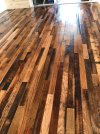
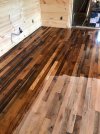
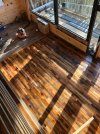
We prefer reclaimed hardwood. Here's one floor we put in one of our cabins. It's a mix of 5 different hardwood species with clear urethane on it. Any imperfections after installation just add character.IMG_5918.jpgIMG_5917.jpgIMG_5919.jpg
 
Floating install of engineered wood works well on slabs, especially in areas with high moisture variation by season. The key is not going cheap on the underlayment.
 
Maybe I've been on cheap floating floors but I dislike the hollow tap it gives when walking on it.
 
We’ve had carpet, 12” tile, engineered hardwood, and solid hardwood flooring across our houses. Currently our 2900sf house is 60% engineered wood, 30% tile, and 10% (2 guest bedrooms) carpet.

With tile, you want the grout to be proportional to the size/format from both an aesthetic and a functional perspective. Aesthetically, you’ll want to see how any patterns or veining will look in a large layout. Some tile looks great in a 10x10’ but is absolutely hideous in a 15x20 or whole house layout. The surface texture can be hazardous in socks or when wet. We’ve yet to have a house with 12” or larger format tile that hasn’t had a tile crack over time for one reason or another.

Grout. Colored epoxy grout has given us the best results over time and is a premium component worth the up charge.

Project-wise, you’ll want at least 10” extra, maybe more. Depending on how the previous flooring was installed (under vs butting baseboards/door casings) that’s going to be something the designer and installer should be addressing before you buy the tile.

The design center should be honest with you if any of what you want may not turn out as expected. This is most important with patterned or veiny tile, grout spacing, and color matching. They should have be willing to put together a 2xx2 with the grout you want so you can see it in the actual space at home before you buy.
 
All above info is greatly appreciated.
What are some manufacturers of quality porcelain tile that you have experience with?
 
Finding the color we want in Porcelain has proved difficult. We were about to take our chances with ceramic and I said, let’s do a drop test on the sample we bought.
I laid the sample on clean, smooth, flat concrete of my porch. I held a ~1 lb empty cooking pot 12” above the tile. I dropped it so the heavy base would strike first.
Smashed it to bits.
I was quite disappointed.
Perhaps when installed with thinset or other adhesive, it would be more stable?
 
…Perhaps when installed with thinset or other adhesive, it would be more stable?

It’s much more break resistant when properly installed. The only floor tile we’ve had crack after installation was due to foundation settling. I also can’t recall dropping pots or pans, but we’ve lost plates, bowls, and glasses over the years.

What I will say is you’re looking at a significant investment you’re going to live with everyday. You probably shouldn’t settle on something you’re entirely happy with.
 
Having had homes with hardwood, ceramic and LVP (which is what we have now), I'm very happy with the appearance and maintainability of the LVP. It will also be a bit warmer to your tootsies on a cold west Texas morning. And, as noted by others, substantially more forgiving when you drop stuff.

As for the tile that broke on the drop-test, I'd expect it to be much more durable (structurally) once properly installed; on the other hand, you will have the finish chipping when you drop something like that cookpot, and you don't even want to know what's involved in trying to replace a single tile on a grouted floor and trying to make it match perfectly.
 
As with most things in life, there are good and bad qualities with the various flooring options. Having owned multi unit apartment buildings we had occasional units where bedbugs were identified. The best method of eradication we found was heat treatment. We had the entire apartment heated to at least 140 degrees and held there for at least 2 hours. In our observation, lvp suffered damage with these treatments. We all hope to never find ourselves needing to eradicate such a pest from our homes, but the incidence is increasing.
 
I dunno if the 1500 sf of tile in my house is porcelain or ceramic. I do know it is 25 years old and has one chip in the finish, roughly 1/4 inch in diameter, which I fixed with a dab of paint and have not noticed in years.

The grout is a different story. I used to try to keep it clean by scrubbing with bleach. Yeah, that sucks. There are also some cracks in the grout which I am too lazy to repair.

We just installed engineered hardwood in our condo in Colorado. Wide plank white oak. Beautiful stuff, but I can already tell it is not nearly as durable.

PXL_20250125_171741472.jpg
 
Last edited:
Second the recommendation that you buy and store at least a box of the tile you select, and go with a neutral grout. We did a white ceramic with titanium gray grout in our kitchen, dining room, and hallways many years ago, and when we remodeled the kitchen, the contractor had to do some extra work to match the grout color. Has held up fantastically well over the 20 years we have had it in place.

Having said all that, I went with engineered planking when we pulled the carpet from the living room and sun room, and high-quality carpet in my den and the bedrooms because the tile s is hard on my feet when standing for a while. A high-grade engineered wood product has a great feel and holds up well
 
Second the recommendation that you buy and store at least a box of the tile you select, …l
The installer will want 10% more tile ordered than the job calls for (i.e., for a 1000sf job, order 1100sf worth) to allow for variation, cuts, and other installation reasons. Add the extra box on top of that. Most places will accept a return of unopened boxes unless you’re dealing with custom.
 
The terrazo tile in my living room will survive nuclear blasts, lol. I'd swap it out, but I can't imagine the nightmare of getting it pulled up and my young children would absolutely destroy anything new we put down.

1758575144740.png
 
We did an open house a while back where they polished and finished the concrete floors (slab). SWMBO is really liking this for our bath (s) and kitchen remodels that we're planning for the next couple of years. I say hells bells and lets do the whole house..


iu
 
We did an open house a while back where they polished and finished the concrete floors (slab). SWMBO is really liking this for our bath (s) and kitchen remodels that we're planning for the next couple of years. I say hells bells and lets do the whole house..


iu
Do it right and on a suitable slab and you’ll be happy. Try it in the cheap or on a bad slab and no bueno.
 
We did an open house a while back where they polished and finished the concrete floors (slab). SWMBO is really liking this for our bath (s) and kitchen remodels that we're planning for the next couple of years. I say hells bells and lets do the whole house..


iu
My cousin did do that in her entire new custom home. She loves it.

There's a guy with a couple auto-gyros right here at KCMA (not the ones that you actually see flying) who does that type of work. If your slab isn't a candidate for polishing, there's some sort of black magic that he can do with epoxy products that will allow you to achieve a good result on a poor-quality slab as long as it doesn't have open cracks.
 
One thing about polished concrete and/or tile. The rooms will be LOUD. Our outlaws in San Antonio have polished concrete and few soft surfaces to muffle sound. We call it “The loud house”.
 
One thing about polished concrete and/or tile. The rooms will be LOUD. Our outlaws in San Antonio have polished concrete and few soft surfaces to muffle sound. We call it “The loud house”.
I think area rugs/runners are often used in those spaces for seating areas and sound attenuation.
 
I think area rugs/runners are often used in those spaces for seating areas and sound attenuation.
No doubt rugs and sofas and tapestries and curtains and whatever else… help. But the outlaws’ house is brutal from a noise perspective it doesn’t have many/much of those kinda things.
 
I love it - if you put a decent size metal lathe and a milling machine in there. Epoxy concrete floor is a perfect floor for a machine shop. Or maybe a bar where there are a lot of stabbings. I wouldn't want it in my house, though. Too cold, too noisy, too industrial looking, too likely to get a concussion if you fall, too cold (worth mentioning twice).

I'm sure builders love it, because it's cheap, it's fast, and it's easy to clean. Easy to schedule I bet as well, because they could probably do the floor finish at any point in the build rather than having to wait until all the interior walls are up, and there's almost zero chance their crew will hurt it. Oh, it would be good for a jail, too.

Perhaps I'm being too negative. I like warm and friendly floors, perhaps as a reminder that I need to be more warm and friendly. I'm more like concrete - cold, hard, not good in a residential environment. :)

Oh, but if it lets you work on the motorcycle in the living room, then that might be an actual advantage.
 
If you go with tile, make sure you buy extra and have a place to store it. You will have tiles broken over the years and often a pattern is discontinued. Agree with minimizing grout. Suggest you consider going with the standard off white grout without coloring as down the road matching coloring recipe will be challenging.
Even if a tile is not discontinued, there are different ‘runs’ of it. Slight, but noticeable variances can occur. It’s possible to purchase boxes from different runs at the same time. The seller should guard against this but you should verify.
 
Check the static and dynamic friction wet and dry.

This can be as simple as seeing how your foot and typical shoes slip on the tile wet and dry. Wet tiles can be stupidly slick.
 
Back
Top