Memory items and procedure suggestions - keep it simple

CRAFT gives me a nice place to put everything and keeps me from being quite so messy
While I don’t use them (I can write “900B” faster than “900” (with or without the zeros) and look for the “BKN” box to check it off), I do understand the attraction of templates.

But I’m not sure how a CRAFT template where the route has same amount of space as a 4-digit transponder frequency and has barely enough room for “RV FXNAM A/F” helps keep things less messy. I love watching pilots using one to copy a more extended clearance go all over the page. If it were more like
C​
R​
​
​
​
A​
F​
T​
it would make more sense to me.
 
The conundrum which AlphaPIlot describes is really about memory items vs MASTERY: Yeah some things do need to be "Redlisted" (These are generally, the things we don't commonly do or are CRITICAL). I believe the checklist to be important, but subservient to mastery.

But we been teaching (since 2001's "no child left behind"), in the schools that rote memorization = learned. Teachers teach to the test for preserve their own careers and tenure (e.g "to the test"). Mastery vs rote memorization: they AREN'T the same, no how no way. We'll it's been 25 years. Time to reap what was sown.

"no child left behind" is the single worst piece of legislation we ever passed.
The only other one that is "up there" may be, the closure of the schools during the pandemic. Those kids may never "catch up".
 
We definitely have teaching to the test and rote memorization in flight training. I was in a Facebook thread where I dared to make the outlandish extreme claim that it's OK if a student pilot waits to take the knowledge test until they have the context to understand what was being taught.

It may be because I have mor exposure, but the worst teaching to the test seems to be for the instrument rating.
 
Well, in military training, you GOTTA just memorize it. You’ll understand it later…

PULL, CHECK, FEATHER, CLEAN, SELECT, LOCK then do your ABCs, and you WILL survive an engine failure in a T-34C.

The system is designed around it and it works.

Some students work better that way and some don’t, that’s the nature of civilian training. You have options. Understanding is probably best but is likely gonna cost in terms of time and money.

Airlines are “just do what the book says”.

None of the three are causing planes to fall out of the skies, so the take away is “it depends”.

As an instructor, it’s my job to figure out which works for the student. And what’s feasible. May be capable but unwilling…

Categorically calling any learning method bad is simply looking at it from your own point of view.
 
Some students work better that way and some don’t, that’s the nature of civilian training. You have options. Understanding is probably best but is likely gonna cost in terms of time and money.
This is an example of the difference between (attempted) memorization and thinking (which costs nothing)

I happened to walk into a room where an instructor was quizzing a private pilot applicant on the emergency procedure for an engine fire in a 172. The applicant just had trouble with the boldface memorization (personally, I would too). Finally, the instructor said, "Forget the book. Your engine is on fire. What do you do?'" With no hesitation, the student responded, "Shut the fuel, shut the vents, and get your a$$ down."
 
And if I can’t recall where I’m going, it’s definitely time to quit flying.

Guilty!

Although in my defense, some of my flights involve 5 or more IFR flight plans, A-B, B-C, C-D, D-E, etc, all without landing until the end. Especially if we have to change the order, it can get a little confusing.

But in general, absolutely I agree with you. Not necessary to write it down.
 
I also typically leave out the destination when copying an IFR clearance. I’ve never received a departure clearance with a clearance limit other than the destination. And if I can’t recall where I’m going, it’s definitely time to quit flying.
What about departing IFR to VFR?
But in general, absolutely I agree with you. Not necessary to write it down.
Although I don't write it down, I do make a mental note of it. My DPE gave me a few sample clearances and asked me to identify which ones are not valid.
 
Guilty!

Although in my defense, some of my flights involve 5 or more IFR flight plans, A-B, B-C, C-D, D-E, etc, all without landing until the end. Especially if we have to change the order, it can get a little confusing.

But in general, absolutely I agree with you. Not necessary to write it down.
As soon as I hit “Post,” I knew that someone had to mention pilots who fly multiple legs and long days, but I was thinking about cargo people more than flight checks.
 
Just learned a new one... When not to attempt restart on a turbine engine:

Fire
Oil pressure low/nil
Rotation - if it's not even windmilling a little it's likely siezed
Damage - If you shut it down due to excessive vibration, that's not going to get any better.

So, a turbine FORD but wasn't the jet-powered car a Chrysler product?
 
But I’m not sure how a CRAFT template where the route has same amount of space as a 4-digit transponder frequency and has barely enough room for “RV FXNAM A/F” helps keep things less messy. I love watching pilots using one to copy a more extended clearance go all over the page. If it were more like
C​
R​
​
​
​
A​
F​
T​
it would make more sense to me.
I'm based in the Midwest. We don't get anything other than "Direct" or "As Filed" until we're at least two Centers away! :rofl:

Well, as long as we file around Chicago Approach airspace (KELSI or T265) and file preferred routes. You're gonna get HAWKN ROBBY EAU AGUDE.AGUDE5 no matter what, even if you never fly it.
 
Always put in the destination since that's how the clearance starts "ATC clears N1234 from KABC to KXYZ." Plus go to many different fields over the course of a year, so it's nice to have the identifier imprinted on the brain. Also get lots of clearances at non-controlled airports... Now at the big fields they text it to you ahead of time if you sign up. Kind of nice.
 
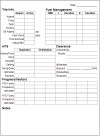
I got my private in 89 and my instrument in 95. I hear a lot of things these days that I was never taught. I was never told to say "airspeed alive" on the takeoff roll, but just about everyone I know that got their ticket in the last 20 years does this. During my instrument training I was never taught CRAFT or any other mnemonic for clearance. During my instrument training I flew with a young CFII on an instrument cross-country, and as I was copying the clearance on a blank sheet he jumped my **** -- "CMEDS, CMEDS, where's your CMEDS!!??" I didn't know what the hell he was talking about. He wrote down C, M, E, D, and S in a vertical column. "Clearance, Maintain, Expect, Departure Freq, Squawk. It will always be in that order. This helps you stay focused on what is coming next." I took that to heart. I never once have heard any other instructor mention CMEDS. I still use it, though. I built a flight log sheet maybe 15 or more years ago - I got one from someone on a forum and tweaked it to fit my needs. I think it had CRAFT, but I changed that to CMEDS (primacy, I guess). This little log sheet has served me well over the years.

1768348337593.png
 
"CMEDS, CMEDS, where's your CMEDS!!??" I didn't know what the hell he was talking about. He wrote down C, M, E, D, and S in a vertical column. "Clearance, Maintain, Expect, Departure Freq, Squawk. It will always be in that order. This helps you stay focused on what is coming next." I took that to heart. I never once have heard any other instructor mention CMEDS. I still use it, though. I built a flight log sheet maybe 15 or more years ago - I got one from someone on a forum and tweaked it to fit my needs. I think it had CRAFT, but I changed that to CMEDS (primacy, I guess). This little log sheet has served me well over the years.
I think I know how you'd fill this out, but for confirmation how would this look on your sheet?
"N1234 is cleared to the Podunk airport via the KDEP obstacle departure procedure, ONEFX, TWOFX, direct. Climb and maintain 3000. Expect 5000 after 5 minutes. Center frequency 120.1. Squawk 4321."

(D and S are pretty obvious but not entirely sure about CME)

And if you got an EFC, where would that go?
 
I got my instrument rating 3 years before you and was taught CRAFT. Might even have been in some of the texts.
There an 80s or early 90s video of Rod Machado using CRASH. I'm guessing Clearance Route Altitude Squawk Handoff. I wonder why that one didn't catch on :dunno:
 
My buddy does the ATIS stuff writing it down. I question him why. Does he really need to write down the cloud height, whether it’s broken or scattered? Does writing down the winds actually matter? Does he really need to know what runway is in use, ground is gonna tell him what runway he is using.
 
I’ve been a gold seal CFI for decades, instructing in single engine pistons to airliners. I still instruct GA locally occasionally and have found some of the procedures new pilots have been instructed to perform a bit concerning in terms of practicality and as a foundation to move forward to bigger flight decks.

I see more new pilots struggling with weird memory aids and techniques that have benefitted from this, including those retaking checkrides with far better results and confidence.

These are really fundamental skills that I would suggest all new pilots, and CFI s consider, especially CFIs as we set a standard that will be followed and engrained affecting students future progress.

I see more private, instrument and commercial pilots using abstract memory aids and odd procedures. I think this is mostly due to contemporary CFIs being new and coming from different schools that may not have consistency and picking up habits they hear. I have seen it mostly in part 61, but some from part 141 students, as well.

I recently worked with a pilot that failed a private ride, as well as a commercial applicant that wasn’t feeling great about upcoming ride….both appreciated the advice I gave and did great on their ride. Several others said it made them better in performing procedures as well, So thought I would share just one point that most believed made a big difference in their training. It’s simple stuff applicable to all planes and basis of airline training models developed by the industry.

Disclaimer… take this for what it’s worth, consider it or don’t. I’m always reluctant to give such advice online as there is always some contrarian to set me straight or pontificate on a better way and goes on about how it really should be done….if this is you, I find you annoying and please punch out of this post now. As I said, this has helped several pass check rides and make them more confident as well prepaid for the airline way of doing things…., and thought a few may find helpful after reading some posts.

I continue to see different procedures for basic events as takeoff, go around, etc… I recently worked with 2 pilots, for example, that used some ridiculous technique for their go around procedure they called the 4 C’s that called for “crunching” the throttle forward as step 1. Let’s start here….. the contemporary method of such procedures in big airplane world is typically called “LITANY” method…..which is a simple memorized repetitive verbal step by step procedure you would say aloud, it’s like mind muscle memory, and you simply follow the steps with action as you say your litany (litany basically means a list of repetitive actions), some may call it a memory item but difference being litany only includes actionable items, not conditions or triggers. For example, for a C172 go around it would be something like

“GO AROUND “,,,,,, MAX POWER,,,,,FLAPS 20,,,,,,FLAPS UP…….AFTER TAKEOFF CHECKLIST”

“FLAPS UP” as airspeed builds and descent rate reverses to climb and you are in control. (this works for a c172 as motorized flaps move slow but a mechanical flaps like a piper would require stopping at additional flap settings as airspeed increases.

So for go around its Simple items that will catch most significant errors. Some may call this a memory item procedure or trigger or action item depending your origins, but what’s important is it’s simple actionable items only, in a specific sequence that you follow while saying the item aloud.

By saying GO AROUND aloud, it sets your mind in the mode and brain muscle memory kicks in and you automatically say the litany….It’s almost like having a co-pilot reading you what to do step by step….you just need to have memorized the litany well so you you don’t have to think about it when distracted or under pressure.

Don’t use over complicated call outs like I’ve seen lately as , “power up, pitch up, trim, flaps one notch, speed, trim, flaps up, trim”…..you should know/be inherent you need to pitch up, trim, and establish Vy….. keep it simple. If you need to be reminded to fly away from the ground on a go around, consider different career or CFI.

These are basic verbal commands to yourself in a single pilot op, but necessary in crew cockpits to let the other pilot know what’s going on and follow…. it will help you or student transition to bigger and better aircraft… Learn the litany method early so you don’t have to relearn later or use such memory aids that don’t included things you don’t need to be reminded of like pitch up or trim….such things will soon be inherent. I’m sure there are several litany or like memory items example floating around the web, or make your own. Go arounds are not emergency procedures so take your time speaking the steps , allowing enough time to remain in control and trim as the plane changes configuration and power. I teach litany’s for other phases of flight as well, and its help many that were otherwise struggling from other learning methods.


One more thing….i see many pilots using different procedures for often the same mission. Example, when recovering from a stall, and either there’s no real procedure followed/used or it is a different memory aid specific for that maneuver. Find ways to use already known procedures for different events. For example, after stall and lowering nose and applying max power, at Vr (a speed you know the plane will fly in clean configuration) call “GO-AROUND” and use same go around litany procedure. It will get you safely climbing and cleaned up. Oh, and one more piece of advice for c172 drivers…. when applying full power, don’t push in the carb heat first then the throttle……the carb heat knob is positioned and has flat surface to ergonomically use your thumb to push it in as you push throttle in (at least from left seat)….its one less step.

Hope this may help someone going forward.


Most ineffective memory aids communicated in basic flight training are formulated by someone who believes it is effective in a world of no standardization.
 
Last edited:
You forgot C!

See, CRAFT is necessary here! :D

I do use FF"s "CRAFT" scratchpad. In my Scratchpads, I have ATIS (for departure), CRAFT, ATIS again (for destination), a blank one for writing down the phone numbers that ATC gives me :rofl:, and the PIREP one because otherwise I can never remember what all to give them or in what order.

The ATIS ones help me keep up with a faster ATIS by just putting a mark on OVC instead of writing OVC for example. CRAFT gives me a nice place to put everything and keeps me from being quite so messy as I would be freeform... And it helps to make sure I don't accidentally miss something. I don't see why that's a bad thing. :dunno:
Forgot the C? They cleared you to your destination and you fear forgetting where you are going?
 
My buddy does the ATIS stuff writing it down. I question him why. Does he really need to write down the cloud height, whether it’s broken or scattered? Does writing down the winds actually matter? Does he really need to know what runway is in use, ground is gonna tell him what runway he is using.
Don’t you think knowing the winds, runway in use, taxiway closures, etc is helpful for planning your approach into an airport?

If so, why take the extra brainpower to pick and choose which items you think you might need instead of simply writing them as the come without thinking?

Creating consistent SOPs (aka habits) avoids errors. And this particular one will be a step up for copying IFR clearances longer than “as filed.”

This may be a bad habit/technique, but I’ve started comparing ATIS to what’s on my EFB for that airport’s wx. If it’s the same, I just copy the letter and any amplifying info not on the EFB wx report.

If it’s different, I copy it all down and compare the times; whichever is most current may prompt me for info from tower. Sometimes I’ve seen the EFB update the airport weather at the half hour but ATIS was done on the hour and there’s been a wind change.
 
If it’s different, I copy it all down and compare the times; whichever is most current may prompt me for info from tower. Sometimes I’ve seen the EFB update the airport weather at the half hour but ATIS was done on the hour and there’s been a wind change.
I also do the comparison, but tower ATIS always rules, unless at a big airport where they text with the letter to the phone (departing). I think the only way the EFB could have more up-to-date winds is at a field with a tower and an ASOS/AWOS - otherwise the tower would have issued a special if merited. Maybe there's another corner case where this can happen, not sure.
 
This may be a bad habit/technique, but I’ve started comparing ATIS to what’s on my EFB for that airport’s wx. If it’s the same, I just copy the letter and any amplifying info not on the EFB wx report.

If it’s different, I copy it all down and compare the times; whichever is most current may prompt me for info from tower. Sometimes I’ve seen the EFB update the airport weather at the half hour but ATIS was done on the hour and there’s been a wind change.
What I do is copy the ADSB weather and then when I get into radio range edit my copy with the ATIS (e.g. winds magnetic versus true).
 
I think the only way the EFB could have more up-to-date winds is at a field with a tower and an ASOS/AWOS - otherwise the tower would have issued a special if merited. Maybe there's another corner case where this can happen, not sure.
The "1-minute weather" on AWOS/ASOS is more up to date that the last METAR issued up to an hour ago, even if updated with a SPECI. That's a reason why controllers are required to ask if you have it when IFR. That's aside form the METAR winds being true rather than magnetic.

We actually did a PilotWorkshops scenario some years back where it made a difference.
 
This may be a bad habit/technique, but I’ve started comparing ATIS to what’s on my EFB for that airport’s wx. If it’s the same, I just copy the letter and any amplifying info not on the EFB wx report.

If it’s different, I copy it all down and compare the times; whichever is most current may prompt me for info from tower. Sometimes I’ve seen the EFB update the airport weather at the half hour but ATIS was done on the hour and there’s been a wind change.
So long as a technique works, it's good. For me, FIS-B METAR is for planning, before I get within range of the ATIS or AWOS/ASOS. But when I get in range the latter is the only one that counts for me, so I note it. Yeah, I'll compare, but only for "wow! that's really changing a lot!!!"
 
Forgot the C? They cleared you to your destination and you fear forgetting where you are going?
It's not your "Cestnination" it's your "Clearance Limit." Nobody is forgetting where they're going.

For example, several years ago I had filed from KOXI around C90 to the Milwaukee area. When I called for my clearance I got "You are cleared to the Knox VOR, climb and maintain 4,000, ..."

So, I took off, flew the ODP (or standard, can't remember what it was), turned toward the VOR, entered the hold, and within the first turn got the clearance extended farther along.
I getit, but in a filed to destination clearance I don’t record the clearance limit. Today most clearances are to destination as filed. If you feel better recording in case you forget where you filed to, so be it.
 
Back
Top