Manifold Pressure

Sky High Pete

Filing Flight Plan
Joined
Jan 16, 2026
Messages
2
Display Name
Sky High Pete
My recently purchased Skylane with a Lycoming IO-540 produces 27-28" of manifold pressure on takeoff near Sea level altitude. I love the power but that seems a little high to me. Any thoughts?
 
What does it read when the engine isn't running. Hint, at sea level it should read the current altimeter setting or close to. Not theoretically impossible to read the same wide open at sea level, although there is a certain amount of restriction through the induction system.
 
My recently purchased Skylane with a Lycoming IO-540 produces 27-28" of manifold pressure on takeoff near Sea level altitude. I love the power but that seems a little high to me. Any thoughts?
Pretty normal. Check the accuracy of the MP gauge by setting the altimeter to read your field altitude, and see if the MP gauge agrees with the altimeter's barometer setting. Tap the panel next to the gauge to unstick the needle.
 
If your MP gauge is correct, and without knowing what your manual says, that doesn’t sound far off at sea level.

Are you thinking it’s too high, like an intake leak? You might be able to tell by poor idle or cylinder temps.

What you don’t want is a lower MP which might speak to a misadjusted throttle plate or blockage in the intake stream (think dirty air filter or broken alt air door), or some other inherent engine issue.

My 2 cents, I’m not an A&P.
 
If anything at wot it might be a little low. What air filter do you have? Switching from from a brackett to a Donaldson increased my MP slightly. Should lose about an inch from the altimeter depending on the health of your induction system and accuracy of your gauge.
 
How does that compare to the AFM or TCDS numbers?
What does it read when the engine isn't running. Hint, at sea level it should read the current altimeter setting or close to. Not theoretically impossible to read the same wide open at sea level, although there is a certain amount of restriction through the induction system.
I will check without the engine running. I assume it's correct. My past Skylane was O-470 and the MP was 26 on climb out. I assumed the Lycoming would read the same. I appreciate the feedback.
 
Geoffrey Thorpe kindly corrected me. Setting the altimeter to field altitude will not give local barometric pressure, which is what the MP gauge will read. You'd have to set the altimeter to 0 feet to get the local pressure.
 
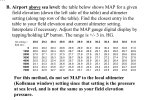
This might help, though you might not be able to easily adjust an analog gauge, but should be able to compare your engine off reading to these (from the JPI EDM-830 manual).
IMG_0320.jpeg
 
I would be more concerned with MP at idle, like the time I supposedly set 60% power on downwind but later stuck my head behind the panel and found the hose going to the gauge had a hole in it.
 
My recently purchased Skylane with a Lycoming IO-540 produces 27-28" of manifold pressure on takeoff near Sea level altitude. I love the power but that seems a little high to me. Any thoughts?
Why do you think that is high? Wide Open Throttle on a Fuel Injected gasoline engine should be nearly the same as ambient air pressure with a clean Air filter. A carbureted engine will be about 1-2 inches less because the venturi adds a restriction, but there should be no restriction on a fuel injected engine.
 
My Lance which also has an IO-540 has a placard that says “After 5min reduce power to 2575 RPM and 33in”.

My normal practice is to have everything at full power until I hit 1,000’ and reduce to 24”/2400rpm for cruise climb then once at altitude I set cruise power according the chart from the POH… usually 2300rpm and whatever manifold pressure puts me at 65% power which is usually full throttle by 6-7,000’.
 
Why do you think that is high? Wide Open Throttle on a Fuel Injected gasoline engine should be nearly the same as ambient air pressure with a clean Air filter. A carbureted engine will be about 1-2 inches less because the venturi adds a restriction, but there should be no restriction on a fuel injected engine.
No induction system is friction-free. There will be some drop in pressure even at full throttle. Most of these systems are full of sharp bends, connections and so on, all contributing drag.

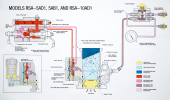
The RSA injection systems used on Lycomings do have a venturi as part of the fuel metering system.

1768673531714.png

Right there at the boundary between yellow and blue. It generates suction that is balanced by ram pressure from the impact tubes. Those pressures move a diaphragm that is coupled to another diaphragm moved by inlet fuel pressure against metered fuel pressure. It works amazingly well.

 
No induction system is friction-free. There will be some drop in pressure even at full throttle. Most of these systems are full of sharp bends, connections and so on, all contributing drag.

The RSA injection systems used on Lycomings do have a venturi as part of the fuel metering system.

View attachment 149059

Right there at the boundary between yellow and blue. It generates suction that is balanced by ram pressure from the impact tubes. Those pressures move a diaphragm that is coupled to another diaphragm moved by inlet fuel pressure against metered fuel pressure. It works amazingly well.
I sometimes use Performance Trends Engine Analyzer. If memory serves 2 barrel carburetors are rated 3 inches of Mercury drop at rated CFM and 4 barrel carburetors are rated 1.5 inches. The OP stated 27-28 inches at WOT. If you add 1.5 inches to 28, that's 29.5 inches of barometric pressure. I don't find the stated numbers out of line.
 
Back
Top