found major corrosion

Does no one, especially pilots, do some basic inspections on their cars once in a while? Fluid levels, brake wear, batteries, accessory drive belts, tires and mounting hardware?

Monthly car check on each vehicle:
Tire pressure
Oil and other fluids level
Top up windshield washer fluid
Check wipers
Clean inside of windshield
RainX outside of windshield

At each oil change, check cv boots, look for anything abnormal

At each tire rotation:
Check brake pads and rotors
Check rubber brake hoses for cracks
Check cv boots, check other suspension boots
Check shocks/struts for leaks
 
My 2005 Cadillac had the battery under the back seat.
Same with an 06 my dad had. And it lasted 10 years. One day the battery died in a parking lot and dad decided he was ready for his next car and called a tow truck. Lol.
 
Does no one, especially pilots, do some basic inspections on their cars once in a while? Fluid levels, brake wear, batteries, accessory drive belts, tires and mounting hardware?
Check Engine Light Turns Off - Check
ABS Light Turns Off - Check
Alternator Light Turns Off - Check
TPMS Light Turns Off - Check

...Let's roll!
 
Does no one, especially pilots, do some basic inspections on their cars once in a while? Fluid levels, brake wear, batteries, accessory drive belts, tires and mounting hardware? Stuff is run to failure.

Which is why the feds mandate annual inspections on airplanes. Without those, the same stuff would be happening with aircraft. Run to failure. As it is, too many mags, vac pumps and alternators are ignored until they quit.
genuinely the only people I know that do basic inspections on their cars are one, car enthusiasts, or two, people on this forum. Otherwise, if the mechanic doesn't tell them, no one knows.
 
Check Engine Light Turns Off - Check
ABS Light Turns Off - Check
Alternator Light Turns Off - Check
TPMS Light Turns Off - Check

...Let's roll!
As an experienced used car owner, most of my stuff has the check engine light on. But I know what their for and have determined it is not a "flight risk" Lol. The cost of chasing down an inconsequential sensor far outweighs the benefit of some sensors.

Except for an older early electronics mustang I have. The dash will literally light up different warning lights at random, but I have an OBD II reader that tells me all the actually raw data and 99.9% of the time its just the dash lights going haywire. Sometimes when I hit a bump they turn on or off.
 
Does no one, especially pilots, do some basic inspections on their cars once in a while? Fluid levels, brake wear, batteries, accessory drive belts, tires and mounting hardware? Stuff is run to failure.

Which is why the feds mandate annual inspections on airplanes. Without those, the same stuff would be happening with aircraft. Run to failure. As it is, too many mags, vac pumps and alternators are ignored until they quit.

I absolutely do, I actually do my own oil changes and look everything over each time.

However, given the consequences aren’t nearly as great I’ll run non-safety components on a car to or near to failure. Stuff like Eman’s battery for example… I probably wouldn’t worry about it if there were no functional problems and just deal with it when it comes time to replace the battery. OTOH brakes looking close to worn out would be a fix ASAP situation.
brakes and tires are huge priorities for me. I usually replace tires a little early and go with more premium options. Buddies of mine will run dry rotted tires with no concerns and wonder why I don't want to get in their car.
 
if the mechanic doesn't tell them, no one knows.
It really depends on the car, I suppose. Going back to @Dan Thomas 's list, fluids have sensors. Brakes either have sensors or a squeal tab. Batteries have sensors. Tire pressures have sensors. Mounting hardware gets checked during oil changes, which are scheduled according to sensors. Drive belts are on a 100k mile schedule.
Except for an older early electronics mustang I have. The dash will literally light up different warning lights at random, but I have an OBD II reader that tells me all the actually raw data and 99.9% of the time its just the dash lights going haywire. Sometimes when I hit a bump they turn on or off.
Let's see... OBD2 made its debut 1994 so your Mustang is ~30 years old?
 
It really depends on the car, I suppose. Going back to @Dan Thomas 's list, fluids have sensors. Brakes either have sensors or a squeal tab. Batteries have sensors. Tire pressures have sensors. Mounting hardware gets checked during oil changes, which are scheduled according to sensors. Drive belts are on a 100k mile schedule.

Let's see... OBD2 made its debut 1994 so your Mustang is ~30 years old?
Slightly newer, about 25 years. Picked it up earlier this year for a good deal from a friend. Fun to bang the gears in and the simplicity, but naturally can't compare to a modern mustang.
 
Does no one, especially pilots, do some basic inspections on their cars once in a while? Fluid levels, brake wear, batteries, accessory drive belts, tires and mounting hardware? Stuff is run to failure.

Which is why the feds mandate annual inspections on airplanes. Without those, the same stuff would be happening with aircraft. Run to failure. As it is, too many mags, vac pumps and alternators are ignored until they quit.
In fairness, Firestone flagged the corroded battery terminal clamp a couple months before the event. I should have listened to them. I didn't. I'm a bad pilot. If I listened to them, that issue never would have happened.

Hey, I learned something. Don't hate on me.
 
Check Engine Light Turns Off - Check
ABS Light Turns Off - Check
Alternator Light Turns Off - Check
TPMS Light Turns Off - Check

...Let's roll!
But not everything has a sensor and warning light. When the engine in my old Cavalier quit, there was no light. No OBD code either. It was the in-tank fuel pump that failed.

Alternators do not have brush length warning sensors. When my Hyundai got to 250K kilometers and few years ago, I took the alternator out and opened it. The brushes were on the verge of complete failure, and the slip rings were so badly worn that new brushes would not have fixed anything. Bought a new alternator and saves a big towing bill and much inconvenience. Shortly after that the alternator in my Ford Ranger failed for all the same reasons. Lucky, it failed in the driveway. I should have pulled it off earlier.
It really depends on the car, I suppose. Going back to @Dan Thomas 's list, fluids have sensors. Brakes either have sensors or a squeal tab. Batteries have sensors. Tire pressures have sensors. Mounting hardware gets checked during oil changes, which are scheduled according to sensors. Drive belts are on a 100k mile schedule.
Lots of stuff has no sensors. Wheel bearings. Transmission fluid. Neither of my vehicles has a coolant level sensor; maybe newer cars do now? Drive belts have no sensors, and the idler pulleys that tension them certainly have no sensors. Last summer I loosened the belts in both vehicles and spun the idler pulleys, finding that the ball bearings in both of the truck's pulleys were noisy and loose. The damper pulley in the car was also making ugly noises one day last year, and when I got home I pulled the right front wheel off to get at it. The layer of rubber bonded between the pulley's hub and sheave rim had lost its bonding and let the sheave move inward and rub on the timing chain cover. A few more miles and it would have chewed right through it and lost much oil. At that point I found the idler pulleys also shot. No sensors on any of it.

Maybe 20 years ago we had a Dodge shop car to run errands in. A belt idler pulley failed and trashed the belt, and the alternator then could not keep the lights and ignition and EFI working very long. It quit on a lonely highway in the middle of winter.
 
Last edited:
A bit of a tangent: What are the steps for inspecting aircraft alternator brushes? Does it involve complex disassembly?
When I did the inspection, I'd take the alternator off, open it up, check the brush lengths as well as bearing smoothness and look at the other stuff inside, then reassemble and reinstall the alternator. It typically took about an hour, total, for the Ford alternator on a Lycoming or larger Continental. Gear-driven alternators take a little longer, as cleaning off of the old gasket takes a little time. And they're not as accessible.

I normally found the brushes about 1/3 gone at 500 hours, and 500 hours later they were 2/3 gone and I'd replace them. They would fall out before the next 500 and trash the alternator.

That was in the steam-gauge airplanes; in the G1000 172, I had to check them about every 300 hours. The considerably higher electrical load on the alternator required a higher field current flow through those brushes and they wore out sooner. When I did the first inspection at the 500-hour mark, I found those brushes more than half gone. That's when I revised the interval to 300 hours.
 
That was in the steam-gauge airplanes; in the G1000 172, I had to check them about every 300 hours. The considerably higher electrical load on the alternator required a higher field current flow through those brushes and they wore out sooner. When I did the first inspection at the 500-hour mark, I found those brushes more than half gone. That's when I revised the interval to 300 hours.
Haven’t owned a plane yet, but coming from the car world, wouldn’t a higher amp rated alternator negate the need for checking more often?
 
Haven’t owned a plane yet, but coming from the car world, wouldn’t a higher amp rated alternator negate the need for checking more often?
More output requires more input, meaning more current through the brushes. But the car's alternator also runs at a much lower RPM than the airplane's, so less wear due to friction.

Alternators are driven at a ratio to crankshaft speed so that the alternator's redline is achieved at engine redline. The airplane's engine typically cruises at over 90% of redline, while the car is often at 30% in cruise. Makes a big difference to brush wear.
 
It be much worse if those anti corrosion felt pads weren't there.
Yes by the looks of the terminals that battery has been in there for a while, It might be time to replace it? Do a load test?

A few months ago we noticed my wife's Cad XT5 wasn't shutting down at stops anymore.
It was because she needed a battery. A AGM battery that listed at near 300 bucks!
Luckily I got it for close to 200 bucks as we have business account at O reillys. This was on a Sunday as I usually buy all of our battery's at work from Bill's Battery here locally. But they weren't open on Sundays.
It was the toughest battery I have ever replaced, especially as a first timer in this model SUV.
There is 10 pounds of crap on top of the battery that must disconnected and swung over to the side to get to the battery. And it is a large heavy battery.
Be careful of that rassum frassum current sensor on the negative terminal... :incazzato:
 
If you have an uber alternator pumping out mega watts you’ll need to dump all those watts via the regulator. An alternator doesn’t have variable output at a given rpm. That’s what the regulator does.

Correct me if I’m wrong.

So - apparently I’m wrong - never mind. Had thought the regulator dumped excess power into heat.
 
Last edited:
If you have an uber alternator pumping out mega watts you’ll need to dump all those watts via the regulator. An alternator doesn’t have variable output at a given rpm. That’s what the regulator does.

Correct me if I’m wrong.
the regulator limits the field current: lower field current = weaker magnetic field = less power generated. An alternator is absolutely variable. Now generators, a little different story.
 
So... what does it cost to install a battery?

I'd pay to do it on our i3. Presumably our EQS too. The Subaru I can do in like 2 minutes.
Its a good thing the Subie isn't harder to do... because you have to remove the battery to get access to change the driver's side headlight bulb. And they seem to pop frequently.
 
Last edited:
More output requires more input, meaning more current through the brushes. But the car's alternator also runs at a much lower RPM than the airplane's, so less wear due to friction.

Alternators are driven at a ratio to crankshaft speed so that the alternator's redline is achieved at engine redline. The airplane's engine typically cruises at over 90% of redline, while the car is often at 30% in cruise. Makes a big difference to brush wear.
Not trying to knock you, but from everything I've researched, your statements are a common misconception about alternators. If a plane with steam gauges and low electrical load has a small alternator at 50% usage on average, and then a plane with a G1000, etc. with a large electrical load, as long as you upsize the alternator to also be at that same 50%, then it should last just as long. This assumes same manufacturer quality, etc.

I would not say a cars alternator runs at a lower rpm. The pulley on car alternators are designed to be smaller so that you can get near full output at low engine/near idle rpm. This smaller pulley puts the effective rpm on the alternator at a similar speed as a plane.

Edit: To add, alternators can run well over 10,000 rpm from a pure not gonna destroy itself perspective, so the main concern on modern alternators is getting near full output at idle.
 
Last edited:
Not trying to knock you, but from everything I've researched, your statements are a common misconception about alternators. If a plane with steam gauges and low electrical load has a small alternator at 50% usage on average, and then a plane with a G1000, etc. with a large electrical load, as long as you upsize the alternator to also be at that same 50%, then it should last just as long. This assumes same manufacturer quality, etc.
Except that the G1000 Cessna 172 and 182 did not use larger alternators.

Moreover, at a given RPM, it takes a specific field current to produce a specific output current. There is nothing free here. A larger alternator has heavier windings and can carry more field and output currents.
I would not say a cars alternator runs at a lower rpm. The pulley on car alternators are designed to be smaller so that you can get near full output at low engine/near idle rpm. This smaller pulley puts the effective rpm on the alternator at a similar speed as a plane.
Have you ever measured the pulley sizes on crankshaft and alternator pulleys? I have, and the alternator is driven at a ratio to keep it within its design RPM. Yes, newer, smaller alternators on cars have higher redlines, but now we're comparing apples and oranges. They also have slip rings of a much smaller diameter than the lower-RPM alternators usually found in aircraft, which reduces the feet-per-second speed against the brushes.

I inspected a lot of alternators as a mechanic, and my experience showed that one could not expect more than maybe 1200 or 1400 hours before the brushes failed and their spring arced against the slip rings and trashed them. On POA we regularly hear of failed alternators, and in most cases it's worn-out brushes. People keep thinking that their car's alternator has 200,000 miles on it, so the one in their airplane must be just fine. But cars are not airplanes, and never will be, Their operating parameters are vastly different, and the risks arising out of failures are much worse.

What are your qualifications and experience in aviation maintenance?

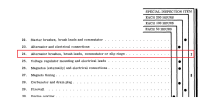
Let's look at an excerpt from a Cessna inspection checklist found in their service manuals:

1764032464589.png
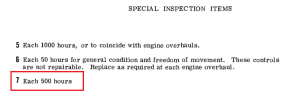
See that "7" under special inspection item?

1764032595457.png

Plane Power sells a lot of alternators. Some folks think that they're better because they're newer designs and should last a very long time. But if we start checking their service manuals we see stuff like this that isn't in their ads in magazines or aviation websites:

1764032799859.png

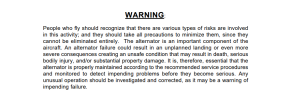
Then we encounter this:

1764033148634.png
 
Except that the G1000 Cessna 172 and 182 did not use larger alternators.

Moreover, at a given RPM, it takes a specific field current to produce a specific output current. There is nothing free here. A larger alternator has heavier windings and can carry more field and output currents.

Have you ever measured the pulley sizes on crankshaft and alternator pulleys? I have, and the alternator is driven at a ratio to keep it within its design RPM. Yes, newer, smaller alternators on cars have higher redlines, but now we're comparing apples and oranges. They also have slip rings of a much smaller diameter than the lower-RPM alternators usually found in aircraft, which reduces the feet-per-second speed against the brushes.

I inspected a lot of alternators as a mechanic, and my experience showed that one could not expect more than maybe 1200 or 1400 hours before the brushes failed and their spring arced against the slip rings and trashed them. On POA we regularly hear of failed alternators, and in most cases it's worn-out brushes. People keep thinking that their car's alternator has 200,000 miles on it, so the one in their airplane must be just fine. But cars are not airplanes, and never will be, Their operating parameters are vastly different, and the risks arising out of failures are much worse.

What are your qualifications and experience in aviation maintenance?

Let's look at an excerpt from a Cessna inspection checklist found in their service manuals:

View attachment 147480
See that "7" under special inspection item?

View attachment 147482

Plane Power sells a lot of alternators. Some folks think that they're better because they're newer designs and should last a very long time. But if we start checking their service manuals we see stuff like this that isn't in their ads in magazines or aviation websites:

View attachment 147483

Then we encounter this:

View attachment 147484

Appreciate the additional detail here. It’s certainly interesting that the alternator size did not change between steam and g1000. My original point though was if they had increased the size proportionally, then lifespan should be similar. If they’re running the same alternator at higher load then it 100% makes sense that it’d wear quicker. I don’t disagree with any of the rest of your post.
 
the regulator limits the field current: lower field current = weaker magnetic field = less power generated. An alternator is absolutely variable. Now generators, a little different story.
Generators are regulated the same way. Only difference is that the field is the pole shoes attached to the generator case, and the rotating armature produces the current. In the alternator, the stator (non-rotating) coils produce the output, and the field is handled by the rotor.

Both generators and alternators produce alternating current. The generator used the commutator on the armature, and brushes running on the commutator, to get DC out of it. The commutator and brushes are constantly switching to keep the output polarity the same. The problem is that those brushes have to be heavy to carry the output, and the current capacity is much lower. The generator's regulator has a current limiter to prevent generator burnout under heavy load, and it also has a reverse-current relay to prevent the battery from trying to "motor" the generator at low or no RPM. A generator can function as a series-wound motor. An alternator's diodes prevent that, and the alternator's basic design and sizing to the airplane's system prevents overloading.

The alternator came about because suitable heavy diodes became available in the 1960s. Six diodes inside the alternator rectify the AC into DC, and the output comes off the stator instead of the rotor, since there is no need for commutator switching, and much smaller brushes can be sued to feed the rotor's field current.
 
Its a good thing the Subie isn't harder to do... because you have to remove the battery to get access to change the driver's side headlight bulb. And they seem to pop frequently.
Outback? I recall going through the wheel well liner for that ruddy bulb, but it's been awhile.

Ours is a cockroach and seems to never need anything but basic things. I have been unsuccessful at giving it away, which is a shame, since it has been in 42 countries and deserves a better end than "random airport car I love to hate" :)
 
Chrysler Pacifica. New battery was ~$475 from dealer. ~$250 from private shop.
Got around to checking the logs. Good ol' Group 47 (DIN H5 in Euro-speak) was $130 for Flooded Lead Acid and $170 for Absorbent Glass Mat from Costco back in August if I install it myself.
 
Back
Top