That 10 years early part was about the time the 1994 Young Legal Interp. came out.I don't know about 2005, but recall having an argument about it with a CFII 10 years before that.

You are using an out of date browser. It may not display this or other websites correctly.
You should upgrade or use an alternative browser.
You should upgrade or use an alternative browser.
Do You Understand HILPT???
- Thread starter M20K
- Start date

- Joined
- May 25, 2006
- Messages
- 22,048
- Location
- KTTA, North Carolina
- Display Name
- Who you kiddin?
- Home Airfield
- KTTA
It might have been but we didn't talk about it. I'm pretty sure that they weren't available on the internet back then, unless one of the former FAA people who frequented the rec.aviation Newsgroups uploaded the text. And I didn't have the ~$500/year subscription to the hardcopy from West Publishing.That 10 years early part was about the time the 1994 Young Legal Interp. came out.
Might we be over thinking it a bit?Which takes you back to the original post and the hidden question, how did you get to be on the 216R inbound down at four thousand feet?
 I just grabbed an Approach that had a HILPT and you can grab almost any one that doesn't have a mountain in the way, a TAA or a NoPT on the Straight In and the same question works.
But if you need to line up all your ducks, I'll slightly change the scenario for you.
Your original Clearance was KYKM YKM KMWH, 5,000 (or pick an Alt of your choice). Upon Takeoff you contact ATC and are Cleared Direct FEBUS, Direct Destination.
Nearing FEBUS you're are Cleared to 4,000
Now you are nearing KMWH and you get N1234 proceed Direct ONPIC, cross ONPIC at 4,000ft, Cleared for the RNAV Y Rwy 4 at Grant Co.
And my mind goes to VORs when "Radials" are brought up. No VOR ever mentioned in this RNAV Approach scenario, so if you were referring to the 216R off of MWH, it really would be the 213R.

- Joined
- May 25, 2006
- Messages
- 22,048
- Location
- KTTA, North Carolina
- Display Name
- Who you kiddin?
- Home Airfield
- KTTA
For an extremely good reasonAnd my mind goes to VORs when "Radials" are brought up

Roger Wilco
Line Up and Wait
Maybe we should start a pool speculating about just how many replies will be generated in response to a question that was effectively answered within the first 5 posts, and could easily have been resolved through a simple search. Just a thought.

luvflyin
Touchdown! Greaser!
- Joined
- May 8, 2015
- Messages
- 17,471
- Location
- Santa Barbara, CA
- Display Name
- Luvflyin
- Home Airfield
- KVUO
You left the P out of the PTAC spiel
- Joined
- May 25, 2006
- Messages
- 22,048
- Location
- KTTA, North Carolina
- Display Name
- Who you kiddin?
- Home Airfield
- KTTA
You are correct. but at least I did that one on purpose to save room.You left the P out of the PTAC spiel
luvflyin
Touchdown! Greaser!
- Joined
- May 8, 2015
- Messages
- 17,471
- Location
- Santa Barbara, CA
- Display Name
- Luvflyin
- Home Airfield
- KVUO
I suspect that would create a lot of insider trading so to speak. I wanna see the post that will be made in desperation to lock the thread like right nowMaybe we should start a pool speculating about just how many replies will be generated in response to a question that was effectively answered within the first 5 posts, and could easily have been resolved through a simple search. Just a thought.
- Joined
- May 25, 2006
- Messages
- 22,048
- Location
- KTTA, North Carolina
- Display Name
- Who you kiddin?
- Home Airfield
- KTTA
personally, I’d be very concerned if a thread stopped once an answer was given. I think that when people argue against it and we see errors and kick them back and forth that learning takes place for many.Maybe we should start a pool speculating about just how many replies will be generated in response to a question that was effectively answered within the first 5 posts, and could easily have been resolved through a simple search. Just a thought.
Roger Wilco
Line Up and Wait
Just to be clear, I don’t object. In fact, I find it somewhat amusing, like a side show.personally, I’d be very concerned if a thread stopped once an answer was given. I think that when people argue against it and we see errors and kick them back and forth that learning takes place for many.
But if a thread actually were to stop once an answer were given, it would not concern me in the least. Given the PoA modus operandi, such an anomaly might be even more amusing.
Last edited:
@Roger Wilco
I'm curious what the "Fake Cone of Silence" is?
I'm curious what the "Fake Cone of Silence" is?

bentmettle
Pre-takeoff checklist
Appreciate the post and discussion. I’ve taken most of this year off from flying to focus on other life and am starting to dip my toe back into recovering some proficiency.
I’m looking at the wording and the aim, this scenario felt pretty cut and dry.
If you aren’t cleared for the approach until after crossing that fix, and the hilt is part of the approach, how could you not fly the hilt?
I could without much imagination see a scenario where you get that clearance and something pops up that turns the PT part of the hilt back into a hold to make space/time for departing traffic. This seemed to happen a few times on practice approaches to get air ambulance traffic out locally.
And yes, I’d have probably tried to fly in straight in until I looked at the aim to refresh my brain.
- Joined
- May 25, 2006
- Messages
- 22,048
- Location
- KTTA, North Carolina
- Display Name
- Who you kiddin?
- Home Airfield
- KTTA
In the scenario the approach clearance is given before crossing the fix. Looking at the green on my drawing (I should probably add airplanes to it), the full instruction , after being cleared direct ONPIC would be something like,Appreciate the post and discussion. I’ve taken most of this year off from flying to focus on other life and am starting to dip my toe back into recovering some proficiency.
I’m looking at the wording and the aim, this scenario felt pretty cut and dry.
If you aren’t cleared for the approach until after crossing that fix, and the hilt is part of the approach, how could you not fly the hilt?
"Six miles from ONPIC. Cross ONPIC at or above 4,000. Cleared RNAV 4 Approach."
Actually, without an approach clearance, you would not do the hold. But you are basically correct. Unless cleared straight in, the hold is mandatory.
No imagination required. It's a common scenario, probably the most common hold a GA pilot gets. Its one I give for recurrent and transition training and IPCs. It happened to a friend. Instead of the original, let's use the approach mentioned by @Fffflats since it's a little cleaner without the RUBEL reg herring. Except for the location, this is what happened to my friend.I could without much imagination see a scenario where you get that clearance and something pops up that turns the PT part of the hilt back into a hold to make space/time for departing traffic. This seemed to happen a few times on practice approaches to get air ambulance traffic out locally.
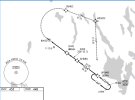
ATC (while about 20 miles out): Say approach request.
Pilot: Request the RNAV 32 from SERPA.
ATC: Expect that. Proceed direct SERPA. Expect straight in.
Pilot loads the approach and when prompted (Garmin) says "No" to the hold.
ATC (3-4 minutes out from SERPA): There's a departure out of White Mountain I'm not talking to yet. Hold at SERPA as published.
Bonus points: how would you handle it? I knew about ti happening to my friend because he wasn't sure (he managed
) and called me after the flight.
RussR
Final Approach
Like in many of these scenarios, the quickest and cleanest way to do it, especially with plenty of time (3-4 minutes is certainly plenty of time) is to simply reload the approach.In the scenario the approach clearance is given before crossing the fix. Looking at the green on my drawing (I should probably add airplanes to it), the full instruction , after being cleared direct ONPIC would be something like,
"Six miles from ONPIC. Cross ONPIC at or above 4,000. Cleared RNAV 4 Approach."Actually, without an approach clearance, you would not do the hold. But you are basically correct. Unless cleared straight in, the hold is mandatory.
No imagination required. It's a common scenario, probably the most common hold a GA pilot gets. Its one I give for recurrent and transition training and IPCs. It happened to a friend. Instead of the original, let's use the approach mentioned by @Fffflats since it's a little cleaner without the RUBEL reg herring. Except for the location, this is what happened to my friend.
View attachment 156466
ATC (while about 20 miles out): Say approach request.Pilot: Request the RNAV 32 from SERPA.ATC: Expect that. Proceed direct SERPA. Expect straight in.Pilot loads the approach and when prompted (Garmin) says "No" to the hold.ATC (3-4 minutes out from SERPA): There's a departure out of White Mountain I'm not talking to yet. Hold at SERPA as published.
Bonus points: how would you handle it? I knew about ti happening to my friend because he wasn't sure (he managed
I often see this real resistance to just reload the approach when something goes away or the pilot hits some buttons by mistake and gets caught in Garmin knob-hell. "Man, just reload the approach, save yourself the aggravation!"
Now,.if we're almost on top of SERPA and asked to hold, the quickest immediate solution is to go into heading mode and just turn left to 144. Then you have 4 miles to take your time and reload the approach.
- Joined
- May 25, 2006
- Messages
- 22,048
- Location
- KTTA, North Carolina
- Display Name
- Who you kiddin?
- Home Airfield
- KTTA
Of course, although I wasn't expecting an expert to answer itLike in many of these scenarios, the quickest and cleanest way to do it, especially with plenty of time (3-4 minutes is certainly plenty of time) is to simply reload the approach.
Reloading is a cure for so many things. I have a series of reload scenarios in my "GPS TAsks Pilot Don't Know How to Do." There's a reason; a surprising number of pilots don't even think of it, even though they have done the exact buttonology process multiple times during lessons. I did one of the scenarios when I was asked to do a mock checkride flight; it was the first time they saw it in that context. Best of all, after their successful checkride, they reported back to me that they screwed something up and saved it by reloading. The DPE told me they was sure there was going to be a bust.
Fortunately, ATC tends to be pretty good about warning about a hold in advance, so the "hold right here, now!" is not common. But yeah. Turn outbound and fix it while on the leg. If with an autopilot, just be careful when you switch from HDG to NAV because that can be a gotcha!
Another alternative I've seen work is to accept the hold to begin with and delay clearing it until cleared for the approach.
luvflyin
Touchdown! Greaser!
- Joined
- May 8, 2015
- Messages
- 17,471
- Location
- Santa Barbara, CA
- Display Name
- Luvflyin
- Home Airfield
- KVUO
Garmin knob-hell. Do you have it Trademarked, or can I use it to?Like in many of these scenarios, the quickest and cleanest way to do it, especially with plenty of time (3-4 minutes is certainly plenty of time) is to simply reload the approach.
I often see this real resistance to just reload the approach when something goes away or the pilot hits some buttons by mistake and gets caught in Garmin knob-hell. "Man, just reload the approach, save yourself the aggravation!"
Now,.if we're almost on top of SERPA and asked to hold, the quickest immediate solution is to go into heading mode and just turn left to 144. Then you have 4 miles to take your time and reload the approach.
RussR
Final Approach
Permission granted.Garmin knob-hell. Do you have it Trademarked, or can I use it to?
Have a look at ILS Sanford. You’ve passed CON VOR as part of your en route with a filed and cleared to HAVAN. You will almost never be cleared for the approach prior to passing CON VOR; you’re too far away for such and you’re in a completely different sector of Boston Approach. So, after passing CON VOR, well after, you get switched, and you get “N1234 clear direct HAVAN, cross HAVAN at three thousand, clear ILS-07 Sanford.”
Are you doing the HILPT?
No, you are not. Your green line does not exist inside RUBEL. And, yes, there are plenty of times and places in which you don’t get cleared for the approach till after the IAF.
If you’re coming from the southwest in the original approach, you are going through RUBEL and that is NoPT. Only if you’re too high and need the descent space will you have that hold, and in such a condition, you will have already done it hence be PT complete if you’re already on final course inbound to ONPIC at four thousand feet. Hence you’re already straight in.
This isn’t about the correctness of the answer to the question, it is skepticism to the premise of the question itself. There is unique context that drives the skepticism and is why the other example for a clean question setup.
I get it, you’re going to ask, what about cleared to HAVAN prior to CON? Yes, true, and yes that “green line” would exist. But it can’t exist SW of ONPIC SW of RUBEL. At least not down at four thousand feet. Not only do you have that OROCA of eight thousand, you also have a previously highlighted MEA into RUBEL from the SW of six thousand, which really means seven thousand given direction of cruising altitudes. Your green line can only exist outside of a NoPT IAF but in this specific instance, it can’t exist because of the topography.
You wouldn't be given a vector to the final approach course followed by a Direct clearance.
Such actually happens all the time. It isn’t the majority case but it is frequent enough.
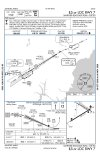
ATC (while about 20 miles out): Say approach request.Pilot: Request the RNAV 32 from SERPA.ATC: Expect that. Proceed direct SERPA. Expect straight in.Pilot loads the approach and when prompted (Garmin) says "No" to the hold.ATC (3-4 minutes out from SERPA): There's a departure out of White Mountain I'm not talking to yet. Hold at SERPA as published.
As far as the original question, this is actually a strawman of a scenario. It is a good scenario from a training and workload in training perspective. But it doesn’t get to the question of being required to do the hold PT or request straight in as was the intent of the original post. This is an after-the-fact hold scenario. It is also one in which more robust holding instructions would be issued.
To it, while reloading time permitting is fairly easy, and also in some systems simply adding a hold at the fix is easy too, while downgrading to heading bug is also fairly easy, I would offer that if you downgraded to HDG you don’t need to reload, merely repeat a direct-enter-enter when the space is right, though personally more simply I would have just clicked the red button and hand flown the lap. Reloading is really only helpful here if you anticipate multiple laps as your scenario offers but is different than merely shifting from an expected straight-in to a normal procedure. Having said this, in some systems it is easier to delete the hold, so maybe load it with it anyway? Then delete it when actually cleared straight in.
- Joined
- May 25, 2006
- Messages
- 22,048
- Location
- KTTA, North Carolina
- Display Name
- Who you kiddin?
- Home Airfield
- KTTA
But I decided to add it for completeness. In aces anyone wonders, I may end up using this in the next version of my IPC quiz.You are correct. but at least I did that one on purpose to save room.
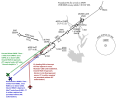
- Joined
- May 25, 2006
- Messages
- 22,048
- Location
- KTTA, North Carolina
- Display Name
- Who you kiddin?
- Home Airfield
- KTTA
Like I said earlier we disagree. The rules about when a PT is required or not have not changed, no matter how much you insist they have. Will you fly the hold at that point unless they need you to hold? Of course not. You will be "cleared straight in." If Portland forgets the words their official manual requires, you can either assume or clarify. And if you assume, you are probably ok, although my SOP is to clarify with a simple "confrirm straight in" in my readback. But the rule is the rule and a vector to the final approach course is a heading to intercept and not a direct to fix instruction. I keep looking for the "if you happen to incidentally cross a NoPT fix on the way in" exception and can't find it.Have a look at ILS Sanford. You’ve passed CON VOR as part of your en route with a filed and cleared to HAVAN. You will almost never be cleared for the approach prior to passing CON VOR; you’re too far away for such and you’re in a completely different sector of Boston Approach. So, after passing CON VOR, well after, you get switched, and you get “N1234 clear direct HAVAN, cross HAVAN at three thousand, clear ILS-07 Sanford.”
Perhaps you can find what I can't - a document in which the FAA uses the term radial to refer to a form of navigation other than VOR or TACAN.As to radials, no they are not VOR specific. They are merely half a polar coordinate in contrast to a Cartesian coordinate. They can apply to anything. Any and all reference points have radials.
Last edited:
Roger Wilco
Line Up and Wait
Simply put:@Roger Wilco
I'm curious what the "Fake Cone of Silence" is?

Real Cone of Silence*
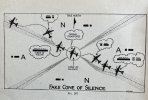
Fake Cone of Silence
Can you spot the difference?
*NOT FOR USE IN NAVIGATION
Last edited:
Roger Wilco
Line Up and Wait
But seriously—@Roger Wilco
I'm curious what the "Fake Cone of Silence" is?
Cone of Silence refers to an area directly over a radio antenna in the shape of an inverted cone, within which the signal may be too weak to receive. The radio men called it the antenna blind cone. Back when fate was the hunter* and pilots had to fly instrument “let downs” using radio range navigation, the cone of silence let them know when they were over the station. Apparently, certain terrain and other factors sometimes caused signal drop-outs, “fake” cones of silence, along a range course that could be mis-interpreted as the real cone of silence associated with station passage.
The images come from a late 1930s book titled Through the Overcast by Assen Jordanoff, which was an early textbook on instrument flying.
*Fate is, of course, still the hunter. Especially in Garmin knob hell.
Roger Wilco
Line Up and Wait
No, I meant what I posted in #102.I think you mean cone of confusion. The cone of silence was a privacy device in Get Smart sitcoms.
Clip4
Touchdown! Greaser!
You do realize your depiction is a 4 course range. Not modern navaids.No, I meant what I posted in #102.
Roger Wilco
Line Up and Wait
There are two ranges in that post: a two-course, and a four-course.You do realize your depiction is a 4 course range. Not modern navaids.
Note: I had to add the disclaimer “NOT FOR USE IN NAVIGATION” to #102, so as to avoid creating a dreaded cone-of-confusion.
Last edited:
- Joined
- May 25, 2006
- Messages
- 22,048
- Location
- KTTA, North Carolina
- Display Name
- Who you kiddin?
- Home Airfield
- KTTA
I though the cone of silence was being below VOR line of sight in a canyon. No?You do realize your depiction is a 4 course range. Not modern navaids.
Roger Wilco
Line Up and Wait
That cone of silence occurs immediately after the sound-of-impact, with a crater at its vertex.I though the cone of silence was being below VOR line of sight in a canyon. No?

dmspilot
Final Approach
- Joined
- Oct 20, 2006
- Messages
- 6,791
- Display Name
- DISPLAY NAME
Where? When? No it doesn't. Show one example. I doubt you can find one, except through controller error. You're just making s*$# up to avoid looking like an idiot. But it's too late for that.Such actually happens all the time. It isn’t the majority case but it is frequent enough.