Do You Understand HILPT???

I’m IR, but 2-3 years out of currency. If it’s during tower ops, I’ll just ask them if I’m approved straight in, no hold. If after hours, I’ll ask approach control the same thing. Why? Because I don’t know the book answer, either because I forgot or was not taught (and if I was taught wrong, maybe it’s good that I forgot). Maybe not the answer you were looking for. Am I a fool?
A little. But you’re honest. That’s a trait I value over about any other.

I’m a little bit of a fool sometimes too. I have some things I treat exactly as you describe. Terminal approach procedures that we use to find runways hiding in clouds is not an appropriate application of that process.
 
Even if you happen to fly over those fixes still doesn't make that your formal clearance. Nevertheless, it is for these reasons that I think this is pedantic discussion. If you are coming from the southwest, no controller is going to expect you to turn around and fly that racetrack. If you do that, he is going to query you what the heck you are doing. If he is wants you fly the hold for traffic separation, he will say so explicity.
There are many Controllers who are going to expect you to turn around and fly that racetrack and all should. That’s why they include “straight in” in the approach clearance.
 
I'm not sure it doesn't. Perhaps not at a C or B where vectors to final is the rule of the day, but I've been seeing a lot of direct to an IF and cleared for the approach lately and expect to see more. My home base is an example. Even if you request vectors to final for the ILS or RNAV 3 into TTA, FAY will almost invariably give you direct to the IF. I've suspected it was one of the reasons Garmin changed the action when selecting VTF to include the straight line fixes.
They probably do that to save verbiage. It’s only 5 miles from IKTOW to HEDDY. The rules for vectoring to final take you almost that far out anyway. Lot easier to do direct IKTOW than the whole PTAC spiel.
 
There are many Controllers who are going to expect you to turn around and fly that racetrack and all should. That’s why they include “straight in” in the approach clearance.

And there's a reason that controllers expect you to do that. It's required by regulation. Procedure turns are never optional.
 
Last edited:
Some easy ways to fix this,

1. Request a straight-in approach

2. Request 10° Left/Right to join final approach course (to make it a vector to final just outside of ONPIC)

3. Request Direct RUBEL for the approach
They'll all work, but starting from
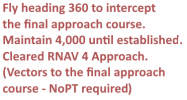
"N1234A, proceed direct ONPIC. Cross ONPIC at 4,000, cleared RNAV Y RWY 4"​
I think #1 is the most efficient from both a controller and pilot standpoint.

My theory is, when a controller clears you to a fix and the approach, they are transferring navigation responsibility to the pilot to free themselves up for other tasks. #2 is asking them to retake it.

I guess #3 depends on where you are when you receive the approach clearance. Asking for a specific fix is something I would be doing long before being cleared for the approach.

#1 just requires a readback:
"Cross ONPIC at 4,000, cleared for the RNAV 4. Confirm cleared straight in."​
 
And there's a reason that they expect you to do that. It's required by regulation. Procedure turns are never optional.
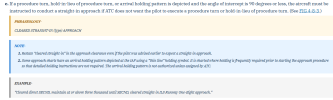
This the from the 7110. Note 1 is really interesting. Even if told to expect straight-in, the controller is to include it with the approach clearance.

1793892651571.png
 
Last edited:
They probably do that to save verbiage. It’s only 5 miles from IKTOW to HEDDY. The rules for vectoring to final take you almost that far out anyway. Lot easier to do direct IKTOW than the whole PTAC spiel.
I think there are two reasons. One, definitely to save PTAC verbiage. The other, which I've heard the guys on Opposing Bases talk about, is to reduce the controller workload that's associated with that verbiage. Vectors to the FAC requires direct controller monitoring all the way to intercept outside the approach gate. The heading they gave might not be working and the have to fix things. Direct to the IF gets close to the same result and once you are direct, the degree of controller monitoring is reduced.
 
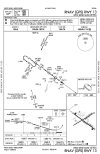
Hmm. This is getting fun now. Suppose you get cleared direct ONPIC, and just by coincidence, you fly right over EDSEW or RUBEL.
What fix did ATC clear you to begin the procedure? Does it matter?

When is a PT required and a PT prohibited on this approach? Or is a PT optional without ATC approval?
 
Last edited:
And when a pilot has received an expect straight in then goes NORDO?
If a pilot goes NORDO, I hope they follow my favorite passage in the AIM (my emphasis; it applies to so much more than communication failure)

6-4-1. Two‐way Radio Communications Failure​
a. It is virtually impossible to provide regulations and procedures applicable to all possible situations associated with two‐way radio communications failure. During two‐way radio communications failure, when confronted by a situation not covered in the regulation, pilots are expected to exercise good judgment in whatever action they elect to take. Should the situation so dictate they should not be reluctant to use the emergency action contained in 14 CFR section 91.3(b).​
 
Reminds me of a time where we were cleared airport to airport on a roughly south initial course and took off from a westerly runway and then given a vector which was roughly toward the destination. My FO was PF. ATC asked what our course to the destination was, and I answered. ATC said to "resume own navigation". FO went for "technically correct" instead of what ATC likely intended, and began turning left to intercept the course from the airport we had departed rather than going direct to the destination. I stopped him and queried ATC whether they meant direct or back to the initial course, and of course they meant direct.

Always always always worth clarifying whatever so that everyone is on the same page.
Not to derail this great thread too much, but this very thing has been mentioned by the Opposing Bases guys as well. Controllers almost always mean direct as they have no idea where your magenta line might take you in their airspace.

This shares the same principle as the "real world" answer to OPs question: "Be predictable". The OB guys mention that in their podcast often, too. Unsure whether ATC wants the HILPT? Ask, don't give them a surprise. :)
 
ONPIC. Yes. When you don’t get straight in/when you do get straight in. No.

Questions: 1. Is the flight path you drew direct to the ONPIC?
2. Is the clearance you recorded a radar vector to a final approach course or fix, a timed approach from a holding fix, or an approach for which the procedure specifies “No PT,”?

Direct means a straight line, not a dog leg. You ignored the clearance, then failed to follow the IAP.
 
Last edited:
You ignored the clearance by intercepting the FAC and then failed to follow the IAP.

You don’t magically get on the 216R at four thousand feet. How you got there matters. Such sets a unique context that skews the question. It is why I put the KIZG approach up with that approaching SERPA from 180. There is no way to get to the 216R down at four thousand feet without having done something that is either already a lap in the hold or is in a manner putting you into a no PT context.
 
You don’t magically get on the 216R at four thousand feet. How you got there matters. Such sets a unique context that skews the question. It is why I put the KIZG approach up with that approaching SERPA from 180. There is no way to get to the 216R down at four thousand feet without having done something that is either already a lap in the hold or is in a manner putting you into a no PT context.
I am trying to figure out what a 216R radial has to do with the IZG RNAV that doesn’t even have a VOR.
 
I am trying to figure out what a 216R radial has to do with the IZG RNAV that doesn’t even have a VOR.

Original post said track 036 essentially on final course, which is 216 radial (and also down at four thousand). KIZG was offered to remove considerations for an essentially in line no PT IAF and also the note for procedure NA in the wedge of airway radials while also noting higher terrain considerations in the west from the axis of arrival. KIZG made for a clean HILPT question whereas the original post brought with it a lot of hidden context. Point being the approach provided in the original post, you had to do something to get you there, either spiral down in the hold, or vectored around to be there. You don’t just get yourself to that 216R down at four thousand feet.
 
Some easy ways to fix this,

1. Request a straight-in approach

2. Request 10° Left/Right to join final approach course (to make it a vector to final just outside of ONPIC)

3. Request Direct RUBEL for the approach
Number 3 is what I would expect to see. Below is an approach that I fly fairly regularly. Every single time I fly in, they route me towards BAE, then vector to intercept the final course long before I ever actually get to BAE. It's almost as if calling for the BAE arrival and flying it for 2 minutes is a formality to keep us out of the HILPT.

1793914836986.png
 
Number 3…. It's almost as if calling for the BAE arrival and flying it for 2 minutes is a formality to keep us out of the HILPT.

Almost like the best answer would be to change the rule so as to have it be that if your entry would be direct, no PT except should such specifically be added in the real-time ATC clearance as needing delay of a hold.
 
Almost like the best answer would be to change the rule so as to have it be that if your entry would be direct, no PT except should such specifically be added in the real-time ATC clearance as needing delay of a hold.
Well, I think that it depends on your inbound course and altitude. The rule probably makes sense for kerosene burners, but perhaps not for a spam can coming from the South at 4-6K ft.
 
Well, I think that it depends on your inbound course and altitude. The rule probably makes sense for kerosene burners, but perhaps not for a spam can coming from the South at 4-6K ft.

I think they could add a noPT sector for JESIB in your case. As to from the SW into ONPIC from vicinity of RUBEL, I think the jets too can manage. I am sure you could find different approaches, however, that could jam them. Then again, patterns are supposed to be on a feet descent per mile aspect not a VVI vs ASI. The velocity element should cancel out.
 
Even if to to expect straight-in
And kind of the point of this question, which is not as clear to a lot of people as I would have thought it was.

"Oh, sorry Mr/Ms ATC... I thought that Direct To was just your way of saying Vectors to Final." :D
 
Almost like the best answer would be to change the rule so as to have it be that if your entry would be direct, no PT except should such specifically be added in the real-time ATC clearance as needing delay of a hold.
Sounds like it might be, but I really don’t see the gain. There’s a really simple rule right now and see how many don’t understand (refuse to accept?) what it says. I’m not sure replacing it by in effect making it optional to the pilot would help. The hold entries are themselves optional. My direct entry arc might be 20° wider than yours. I sure hope you are not going to make me do cockpit math! What about those HILPTs where the entry is direct but the purpose is to lose several thousand feet of altitude, not merely turn around? And apparently I don’t have to tell ATC what I going to do since, if I have to clarify, well that’s just like now.

A charted procedure turn is required unless cleared straight in, arriving via a NoPT segment or area, or vectored to intercept the final approach course. (Yeah, timed approaches from a hold too).

No math. No worries about whether it’s direct or 6° into AIM standard parallel or teardrop. And if some controller forgets to say the magic words, or some pilot is not certain, ask. So easy.

It sort of reminds me of similar discussions about “implied” VFR Class B clearances when the controller “obviously” intended you to enter the Bravo.
 
PT is never optional.
A rather commonly misunderstood IFR procedure. “A procedure turn is the maneuver prescribed when it is necessary to reverse direction to establish the aircraft inbound on an intermediate or final approach course”

If the pilot doesn’t think it is operationally necessary, some think it is optional.
 
Last edited:
Number 3 is what I would expect to see. Below is an approach that I fly fairly regularly. Every single time I fly in, they route me towards BAE, then vector to intercept the final course long before I ever actually get to BAE. It's almost as if calling for the BAE arrival and flying it for 2 minutes is a formality to keep us out of the HILPT.
Totally different issue, which has nothing whatsoever to do with that particular approach procedure. There is a LOA between RFD and MKE that any traffic coming through RFD's airspace and landing in MKE's airspace gets routed to BAE. I suspect that the reason for the LoA is long gone - Might have had something to do with the old VEENA non-RNAV arrival into MKE and keeping traffic away from that or something.

Anyway, while I've never understood the point of it, the LOA is there, so if you're coming from anywhere from about SSW to W into MKE's airspace, you get BAE added when you contact RFD, and then MKE takes it away. Drives me nuts! I discovered the hard way that I was always going to get BAE, so I started filing BAE but well-meaning controllers hundreds of miles away will clear me direct destination and then I have to tell them I'm gonna get BAE anyway, so can I go direct there instead?

Now that you bring it up, I'm gonna see if I can find out if anyone even remembers why that exists, and maybe see if there's a way to get rid of that LOA or make it make more sense.
 
A rather commonly misunderstood IFR procedure. “A procedure turn is the maneuver prescribed when it is necessary to reverse direction to establish the aircraft inbound on an intermediate or final approach course”

If the pilot doesn’t think it is operationally necessary, some think it is optional.
I haven’t heard that argument in years, but I remember it well.
 
I guess time passes more quickly than I realize. The AIM changed in 2005. But as we see in this thread, it is still an issue.

There were two issues I recall seeing.

One was treating a definition - what something is as the the entirety of the regulatory requirements surround its use. Yes, a procedure turn is "the maneuver prescribed when it is necessary to reverse direction to establish the aircraft inbound on an intermediate or final approach course." But that doesn't' tell you anything about rules rules abut its use.

The other was missing the wrod "prescribed" or somehow figuring that pilots, rather than the FAA, "prescribe" procedure turns.

I don't know about 2005, but recall having an argument about it with a CFII 10 years before that. I figured out pretty early on that the rules about when you must use a procedure turn is the inverse of the 91.175 rule on when you may not use a procedure turn.

91.175(j). Limitation on procedure turns. In the case of a radar vector to a final approach course or fix, a timed approach from a holding fix, or an approach for which the procedure specifies “No PT,” no pilot may make a procedure turn unless cleared to do so by ATC.​

It's not stated that way in the reg, but in this case, the inverse is also the rule.

Limitation on Requirement for procedure turns. Except In the case of a radar vector to a final approach course or fix, a timed approach from a holding fix, or an approach for which the procedure specifies “No PT,” no a pilot may must make a procedure turn unless cleared not to do so by ATC.​
 
Limitation on Requirement for procedure turns. Except In the case of a radar vector to a final approach course or fix, a timed approach from a holding fix, or an approach for which the procedure specifies “No PT,” no a pilot may must make a procedure turn unless cleared not to do so by ATC.​

Which takes you back to the original post and the hidden question, how did you get to be on the 216R inbound down at four thousand feet? The answer to this makes all the difference and is why the KIZG approach better fits the intent of the topic to the question.

91.175(j). Limitation on procedure turns. In the case of a radar vector to a final approach course or fix, a timed approach from a holding fix, or an approach for which the procedure specifies “No PT,” no pilot may make a procedure turn unless cleared to do so by ATC.​

The positioning of the original approach and the topography about it as well as the en route altitudes box you in and create a past that changes what is actually being asked. You either teardropped that hold for course reversal already, you did laps in that hold to lose altitude, or you were vectored to the final course and/or you are flying through a noPT IAF. There is no other way to get there.
 
The positioning of the original approach and the topography about it as well as the en route altitudes box you in and create a past that changes what is actually being asked.
I think the original post is perfect. In addition to the usual "on course on altitude" which leads some to think it's not required, it exposes errors like thinking an instruction to go direct to an intermediate fix is "a radar vector to a final approach course." Best of all, it includes the red herring of flying near or over a NoPT fix without it being part of the route or approach clearance.

I think I understand what you mean by the topography. I suspect there are controlling obstacles that prevent a NoPT Terminal Arrival Area. But the scenario as asked is realistic. How you got there was radar vectors. But again a series of radar vectors culminating with direct to a fix, is not "a radar vector to a final approach course." Again. a perfect scenario for several lessons.
 
The scenarios presented have the aircraft entering the IAP at lower altitude. A controller can issue a direct IAF cleared approach at higher altitude and the pilot uses the HILPT to descend.
 
Which takes you back to the original post and the hidden question, how did you get to be on the 216R inbound down at four thousand feet? The answer to this makes all the difference and is why the KIZG approach better fits the intent of the topic to the question.
Normally I'm not too picky on terminology (see the "license vs certificate" debate), but your repeated use of R and Radial here has been legitimately confusing me and evidently some others as to which procedure you're talking about. There are no radials on an RNAV (GPS) approach, or radials from waypoints. I suspect you're referring to the 036 final approach course, and/or being on the 036 course to ONPIC.

As for how you got to be down at 4000, some comments:
- There is no charted requirement to cross ONPIC at 4000. At or above 4000, yes. If you're in the hold, then between 4000 and 8000. But you don't have to cross ONPIC at 4000 in order to proceed inbound. If you cross as high as 4700 you'll still be below the LPV glidepath when it goes active, and if you cross higher than that but can still manage to get down to glidepath or 2800 by the FAF you will be fine. In a 172 or similar this is not a problem.
- You seem to be inferring that the OROCA being at 8000 in this area is limiting. Which it might be if there was no radar coverage (although, with no radar coverage, you should be on one of the airways and therefore using the RUBEL or EDSEW IAFs, and that eliminates the descent problem). But assuming radar coverage, ATC can take you down to as low as the MVA (which depending on radar in use, is as low at 3000).
- Even if you had to stay at 8000 due to radar or OROCA, then you either need to descend in the holding pattern, or if you're coming from the S/SW/W, just request to start the procedure at RUBEL or EDSEW. From EDSEW you certainly have enough time to descend (10.3 nm from EDSEW to ONPIC). RUBEL is tighter (4.8 nm to ONPIC), but some planning ahead on airspeed and configuration should make it manageable in many airplanes. And of course, if you can get cleared to intercept the airways leading to those fixes, you can get cleared to descend to the airway MEA, making it even more manageable (the design criteria has a limit on maximum descent gradient from IAFs using the airway MEA).

This procedure IS a good example of what we need to preach during instrument training and refreshers - that you can't just show up at a procedure and hope everything works out, especially in the mountains. You need to look at the IAFs and plan ahead, which includes how and when you need to descend, and in what configuration.

 
Slight wording issues aside, looks right to me.
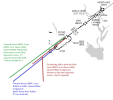
Even the slight ones. It's still a draft and I noticed that I accidentally blocked out some chart elements I wanted to retain, so,

I guess one is that the red one should say "intercept" rather than "join" since it's part of the clearance. And perhaps "final approach course" should be said in full rather than just "final".

Edit. I think this is better.

1793994970796.png
 
Last edited:
Which takes you back to the original post and the hidden question, how did you get to be on the 216R inbound down at four thousand feet? The answer to this makes all the difference and is why the KIZG approach better fits the intent of the topic to the question.
You wouldn't be given a vector to the final approach course followed by a Direct clearance.
 
Back
Top