Can somebody explain to me how a fuel injection distributor works?

Sac Arrow

Touchdown! Greaser!
Joined
May 11, 2010
Messages
21,566
Location
Charlotte, NC
Display Name
Snorting his way across the USA
I -think- and I may be wrong, that the fuel injection "spider" is a fuel distributor geared off the engine somehow, probably the camshaft. But I can't find any reference as to how that works. Can someone help me out on how that operates?
 
Nope. It's just a distribution block. It's not sequential fuel injection like in modern cars...the fuel just sprays all the time.
 
Early on I thought there was a vane in there somehow actuated by the air flow, like in the old Bosch Jetronic mechanical fuel injection systems.
But no, as stated above, it's just a fancy 1 in, 4 out, fuel manifold.
 
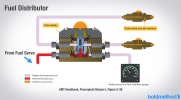
It has one moving part, two if you count the spring. There is a valve in it that is raised by incoming fuel pressure, opening the outlets to the fuel going to the cylinders. When the mixture is pulled to ICO on shutdown, that valve springs closed to prevent fuel from continuing to dribble into the induction system, flooding the intakes and making restarting miserable.

It's also called a flow divider.

1741310873202.png

The fuel pressure (red) is run through the small vertical line (past the left pink outlet line) to the underside of a diaphragm that raises the valve (blue) to let the fuel flow to the injectors (pink lines).

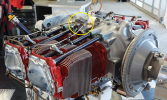
It's the gray thing in the yellow circle, here:

1741311222172.png
 
Early on I thought there was a vane in there somehow actuated by the air flow, like in the old Bosch Jetronic mechanical fuel injection systems.
But no, as stated above, it's just a fancy 1 in, 4 out, fuel manifold.

You mean 1 in 6 out :)
 
Oh. Well. Alrighty then. Thanks.
I assumed the same before I bought my Lance and dove into the systems a bit more. I figured that fuel injection was responsible for the the increase in power of an io-540 over an o-540, for example. In reality it probably accounts for little to no power increase.

It removes the carburetor and it's icing issues, along with the uneven fuel distribution it can cause. Also, it allows a much more complex tuned air induction system. That, along with much bigger valves and higher compression are where the power comes from, but the better fuel distribution is critical for the higher compression.
 
Nope. It's just a distribution block. It's not sequential fuel injection like in modern cars...the fuel just sprays all the time.
I've replaced injectors on cars, but never a plane.

Correct me if I am wrong.

I would guess the partial vacuum created by the intake stroke would suck the fuel into mostly (or entirely) into only "intaking" cylinders. If fuel was continuously spraying into every cylinder, fuel consumption would sky rocket, the exhaust system would fill with unburned gas fumes, ignite, backfire, and havoc would reign.

Do the injectors contain a check valve?
 
Plumbing and constant pressure to all cylinders....it's very simple for aviation. Cars have "direct" injection with electronically controlled solenoids....much more effective and complex.
 
I've replaced injectors on cars, but never a plane.

Correct me if I am wrong.

I would guess the partial vacuum created by the intake stroke would suck the fuel into mostly (or entirely) into only "intaking" cylinders. If fuel was continuously spraying into every cylinder, fuel consumption would sky rocket, the exhaust system would fill with unburned gas fumes, ignite, backfire, and havoc would reign.

Do the injectors contain a check valve?
It dribbles approximately the correct amount of fuel for a combustion event into the intake manifold over the course of all 4 strokes. One cylinders worth of fuel and air gets sucked in during the intake stroke. If you had a transparent intake manifold you would likely see liquid fuel splattered all over the walls of the intake manifold / port that would get swooshed into the cylinder when the intake valve opened.
 
I've replaced injectors on cars, but never a plane.

Correct me if I am wrong.

I would guess the partial vacuum created by the intake stroke would suck the fuel into mostly (or entirely) into only "intaking" cylinders. If fuel was continuously spraying into every cylinder, fuel consumption would sky rocket, the exhaust system would fill with unburned gas fumes, ignite, backfire, and havoc would reign.

Do the injectors contain a check valve?
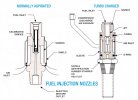
Nope again. Straight through. The brass body that threads into the cylinder is is just a holder for the steel "calibrated orifice" that slips into it. There's also an airbleed, which I'll admit I don't totally understand the purpose of. I think it might aerate the fuel to improve volotization. It's possible that the lower pressure of the intaking cylinder does "suck" more fuel in that direction, but I doubt it's a lot considering the size of the lines and oriiface. Also, I think it'd be more likely to suck air through the bleed instead of fuel.

F_Fuel_Nozzles_1000 (1).jpg
 
I've replaced injectors on cars, but never a plane.

Correct me if I am wrong.

I would guess the partial vacuum created by the intake stroke would suck the fuel into mostly (or entirely) into only "intaking" cylinders. If fuel was continuously spraying into every cylinder, fuel consumption would sky rocket, the exhaust system would fill with unburned gas fumes, ignite, backfire, and havoc would reign.

Do the injectors contain a check valve?
it's nowhere near as complicated as EFI. it's not really fuel injection... just fuel distribution. fuel is always being sprayed when the engine is running
the injectors are just metered orifaces.

the farm tractor technology is absolutely nothing like a car.
 
It dribbles approximately the correct amount of fuel for a combustion event into the intake manifold over the course of all 4 strokes. One cylinders worth of fuel and air gets sucked in during the intake stroke. If you had a transparent intake manifold you would likely see liquid fuel splattered all over the walls of the intake manifold / port that would get swooshed into the cylinder when the intake valve opened.
You also have to remember how fast all this is happening. At 2400rpm, there's 20 combustion events per cylinder, per second. Each combustion consumes about .004oz or .1mL of fuel. We're talking a couple tiny drops. The fuel probably doesn't even have time to collect. Most of it vaporizes instantly.
 
I've replaced injectors on cars, but never a plane.

Correct me if I am wrong.

I would guess the partial vacuum created by the intake stroke would suck the fuel into mostly (or entirely) into only "intaking" cylinders. If fuel was continuously spraying into every cylinder, fuel consumption would sky rocket, the exhaust system would fill with unburned gas fumes, ignite, backfire, and havoc would reign.

Do the injectors contain a check valve?
The injectors place the fuel in the non-combustion side of the intake. In front of the valve. So the fuel doesn't get sucked into the cylinder until the intake valve opens. It can't dribble into the cylinder.
 
It dribbles approximately the correct amount of fuel for a combustion event into the intake manifold over the course of all 4 strokes. One cylinders worth of fuel and air gets sucked in during the intake stroke. If you had a transparent intake manifold you would likely see liquid fuel splattered all over the walls of the intake manifold / port that would get swooshed into the cylinder when the intake valve opened.
It only dribbles at idle, when the fuel pressure is low. At higher power settings, it is spraying an atomized cone of fuel. The flow is constant so that the injector creates a cloud of fuel that is sucked into the cylinder on the intake stroke.
There's also an airbleed, which I'll admit I don't totally understand the purpose of. I think it might aerate the fuel to improve volotization. It's possible that the lower pressure of the intaking cylinder does "suck" more fuel in that direction, but I doubt it's a lot considering the size of the lines and oriiface. Also, I think it'd be more likely to suck air through the bleed instead of fuel.
It is for atomization. Look closely at the injector picture and see that the calibrated orifice is smaller than the passage beneath it to the intake. That creates a pressure drop there that aids in drawing in air past the filtering screen, and low manifold pressure does the rest. The injector with the tube for the "compressor discharge" is for turbocharged systems, and the turbo discharge is ducted to the tube to prevent the boosted MP from blowing the fuel out of the filtering screen and into the engine compartment.

If one sees blue stains on the exterior of the injector, it usually signifies a dirty or partially-blocked injector and the fuel is escaping out of the screen.
it's nowhere near as complicated as EFI. it's not really fuel injection... just fuel distribution. fuel is always being sprayed when the engine is running
the injectors are just metered orifaces.

the farm tractor technology is absolutely nothing like a car.
Yeah, the old tractor-technology that you are forever accusing aircraft engine makers of using. I challenge you to create an electronic fuel injection system that is as reliable as these older-tech aircraft systems, without a whole bunch of redundancy for backup. You can't. EFI relies 100% on a supply of electricity at adequate voltage and current, and in airplanes where that alternator is running at twice or three or four times as fast as in the car (we've argued THAT before) but not often getting the inspections they should, their brushes wear out and fail and the battery has to keep radios and lights and some instruments working until a landing can be safely made. Electronic fuel injection absorbs a lot of power, too. The old mechanical systems just keep on working when the electrics fail, like magnetos will do. The FAA knows this and so designing and certifying an engine with EI and EFI is expensive. Just ask Lycoming how much it cost to get certification on their iE2 series. They have the usual alternator plus a built-in backup alternator, and the airplane will have at least one more battery. It all adds weight and cost and complexity. I'd bet that it cost more to get the certification than it did to develop and build the engine.

How much experience do YOU have working on aircraft fuel injection systems, both Continental and RSA/Lycoming? There are significant differences between them, with the RSA being much more complex and offering a more accurate fuel flow.
 
Last edited:
Dribble, splurt, atomize, spray, puke, whatever. Some fuel hangs in the air and a bunch splats onto the walls of the manifold/ port / back of the intake valve. The liquid film gets wooshed along the surface with when the intake stroke is happening and tends to sheer off the edge of the valve and port.
Ain't no injector on this planet that does not make a puddle. If there was, my life (automotive emission control) would have been much simpler and auto makers would never have spent the money to go to in cylinder injection.
You might think that it is easy to compensate for changes in the amount of fuel in on the manifold walls, but it's not. Many, many have tried, all have come up short.
 
I challenge you to create an electronic fuel injection system that is as reliable as these older-tech aircraft systems, without a whole bunch of redundancy for backup. You can't. EFI relies 100% on a supply of electricity at adequate voltage and current, and in airplanes where that alternator is running at twice or three or four times as fast as in the car (we've argued THAT before) but not often getting the inspections they should, their brushes wear out and fail and the battery has to keep radios and lights and some instruments working until a landing can be safely made. Electronic fuel injection absorbs a lot of power, too. The old mechanical systems just keep on working when the electrics fail, like magnetos will do. The FAA knows this and so designing and certifying an engine with EI and EFI is expensive.
I'll be vague, because some of this stuff is patent-worthy and I hope to have enough free time at some point to put it all in an application and submit it to the USPTO.

An electronic fuel injection system, fully sequential and with optional closed-loop mixture control (if we manage to get rid of the lead, although even with the lead a sensor should last enough to make it to the next oil change) could be created from commercial, off-the-shelf parts, with about 10-15% added for redundancy to what it would be needed for a single, non-redundant system.
You just have to design smart. Sometimes it's a lot cheaper to duplicate components than to go through the reliability analysis required to prove one of them is enough.
In this day and age, even back-up power is not an issue. You mentioned alternators and the complete lack of proper maintenance on them. Valid point. But we don't need brushes anymore. Most FADEC systems use a PMA (permanent magnet alternator) to keep the FADEC alive if all primary power is lost. It's literally a magneto without the points and the high voltage coil and distributor. Cheap in the grand scheme of things.

Certification is a problem really just in terms of cost, and the market not being committed and unified enough to make it viable.
Here's what I mean by that. An EFI system today costs about $1000-1500 in parts, including ECU, sensors, injectors and ignition coils. Add maybe another $500 if you include parts required for redundancy. We're not going to discuss installation costs, as those can vary and would be outside the scope of a company selling the retrofit kits. Of course, if I make this there will be some profit margin tacked on top. I'm not a charity and I expect to be sued, even if the guy crashed because he ran out of fuel.
But to certify this, between the design work, creating drawings, manuals, certification documentation, ground and flight testing and everything else required for certification, you need, optimistically (again, assumes a smart design with a good understanding and mitigation of the hazardous/catastrophic failure modes) a minimum of $250k, with a more realistic number being probably closer to $500k.

Now, if I show up in July at OSH with an experimental aircraft, equipped with an O-360 and a full EFI system, and I tell everyone that it could be on their aircraft in a couple years if they give me a $500 deposit (balance due at delivery), how many deposits do you think I'm going to walk away from OSH with? Based on what I've seen so far, I think I know what that number will be. 0
Too much "I'm perfectly happy with my system that I can barely get parts for", "Why change it if it works?", "Too new for me, I don't understand electricity" out there to have a viable market.


A bit of a tangent here, but if I were some big exec at AOPA, this is the kind of stuff I would focus on. Put out a request for proposals for a given system (EFI in our case), have people submit preliminary designs, get them vetted, select the best, work with the proponent and the FAA to establish a certification path and then fund the certification. Get this thing to market and use my marketing might to convince people to go for it. We don't need two dozen competing systems, all eating each other alive in too small of a market for all of them to be viable. You need one or two solutions that work and cover 80-90% of the existing fleet. Stuff like that will keep the certified fleet going and potentially economically viable. Pick a project every year. Skytec is gouging people on starters? RFP for a new starter option. And so on.

 
Today....you can fly your contraption on an experimental aircraft....do it. Prove it out and sell kits at OSH. You'll be rich.

Having said that....what you attempt to do has been done before. Even to the extent of running different fuels. ;)
 
But to certify this, between the design work, creating drawings, manuals, certification documentation, ground and flight testing and everything else required for certification, you need, optimistically (again, assumes a smart design with a good understanding and mitigation of the hazardous/catastrophic failure modes) a minimum of $250k, with a more realistic number being probably closer to $500k.
As mentioned, this has already been done and flown. However, if you believe your design provides a better route you could initially develop this for well below your estimated $500k. Using your aircraft or a donor aircraft, buy your OTS fuel injection components and adapt them to the engine. Nothing prevents you or anyone else that helps you from performing this work. Once your system is installed perform the necessary ground runs to validate its performance and limitations.

If you believe that performance is worthy of a test flight, apply for a Special AWC under Experimental R&D for 30 or 60 days and perform the necessary tests to confirm the system's performance and integrity. Then when you are satisfied with those numbers, apply for an AWC Experimental Exhibition and fly it to build data and exposure in the industry. Just be sure to document everything in case you do decide to pursue certification.

Now for the flip side to consider. First, you'll need well north of $500k for any certification effort due to various reasons. One method to cut costs would be to use specialized components from top tier engines like found on Formula 1 or Indy cars. One of the hardest certification parts to pass for "vehicle" engines/parts is fire prevention rules. However, those top tier parts tend to cost more than current certified parts.

And so on. However, the biggest consideration to this venture is your potential market size which is unfortunately the reason these and similar attempts rarely have the economics of the venture work out in a positve manner.
 
I challenge you to create an electronic fuel injection system that is as reliable as these older-tech aircraft systems, w
Any off the shelf auto EFI will work for decades. If you are going to claim reliably then thats the same thing as asking how long is a piece of string.
 
Any off the shelf auto EFI will work for decades. If you are going to claim reliably then thats the same thing as asking how long is a piece of string.
Powered by off-the-shelf alternators that DO NOT work for decades in airplanes. You really missed the point, didn't you? An EFI system without electrical power does not work. Period. Dead engine, instantly.

And that's beside the whole electrical supply system that is, in many airplanes, completely ignored until it quits or it start glitching. Annual "inspections" that don't inspect all those cables and connectors and contactors and switches. "Run it 'till it quits" is a common attitude.

With electricity-dependent engine systems, that attitude will have to change. Cessna, for example, has found that it has to demand periodic replacement of certain electrical components in their restart aircraft due to their importance and the neglect so common in this industry.
 
Last edited:
Most FADEC systems use a PMA (permanent magnet alternator) to keep the FADEC alive if all primary power is lost.
I mentioned Lycoming's iE2 EFI/EI engine. That's what they use.
 
Powered by off-the-shelf alternators that DO NOT work for decades in airplanes. You really missed the point, didn't you? An EFI system without electrical power does not work. Period. Dead engine, instantly.

And that's beside the whole electrical supply system that is, in many airplanes, completely ignored until it quits or it start glitching. Annual "inspections" that don't inspect all those cables and connectors and contactors and switches. "Run it 'till it quits" is a common attitude.

With electricity-dependent engine systems, that attitude will have to change. Cessna, for example, has found that it has to demand periodic replacement of certain electrical components due to their importance and the neglect so common in this industry.
wanna know how many injectors, ECUs and Alternators I've replaced in 55 years of owning everything from a 42 Ford to a 2014 Dodge? Zero. not one. not for family, friends, at work, neighbors... at all.

you are falling into the i't's more complicated so it must must be worse' mindset.... nope.

since you cannot define your parameters for 'reliable' you are just going to go in circles.

my current car is 11 years old and has 218000+ miles,still gets 27+ mpg and I've never touched a thing you said is unreliable.

as I said before, Alternators rarely break... it's usually a diode that pops.
dirt in the fuel will kill any fuel injector.

ECUs hit with a voltage spike will die, but again you are in the lowest percentile if you ever had to replace an ECU.

please don't repeat old wives tales.
 
I mentioned Lycoming's iE2 EFI/EI engine. That's what they use.
also a battery will power an EFI for at least 30 minutes. if you design a system with single points of failure then don't be surprised when that single failure happens.

EFIS have backup batteries. You fly with an EFIS don't you? An air driven turbine is standard in many jets and some props.

If you are going to rely on an ECU you DESIGN THE SYSTEM TO SUPPORT IT. I hope you at least understand that.
 
Any off the shelf auto EFI will work for decades.
Except it makes one wonder if its so simple and dependable why doesn't every aircraft have EFI to include E/ABs? Especially since there have been complete kits available for Lycomings/TCMs for quite some time on the E/AB side. Seems to me, if the benefits were so great one would even put an aircraft on Exp/Exh just to install one of the existing non-certified EFI kits? But few if any do.
 
Electronic ignition was adopted in the automotive world in the mid-late 70s and we're only recently getting it in airplanes. Going on that timeline we should be due for aircraft EFI in about another decade. I'd say the big advantage for EFI in an aviation application aside from easier starts/smoother idle would be you could eliminate the mixture knob/handle and have the computer keep the engine at the ideal air/fuel ratio at all times.
 
Off the shelf automotive won't work....the fuel mapping isn't designed to work at altitude. Ted worked a project at Textron with a few other guys....we did this. ;)
 
the fuel mapping isn't designed to work at altitude.
It is.
But, the assumptions built into the software (at the least the software released in the U.S. that I worked with) was that there are no roads above 14000 feet, so if you measure barometric pressure above that there may be issues. If you use a hot wire mass air sensor, the altitude effect is not that big.
 
wanna know how many injectors, ECUs and Alternators I've replaced in 55 years of owning everything from a 42 Ford to a 2014 Dodge? Zero. not one. not for family, friends, at work, neighbors... at all.

you are falling into the i't's more complicated so it must must be worse' mindset.... nope.

since you cannot define your parameters for 'reliable' you are just going to go in circles.

my current car is 11 years old and has 218000+ miles,still gets 27+ mpg and I've never touched a thing you said is unreliable.

as I said before, Alternators rarely break... it's usually a diode that pops.
You spouted this nonsense a couple of years ago and I proved that the same alternator in an airplane will wear out its brushes much faster because it is turning near its redline.

Look, folks: An alternator has a redline, typically around 10,000 RPM. It is driven by the engine using pulleys of such ratios that the alternator will not exceed its redline when the engine hits its redline. So in my Hyundai, which redlines at 6500 RPM but cruises at around 2200, that alternator will be running at 3385 RPM, far short of that 10K redline. In the airplane, the pulley ratios are set to drive that alternator at or near its redline when the engine is at redline. So the Lyc that redlines at 2700 but cruises at 2500 will be spinning its alternator at 9260 RPM. Since more speed means more surface travel of the slip rings that the brushes ride on, those brushes get hotter and wear out much sooner. It's spinning almost three times faster!

In the car that's never off the highway, the brushes last a long time. A bit of dust and they're gone sooner. But none of them last forever, which is why auto parts shops stock lots of alternators.

Diodes? In all my years wrenching on airplanes and flying them I never had a diode fail. Ever. I did replace a lot of brushes at the second 500-hour inspections, though. The new Cessnas with the Garmin glass panels ate those brushes sooner. I found them 2/3 gone at the first 500-hour inspection. That glass uses a lot of electricity, and the brushes have to carry more field current to generate it.

What is your small-airplane maintenance experience? You still haven't told me what aircraft fuel injection systems you have maintained. How many alternators have you repaired with new brushes?

Both my car and truck ate their alternators at around 230K kilometers, or around 143K miles.
 
Last edited:
If you are going to rely on an ECU you DESIGN THE SYSTEM TO SUPPORT IT. I hope you at least understand that.
Isn't that what I said? You said you could stick an OTS EFI system in an airplane and it would work just fine. Like so:
Any off the shelf auto EFI will work for decades. If you are going to claim reliably then thats the same thing as asking how long is a piece of string.
 
it's nowhere near as complicated as EFI. it's not really fuel injection... just fuel distribution. fuel is always being sprayed when the engine is running
the injectors are just metered orifaces.

the farm tractor technology is absolutely nothing like a car.
Not unlike a Hilborn set up in a car.
 
Back
Top