Big stir in the Citation world

and the FAA just arbitrarily excluded a bunch of airplanes after 42 years based on a meaningless paper technicality from the 70s.
…and fairly widespread violation of exemption criteria, and the inability of exemption holders to police the pilots operating under their exemption, and the inability of the FAA to properly oversee the process.
 
Probably true but you have to draw the line somewhere. Why is a 501 OK with 1 pilot but a 500 needs 2? You can also stretch that argument much further. I bet any plane would be safer with two well trained pilots with good CRM - should every GA flight now have 2 fully trained CRM pilots? Need to bring a right seater in your 152 to the pancake breakfast? I’m sure it would be safer. For that matter why stop at 2, let’s have 3 fully typed and trained pilots in every jet…

The argument is not that 1 pilot is just as safe as 2, but that we have decided that for some operations (part 91), we can live with the slightly higher risk of single pilot and the FAA just arbitrarily excluded a bunch of airplanes after 42 years based on a meaningless paper technicality from ….
You said it much more eloquently than me. Where does it stop with 2 pilots?
 
Probably true but you have to draw the line somewhere. Why is a 501 OK with 1 pilot but a 500 needs 2?
I get what you're saying, but the line was first drawn with jets, the Lear 23 specifically. Bill Lear's strategy of certifying under Part 23 and below 12,500 lbs. gross weight so only one pilot could fly it didn't cut it with the feds. So, Lear embraced Part 25 instead starting with the model 24. Cessna couldn't compete on performance, so they also certified the Citation 500 under Part 25 even though it was below 12,500 lbs., and then lobbied hard for single pilot approval, thus turning a marketing weakness into a strength. That's why a 501 is OK with 1 pilot but a 500 needs 2.
 
not sure if this is relevant, but read & respond;

LOL! The last sentence: "Take a look at the data presented here, and then you make the call."

I call BS. Where does it indicate the accident rate per hours flown? Nowhere I could see. For all anyone knows from this article 99% of one group could have crashed and only 1% of the other, with no way to tell which is which.
 
No, it just increased the value of Bic pens. Suddenly, half of your local CFI‘s will have their “3 bounces and some systems training”.
Beats having a 172 pilot flying a jet in IMC in an emergency.
*Equals* having a 172 pilot flying a jet in IMC in an emergency.
I’d recommend reading what’s required of a SIC that satisfies the single-pilot exemption.

I'd recommend reading 61.55(b) because that's what we're talking about here - A pencil-whipped but legal right-seater, not someone who is type rated and satisfies the single pilot exemption.
 
LOL! The last sentence: "Take a look at the data presented here, and then you make the call."

I call BS. Where does it indicate the accident rate per hours flown? Nowhere I could see. For all anyone knows from this article 99% of one group could have crashed and only 1% of the other, with no way to tell which is which.
It doesn't - And that's the problem with this problem! There is no data collected in terms of hours flown with two pilots vs a single pilot, and no easy way to even so much as infer it, which leaves you without a denominator for the accident rate.

So yeah, that whole article is a bunch of inference but no reliable conclusion.
 
I'd recommend reading 61.55(b) because that's what we're talking about here - A pencil-whipped but legal right-seater
I don’t need to read it, that’s what I was referring to. And nobody is talking about pencil-whipped anything. That’s just as illegal as having your 172 pilot kid in the right seat. And if you don’t think knowing

(I) Operational procedures applicable to the powerplant, equipment, and systems.
(ii) Performance specifications and limitations.
(iii) Normal, abnormal, and emergency operating procedures.
(iv) Flight manual.
(v) Placards and markings

make a legal SIC better than aforementioned kid who knew none of this, I really don’t know what to say.
 
You are sure right about that. In fact I believe this is the reason we have mandatory ELT's in planes. Some important Congressman in Alaska went missing back in the early 70's on a GA flight in some remote area of that state and the plane was never found (to this day). Congress then decided ELT's would fix that. ELT's may occasionally save live's, but most of the time they just lead to dead bodies (when not setting off false alarms).
Actually we'd be better off without ELTs isn't nearly the wildest take I've read on this website, but it's up there.
 
Actually we'd be better off without ELTs isn't nearly the wildest take I've read on this website, but it's up there.
You would be better served carrying a PLB in the plane.

I always carried a portable radio with me.
Figured I could raise an airliner overhead possibly.
 
FWIW: there has been a number of working papers written on the issues of single pilot vs two pilot ops with a more recent look the subject by ICAO, EASA, FAA, etc. as new technologies expand it to remote pilotage and eventually to autonomous ops.

Here's one:
EASA: eMCO-SiPO – Extended Minimum Crew OperationsSingle Pilot Operations
So, basically, in order for single pilots to be as safe as two, they need automation for a backup and if they have that, then they don't even need a pilot at all, right? It fits with my suspicion of the whole purpose of NEXTGEN.
 
It fits with my suspicion of the whole purpose of NEXTGEN.
Except NextGen applies only to modernizing the NAS and funded as such. However, as part of that NAS upgrade they are making provisions to manage those types of ops to include UAS, eVTOL, eCTOL, etc. and are currently flying test flights. Regardless, the FAA doesn't have a formal eMCO/SiPO programs at the moment other than a study performed about 7-8 years ago on cargo ops. Its mainly a ICAO and EASA topic for now but the single/remote/autonomous ops discussion has been around for many decades.
 
So has NEXTGEN. I guess I don't see your point.
Point being NextGen has zero to do with the regulatory path or development of those types of pilot operations, which was further defined by congress in Feb 2026 when they codified two pilots on flights for all 121 ops. However, I haven't seen any FAA NPRM released on that part yet.
 
I don’t need to read it, that’s what I was referring to.
OK. Your wording of "a SIC that satisfies the single pilot exemption" was confusing. The SIC doesn't satisfy the exemption, the PIC does if they want(ed) to be PIC on their own.

And nobody is talking about pencil-whipped anything.
I'm pretty sure that's exactly what this comment was about:

No, it just increased the value of Bic pens. Suddenly, half of your local CFI‘s will have their “3 bounces and some systems training”.

That’s just as illegal as having your 172 pilot kid in the right seat. And if you don’t think knowing

(I) Operational procedures applicable to the powerplant, equipment, and systems.
(ii) Performance specifications and limitations.
(iii) Normal, abnormal, and emergency operating procedures.
(iv) Flight manual.
(v) Placards and markings

make a legal SIC better than aforementioned kid who knew none of this, I really don’t know what to say.
OK, so they're better by a very fine hair. But none of that is going to matter in a real emergency when they've probably never experienced it in the sim or in an airplane. And no, "maneuvering with an engine out" because it was pulled back isn't going to make a big difference when the engine fire bell goes off just after V1 and there's pretty lights all over.
 
OK, so they're better by a very fine hair. But none of that is going to matter in a real emergency when they've probably never experienced it in the sim or in an airplane. And no, "maneuvering with an engine out" because it was pulled back isn't going to make a big difference when the engine fire bell goes off just after V1 and there's pretty lights all over.
Ha. That reminds me of a captain I flew with who had 10,000 hours in straight-pipe Lears and came back from his first ever sim session to be typed on the brand new LR 35. Says I, "How'd your initial training go, Ned?" Says he, "I hated it! First, they put you a box, then they turn out the lights, then they set you on fire!"
 
Point being NextGen has zero to do with the regulatory path or development of those types of pilot operations, which was further defined by congress in Feb 2026 when they codified two pilots on flights for all 121 ops. However, I haven't seen any FAA NPRM released on that part yet.
I see. My comment is limited to ARINC 424 path terminators. It's clear to me the purpose was to entirely remove human guesswork and manual stick-and-rudder flying from standard instrument procedures, laying the groundwork for modern, fully automated flight.
 
Thanks, that was a nice response, and I agree with your conclusion about the future likelihood of not being included. That said, I am a firm believer in "two heads are better than one" and "four eyes better than two".

Yes but they allowed the airlines to and manufactures to slowly get rid of the Flight Engineer, where 3 heads and 6 eyes was a good option. As an FE, I contributed quite a bit to the safe operation. Personally preventing runway incursions, wrong taxing operations, etc. Even 2 pilots can get overwhelmed under the right circumstances.
 
You can be over-standardized. Standards are great for creating common language and common understanding, expectations, appreciation for roles and responsibilities. But in roles and responsibilities they help for you to notice when such aren’t being met so as to be able to cover down or mitigate. We too often however, strive to meet or hold the standard when context demands different.

I agree completely, as I have seen in other countries flight crews, where common sense and total awareness never came in the door.

Where standards and procedures were the overriding cause of an unintended outcome.
 
I see. My comment is limited to ARINC 424 path terminators. It's clear to me the purpose was to entirely remove human guesswork and manual stick-and-rudder flying from standard instrument procedures, laying the groundwork for modern, fully automated flight.
If interested, here is the final NextGen report. It was reorganized into the Airspace Modernization Office as part of a larger FAA reorganization last year.
NextGen Final Report 2025
 
LOL! The last sentence: "Take a look at the data presented here, and then you make the call."

I call BS. Where does it indicate the accident rate per hours flown? Nowhere I could see. For all anyone knows from this article 99% of one group could have crashed and only 1% of the other, with no way to tell which is which.

Just goes to show, the figures can be made to look like any thing you want them to.
 
What a mess. I was looking hard at going down the 550 path with a SPE, but ended up buying the 441. I really feel for the guys following the rules in good faith that are faced with essentially emergency revocation with no notice, little remedy, and threat of violation for actions they had zero control of.
 
Yes but they allowed the airlines to and manufactures to slowly get rid of the Flight Engineer, where 3 heads and 6 eyes was a good option. As an FE, I contributed quite a bit to the safe operation. Personally preventing runway incursions, wrong taxing operations, etc. Even 2 pilots can get overwhelmed under the right circumstances.
Protect essential.

I miss having FEs on the deck.
 
Having read the letter sent out by the FAA, I don’t think they over reacted. My reading of the thing indicates the door isn’t closed on these waivers. Only closed on certain training providers because they were bad actors. Looks like the biffle accident broke the camel’s back.
 
Having read the letter sent out by the FAA, I don’t think they over reacted. My reading of the thing indicates the door isn’t closed on these waivers. Only closed on certain training providers because they were bad actors. Looks like the biffle accident broke the camel’s back.
My understanding was that the pilot of the Biffle flight didn't have a SPE.
 
You can be over-standardized. Standards are great for creating common language and common understanding, expectations, appreciation for roles and responsibilities. But in roles and responsibilities they help for you to notice when such aren’t being met so as to be able to cover down or mitigate. We too often however, strive to meet or hold the standard when context demands different.
This is an interesting position, that ignores reality. I won’t try to argue it, because I’ve had a successful military career, and now civilian career, proving that standardization is the only way to get out of this field alive. Standardization = safety; safety = standardization. As an aviator, the goal is to live to retirement.
 
This is an interesting position, that ignores reality. I won’t try to argue it, because I’ve had a successful military career, and now civilian career, proving that standardization is the only way to get out of this field alive. Standardization = safety; safety = standardization. As an aviator, the goal is to live to retirement.

Seems three services at least taught differently:

IMG_1635.webp
 
Seems three services at least taught differently:
What's the S in NATOPS stand for?
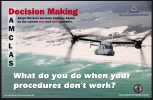
DAMCLAS neither teaches nor implies abandoning standardization, but recognizes (as does NATOPS) that not all situational responses can be standardized.

Nauga,
whose grove is unharvested
 
Last edited:
What's the S in NATOPS stand for?
DAMCLAS neither teaches nor implies abandoning standardization, but recognizes (as does NATOPS) that not all situational responses can be standardized.

Nauga,
whose grove is unharvested

Actually, NATOPS specifically states, not implies, outright says standards and procedures may need to be rejected in context. They tell you you may need to abandon them. And not just to handle emergency either, to avoid emergency as well. They tell you standards and procedure are not there to replace judgement.

Per CNAF 3710.7, “This manual prescribes general flight and operating instructions and procedures applicable to the operation of all naval aircraft and related activities. This manual is not intended to cover every contingency that may arise and every rule of safety and good practice… In the tactical environment, military exigency may require on-site deviations from instructions/procedures contained here. The existing risk of deviation must continually be weighed against the benefit of deviating from this manual. Deviation from specified flight and operating instructions is authorized in emergency situations when, in the judgment of the pilot in command, safety justifies such a deviation. It is often not feasible to completely specify all situations or circumstances under which provisions of this manual shall apply”

Per F/A-18A-D NATOPS: “… In order to remain effective, NATOPS must be dynamic and stimulate rather than suppress individual thinking… It provides the best available operating instructions for most circumstances, but no manual is a substitute for sound judgment. Compound emergencies, available facilities, adverse weather or terrain, or considerations affecting the lives and property of others may require modification of the procedures contained herein. Read this manual from cover to cover. It is the air crewman's responsibility to have a complete knowledge of its contents.”

Pulled up the T-37 “Dash One,” turns out the Air Force sees it rather similarly: “SOUND JUDGEMENT Instructions in this manual are for a pilot inexperienced in the operation of these airplanes. This manual provides the best possible operating instructions under most circumstances, but it is not a substitute for sound judgement. Multiple emergencies, adverse weather, terrain, etc. may require modification of the procedures.”

 
Last edited:
Back
Top