Aviation PPE?

455 Bravo Uniform

Final Approach
Joined
Aug 18, 2015
Messages
6,956
Location
KLAF
Display Name
455 Bravo Uniform
Home Airfield
KLAF
The Fresno crash got me thinking. Investigators try to determine the cause of plane accidents. I’m interested in the injury or causes of death. Is there an easy way to find that data?

For instance, burn, head trauma, internal bleeding, etc. That way one could opt for PPE like Nomex suit, gloves, shoes, helmet, etc.

Coming from various chemical companies, our PPE is hazard specific and dependent. Also from a racing standpoint, as a former drag racer of 25 years, suits were fire retardant and helmets were roll-bar contact tested and fire tested. As a newer kart racer, suits are abrasion rated and I use a motorcycle helmet (no fire rating; no seat belt).

Paging @wanttaja …
 
Helicopter pilots often wear helmets and other PPE that you don't normally see in fixed wing. Warbird pilots also usually wear nomex flight suits and helmets.

I have seen GA pilots wearing flight suits, or even a helmet, but it seems that practice is often mocked.

From that standpoint though, what do you wear in your car driving from home to the airport?
 
a lot of it is g-forces.
hard to stop an aorta from rupturing, a liver being torn from its attachments.
Seats designed to dissipate energy on impact; cabin structure, Amsafe bags…..

Yeah, head injury is huge too.
I knew a California Viking pilot who had two motorcycle helmets, I think they wore them during takeoff & landing.
 
When I started flying, instructors insisted you wear long pants and closed-toe shoes in case of fire. Today, I'm almost always wearing shorts. It's really just a matter of what you feel comfortable with. I would wear a helmet if flying aerobatic competitions, but I don't in warbirds. Flight suit... not for me.

And yes, we will make fun of you if you come out of a 172 with a helmet and flight suit on. :D
 
And yes, we will make fun of you if you come out of a 172 with a helmet and flight suit on.

Motorcycling created a market for jeans and undergarmets with built-in padding, armor, and abrasion resistance.

I wonder whether there would be an aviation market for casual-looking garmets that were fire retardant. Cotton treated with Proban could be used to make jeans, slacks, polo shirts, socks, jackets, etc. A pilot and passengers could then have some fire protection without looking like dweebs.
 
It I dolled up the plane with military decor like stars and bars, etc, could I wear my old flight suit as well?
 
Motorcycling created a market for jeans and undergarmets with built-in padding, armor, and abrasion resistance.

I wonder whether there would be an aviation market for casual-looking garmets that were fire retardant. Cotton treated with Proban could be used to make jeans, slacks, polo shirts, socks, jackets, etc. A pilot and passengers could then have some fire protection without looking like dweebs.
Maybe, but would you wear it? Honestly, I wouldn't. It would be expensive and in my 10K hours of flying, I've never experienced a fire.

I did have a crash in my Luscombe and a helmet would have saved damage to my face, but so would a shoulder strap, which I didn't have.
 
Fire is scary and I understand the interest in PPE that many have. Unless military flight suits have changed a lot recently, they offer very limited protection. A fire-resistant rig that might actually be effective in a crash would include a full-body, multi-layer firesuit such as those designed for auto racing. A suit with the highest rating (that I'm aware of) of, SFI 3.2A/20, provides 40 seconds of protection until the inner layer reaches a temperature hot enough to cause second-degree burns. The lowest rating, 3.2A/1, offers only 3 seconds of protection under the same conditions. I don't know where a military flight suit rates in comparison, but I'm guessing it's closer to 3 seconds than 40. It's crucial to get a good seal at the ankles, wrists, and neck, and that those areas are protected by fire-resistant boots, gloves, and a Nomex balaclava/headsock. Then top it off with a helmet with a face shield/visor, and you will have cocooned yourself in a rig that might provide enough fire protection to be meaningful. You will also be quite uncomfortable, especially on hot days.

As for helmets, I can imagine a reasonable rationale for certain operations but not for the vast majority of GA flying.

When it comes to military-style flight suits and helmets, I suspect that most of the GA pilots outfitted in such a get-up do so to facilitate their Walter Mitty fantasies. To me, they're all too much like Snoopy engaging the Red Baron from the roof of his doghouse. Plus, a flight suit is a good place to affix patches, and they have special pockets that keep those grease pencils handy.
 
Last edited:
Maybe, but would you wear it? Honestly, I wouldn't. It would be expensive and in my 10K hours of flying, I've never experienced a fire.

Probably not. I could treat clothing I already own for the cost of a bucket of flame retardant, probably a couple of hundred bucks, but I've never done it. For the most part, I don't think it would add enough safety to matter.

As @Roger Wilco points out, you don't gain much time from protective clothing. When I was racing, the firesuit I wore was a combination of nomex and proban, and it would only afford me about 10 seconds in flame. Plus I was wearing nomex socks, leather+nomex gloves and shoes, a nomex hood sock, and an SA rated full-face helmet. Wearing just pants and shirt in a cockpit might make my knees and elbows survive for an extra few seconds, but my face and fingers would already be gone.

And even if I wore all my racing gear in the cockpit and could expect 10 seconds or so of protection, would that really be enough to do me any good? With an in-flight fire, certainly not. In a post-crash fire, maybe it would afford me time to exit the plane, assuming I had no other major injuries and I wasn't trapped, but the odds are long against it.

Military flight suits only have to protect the pilot long enough for him to eject. That's not an option for us.
 
Motorcycling created a market for jeans and undergarmets with built-in padding, armor, and abrasion resistance.

I wonder whether there would be an aviation market for casual-looking garmets that were fire retardant.
I mentioned it in another thread, but casual-looking FR clothing already exists and it's fairly comfortable even in summer. button-ups, t-shirts, jeans, and even sweatpants. Ariat, Cody James, and Carhart are a few but there are others. If a guy was concerned and didn't want the teasing, he (and she) could just check out their local western or work wear store.
 
Driving suits work only because when racing you are in very close proximity to those who are going to pull you out plus there is an ambulance right there for almost all organized events.

A fire suit while flying being beneficial would be an extremely rare occurrence.
 
1940s-determined-experienced-man-aviator-wearing-leather-flying-helmet-goggles-canvas-flight-suit-standing-ready-by-biplane-a1372-har001-hars-lifestyle-planes-satisfaction-history-conflict-ready-ww2-jobs-rural-copy-space-half-length-persons-inspiration-goggles-males-risk-confidence-transportation-expressions-bw-freedom-skill-occupation-happiness-skills-adventure-airplanes-canvas-strength-courage-experienced-excitement-low-angle-recreation-world-wars-pride-world-war-world-war-two-world-war-ii-by-authority-aviation-occupations-uniforms-conceptual-aviator-stylish-world-war-2-determined-T62PT8.jpg
 
Driving suits work only because when racing you are in very close proximity to those who are going to pull you out plus there is an ambulance right there for almost all organized events.

A fire suit while flying being beneficial would be an extremely rare occurrence.
When doing this shoot, I somehow became part of the crew as well, lifting the body up to get him out of the car. I was okay with that until something went wrong and the driver was afraid it was going to burn. We got it open, but not fast enough for him and he yelled at everyone. From then on, I was just the photographer!

53342286854_6f9c84c6f1_b.jpg
 
Driving suits work only because when racing you are in very close proximity to those who are going to pull you out plus there is an ambulance right there for almost all organized events.

Plus there's a fire bottle in the car, often with a nozzle aimed at the driver, and (at least at roadracing events) the corner workers all have fire extinguishers.
 
My first thought is @wanttaja might have data on mechanism of injury/fatality. Aside from that, being conscious and ambulatory would be a +1 skill to have so you can self-rescue. Seatbelts and shoulder harnesses properly worn do a lot to help with that, but aren’t a panacea and neither is a helmet in an uncontrolled crash.

Now, for PPE, I have a headset to protect my hearing, sunglasses to protect my eyes, and a big watch to protect my ego. I have a partner that don’s latex gloves when messing with fuel or oil. I don’t make fun of him for doing that though.

Anecdotally, it seems if you can crash as slowly and softly as possible, that is probably the best PPE out there.
 
Ditching polyester and nylon clothing would be a big improvement.
Yeah, always figured this was "Step 1" when it came to aviation PPE. Don't wear stuff that could potentially melt and stick to your skin.
 
I kinda of posted this same thought in another thread but.... what PPE? What makes sense for one scenario might be detrimental to another.

A fire retardant suit might save your life in a survivable crash with a post-crash fire but it might be a hindrance in a ditching and make you uncomfortable on a hot day leading to poor decisions. I consider light shorts, and a light breathable shirt to be important to keeping me cool/comfortable when I fly in FL in the summer. I've had a few summer flights where I started thinking about taxiing back to the ramp because heat was getting to me while getting ready/waiting for takeoff.

Fatigue is a factor in many accidents too so if you're wearing something that's not comfortable to protect yourself from a specific type of accident that isn't necessarily likely I'm not sure that makes good sense.
 
The Fresno crash got me thinking. Investigators try to determine the cause of plane accidents. I’m interested in the injury or causes of death. Is there an easy way to find that data?

For instance, burn, head trauma, internal bleeding, etc. That way one could opt for PPE like Nomex suit, gloves, shoes, helmet, etc.

Coming from various chemical companies, our PPE is hazard specific and dependent. Also from a racing standpoint, as a former drag racer of 25 years, suits were fire retardant and helmets were roll-bar contact tested and fire tested. As a newer kart racer, suits are abrasion rated and I use a motorcycle helmet (no fire rating; no seat belt).

Paging @wanttaja …
The NTSB reports often include autopsy information, but I don't believe I've ever seen conclusions based on them.

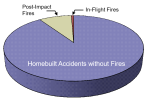
For homebuilts, fires are relatively rare:
1789065488919.png
This doesn't take into account the relative survivability of the accidents; in some of those "Post-Impact Fire" cases, PPE probably wouldn't have made any difference. In the others, the autopsy may reflect death due to smoke inhalation rather than blunt force trauma. Reading accident reports is often icky enough; I haven't made an effort to identify those cases where the occupants burned alive.....

Ron Wanttaja
 
Given the low probability an accident, and the even lower probability of a fire, and the low probability that flame retardant clothing would buy you enough time make a difference, I'll pass on the Nomex and go for comfort. Cotton, wool, and/or leather as appropriate, I don't wear synthetics anyway.

I did wear a helmet for paramotoring and ultralights. For the biplanes I fly now it's a leather helmet (zero impact protection and minor abrasion protection).
 
Too hot down here in the summer to be wearing long sleeves and pants, especially heavier material and fabric that doesn’t breathe well. You could bundle up in all of that and your odds of being a heat casualty are going to be exponentially higher than that of burning in a crash.

I’m sticking with shorts and a loose shirt. Heck, sometimes my shirt and shoes or flip-flops go in the back seat.
 
Yes, but most FBOs object to naked pilots on the ramp.
You did say "most", which equals "Not all that you know of". So........ what special places have you been to?
 
I dealt with an accident investigation involving a propane explosion. It educated me on what happens to your lungs in a fire. One breath of that super heated air and your airway and lung tissue is seared. You are going to die. Clothing without a mask or face shield is mostly for show. Who the heck wants to fly around with a mask on?

I know some aerobatic competitors and airshow pilots who wear helmets. I'll be at Nationals next week and I'll take a mental count. I think the logic there is to avoid getting knocked out while bailing out.
 
Motorcycling created a market for jeans and undergarmets with built-in padding, armor, and abrasion resistance.

I wonder whether there would be an aviation market for casual-looking garmets that were fire retardant. Cotton treated with Proban could be used to make jeans, slacks, polo shirts, socks, jackets, etc. A pilot and passengers could then have some fire protection without looking like dweebs.
Someone else mentioned that there are now casual looking clothes that are fire rated pretty easily available. Part of that is, as I understand it, driven by stronger osha rules and a better recognition of the dangers of arc flash for electrical work. Carhart and Wranger both make clothing with a FR tag, and they're comfy. I use them mostly around electrical things, specifically for the arc flash bit. The face shield is the only expensive/unusual thing for low energy arc danger.

But back to planes, I just wear non-plastic clothes flying, specifically because of the risk of the potential of having it melt to me in a fire. I've read a couple of stories about the aftermath of things like polypro clothing with a wing walker that were just horrible. So I view it not as "fire protection" but rather "not making fire damage way worse than it would be otherwise". Oh, and my alternative to polypro for warm in the winter is carbonx. I think Simpson offers it, among others, as car racing rated fire resistant layer.
 
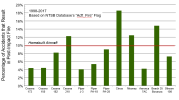
This is not a confidence-building chart for certain aircraft. 172 looking pretty good I'd say.
Some of that is performance-related; the faster the airplane is able to go, the harder the impact, and the higher likelihood of a post-crash fire.

However, it does look like composite construction is more likely to burn. Did a quick look at homebuilts 2009-2024, using that same NTSB flag to indicate fires. Overall rate for post-crash fires is about 8.9%. The Glasair is a bit higher (10.6%), Velocity about 19%, and the Lancair line comes out at about 22%.

Don't pat yourself on the back too hard; remember what your cowling (and many of the other non-structural components) are made of.....

Ron Wanttaja
 
I dealt with an accident investigation involving a propane explosion. It educated me on what happens to your lungs in a fire. One breath of that super heated air and your airway and lung tissue is seared. You are going to die. Clothing without a mask or face shield is mostly for show. Who the heck wants to fly around with a mask on?

I know some aerobatic competitors and airshow pilots who wear helmets. I'll be at Nationals next week and I'll take a mental count. I think the logic there is to avoid getting knocked out while bailing out.
As someone who works with fire and has been burned. Burns are painful. I raced against a guy who had his Nascar truck catch fire and despite the fire suit. Fire is still hot.


An interview he gave a year later.
 
Helicopter pilots often wear helmets and other PPE that you don't normally see in fixed wing. Warbird pilots also usually wear nomex flight suits and helmets.

I have seen GA pilots wearing flight suits, or even a helmet, but it seems that practice is often mocked.

From that standpoint though, what do you wear in your car driving from home to the airport?
Years ago I knew a married couple who wore helmets flying their 172.
 
Been on fire twice in my life and didn't like it either time. First time I did suffer permanent scarring. The 2nd, was really lucky to get away from the main flame source and strip off my flaming shirt before any serious damage.

Not a fun time to be had. I'm constantly around large quatities of fuel and explosives, so I take fire safety and flammability issues seriously.
 
Shoulder harness use in small aircraft has saved more people than all the other items being mentioned by a large factor. Remaining conscious after an incident goes along way to mitigating the other issues to include fire.
 
I know some aerobatic competitors and airshow pilots who wear helmets. I'll be at Nationals next week and I'll take a mental count. I think the logic there is to avoid getting knocked out while bailing out.
When I was flying aerobatics, I was invited to a competition and told I couldn't join because I didn't have a helmet. I thought it was an IAC requirement.

These days I would probably wear one if I was in a competition. Most of the modern planes wouldn't do well landing off field and you're putting a lot more strain on your engine.

Definitely not a requirement.

Off field landings might be a concern for practice on your own, but contests are almost always done directly on top of a runway. The logistics pretty much require it.
 
Back
Top