ARC propellers and MOSAIC!

HelixCarbon

Filing Flight Plan
Joined
Mar 24, 2026
Messages
19
Location
Germany
Display Name
HelixCarbon
Home Airfield
Merzbrück
Hi all,

My name is Jesse. I work for a small propeller manufacturer in Germany. We are currently working on bringing a new composite propeller design into the US market ahead of the upcoming MOSAIC rules changes and I thought it might be fun to open up a discussion and see what kind of questions / comments / concerns you might have.

Particularly (potentially?) interesting is the blade geometry of the new ARC propellers vs more traditional (NRC / TRC) propellers (namely: the forward- or advanced- curvature of the blade, as opposed to scimitar or straight blade types), and I would be happy to answer questions or go into detail if anyone’s interested.

We are also looking to gather feedback from pilots who’d be interested in comparing this type of propeller against their current setup in real-world flying.

So don't be shy and I will do my best to answer any questions..

Cheers!
 
Have a picture? Are you targeting the experimental or certified market?
 
Have a picture? Are you targeting the experimental or certified market?
Good question. Since they mentioned MOSAIC, I'd guess they are looking at least initially at the experimental and light-sport aircraft categories. But when we talk about adding a new prop design, I think the start needs to be experimental unless they find an LSA manufacturer willing to incorporate it.
 
Have a picture? Are you targeting the experimental or certified market?
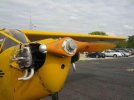
Here's a pic of the H42A VTL "Talon" on a VL3.. we are targeting everything that fits under the new MOSAIC rules, including experimental.. we're currently only looking at Rotax engines (915 / 916, primarily), but once the dust settles we'll also be endurance testing on lycomings

_GR69779_stitch.jpg
 
Here's a pic of the H42A VTL "Talon" on a VL3.. we are targeting everything that fits under the new MOSAIC rules, including experimental.. we're currently only looking at Rotax engines (915 / 916, primarily), but once the dust settles we'll also be endurance testing on lycomings

View attachment 151144
Whoa... So it's like having a forward-swept wing! Interesting. What advantages does that have?
 
Whoa... So it's like having a forward-swept wing! Interesting. What advantages does that have?
there are two elements to the Helix ARC's (including the above pictured VTL "Talon").. the advanced radial sweep distributes the force on the leading edge differently than traditional NRC / TRC props which reduces noise and vibration and essentially puts more power from the engine into actual thrust.. the second part of what makes our ARCS interesting is that they are also swept backwards towards the aircraft- and where other propellers bend forward during flight, ours straighten out- better matching the incoming stream of air.. it was all very theoretical in the beginning and it took a lot of time and doing to make the sucker strong and rigid enough to handle the additional stress at the tips- but the end result is pretty awesome.
 
the second part of what makes our ARCS interesting is that they are also swept backwards towards the aircraft- and where other propellers bend forward during flight, ours straighten out- better matching the incoming stream of air..
Have you developed any prop balancing procedures for those mounted on aircraft?
 
Have you developed any prop balancing procedures for those mounted on aircraft?
I'm not entirely certain what you mean- we balance props twice when we install them- once when they're assembled, and again with a Dynavibe when they're mounted. Let me know if I'm answering the wrong question : )

We have a few certified installers in the US and are working on getting more trained.. the goal being to have service centers accessible to the entire continental US.
 
We have a few certified installers in the US and are working on getting more trained.. the goal being to have service centers accessible to the entire continental US.
You answered the balance question but generated another one. Is it your intent to have your props installed and maintained only through your “certified” installers and service centers?

To note, the FAA LSA and amateur-built regulatory process is different than the EASA process on a number of levels. Most owners here pursue these aircraft categories for their regulatory flexibility and perhaps even more now with MOSAIC's increased flexibility. So while providing technical support to these owners is one thing, trying to limit their abilities to install and maintain your props on their aircraft may not be the best approach in the long run.
 
Here's a pic of the H42A VTL "Talon" on a VL3.. we are targeting everything that fits under the new MOSAIC rules, including experimental.. we're currently only looking at Rotax engines (915 / 916, primarily), but once the dust settles we'll also be endurance testing on lycomings

View attachment 151144
Unfortunately, I'm really in the market for a seven bladed prop...

Seriously, it's always nice to see people innovating. :-)
 
Unfortunately, I'm really in the market for a seven bladed prop...

Seriously, it's always nice to see people innovating. :-)
I always thought unless you had gobs of horsepower anything more than 3 blades was just inefficient.
 
You answered the balance question but generated another one. Is it your intent to have your props installed and maintained only through your “certified” installers and service centers?

To note, the FAA LSA and amateur-built regulatory process is different than the EASA process on a number of levels. Most owners here pursue these aircraft categories for their regulatory flexibility and perhaps even more now with MOSAIC's increased flexibility. So while providing technical support to these owners is one thing, trying to limit their abilities to install and maintain your props on their aircraft may not be the best approach in the long run.
That's an excellent question and an excellent point (why is there no "laugh" emoji? i feel totally lost without a "laugh" emoji!).. As far as I am aware- installation of the prop will be handled through Helix certified techs. At first, we're talking about a handful of shops located around the country but we are hoping to expand that number. Basic maintenance can, of course, be done by the owner but I thiiiink our intention for right now is to require Helix certified techs to perform overhauls, etc.. The H42A / H62A is a relatively easy to assemble / maintain prop hub and we are happy to fly out and hold a cert course where there is enough interest. I will bring this up with the powers that be- it is a good point and although I'm sure they've already got it on their radar- it's worth mentioning again.
 
I always thought unless you had gobs of horsepower anything more than 3 blades was just inefficient.
That was definitely a concern before we started flight testing the Talon.. turns out- if the blade geometry is good- 5 blades can pull more out of an engine than a 2, 3, or 4 blade : )
 
Unfortunately, I'm really in the market for a seven bladed prop...

Seriously, it's always nice to see people innovating. :-)
7 (even 8) blades isn't out of the question! We are, in the deepest recesses of our collective soul, a research facility, and we've built and flown just about every prop arrangement and blade profile you can think of..
 
As far as I am aware- installation of the prop will be handled through Helix certified techs. At first, we're talking about a handful of shops located around the country
You are aware I presume that on Experimental amateur built aircraft the aircraft is mandated to re-enter phase one after any major changes. A prop change is considered a major change. Phase one is limited to a small geographic area typically 50 nm or so around the owners home field. So, your installers would need to travel to the buyer for install.
 
You are aware I presume that on Experimental amateur built aircraft the aircraft is mandated to re-enter phase one after any major changes. A prop change is considered a major change. Phase one is limited to a small geographic area typically 50 nm or so around the owners home field. So, your installers would need to travel to the buyer for install.
We are aware of the phase 1 requirement. It is not ideal, of course, but the FAA can be petitioned to designate the area around the service center as a test area, at which point the aircraft can fulfill the 5 hour phase 1 testing. Again- not ideal, we know- but for pilots of experimental aircraft who want to install our propeller- that's the option we have right now for e-lsa. For the future- we are actively working on increasing the number of service centers, as well as developing a team of mobile service techs so that we CAN come to you and ensure that the propeller is installed to our engineers' satisfaction. And, of course, we still have a wide range of fixed and ground-adjustable propellers which are also very popular with UL, experimental, STOL, etc aircraft..
 
I will bring this up with the powers that be- it is a good point and although I'm sure they've already got it on their radar- it's worth mentioning again.
Do you already have an American partner with LSA and experimental aircraft experience? If not, I would get one so they can explain to your powers that be the owners of LSA and amateur-built aircraft tend to follow a different path than your average Cessna or Piper owner.
 
I imagine any gain in performance would be incremental, if it actually exists. The price and (hopefully) proven reliability over time will result in the success or failure of this new offering. It will take time to recoup the R&D investment if this new design offers an advantage over what currently exists.
 
Do you already have an American partner with LSA and experimental aircraft experience? If not, I would get one so they can explain to your powers that be the owners of LSA and amateur-built aircraft tend to follow a different path than your average Cessna or Piper owner.
We have partnered with a dealer in the US and they are aware of the challenges seem pretty confident that we will overcome them.
 
I imagine any gain in performance would be incremental, if it actually exists. The price and (hopefully) proven reliability over time will result in the success or failure of this new offering. It will take time to recoup the R&D investment if this new design offers an advantage over what currently exists.
Hi!

This particular propeller is a new offering in the US- but has been flying in Europe for a couple years already. And because we are also a research and development facility (our project list in the EVTOL space is long and storied, for example), we don't carry the same R&D investment burden that some other companies might. We've already made the investment- and spread it over literally around 1000 different propeller types and profiles. It's part of what makes working for Helix so interesting- every day I discover something completely off the wall that we did last month, last year, 30 years ago, etc..
 
I imagine any gain in performance would be incremental, if it actually exists. The price and (hopefully) proven reliability over time will result in the success or failure of this new offering. It will take time to recoup the R&D investment if this new design offers an advantage over what currently exists.
Ah! I totally forgot to address your other concern- gain in performance! Yes, the increase is incremental. We are not claiming to double your airspeed : ) We have done multiple tests comparing our prop to competitors' 2, 3, and 4 blade (typically OEM) props. So, static thrust, takeoff distance, climb rate and max speed. One example I can give you right off the bat is the VL3 with a Rotax 915is. At 83% throttle with the Helix prop, the VL3 achieved 8-9kph improvement in both indicated and true airspeed over the 4-blade OEM. It's the same story for takeoff distance and climb rate. We have a lot of very positive anecdotal data from customers as well- however we only really report data if we can do multiple flights back to back with controlled variables- same day, same weather, same weight, etc..
 
We have partnered with a dealer in the US and they are aware of the challenges seem pretty confident that we will overcome them.
Interesting. Perhaps have your US dealer list all the other "certified" installers and service centers that service the LSA and amatuer-built market after the aircraft is released or built? That number may interest you. Regardless, any innovation in aviation is a plus. Best of luck.
 
No mention of cost? Can a Rotax really make rated RPM with a 4+ blade prop?
 
No mention of cost?
(you posted this as I was typing).

One thing I didn't see mentioned at all is cost (relative to competition or absolute numbers).

It's no surprise to anyone that cost is the main reason we don't see adjustable/constant speed props everywhere. I could build a decent 2-seat experimental for about 65k (prices before aluminum went through the roof), but if I want to add a constant speed prop to it that'll be another 15k-ish.

If you're coming at the same (or higher) price point, I doubt you'll have too much of a market adoption. Most people are a bit reluctant to pay the same (or more) for an unproven product. So, realistically, what are your price goals? We'll make it easy, a prop that can handle 180-200hp at 2700 rpm.
 
Are these more of a cosmetic mod or performance?

Lots of the guys competing with their planes use larger 2 blades for a reason, it’s odd to see a itty bitty rotax with a 5 blade on it. I wonder the power loss with swinging all that up front.

The main reason for more blades used to be to reduce ground clearance when required, or lower tip speed / noise
 
No mention of cost? Can a Rotax really make rated RPM with a 4+ blade prop?
We are still working out exactly what our package will look like (phrasing) and what it will cost. We are trying to squeak in under the major competitors while still offering a complete "one-and-done" package.

The propeller in question (5-blade H42A VTL "Talon") is currently flying on rotax 912uls, 915is and 916is powered aircraft. There have been no issues hitting target RPM's (5300, 5500, 5800, etc..). We have a lot of experience building propellers with a very low moment of inertia, and the ARC blade profile is extremely efficient.
 
(you posted this as I was typing).

One thing I didn't see mentioned at all is cost (relative to competition or absolute numbers).

It's no surprise to anyone that cost is the main reason we don't see adjustable/constant speed props everywhere. I could build a decent 2-seat experimental for about 65k (prices before aluminum went through the roof), but if I want to add a constant speed prop to it that'll be another 15k-ish.

If you're coming at the same (or higher) price point, I doubt you'll have too much of a market adoption. Most people are a bit reluctant to pay the same (or more) for an unproven product. So, realistically, what are your price goals? We'll make it easy, a prop that can handle 180-200hp at 2700 rpm.
We are still fine-tuning our package cost, which includes a trade-in option for your old propeller. Goal is to come in at or below equivalent competing propeller systems (before trade-in).
And although we do have propellers that can handle higher horse power- our current roll out is for the H42A which is rated for Rotax engines up to around 180hp. I would have to ask about pricing on the H42A's bigger brother- the H62A (rated for engines up to around 240hp).
 
Are these more of a cosmetic mod or performance?

Lots of the guys competing with their planes use larger 2 blades for a reason, it’s odd to see a itty bitty rotax with a 5 blade on it. I wonder the power loss with swinging all that up front.

The main reason for more blades used to be to reduce ground clearance when required, or lower tip speed / noise
This is definitely a performance mod. We would never claim to beat every other propeller arrangement on every aircraft- but in every single comparison test we have done so far (rotax 912uls, 915is, 916is on a variety of platforms), we have been able to produce more static thrust, higher top speed, faster climb rate, etc.. Sometimes only a small improvement- sometimes more significant. One example would be a 912uls powered Shark 600, where the H42A 5-blade showed a speed increase of around 20kph at both 5100rpm and 5300rpm, and an increase of 30kph at 5800rpm, over the OEM 2-blade propeller.
 
We are aware of the phase 1 requirement. It is not ideal, of course, but the FAA can be petitioned to designate the area around the service center as a test area, at which point the aircraft can fulfill the 5 hour phase 1 testing. Again- not ideal...
It's even less ideal than that, as the test area for any particular aircraft is defined in the aircraft's operating limitations, which are part of the airworthiness certificate. To change the test area, the owner has to apply to the FAA for a new airworthiness certificate.
 
One example would be a 912uls powered Shark 600, where the H42A 5-blade showed a speed increase of around 20kph at both 5100rpm and 5300rpm, and an increase of 30kph at 5800rpm, over the OEM 2-blade propeller.
"Extraordinary claims require extraordinary evidence." Certainly today's materials technology (new light, stiff materials) makes this kind of innovative prop design possible, but an improvement that large would mean the designer did a terrible job of selecting the original propeller, or you're getting speed at the expense of climb.

What about weight? Rotax gearboxes have strict limits on the allowable moment of inertia of a prop attached to their engines, and multiple blades, unless much shorter, would seem to bump against that limit.
 
.. the second part of what makes our ARCS interesting is that they are also swept backwards towards the aircraft- and where other propellers bend forward during flight, ours straighten out-
Ordinary propellers (aluminum) are designed the other way around. Their blades angle a bit forward of the hub centerline. That way, the centrifugal forces bend them back to counteract the thrust, with the net result that the blades don't bend much at all. Reduces fatigue on the prop. Maybe composites don't suffer fatigue?

Your design will bend forward under both thrust and centrifugal bending moment.
Yes- as I said- it straightens out. We've done a lot of testing to this end and found that this creates a better interaction with the incoming airstream.
 
Yes- as I said- it straightens out. We've done a lot of testing to this end and found that this creates a better interaction with the incoming airstream.
My point was that this subjects the blades to unnecessary stresses. Propellers are already the most highly loaded component on the entire airplane, with nine different forces acting on it.
 
My point was that this subjects the blades to unnecessary stresses. Propellers are already the most highly loaded component on the entire airplane, with nine different forces acting on it.
The blades are build specifically to do that- ergo- no unnecessary stresses.
 
Prop efficiency is not a very complicated formula, and it's been around for ages.

(so I don't have to do the boring maths)

I'd like to see some numbers proving out these speed claims. Solve for nu using your prop and a baseline comparison on the market.

Also, to me - it would pencil out that under added torque load, a forward or into the rotation curvature of the blade would tend to increase the dynamic pitch, rather than the more preferred decrease of dynamic pitch(sort of a poor mans variable pitch). This seems inverse in utility during flight to me. Meh - I could be wrong.
 
Last edited:
Prop efficiency is not a very complicated formula, and it's been around for ages.

(so I don't have to do the boring maths)

I'd like to see some numbers proving out these speed claims. Solve for n using your prop and a baseline comparison on the market.

Also, to me - it would pencil out that under added torque load, a forward or into the rotation curvature of the blade would tend to increase the dynamic pitch, rather than the more preferred decrease of dynamic pitch(sort of a poor mans variable pitch). This seems inverse in utility during flight to me. Meh - I could be wrong.
It's a brain tickler for sure- but we've been working on the ARC profile for well over a decade. If you're interested in watching- Darryl Zubot in Canada recently posted a couple videos testing the Talon ARC prop on his Pipistrel Virus. (
) I can also point you to one or two VL3 pilots who have had similar experiences. We will be at OshKosh this year if you are interested in getting into the nitty gritty with one of our engineers.
 
Back
Top