
You are using an out of date browser. It may not display this or other websites correctly.
You should upgrade or use an alternative browser.
You should upgrade or use an alternative browser.
Approach plate symbol??
- Thread starter Cooter
- Start date

Sam D
Pattern Altitude
- Joined
- Feb 27, 2006
- Messages
- 1,605
- Location
- Petaluma, CA
- Display Name
- Sam D
- Home Airfield
- Petaluma (o69)
On the ILS/LOC RWY 25 for KFSM, there is a # next to the S-ILS 25 DA (#646/24). I can't find what that references. Can someone help me out?
I believe it corresponds with the same symbol in the notes at the top.


Cooter
Ejection Handle Pulled
- Joined
- Dec 2, 2015
- Messages
- 2,411
- Display Name
- Cooter
Alright, now I see it. It somehow remained hidden despite all my searching. Thank you.I believe it corresponds with the same symbol in the notes at the top.
Cooter
Ejection Handle Pulled
- Joined
- Dec 2, 2015
- Messages
- 2,411
- Display Name
- Cooter
It does, I just kept looking past it. I knew that it would be easy as soon as I highlighted my ignorance. You guys seemed to have a much easier time finding the note than I did.Looking at the plate, I would think it references the note stating the applicable reduction to RVR with the use of FD or AP or HUD to DA.

tsts4
En-Route


- Joined
- May 25, 2006
- Messages
- 21,997
- Location
- KTTA, North Carolina
- Display Name
- Who you kiddin?
- Home Airfield
- KTTA
Not really. That single # in the middle of the general note text is not the easiest thing to see even if you do know where to look. It's like those trick sentences where there is a repeated short word many if not most people can't see.It does, I just kept looking past it. I knew that it would be easy as soon as I highlighted my ignorance. You guys seemed to have a much easier time finding the note than I did.
- Joined
- May 25, 2006
- Messages
- 21,997
- Location
- KTTA, North Carolina
- Display Name
- Who you kiddin?
- Home Airfield
- KTTA
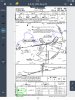
It's actually a fairly standard (i.e., "not aviation-specific," not "we see it all the time") non-numerical footnote/cross-reference notation method. Guess they didn't want to pile up the asterisks.Interesting. In all my years of flying I don't think I've ever run across a symbol like that in the minima fields. I'd have been scanning that plate for a while to find the note. Thanks for sharing.
Cooter
Ejection Handle Pulled
- Joined
- Dec 2, 2015
- Messages
- 2,411
- Display Name
- Cooter
I'm learning the Jepp products now. It is kind of a tough transition, but they do seem to be a better format overall. I think I will like them once I get used to them.Here's how Jeppesen handles it. Much less confusion.

Ryan F.
Cleared for Takeoff
- Joined
- Dec 23, 2016
- Messages
- 1,382
- Display Name
- Ryan Ferguson 1974
I'm learning the Jepp products now. It is kind of a tough transition, but they do seem to be a better format overall. I think I will like them once I get used to them.
They're so much better across the board -- there are obvious differences the first time you start using them but the deeper you dive in, the more subtle improvements you'll find. I don't mind the NACO charts really but I have to admit I always look at the Jepp charts first and prefer using them. If work didn't pay for my Jepp subscription I don't think I'd drop the coin, but man, they're really great.

mscard88
Touchdown! Greaser!
- Joined
- Oct 1, 2015
- Messages
- 23,226
- Location
- Alabama
- Display Name
- Mark
- Home Airfield
- KEET Shelby County AL
They're so much better across the board -- there are obvious differences the first time you start using them but the deeper you dive in, the more subtle improvements you'll find. I don't mind the NACO charts really but I have to admit I always look at the Jepp charts first and prefer using them. If work didn't pay for my Jepp subscription I don't think I'd drop the coin, but man, they're really great.
I agree! Especially the pay part.


jordane93
Touchdown! Greaser!
I haven't met one pilot who prefers government to Jepp charts. They layout is much easier and the information is better presented IMO. They are undergoing big changes (not sure if they started yet) on SIDs and STARs by adding terrain and changing the format of crossing restrictions.I'm learning the Jepp products now. It is kind of a tough transition, but they do seem to be a better format overall. I think I will like them once I get used to them.
- Joined
- May 25, 2006
- Messages
- 21,997
- Location
- KTTA, North Carolina
- Display Name
- Who you kiddin?
- Home Airfield
- KTTA
I think it's 6 of one and a half dozen of the other.

aterpster
En-Route
- Joined
- Apr 15, 2011
- Messages
- 3,317
- Display Name
- aterpster
It's a debate that's been going on since the 1950s, at least. For the light airplane pilot that operates only in the U.S. it is a legitimate debate. But, for operators that operate beyond our borders, Jeppesen is the only good choice. LIDO is an option, but not a very good one in the view of many. Also, Jeppesen provides tailored charts, which many airlines use for certain airports, or for special instrument approach procedures. Even in this country, private airports that have specials must get them charted by Jeppesen.I think it's 6 of one and a half dozen of the other.
Ryan F.
Cleared for Takeoff
- Joined
- Dec 23, 2016
- Messages
- 1,382
- Display Name
- Ryan Ferguson 1974
It's a debate that's been going on since the 1950s, at least. For the light airplane pilot that operates only in the U.S. it is a legitimate debate. But, for operators that operate beyond our borders, Jeppesen is the only good choice. LIDO is an option, but not a very good one in the view of many. Also, Jeppesen provides tailored charts, which many airlines use for certain airports, or for special instrument approach procedures. Even in this country, private airports that have specials must get them charted by Jeppesen.
Even when you stay domestic but move into turbojet/turboprop operations you creep away from 6/half dozen to more like 4 on one and a two-thirds of a dozen on the other. Heh.
For everyday ops in piston airplanes within the United States, which accounts for most of us here, I think Jepps are merely nice to have, and NACO will be just fine. Despite the better symbology there are lots of features which just won't matter much to most light airplane pilots; climb gradients, better airport diagrams, and better integration of alternate and takeoff minimums just for starters. If I had to pay for them, I wouldn't, although I love having them. But arguing against their superior utility in higher performance aircraft is a non-starter.
