
Approach Plate Question

LowHrsMan

Pre-Flight
Joined
Jun 6, 2021
Messages
69
Location
Washington
Display Name
LowHrsMan
Home Airfield
KVUO
IFR student here.
The attached plate for RNAV GPS RWY 13 into KSLE says "Procedure NA for arrival on UBG VOR/DME airway radials 111 CW 204."
Ok, so no arrivals on UBG R111 clockwise to R204.
First, why not? What's the problem with flying direct MCCOY from the south and doing the course reversal using the charted hold in lieu of PT?
Second, is there a legal way to fly the approach when coming from the south? Or must you select a different approach?
In a real scenario, would ATC likely give you vectors to the FAF?

LHM00361R13 conv 1.jpeg
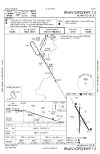
 
They don't want you coming in on airways to the UBG VORDME IAF and doing a near 180 to get on to the approach. This only comes into play typically in lost comm or other situations. If you're vectored or cleared direct somewhere on the approach, ATC is going to take into account that your altitudes and turning radius will be acceptable.

I'm not sure I understand your second question. If you are using MCCOY as the IAF, then you must do the hold-in-loo as depicted. Unlike the barbed procedure turn, which you can do just about anything as long as you remain in the indicated area (typically ten miles), when hold-in-loos or teardrop course reversals are shown, you have to fly them as depicted.
 
What's the problem with flying direct MCCOY from the south and doing the course reversal using the charted hold in lieu of PT?
You CAN do that. MCCOY is a different IAF; the note for UBE doesn't apply.
Second, is there a legal way to fly the approach when coming from the south? Or must you select a different approach?
See above.
In a real scenario, would ATC likely give you vectors to the FAF?
Probably. The practicality of this would depend on Seattle Center's minimum vectoring altitude. If it's too high, Direct MCCOY would be more likely.
 
They don't want you coming in on airways to the UBG VORDME IAF and doing a near 180 to get on to the approach. This only comes into play typically in lost comm or other situations. If you're vectored or cleared direct somewhere on the approach, ATC is going to take into account that your altitudes and turning radius will be acceptable.

I'm not sure I understand your second question. If you are using MCCOY as the IAF, then you must do the hold-in-loo as depicted. Unlike the barbed procedure turn, which you can do just about anything as long as you remain in the indicated area (typically ten miles), when hold-in-loos or teardrop course reversals are shown, you have to fly them as depicted.
Ok, let's see if I understand correctly. If I'm cleared direct MCCOY, and I'm flying on one of the forbidden radials from the south (say R180 TO UBG) , then I CAN fly the approach, and the "Procedure NA..." language does not apply? If correct then my question becomes when does the "Procedure NA" language apply?
 
Ok, let's see if I understand correctly. If I'm cleared direct MCCOY, and I'm flying on one of the forbidden radials from the south (say R180 TO UBG) , then I CAN fly the approach, and the "Procedure NA..." language does not apply? If correct then my question becomes when does the "Procedure NA" language apply?
The note applies only when using UBG as the IAF, and does not apply when using the other IAF or receiving vectors to the final approach course.
 
The note applies only when using UBG as the IAF, and does not apply when using the other IAF or receiving vectors to the final approach course.
Ok I think I got it. Rewording for clarity:
I'm flying northbound on UBG R180 and cleared direct UBG.
Then ATC clears me for the RNAV GPS 13 Approach. So UBG is the IAF.
In this case, I can fly the hold in lieu because the ATC clearance supersedes the "Procedure NA" note on the plate. Correct?
 
Last edited:
Ok I think I got it. So if ATC clears me direct UBG, I can fly the hold in lieu because the ATC clearance supersedes the "Procedure NA" note on the plate. Correct?
Methinks you don't got it. Yet. Assuming you're on the forbidden airway radials when they clear you direct.
 
Ok I think I got it. So if ATC clears me direct UBG, I can fly the hold in lieu because the ATC clearance supersedes the "Procedure NA" note on the plate. Correct?
You mean direct MCCOY?
 
You mean direct MCCOY?
No, UBG. I (now) know I can fly the approach if cleared to MCCOY as the IAF like you said. What if I'm cleared to UBG from the south? Or would ATC just never do that?
 
No, UBG. I (now) know I can fly the approach if cleared to MCCOY as the IAF like you said. What if I'm cleared to UBG from the south? Or would ATC just never do that?
Clear you Direct UBG from the south making you fly 17 miles farther than you have to? I don't think they would ever do that.

Keep in mind, unless the plate says RADAR REQUIRED, everything is designed to work without radar. Flying off-airways or off published routes requires radar. If ATC is able to give you "Direct" anywhere, they can also just vector you.
 
I think if you're coming on UBG R180 going north, you most likely will get MCCOY as IAF.
 
Clear you Direct UBG from the south making you fly 17 miles farther than you have to? I don't think they would ever do that.

Keep in mind, unless the plate says RADAR REQUIRED, everything is designed to work without radar. Flying off-airways or off published routes requires radar. If ATC is able to give you "Direct" anywhere, they can also just vector you.
Right, that makes sense. Thanks to everyone who replied.
 
I think you’re mixing up direct UBG and direct MCCOY. If you’re going direct UBG from the south on the radials listed, you can’t do the approach. That’s because, as mentioned earlier, the turn to intercept the approach course is too big and there is no course reversal there (hence the “NoPT”). If you’re coming from the south and get direct MCCOY, the approach is available because there is a Hold in Lieu of PT available for course reversal. It doesn’t matter that you are somewhere on those “forbidden” radials, you aren’t tracking them inbound to UBG, you’re direct MCCOY.

As a controller, in the radar environment, we are responsible for providing appropriate intercept angles for approaches. For RNAV approaches, it’s usually 90 degrees. If we can’t provide that, there needs to be a way for you to reverse course on the approach
That makes perfect sense, thank you. I was confused as to the meaning of the "Procedure NA.." language on the plate.
 
Your responses suggest you are parsing too much and overcomplicating. The note is literal. If you are arriving at UBG on the named radials, the approach is not authorized. Period. Full stop. Create any other scenario and it's usable.

The reason as already mentioned is the big turn. Turns as part of an approach (other than procedure turns) are limited by design to 90 or 120 degrees. In terms of what ATC will do, they are also angle-limited.

What would I expect from the south? Vectors to intercept the FAC. Direct MCCOY for the procedure turn. Heavy traffic? Maybe vectors to go to UBG without the big angle.

BTW, this is not at all unusual.
I think it would have been a little bit clearer to me if there were a comma or "from" after "arrival on UBG VOR/DME".

I agree with everything else.
 
I think it would have been a little bit clearer to me if there were a comma or "from" after "arrival on UBG VOR/DME".
I’m not sure I understand.

“Procedure NA for arrival on UBG VOR/DME airway radials 111 CW 204."

Oh. I just got it as I wrote it.

That’s just standard verbiage for the note. Trying to save words, I guess. We just learn it like so many others.

BTW, it’s also literal about “airway radials.” The published airways, not all the other radials between them. If that sounds weird, remember they were created when airways were king.
 
Last edited:
That’s just standard verbiage for the note. Trying to save words, I guess. We just learn it like so many others.
Yeah, by "me" I was referring to "instrument student me". Present day me already has Stockholm syndrome.
 
I see five published airways between R-111 CW 204. Here is a question. What if you are not arriving on one of those five published airways, but you are arriving along some other radial between 111 and 204?
 
I see five published airways between R-111 CW 204. Here is a question. What if you are not arriving on one of those five published airways, but you are arriving along some other radial between 111 and 204?
Requesting D> TURNO D> LOTKE should do it if you don't have GPS.

EDIT
To amplify:
Assumed you are following radials because you have no GPS to get to LOTKE.
Assumed you have noted the high MEAs/MIAs SE of the airport and are approaching from there.
Assumed you are in a legacy-equipped airplane with ADF.
 
Last edited:
I see five published airways between R-111 CW 204. Here is a question. What if you are not arriving on one of those five published airways, but you are arriving along some other radial between 111 and 204?
As I mentioned, the note is literal. The note applies to “airway radials.” Technically, it doesn’t. Actually, technically, I guess it doesn’t apply to that T-route since a T-Route doesn’t have “radials.” :D I think the design reasons are historical more than anything - reliance on airways - but maybe @RussR or @John Collins can clue us in.

Anyway, this is what TERPS says

“When the IAF is part of the en route structure, the angle of intersection between the en route structure and a ground-based initial approach segment course must not exceed 120 degrees. For RNAV routes, apply Order 8260.58.” (90°]​

Since the practical reason for not doing it - an excessive turn with no vetted hold - still applies, it’s a bit weird. But between what we hope are rational pilot decisions and ATC limitations, it probably doesn’t matter.
 
Last edited:
Ok, let's see if I understand correctly. If I'm cleared direct MCCOY, and I'm flying on one of the forbidden radials from the south (say R180 TO UBG) , then I CAN fly the approach, and the "Procedure NA..." language does not apply? If correct then my question becomes when does the "Procedure NA" language apply?
It applies to the affected when flying the airways to the VOR. The statement couldn't be clearer. This only comes up when you are in a non-radar situation. If you're cleared direct *ANYWHERE* you have to be in radar contact and above the MVA so whatever concerning obstacle or whatever doesn't exist.
 
The note is a common one. All IAP other than those which require radar for joining the approach, make the basic assumption that there is a transition from the enroute airway system to the terminal approach environment. The procedure assumes you are navigating to it using an enroute airway and not via RNAV direct and should not be viewed outside of the enroute environment. The best way to understand the intent using ForeFlight is to turn on the IFR Low Altitude enroute layer and display the chart on the map with the chart set to a somewhat transparent view. RNAV approaches don't support a course change greater than 90 degrees (conventional approaches support up to 120 degrees). So you can see that V165 north west bound to UBG, T263 north bound to UBG, V495 northeast bound to UBG, V287 northeast bound to UBG, and V182 northeast bound to UBG, all require a turn at UBG that exceeds 90 degrees, so arrivals on those airways are not supported. That does not mean you can't receive vectors if you are arriving on one of those airways, but you are not authorized to join the approach at UBG using your own navigation when you are cleared on one of those airways. It only applies if you are using one of those airways and is not a general prohibition on the specified UBG radials. The T route is not based on radials, but the note applies because the T route joins UBG between the UBG VOR/DME airway radials between the UBG111R Clockwise to UBG204R. For RNAV approaches without a TAA, you will see feeder routes from airways. For TAA, the entire TAA is considered as an RNAV feeder route from any airway that passes through the TAA. There are some TAA that don't have any airways that penetrate the TAA and these will have a feeder route to the procedure from an airway.
 
The "Procedure NA ... airway radials" note is constructed very simply and unfortunately, very vaguely.

The procedure designer looks at the initial segment's course, and determines which airways would require a turn of more than 90 degrees (RNAV) or 120 degrees (non-RNAV). (Why the difference? There's some history at the US IFPP discussion here: https://www.faa.gov/sites/faa.gov/files/about/office_org/headquarters_offices/avs/Hist_14-01-315.pdf )

So, in the OP's case, the course from the UBG VOR is 187. So any airways that are on radials from 097 through 277 would have more than 90 deg of turn onto the 187 course. There are four airways that meet this rule, and they are on the 111, 174, 183, and 204 radials. So the note is worded as 111 CW 204. If there was an airway on the 230 radial as well, it would be worded 111 CW 230. The radials in the note are only listed if they are actual airways.

But what does it mean if you're within that set of radials but not actually on an airway? I don't think that's explicitly spelled out anywhere. What if you're outside of the listed set of radials but would still have more than 90 deg of turn onto the 187? That's also not explicitly spelled out. It's a historical note that causes much confusion with today's operating environment. But it's worded that way because that's what the book says to do.
 
But what does it mean if you're within that set of radials but not actually on an airway? I don't think that's explicitly spelled out anywhere. What if you're outside of the listed set of radials but would still have more than 90 deg of turn onto the 187? That's also not explicitly spelled out. It's a historical note that causes much confusion with today's operating environment. But it's worded that way because that's what the book says to do.
If you are not arriving at the IAF on an airway, you are going to have to meet the ATC criteria for off-airway routing which involves being in radar contact and above the MVA. As such, the issue with the sharp turns at the fix and potential obstacles in the area don't exist as the MVA will keep you above them.
 
If you are not arriving at the IAF on an airway, you are going to have to meet the ATC criteria for off-airway routing which involves being in radar contact and above the MVA. As such, the issue with the sharp turns at the fix and potential obstacles in the area don't exist as the MVA will keep you above them.
Ok then, now we're down to a lost comm situation where somebody filed a direct route off airways and is arriving between forbidden airway radials. Now what? Did they file knowing all the background information in @RussR 's posted link and have a contingency plan at the ready in case of lost comm? Chances are, Slim just left town.
 
Ok then, now we're down to a lost comm situation where somebody filed a direct route off airways and is arriving between forbidden airway radials. Now what? Did they file knowing all the background information in @RussR 's posted link and have a contingency plan at the ready in case of lost comm? Chances are, Slim just left town.
Same as any time you have a lost comms in a vector situation. You fly the highest of what you were assigned, filed, told to expect, or the minimum instrument altitude (you can punt and use the OROCA/MSAs or you can whip out your sectional and figure out what the highest obstacle within 4 NM. Once you get back on an airway or on a published part of the approach, you can follow the rules there.
 
Once you get back on an airway or on a published part of the approach, you can follow the rules there.
Ah, but not on an airway when going lost comm. If you go there (airway) the approach is NA. If you stay direct it might not be NA but logic says if the airways you're between don't meet specs then you can't either. So, what should you do? What would ATC expect? Make up an ad-hoc arrival holding pattern to reverse course? :dunno:
 
Ah, but not on an airway when going lost comm. If you go there (airway) the approach is NA. If you stay direct it might not be NA but logic says if the airways you're between don't meet specs then you can't either. So, what should you do? What would ATC expect? Make up an ad-hoc arrival holding pattern to reverse course? :dunno:
You've lost me. You'd never file or be cleared by airways to that approach. If you're stuck coming in from the S/W go to the IAF at the VOR.
 
You've lost me. You'd never file or be cleared by airways to that approach. If you're stuck coming in from the S/W go to the IAF at the VOR.
I was thinking coming from the SE between the airways on a direct to the VOR w/lost comms occurring prior to any approach clearance.
 
Go to Mccoy.
I thought the gist of the OP's question was that the filed route was over UBG via a direct route between two converging NA airways. If wanting to go to MCCOY why not just file that route instead? It wouldn't be any more difficult than planning a non-airway route to UBG. Taking an airway where all the MEAs are figured by the TERPs people would save some figuring, but it would leave you without a plan in case of lost comm. That's how I understood the question.
 
In this specific scenario, there is actually a workaround I see. Not a particularly practical or useful one, but still a workaround. Let's say you are on V165, you can't legally start the approach from UBG due to the note.

But you CAN fly V165 NW to UBG, then fly V287 SW to MCCOY. MCCOY is on the airway, on the Low Enroute chart, after all. MCCOY is also an IF/IAF for the approach, and there are no notes prohibiting arrivals from any direction at MCCOY, since it has a HILPT.

Now here's where it gets really messy. What altitude do you have to fly, and do you have to do the HILPT? Both of these answers depend on whether you're on a published segment of the approach when you're on V287 between UBG and MCCOY and can therefore fly the published 3100 and get the NoPT indication. You kind of are, because you're physically "on" it. But you're kind of not, because to be "on" it you had to have "started" the approach at UBG, which is NA from the direction you came.

This sounds like fun lawyer semantics to me, either way you slice it.
You just gave a lawyer a headache.
 
I suspect in that situation, long before UBG would've become an issue, you'd hear something like "PuddleJumper XYZ, you're 10 miles south of MCCOY, cross MCCOY at or above 3,100, cleared for the RNAV 13 approach. Report the procedure turn inbound."
 
2. Assigned an altitude to maintain until the aircraft is established on a segment of a published route or
In this specific scenario, there is actually a workaround I see. Not a particularly practical or useful one, but still a workaround. Let's say you are on V165, you can't legally start the approach from UBG due to the note.

But you CAN fly V165 NW to UBG, then fly V287 SW to MCCOY. MCCOY is on the airway, on the Low Enroute chart, after all. MCCOY is also an IF/IAF for the approach, and there are no notes prohibiting arrivals from any direction at MCCOY, since it has a HILPT.

Now here's where it gets really messy. What altitude do you have to fly, and do you have to do the HILPT? Both of these answers depend on whether you're on a published segment of the approach when you're on V287 between UBG and MCCOY and can therefore fly the published 3100 and get the NoPT indication. You kind of are, because you're physically "on" it. But you're kind of not, because to be "on" it you had to have "started" the approach at UBG, which is NA from the direction you came.

This sounds like fun lawyer semantics to me, either way you slice it.
It could work like this. ATC clears you to KSLE via V165 UBG V287 MCCOY maintain [altitude]. Once you are established on the airway, they can simply say Cleared for the RNAV RWY 13 Approach. You don’t have to be on a “…published segment of the approach…”. Victor Airways are published routes. When cleared, you can descend to 4000 if still on V165 and then 3600 on V287.

7110.65BB 4-8-1 b. 2.
2. Assigned an altitude to maintain until the aircraft is established on a segment of a published route or instrument approach procedure.
 
I suspect in that situation, long before UBG would've become an issue, you'd hear something like "PuddleJumper XYZ, you're 10 miles south of MCCOY, cross MCCOY at or above 3,100, cleared for the RNAV 13 approach. Report the procedure turn inbound."
You are hereby charged with the heinous crime of, with malice and forethought, injecting a real life situation into our academic discussions. How do you plead?:devil:
 
Last edited:
ou don’t have to be on a “…published segment of the approach…”. Victor Airways are published routes. When cleared, you can descend to 4000 if still on V165 and then 3600 on V287.
That's right. We often Cliff Note it as "published segment of the approach," but the actual language in 91.175(i) is, "established on a segment of a published route or instrument approach procedure." I talked about it in an IFR Magazine article that is still available without the firewall, Gettin' Down.
 
Back
Top