Angle, or Vx/Vy on takeoff?

It's when we get into descents and approach to land that students take it way too literally. They fixate on that airspeed indicator with no regard to the difference between airspeed and indicated airspeed.
My all purpose fix for landing problems is to cover the airspeed indicator. It was done to me during a checkout >25 years ago. I thought it was great and began using it. When I was doing primary training, landing with no ASI was one of my pre-solo requirements. I use it for fun sometimes during flight reviews. But, when I get someone who is having significant landing issues, I always use it.
 
Yes that (chasing the needles, causing oscillation) is also bad. Just because airspeed is primary doesn't mean the pilot must focus solely and entirely on airspeed alone, ignoring secondary references. One must use secondary references and apply experience & judgement.
Yes but this is not what students do, and it's because of how instructors explain things.

"Airspeed is king" is what is commonly taught. Also taught is "pitch for airspeed, power for altitude" when flying approaches to land. This is the sort of teaching that makes students overreliant on indicated airspeed. They hyper focus on IAS alone while ignoring all other performance data.

Many instructors also don't explain the difference between airspeed and indicated airspeed, nor do they explain reading the instrument vs noting the behavior of the instrument's indication. That can tell you a lot.
 
My all purpose fix for landing problems is to cover the airspeed indicator. It was done to me during a checkout >25 years ago. I thought it was great and began using it. When I was doing primary training, landing with no ASI was one of my pre-solo requirements. I use it for fun sometimes during flight reviews. But, when I get someone who is having significant landing issues, I always use it.
Sounds like you had a great CFI. This is how mine trained me. Pitch + Power = Performance.
 
My all purpose fix for landing problems is to cover the airspeed indicator. It was done to me during a checkout >25 years ago. I thought it was great and began using it. When I was doing primary training, landing with no ASI was one of my pre-solo requirements. I use it for fun sometimes during flight reviews. But, when I get someone who is having significant landing issues, I always use it.

Also helpful experience for a blocked pitot tube, which I've had several times. Pretty much a non event in a trainer, but helps to be shown that.
 
You are absolutely right! And so I may be, but at least I understand the direct relationship between AoA and airspeed. And that relationship ain’t got nuthin’ to do with the throttle.

Colorful names don’t bother me at all. Ignorance and misinformation, and the spread thereof, does.
I, too, understand the relationship between AoA and airspeed.

I also understand the very close relationship between pitch and power.

I also understand the difference between airspeed and indicated airspeed, just as I understand the difference between true altitude, absolute altitude, and indicated altitude. Just as I understand the BEHAVIOR OF THE INSTRUMENT INDICATIONS of all flight parameters...which, sadly, seems to be completely lost on pilots/mechanics who don't also work in avionics.

Maybe next time you claim someone to be confused, post up some actual facts to support your claim. Otherwise, your claim is worthless.
Of what airspeed do you speak while saying airspeed other than IAS? In the context here it ain’t TAS while CAS, EAS, and IAS for our purposes here don’t show significant differences and can be treated as the same. Meanwhile only the tires wheel brakes care about GS.

IAS is a poor proxy for AOA though it was historically what we had. Vx and Vy are better via AOAs as is onspeed AOA for Vref coming to land. Vs is a proxy for critical AOA. I don’t follow the airspeed v IAS coming to land, seems to me you’re trying to say AOA v IAS, which would put you into agreement with @Roger Wilco.
 
Maybe next time you claim someone to be confused, post up some actual facts to support your claim. Otherwise, your claim is worthless.
I understand that you think that you understand, but you don’t seem to understand that you don’t understand.

This being the Internet, everyone’s claims are worthless. Those who may truly be interested are advised to consult any number of studies published by authoritative sources.
 
This being the Internet, everyone’s claims are worthless. Those who may truly be interested are advised to consult any number of studies published by authoritative sources.

Maybe on the internet and “worthless,” but I’m partial to this one:


And these previously linked two:


This is good too, and as it is and has been for a while, included with the FAA’s books, hard to see how anyone could criticize referencing it in the oral:


Back to the original Vx Vy, if you know how to find them, you know what they are and how to use them:


Since we’re ultimately getting at energy (airspeed gets to kinetic state in absolute terms while AOA is kinetic state relative to sufficient kinetic need):


The matter that seems to be at the heart of this discussion is the relationship between AoA and airspeed. If I understood the OP way back in #1, his issue was that his CFI taught him to establish a 10-degree pitch attitude for initial climb, but he felt that a DPE would be looking for a specific airspeed and the relationship between pitch, AoA, and airspeed was not made clear. I suspect that, between the OP and the CFI, something sorta got lost in translation.

Aerodynamics tells us that, in unaccelerated flight, a given AoA corresponds to a specific airspeed. Among the references that you cited, I’m going with Aerodynamics for Naval Aviators, with which I am familiar. It was excellent in 1965 and remains so (although the prose is a bit dry and it’s heavy on the math). The first paragraph of page 23 states, “Note that for the conditions of steady flight, each airspeed requites a specific angle of attack and lift coefficient. This fact provides a fundamental concept of flying technique: Angle of attack is the primary control of airspeed in steady flight. Of course, the control stick or wheel allows the pilot to control the angle of attack and, thus, control the airspeed in steady flight. In the same sense, the throttle controls the output of the powerplant and allows the pilot to control rate of climb and descent at various airspeeds.” [emphasis added]

So, when SOGTI comes up with something as preposterous as,
I'm one of the biggest opponents of "pitch for airspeed, power for altitude" mentality.
well, I just think that it is the duty of every laws-of-physics-abiding citizen to call-out that nonsense.
 
Last edited:
On the topic of AoA, it's worth mention that a traditional "kazoo" stall horn is an audible AoA indicator. It starts to sound quietly about 5 knots above stall speed (more or less, depending on how it's adjusted) and gets progressively louder, higher pitched and angrier sounding as the stall approaches. It has near instantaneous response, unlike the AoA indicator in my AV-30C instruments, which has about a 2 second lag time making it essentially useless.

Due to the way the kazoo works, rotating upward into lower pressure air as the AoA increases, it is accurate not only in straight & level flight but also in steep turns and other maneuvers (e.g. it sounds at a higher airspeed during accelerated stalls). And because it's audible, it is less distracting than a visual indicator, enabling the pilot to keep his eyes out the window or on other instruments.

An AOA, yes, but of insufficient range of utility. Just about every parameter you would want except Vne is better done with AOA. Now a true vane AOA or a stagnation point AOA won’t help in takeoff but will in subsequent climb while a pressure diff derived AOA is actually useful in takeoff too.

 
An AOA, yes, but of insufficient range of utility. ...
True the range is limited to only when you're close to max AoA. Yet while limited, this is useful when you want max performance, like gliding at Vldmax, the impossible turn-back, or climbing at Vx. Pitch until it sounds quietly and keep it there - if it gets quieter or goes away, pull - if it gets louder, push.
 
@MauleSkinner @Roger Wilco we also use AOA to control maneuvering flight but that gets us to Boyd with EM, Fast Transients, and Aerial Attack Survey. His other works are good too though more at decision making.
 
I'm one of the biggest opponents of "pitch for airspeed, power for altitude" mentality.
Me? I pitch for everything: altitude, glideslope, airspeed, steep turns; it's faster.
 
Last edited:
[Pitch + Power = Performance] = [pitch for airspeed (or better for AOA), power for altitude (or path if on approach)]

Now a different thought with the TAS-EAS-CAS-IAS and the absolute alt vs indicated alt discussion:
Who thinks about indicated VVI vs real VVI? Indicated alt vs real while landing at high density altitude airports? Or sea level ones if your normal field is high field elevation? There is a difference and if you’re used to closer to sea level, you may want to start a round out a little earlier maybe cushioning with a little shot of power as you do or land with power if heading to the high field elevation field (hopefully you picked a longer one already and maybe a little bit longer still for landing with power). And if you’re used to the high ones, you may want to drive it in just a little bit more if going to a low one. In that Improve your Landings with AOA and Power Techniques, there was mentioned a more discrete ratchet like “chip and hold” method for round out and flare especially for those changing airplanes often such that seat and eye height to ground vary; such technique would also serve well with significant density altitude changes of landing site from normal landing site.
 
Yes, we pitch for an airspeed at full power for a climb. It's when we get into descents and approach to land that students take it way too literally. They fixate on that airspeed indicator with no regard to the difference between airspeed and indicated airspeed.

Case in point...forward slip to land. The second you turn that airplane sideways, the IAS tanks because the pitot tube is no longer pointed into the wind. The problem is compounded in a plane like a 172 that only has a single static port on the pilot side. You cannot rely on IAS when deciding how much to pitch down during the slip because of this.

On top of that, because pneumatic instruments lag, flying the airspeed indicator leads to chasing the needle, which leads to a dangerous cycle of overcontrolling and lagging reactions.
While there is a small lag, a pilot is chasing an airspeed is due to their decisions and elevator inputs, not indicated airspeed lag. Also, the indicated airspeed doesn’t not “tank” on a properly executed forward slip. If the indicated airspeed is tanking, it’s the pilots elevator inputs, not pitot position. The most indicated airspeed loss from a forward slip in a 172 is 10 knots.
 
Last edited:
While there is a small lag, a pilot is chasing an airspeed is due to their decisions and elevator inputs, not indicated airspeed lag. Also, the indicated airspeed doesn’t not “tank” on a properly executed forward slip. If the indicated airspeed is tanking, it’s the pilots elevator inputs, not pitot position. The most indicated airspeed loss from a forward slip in a 172 is 10 knots.
That error in a 172 is due to the same factor in many other airplanes: static port position. Slip to the left, and the IAS drops. That static port is on the left, and ram air effect in a slip is what does it. A higher static pressure drives the airspeed needle down as the differential between pitot and static pressures falls off. Some of the larger singles have static ports on both sides, plumbed together, to balance out such effects.
 
Yes, both pitot and static play in indicated speed errors in slipping. Some gliders lose speed indication as pitot gets masked in the forward slip. But I think the point is hold your nose up and don’t let it get fast while you do them. The forward slip maxes parasitic while keeping the nose up preserves the induced. Max drag better descent, then the amazing instant flatten out as you release it. A problem in forward slips is letting the nose drop and speed build. Then you have more to recover than simply letting out rudder and aileron. And you may find yourself into unwanted floating down the runway. You won’t have dissipated as much energy as you wanted and thought you did as you inadvertently mixed a dive in with your slip.
 
[Pitch + Power = Performance] = [pitch for airspeed (or better for AOA), power for altitude (or path if on approach)]

Now a different thought with the TAS-EAS-CAS-IAS and the absolute alt vs indicated alt discussion:
Who thinks about indicated VVI vs real VVI? Indicated alt vs real while landing at high density altitude airports? Or sea level ones if your normal field is high field elevation? There is a difference and if you’re used to closer to sea level, you may want to start a round out a little earlier maybe cushioning with a little shot of power as you do or land with power if heading to the high field elevation field (hopefully you picked a longer one already and maybe a little bit longer still for landing with power). And if you’re used to the high ones, you may want to drive it in just a little bit more if going to a low one. In that Improve your Landings with AOA and Power Techniques, there was mentioned a more discrete ratchet like “chip and hold” method for round out and flare especially for those changing airplanes often such that seat and eye height to ground vary; such technique would also serve well with significant density altitude changes of landing site from normal landing site.
Nonsense. What small-airplane pilots uses the altimeter when rounding out and flaring? These airplanes are never equipped for Cat III instrument landings. Airplanes that are certified for that have autoland and radar altimeters. That's airliner stuff.

Indicated airspeed is what matters in any approach. At higher altitudes or density altitude, the true airspeed will be higher than indicated, but the air's effect on the wings is exactly the same as on the airspeed indicator, and the same ASI applies in any approach. The stall will come at the same indicated airspeed. True airspeed will vary, but that only matters for navigation since the actual airspeed and groundspeed is affected.

A higher airport has the same effect as a hotter day at a lower airport. It's why we do (or should be doing) the takeoff calculations to avoid an accident. The air is less dense so the lift at any TRUE airspeed is less, but the ASI will also read lower, reflecting the much longer time it takes to reach flying speed. The airplane will lift off as the usual INDICATED airspeed. It will just take more runway to get there. The climb will also be seriously degraded, mostly due to the lower power.

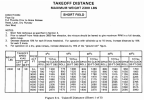
The takeoff chart from a Cessna 172N POH:

1789663393489.png
Note that "Pressure Altitude" is mentioned there. On the ground, you set the altimeter to 29.92" and read off the indicated altitude. Actual altitude is useless here. Then the air temperature at the top is selected, and we see the ground roll we can expect. Note that at sea level pressure altitude, at 0°C, the ground roll is 720 feet. At 40°C (104°F) and an 8000-foot pressure altitude, that ground roll is a whopping 2095 feet. There are numerous pilots who have found out the hard way that this stuff matters. Note, too that the liftoff speed is given in knots INDICATED, not true or calibrated or anything else.

The landing roll is similarly affected, but only because the true airspeed (and therefore groundspeed) is so much higher than the indicated.

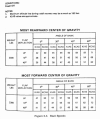
Back to that POH. The stall speed chart:

1789663794096.png
Note that the stall speeds are given in INDICATED speeds, and the Calibrated airspeed is given for reference. Note, too, that neither altitude nor temperature figure into that indication. The indicated speed is lower than the calibrated speed due to the pitot tube's angle to the line of flight in the stall attitude.

You still haven't told us your aviation credentials and experience.
 
Last edited:
Nonsense.
Let’s say you’re going into Aspen late in the afternoon in early August. You think your 450 fpm on your VVI is the same as that 450 fpm going into Boston or Plymouth? Nope. Not even close. You’re falling a lot faster and you need more to break the fall.
You still haven't told us your aviation credentials and experience.
More than yours. A lot more. But I don’t owe them to you.

PS: when you look out the window and you’re judging how high you are relative to the ground, you don’t see indicated. Your eyeball does not range by air molecules.
 
I read this as dealing with rotation or transition… :dunno:
Well, I never claimed to be a great communicator.

The OP brought to mind an ordinary takeoff scenario in which a little back pressure helps the plane fly itself off of the runway, after which the pilot smoothly and deliberately pitches-up to establish the desired climb attitude. It never occurred to me that a CFI might be teaching students to takeoff by hauling-back on the yoke to achieve a 10-degree pitch attitude right off the runway.
 
Let’s say you’re going into Aspen late in the afternoon in early August. You think your 450 fpm on your VVI is the same as that 450 fpm going into Boston or Plymouth? Nope. Not even close. You’re falling a lot faster and you need more to break the fall.
More baloney.

That VVI, what we commonly call a VSI, vertical speed indicator, has a capsule in it that has a tiny, calibrated leak. As the airplane climbs or descends, the instrument's case, which is connected to the static system, experiences a loss or gain of pressure, and air either escapes or enters that capsule via the leak. Because of the restriction of the leak, the capsule expands or collapses and actuates the indicator needle. The whole system works on pressure differential between the case and capsule, and air density does not affect the reading.

Never, in all my training or experience as a pilot or mechanic, have I encountered any correction charts for the VSI. We have them for the altimeter and airspeed indicator, but not the VSI. Maybe you can provide one to prove your assertion?

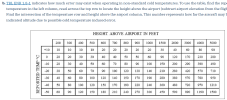
The altitude correction chart:
1789670275345.png
The air's density affects its pressure, which affects the altimeter's accuracy.

An airspeed indicator with the correction formulae handily built right into it:
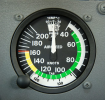
1789670773946.png

Again, the air's density affects the reading, since the air's weight, and therefore the impact it has on the pitot system, works the mechanism. As air temp and altitude rise, the lighter air cannot actuate the reading accurately and correction is necessary for cruise speeds. As I said before, indicated airspeed does not need adjusting for approach or stall speeds. You will note that the correction scale only covers the cruise range, not the stall or approach ranges.

But the VSI/VVI? No correction charts, no internal correction machinery.
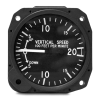
1789670932358.png

It's pressure that matters to it, not air density. We do not need to pad airspeed to allow for it.

What you miss entirely is that true airspeed increases as altitude or temperature increase. The air's density falls and so does drag. Since the true airspeed rises, the lift also rises and counters the loss of lift due to the decrease in density. We continue to use the indicated airspeed for approaches or stall speeds even though the true airspeed has increased and the lift remains the same. Adding airspeed or decreasing descent rate is therefore useless.

 
We see that deflection every time we ask someone positing weird stuff.
Yeah, his story doesn't compute at all. Taking Aspen for example, my back of the envelope calculation is that, since TAS increases 2% per thousand feet of altitude, a 100 MPH Vref gives a 112 TAS at 6000 MSL. If the usual rate of descent is 500 FPM, then 2% more is 560 FPM. Is he so good he can tell the difference? I know, ASE is 7800' but I wanted to use a mile up. A bigger concern would be the 2% up slope of the runway, which he ignores.
 
We see that deflection every time we ask someone positing weird stuff.
In my head when folks bring up stuff like that, I sometimes imagine it's Dennis Hopper rambling about dialectics in Apocalypse Now.
 
Yeah, his story doesn't compute at all. Taking Aspen for example, my back of the envelope calculation is that, since TAS increases 2% per thousand feet of altitude, a 100 MPH Vref gives a 112 TAS at 6000 MSL. If the usual rate of descent is 500 FPM, then 2% more is 560 FPM. Is he so good he can tell the difference? I know, ASE is 7800' but I wanted to use a mile up. A bigger concern would be the 2% up slope of the runway, which he ignores.
That's a geometric way of looking at it. As the airplane descends along a glidepath, any increase in speed will increase the descent rate. Quite normal.

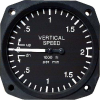
Yeah, try to nail 560 FPM on this:

1789751367551.png

But Fffflats was insisting that the VSI suffers the same sort of errors that the ASI and altimeter do due to changes in density altitude. But nowhere can I find any such thing mentioned, and I have never seen any correction charts or formulae for it.
 
That's a geometric way of looking at it. As the airplane descends along a glidepath, any increase in speed will increase the descent rate. Quite normal.

Yeah, try to nail 560 FPM on this:

View attachment 155079

But Fffflats was insisting that the VSI suffers the same sort of errors that the ASI and altimeter do due to changes in density altitude. But nowhere can I find any such thing mentioned, and I have never seen any correction charts or formulae for it.
And don't forget the 2% upslope. That converts a 3° glidepath to 4° — an increase of 33%, so a much bigger concern, if a concern at all, at ASE.
 
Back
Top