Activate Approach vs Direct-To IAF

asicer

Touchdown! Greaser!
Joined
Jan 1, 2015
Messages
11,765
Display Name
asicer
So this pretty much establishes that the "Activate Approach" function is pretty much a button macro for Direct-To IAF. How many button presses does it actually save?

Direct-To is the D-> button, FPL, IAF, Activate (4)
Activate Approach is Home, Proc, Activate, confirm (also 4?)

Seems like it saves very little.

 
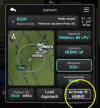
The number of button pushes depends on the unit, but yes, it's mean "Direct to the transition you selected" is what it's meant in the GPS world since at least the earliest 430/530 units. I haven't used it since I learned that, unless it is one of those situations in which "Load and Activate" is the only choice. I'm not sure how long ago that was, but I know I stopped using VTF in 2009 and I'm pretty sure I stopped "Activate Approach" before that.

It's actually called something more like what it is in the new Axis equipment.

1785938708630.png
 
So this pretty much establishes that the "Activate Approach" function is pretty much a button macro for Direct-To IAF. How many button presses does it actually save?

Direct-To is the D-> button, FPL, IAF, Activate (4)
Activate Approach is Home, Proc, Activate, confirm (also 4?)

Seems like it saves very little.


I don’t think this is primarily about saving keystrokes. It is about making the function clearer. “Activate Approach” is sometimes misunderstood as a special mode that enables greater navigational precision. I have even heard people say that you are not legally flying the approach until it has been activated.

Something like “Go to XYZ” would describe that function more clearly than “Activate Approach.”
 
I have even heard people say that you are not legally flying the approach until it has been activated.
That's probably true but a source of confusion. The approach indeed needs to be "activated" (lower case). If you are currently direct to an airport and the approach is merely loaded, approach sequencing will not take place until the sequence is "activated" by going direct to an approach waypoint or activating a leg of the approach (there's that word again).

The source of confusion is that "Activate Approach," only does that by going direct to the transition you initially loaded. It's nice to see that Garmin is in the process of changing that.
 
  • Like
Reactions: WDD
...“Activate Approach” is sometimes misunderstood as a special mode that enables greater navigational precision. I have even heard people say that you are not legally flying the approach until it has been activated.
IIRC, that was true when IFR GPS units were first introduced (pre-Garmin).
 
The number of button pushes depends on the unit, but yes, it's mean "Direct to the transition you selected" is what it's meant in the GPS world since at least the earliest 430/530 units. I haven't used it since I learned that, unless it is one of those situations in which "Load and Activate" is the only choice. I'm not sure how long ago that was, but I know I stopped using VTF in 2009 and I'm pretty sure I stopped "Activate Approach" before that.

It's actually called something more like what it is in the new Axis equipment.

View attachment 154041
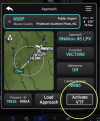
I wonder what the button label shows if you selected VTF as your transition.

I don't think I've ever pushed Activate Approach for an instrument approach in the air. I always load it as soon as I get any inclination of what approach I'll be flying, and then use the Flight Plan page to activate the waypoint or leg that I'm cleared to fly. The situation is usually busier (hand-offs, descents, vectors, traffic call-outs, ATIS, bouncing around in the lower altitudes of the terminal environment, etc.) by the time I'm cleared to fly something. That increased workload makes it more likely that I'll accidentally mash the wrong button and screw things up if I try to load and activate things from scratch at that point.
 
I wonder what the button label shows if you selected VTF as your transition.
1785942920351.png

I don't think I've ever pushed Activate Approach for an instrument approach in the air. I always load it as soon as I get any inclination of what approach I'll be flying, and then use the Flight Plan page to activate the waypoint or leg that I'm cleared to fly.
You and I have the same methodology. I think my earliest was about 250 NM from the destination.
 
You and I have the same methodology. I think my earliest was about 250 NM from the destination.
Those long cross-country flights sometimes leave us looking for something to do. :)

I inferred from your responsive screenshot that there is an Axis trainer app available already. I'm glad my iPad isn't nearby or I'd lose time playing with it to daydream about a panel upgrade I really don't need.
 
I inferred from your responsive screenshot that there is an Axis trainer app available already.
There is. I found it just a few days ago. I was wondering whether Garmin was going to have one available and found it mentioned on the Axis page.

Here. Go play. AppStore link to the trainer. I'm still messing around, mostly looking for differences from other Garmin PFD/MFD combos. There's a lot of similarity on bnasic flows, and some interesting new features, a few of which were borrowed from Garmin Pilot.
 
"Activate" has been the source of so much confusion (and so much extra money for CFIs) for so many years that I am glad to see Garmin getting away from it (sort of - I mean they still have the word "Activate" in @midlifeflyer 's examples). I wish they had never used the term.

In the FMSeses I fly with at work (Collins Pro Line 21 and Pro Line Advanced), there is no "Activate" function. You load the approach you want, it puts it below a "discontinuity" in the flight plan, and when you're cleared to a fix on it, you do "Direct" and select that fix. That's the only way to do it, it makes sense, and there's no confusion with terms like "Activate". I wish I had learned on a system like this first, it would have saved ME a lot of confusion early on with the whole Garmin Activate idea.
 
Right. It's as if they stuck that in there as a button macro way back in the day. But I'm still trying to figure out how much fumbling it actually saved, if any.
 
I wish they had never used the term
I’ve wondered where it came from. I dint think it’s necessarily Garmin. The IFD, which does the FMS discontinuity thing, also has it, although it’s not as prominent. Fortunately, you can do it the way you say in all of them.

I always hesitate pushing people away from what works, but when I fly with an Activate-or, it will generate a ground discussion just to make sure they know what the button does and that its use is unnecessary. i haven’t gone so far as to create a scenario in flight and see what happens.

Like you, I also hesitate to change something that works, but in so many cases I (like I'm sure you) see continuing confusion with Activate. I mean, it seems like every time I'm doing some kind of instrument refresher training the client ALWAYS hesitates over that "Load" or "Activate" function. And usually turns to me and says "now do I load or activate it?" This is with people who have had the same GPS installed in their airplane for years, and we go over it every time. So in this case I think it's worth trying to change habits (to something they can remember).
 
Right. It's as if they stuck that in there as a button macro way back in the day. But I'm still trying to figure out how much fumbling it actually saved, if any.
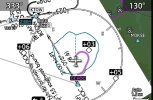
I’ve never counted, but the problem isn’t the keystrokes. We’re talking maybe 3 seconds even in an old twist and push system. The problem is what happens when you press the button in the wrong place because you think it will join the approach anywhere.i like to think there are practical reasons it would be rare, but it could do this..

1785978527190.jpeg
The approach was loaded from OCHOC. The airplane was being vectored and vectored past OCHOC to join the approach at IKTOW. At the point you see in the screen, the pilot tapped “Activate Approach.”
 
Like you, I also hesitate to change something that works, but in so many cases I (like I'm sure you) see continuing confusion with Activate. I mean, it seems like every time I'm doing some kind of instrument refresher training the client ALWAYS hesitates over that "Load" or "Activate" function. And usually turns to me and says "now do I load or activate it?" This is with people who have had the same GPS installed in their airplane for years, and we go over it every time. So in this case I think it's worth trying to change habits (to something they can remember).
I’ve seen it too. My First Commandment only applies if the pilot’s technique works. If I get ”do I load or activate,” the pilot’s technique doesn’t work.
 
IIRC, that was true when IFR GPS units were first introduced (pre-Garmin).
Bendix/King did refer to an approach being activated as the CDI scaling, RAIM check, etc, but this was automatic and did not and could not be activated by the pilot. The concept of a pilot activating an approach was a Garmin thing, I thought. Evidently many people thought these were the same thing.
 
unless it is one of those situations in which "Load and Activate" is the only choice.
Interesting... What would those situations be?

It's actually called something more like what it is in the new Axis equipment.

View attachment 154041
Very nice! Glad they're thinking about such things. I continue to be impressed by Axis, I really think Garmin has stepped up their game a level.

In the FMSeses I fly with at work (Collins Pro Line 21 and Pro Line Advanced), there is no "Activate" function. You load the approach you want, it puts it below a "discontinuity" in the flight plan, and when you're cleared to a fix on it, you do "Direct" and select that fix. That's the only way to do it, it makes sense, and there's no confusion with terms like "Activate".
Oh, the Pro Line has plenty of its own stupidity - The one that your post brings up in my mind is that you have to manually put the destination in not only in the "destination" field, but also at the end of the flight plan, and then add it again before the discontinuity. Maybe you don't do that a whole lot with the type of flying you do, but for us average point-a-to-point-b guys it just seems really dumb.
 
"Activate" has been the source of so much confusion (and so much extra money for CFIs) for so many years that I am glad to see Garmin getting away from it (sort of - I mean they still have the word "Activate" in @midlifeflyer 's examples). I wish they had never used the term.

In the FMSeses I fly with at work (Collins Pro Line 21 and Pro Line Advanced), there is no "Activate" function. You load the approach you want, it puts it below a "discontinuity" in the flight plan, and when you're cleared to a fix on it, you do "Direct" and select that fix. That's the only way to do it, it makes sense, and there's no confusion with terms like "Activate". I wish I had learned on a system like this first, it would have saved ME a lot of confusion early on with the whole Garmin Activate idea.
I have a beach house in the Caymans from all the extra CFI money I earned from Activate confussion.
 
Last edited:
Interesting... What would those situations be?
The one I’ve seen is the approach is already being sequenced and you change or reload it. It happens more in training where we do multiple approaches than the real world. One of the few times you need to remove an approach before loading another.
 
"Activate" has been the source of so much confusion (and so much extra money for CFIs) for so many years that I am glad to see Garmin getting away from it (sort of - I mean they still have the word "Activate" in @midlifeflyer 's examples). I wish they had never used the term.

In the FMSeses I fly with at work (Collins Pro Line 21 and Pro Line Advanced), there is no "Activate" function. You load the approach you want, it puts it below a "discontinuity" in the flight plan, and when you're cleared to a fix on it, you do "Direct" and select that fix. That's the only way to do it, it makes sense, and there's no confusion with terms like "Activate". I wish I had learned on a system like this first, it would have saved ME a lot of confusion early on with the whole Garmin Activate idea.
Unfortunately when Garmin got into the aviation GPS business, they decided they had to reinvent terminology. Between that and the way instrument flying is generally taught, an instrument rating using Garmin equipment should have a Limitation on the certificate much like Centerline Thrust in a multi IMO.
 
Unfortunately when Garmin got into the aviation GPS business, they decided they had to reinvent terminology. Between that and the way instrument flying is generally taught, an instrument rating using Garmin equipment should have a Limitation on the certificate much like Centerline Thrust in a multi IMO.
I'm not sure whether it was Garmin that reinvented it. How old is the UPSAT CNX 80 (later Apollo CNX80; later Garmin GNS 480). It did "Activate" approach too, but I don't know if that was a Garmin addition.

I'm not really bothered by the word "activate." We activate legs, D→ selections, etc, I don't see the "is that really what you want to do" confirmation which those involve being a problem or in any way confusing. All the gripes I have about it are centered in the not-really-descriptive "Activate Approach," and are solved by the new Axis language asking if you want activate direct to the transition you just selected. Even "Activate VTF" does exactly what it says.
 
Oh, the Pro Line has plenty of its own stupidity - The one that your post brings up in my mind is that you have to manually put the destination in not only in the "destination" field, but also at the end of the flight plan, and then add it again before the discontinuity. Maybe you don't do that a whole lot with the type of flying you do, but for us average point-a-to-point-b guys it just seems really dumb.
Oh I am by no means a Pro Line fanboi, and I agree, it not inserting the airport you're going to at the end of the flight plan is ridiculous to the extreme. Yeah, we see it all the time.

Lots of other oddness too, but at least it doesn't have the "Activate" confusion.
 
Unfortunately when Garmin got into the aviation GPS business, they decided they had to reinvent terminology. Between that and the way instrument flying is generally taught, an instrument rating using Garmin equipment should have a Limitation on the certificate much like Centerline Thrust in a multi IMO.
The one that puzzles me is all the different names GPS makers have come up with for "course".
 
I'm not sure whether it was Garmin that reinvented it. How old is the UPSAT CNX 80 (later Apollo CNX80; later Garmin GNS 480). It did "Activate" approach too, but I don't know if that was a Garmin addition.

I'm not really bothered by the word "activate." We activate legs, D→ selections, etc, I don't see the "is that really what you want to do" confirmation which those involve being a problem or in any way confusing. All the gripes I have about it are centered in the not-really-descriptive "Activate Approach," and are solved by the new Axis language asking if you want activate direct to the transition you just selected. Even "Activate VTF" does exactly what it says.
Garmin is the only one I’ve seen where “activate approach” means go direct to a fix, although I haven’t got experience with the UPSAT/Apollo unit.

I disagree that “Activate VTF” does what it says. It activates the final approach course, but does nothing to get ATC to give you vectors.
 
Apollo GX50 user guide says:

"Load your approach to the active flight plan. You can load the approach in the Flight Plan function, or as a short cut, press SEL in the Nav function or while viewing the moving map. At 30 nm your Apollo GX will ask if you want to enable approach, press the ENTER button. Then, enter the local altimeter setting. If you are less than 30 nm from your destination when you load an approach, you will be prompted immediately to enable it."

"Approach Active operation begins when you cross the FAF and ends when you cross the MAP. The CDI is at 0.3 nm full scale per side. The OBS/HOLD Annunciator is on steady. The ACTIVE annunciator is on steady. If the ACTIVE annunciator is not on steady, do NOT continue the approach."
 
Garmin is the only one I’ve seen where “activate approach” means go direct to a fix, although I haven’t got experience with the UPSAT/Apollo unit.
Avidyne IFD.
I disagree that “Activate VTF” does what it says. It activates the final approach course, but does nothing to get ATC to give you vectors.
:p
 
Apollo GX50 user guide says:

"Load your approach to the active flight plan. You can load the approach in the Flight Plan function, or as a short cut, press SEL in the Nav function or while viewing the moving map. At 30 nm your Apollo GX will ask if you want to enable approach, press the ENTER button. Then, enter the local altimeter setting. If you are less than 30 nm from your destination when you load an approach, you will be prompted immediately to enable it."

"Approach Active operation begins when you cross the FAF and ends when you cross the MAP. The CDI is at 0.3 nm full scale per side. The OBS/HOLD Annunciator is on steady. The ACTIVE annunciator is on steady. If the ACTIVE annunciator is not on steady, do NOT continue the approach."
I think this is the most accurate terminology…the unit activates the approach mode automatically at the appropriate time, but the pilot needs to enable the automation.
 
Hitting activate the approach does have some good uses in the Garmin line. Say there is a good low overcast layer covering a decently large area and you want to go do some approaches at multiple airports in a 50 mile radius and those airports are uncontrolled. You can tell the approach control the plan and get alternate missed instructions where on the missed go direct to an IAF at the next airport down the line. When on the missed you just select the approach and the fix hit activate and everything is really clean.

It is also nice when a center asks if you have the weather and approach request. You get the weather, pick the approach and they give you the fix. Pull up the approach hit activate and you are done.

Operating at smaller uncontrolled fields where all approach clearances are given as full procedure and vectoring is about unheard of is where this really works well.
I agree those are appropriate uses. But none of those require Activate Approach, which I suspect led to the original question about relative button pushes. Question of technique.

Take your second one and third examples. In my case the approach is typically loaded long before Center (or for that matter TRACON in busy airspace) asks my approach request. If its a cross country flight of less than an hour, it was probably loaded before I took off. it’s just a matter of asking for what makes the most sense at the time, and selecting that waypoint, which might or might not be the transition I originally loaded.
Pulling on the above ... I use the ADS-B weather at the destination to pretty much guess what the runway in use will be and have that loaded up. When ATC suggests something I typically ask for the XYZ approach I already have loaded and briefed, which they happily accept.
 
Pulling on the above ... I use the ADS-B weather at the destination to pretty much guess what the runway in use will be and have that loaded up. When ATC suggests something I typically ask for the XYZ approach I already have loaded and briefed, which they happily accept.
I think even with just forecasts. Sure, conditions can change, but general forecasts of things like predominant wind direction don’t usually change that much. And yes, ATC accommodates our approach requests, even to towered airports, so long as they don’t conflict with other operations.

My longest was loading the approach about 200 NM before my destination. That wasn’t for a nontowered airport. The exact opposite - a Bravo.
 
I just do it backwards to everybody else probably. I never put in the approach to an uncontrolled field until around 20 miles out. Just a little mental measure to assure me on the ground that if problems start stacking up in the air that I won't be tempted to stick to the plan just because that's what I loaded when I started out. Getting in close lets me get an idea of the most up to date info on real conditions.

Landing with cross winds and tails winds does not really bother me so I will always pick the approach which provides the best buffer between me and buildups or heavy precip.

Of course this is in airplanes with 650 and 750s. Putting in procedures, modifying flights plans, setting up vnav profiles...... can pretty much be done blindfolded and only takes a few seconds to set up. If I was still using older units that required more time and thought to set up I wold probably set things up further out.
 
Apollo GX50 user guide says:

"Load your approach to the active flight plan. You can load the approach in the Flight Plan function, or as a short cut, press SEL in the Nav function or while viewing the moving map. At 30 nm your Apollo GX will ask if you want to enable approach, press the ENTER button. Then, enter the local altimeter setting. If you are less than 30 nm from your destination when you load an approach, you will be prompted immediately to enable it."

"Approach Active operation begins when you cross the FAF and ends when you cross the MAP. The CDI is at 0.3 nm full scale per side. The OBS/HOLD Annunciator is on steady. The ACTIVE annunciator is on steady. If the ACTIVE annunciator is not on steady, do NOT continue the approach."

I just checked an old Bendix/King KLN 89B manual, and it has similar language, although it talks about "arming" the approach instead of enabling it, and it switches to approach active mode 2 NM sooner than the GX50 does. It also has this warning in bold:

WARNING: It is not approved to conduct the final portion of the approach unless the KLN 89B is in the approach active mode (ACTV on external annunciator).​

I suspect that Garmin's later use of similar terminology may be a source of confusion. I know that it was for me when I was first learning the G1000.
 
Last edited:
I’ve wondered where it came from. I dint think it’s necessarily Garmin. The IFD, which does the FMS discontinuity thing, also has it, although it’s not as prominent. Fortunately, you can do it the way you say in all of them.
I don't see activate defined in the RTCA DO-208 MOPS for TSO C129, but in RTCA DO-229 MOPS for WAAS GPS TSO X145/146, there is this:

Path Selection
The equipment shall enable the pilot to select the approach path of the aircraft by
selecting the airport, approach identifier, initial approach fix, and (as applicable) the
runway. Once the approach has been selected, the approach name (airport, runway, route
indicator) shall be accessible for display.
Note: The inherent nature of RNAV procedures requires that a series of waypoints can
be connected to define a procedure. In this document, the term “flight plan” is
used to refer to this basic concept, and can refer to any sequence of waypoints,
that are interconnected (such as an approach procedure). The equipment should
allow the pilot to select and activate an approach procedure without specifically
accessing the flight plan functions defined in Section 2.2.1.2.

The Garmin architecture for the navigation flight plan consists of up to 4 segments: departure, enroute, arrival, and approach. The departure segment automatically sequences to the enroute segment, which in turn sequences to the arrival segment. Sequencing to the approach segment is also automatic after completing the arrival segment or if none is present, after completing the enroute segment. Many flight plans don't include all segments. In a simple flight plan KHEF direct to KUZA and subsequently loading an approach, will sequence from KHEF to KUZA. After KUZA, sequencing is to the first entry of the approach segment. Normally, the path selected in the enroute segment that goes all the way to the destination, overflying the destination, and only then proceeding to the first fix in the loaded approach is not expected method. Once an approach clearance is issued, the path to the destination airport is not the desired path and a new path is selected, either a vector or a direct to an IAF or feeder fix for the procedure. Activating the approach changes the path selection from the enroute path to join the approach segment path. Other better alternatives to change the navigation path to join an approach include direct-to a fix in the approach segment of the flight plan, activating a leg in the approach segment, or selecting vectors to final.
 
I don't see activate defined in the RTCA DO-208 MOPS for TSO C129, but in RTCA DO-229 MOPS for WAAS GPS TSO X145/146, there is this:


The Garmin architecture for the navigation flight plan consists of up to 4 segments: departure, enroute, arrival, and approach. The departure segment automatically sequences to the enroute segment, which in turn sequences to the arrival segment. Sequencing to the approach segment is also automatic after completing the arrival segment or if none is present, after completing the enroute segment. Many flight plans don't include all segments. In a simple flight plan KHEF direct to KUZA and subsequently loading an approach, will sequence from KHEF to KUZA. After KUZA, sequencing is to the first entry of the approach segment. Normally, the path selected in the enroute segment that goes all the way to the destination, overflying the destination, and only then proceeding to the first fix in the loaded approach is not expected method. Once an approach clearance is issued, the path to the destination airport is not the desired path and a new path is selected, either a vector or a direct to an IAF or feeder fix for the procedure. Activating the approach changes the path selection from the enroute path to join the approach segment path. Other better alternatives to change the navigation path to join an approach include direct-to a fix in the approach segment of the flight plan, activating a leg in the approach segment, or selecting vectors to final.
It's not about TSO. It's about clarity. Truth in labeling :D

As I mentioned earlier, I definitely see the need to easily "activate an approach" (lower case), i.e. begin the process of sequencing the approach segment of the flight plan, rather than continue to the last direct waypoint (which might be the destination). To me, that's what the TSO is talking about. Sequencing can begin at multiple waypoints within the segment and, as you mentioned, there are multiple ways to do it.

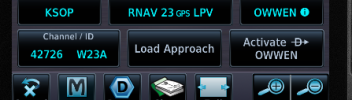
But that's very different than a dedicated button which is arguably mislabeled "Activate Approach," since the only thing it "activates" is direct to the initially selected transition. I'm not personally bothered by it because I understand what is means; but we have all seen pilots who don't. That's why I'm happy with what Garmin is doing - labeling the button to describe what it actually accomplishes. Which I just noticed, seems to be coming to the GTN series as well as the Axis, based on what I see in the latest version of the Garmin trainer.

1786292957014.png
 
The real-world knowledge and experience shared here is great! Thanks to everyone who contributed. I recently changed aircraft, going from a VFR only experimental to a IFR equipped bird with dual 430Ws. I flew a lot of IFR in the past but not for 10+ years. I am scheduled with a CFII for several hours of instruction and have been reading manuals and playing with the 430 sim but definitely no "eureka" moments so far... This discussion has definitely clarified some concepts.
 
I'm happy with what Garmin is doing - labeling the button to describe what it actually accomplishes. Which I just noticed, seems to be coming to the GTN series as well as the Axis, based on what I see in the latest version of the Garmin trainer.

View attachment 154104
I just updated the firmware in my gtn650xi to the current 21.12 version and yes, the notes confirm this at least for the xi models.
 

Attachments

Back
Top