
A & P Second Career

I have to say many seem to think you just drop in to your local GADO and pick up an A&P ticket.

The A&P written test is the hardest one the FAA administers, simply because it cover so many different subject areas, and not just airframes and power plants. It's actually three separate tests. A general knowledge test, then the airframe test, and finally the powerplant test. The closest other test I could imagine the FAA gives, that's tough, is the flight engineer's test, (do they even still do that one?) and this is that - but on steroids.

I went to Northrop University in Los Angeles to get my A&P ticket and it was an ordeal. And if you're older like I am now, start boning up on your math. You'll need for everything.

Here are the areas you'll be tested on:
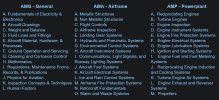
jlkjljljlk.jpg

The full course was 18 months and my G.I. Bill covered most of it, but I had to work in a Shakey's pizza parlor at night just so I could eat. And every lunch period I'd sit in the cockpit of an old Stearman they had there eating left over cold pizza and studying. And it really took me a long time before I could enjoy pizza again. (Years later I got to fly a Stearman and I had that landing sight picture ingrained in my head from all those lunches spent staring out that cockpit wind screen.)

Then if you pass the written exams, and many don't the first time, there is still the practical exam conducted by a DME, or whatever they are called nowadays, and essentially you spend a day (or sometimes two) in their hangar shop working for free and paying $250 (at that time) for the privilege. I timed magnetos, changed out some brake pads, removed a damaged aileron from a Cessna, did the sheet metal work to repair it, replaced it, and rigged it. And I enjoyed that one as the examiner and I took the aircraft around the patch to test it out.

So, if that's the hardest, what's the easiest written test? The Parachute rigger's certification is the easiest simply because it's the shortest one in terms of the possible question pool. And the entire question pool is small and easy to study. But, in both cases, or more probably all cases, these tickets count for little without real world experience. I was already a skydiving instructor when I got my rigger's ticket so it was all relatively easy for me.

One more thing about the A&P question pool. While the three tests are 50 questions for the General, then a 100 each for the other two - the possible question pool is enormous. So you really can't just cram study and pass - you've got to know the material.

I was already in my thirties when I started A&P school and I was the old man on campus. But, no mater your age, if you have the drive, and the wherewithal, then by all means go for it. I'm in my seventies now, and still pilot friends call me begging for help with their airplanes. And I know if I wanted to drop out of being retired, I could go to work full time in just about any GA shop in my area. And an A&P ticket, unlike some others, is good for life. (As long as you keep your hand in occasionally like I do now.) And unlike pilots - the FAA will graciously allow you to die with a wrench in your hand carrying out the privileges of your ticket.
 
I've thought about getting a&p certification just so I could do my own condition inspections on my own aircraft. It seems increasingly more challenging to find the required licensed individuals. Sure would be nice to have a pathway for a limited certification to inspect your own aircraft.

I have read some reports of community colleges with an a&p program and free tuition for seniors. That would make it pretty attractive if one is available near your location.
well currency and previous experience rules might make that a little harder than you think.

also a second career is gonna cost you at least $10k a year. insurance and tools/calibration and AD software are not cheap.

best bet would be work at a shop on a W2. get your IA and make bank.
 
The A&P written test is the hardest one the FAA administers, simply because it cover so many different subject areas, and not just airframes and power plants.

lol wut? there are multiple study guides and practice tests. I never scored below a 90 on general/airframe/powerplant/ppl using nothing but asa prepware.
 
well currency and previous experience rules might make that a little harder than you think.

also a second career is gonna cost you at least $10k a year. insurance and tools/calibration and AD software are not cheap.

best bet would be work at a shop on a W2. get your IA and make bank.
I'm not looking for a second career. Some on here are certainly, but I'm not. My current career is enjoyable and pays way more than I ever thought I would make. My interest in earning A&P certification is limited to being able to sign off a condition inspection on my own personal experimental aircraft. I'm not a builder, so that route is closed. I don't have light sport so that route is closed. Really would be nice to have an option for repairman maintenance course on any experimental. And why isn't that available? Would not a pilot more educated on maintenance practices be a better safer pilot?
 
Really would be nice to have an option for repairman maintenance course on any experimental. And why isn't that available?
Hopefully MOSAIC will end up with something like that given the mx changes they were proposing. As to why there's not for E/AB I was told when the LSRM was initiated that there wasn't enough demand to warrant the setting up a certification path.
 
I'm not looking for a second career. Some on here are certainly, but I'm not. My current career is enjoyable and pays way more than I ever thought I would make. My interest in earning A&P certification is limited to being able to sign off a condition inspection on my own personal experimental aircraft. I'm not a builder, so that route is closed. I don't have light sport so that route is closed. Really would be nice to have an option for repairman maintenance course on any experimental. And why isn't that available? Would not a pilot more educated on maintenance practices be a better safer pilot?
If you own an E/AB you can do all the maintenance you want. No limits.

To be an AnP you have to be current and have done the work before. If you are only doing a condition inspection you will not satisfy 65.83 and possibly 65.81 (the actual condition inspection). Since E/ABs are not maintained under pt 43 then I don’t think you could ‘count’ work done on an E/AB as experience for proficiency.

Signing off your own inspection is IMHO a fools choice. You are biased and uninformed. Paying an AnP $500 or whatever every year to make sure your hoopty is in a safe condition is money well spent.
 
Hopefully MOSAIC will end up with something like that given the mx changes they were proposing. As to why there's not for E/AB I was told when the LSRM was initiated that there wasn't enough demand to warrant the setting up a certification path.
Aren’t LSA’s basically factory AC? Meaning there is tech data to refer to? ELSA is not amateur built IIRC.

I don’t think you can get the FAA to ‘bless’ non-E/AB’s builders with condition inspection authority as they didn’t build the plane (ie have extensive knowledge) and there are no certificated references to rely on. Every E/AB has the possibility of being a unique creation with unlimited possible build combinations. How do you make a class to teach that’s safe to fly??
 
If you own an E/AB you can do all the maintenance you want. No limits.
Yes, I am aware of this.
To be an AnP you have to be current and have done the work before. If you are only doing a condition inspection you will not satisfy 65.83 and possibly 65.81 (the actual condition inspection). Since E/ABs are not maintained under pt 43 then I don’t think you could ‘count’ work done on an E/AB as experience for proficiency.
I've read there may be some movement recently on this; I may be mistaken here. Regardless, absent a pathway such as the one for light sport owners, I will likely never be an A&P.
Signing off your own inspection is IMHO a fools choice. You are biased and uninformed. Paying an AnP $500 or whatever every year to make sure your hoopty is in a safe condition is money well spent.
I used to feel this way. As my experience and knowledge of my aircraft grew, my opinion has changed as well. Given my aircraft (or is it aircraft(s) at this point) are experimental, few A&P have familiarity with them. I've run into some who cause harm, then bill me for their time causing said harm as well as the parts and labor to fix said harm. I've run into some who don't want me involved in any way; that is what led to said harm in the past so that's not going to happen again. My issue isn't paying $500 for an extra set of eyes once a year. My issue is finding an A&P willing to do that with me. The last guy I had was great but sadly was murdered last year.
 
I don’t think you can get the FAA to ‘bless’ non-E/AB’s builders with condition inspection authority as they didn’t build the plane (ie have extensive knowledge) and there are no certificated references to rely on.
Why not? An A&P or LSRM didnt build the aircraft they service either. And if certified references were an issue how could an A&P or CRS sign off a Condition inspection? Regardless, if one wanted you could develope a basic certified E/AB non-builder repairman based on the LSRM model with some additional requirements specific to E/AB aircraft, restrict its use to a specific aircraft by S/N, change the Ops Limits, and let them call it a day. Afterall since these owners can legally maintain/alter their aircraft the other 364 days of the year, I dont think its much of a stretch to let them sign their own Condition insp.

I've read there may be some movement recently on this; I may be mistaken here.
If you read the final MOSAIC proposal it shows some changes to the aircraft mx side. If you read between those lines and the comments left by those against those changes it leads one to think more people will be eligible to work on certain aircraft IF the NPRM is accepted/issued in its present form. At least thats how it appears from the outside looking in.
 
At age 64, retired, I'm starting A&P school this fall. Always like wrenching, should be fun!
That's awesome! Keep us up to date on the program.

Maybe you can sign off my next engine :biggrin:
 
  • Like
Reactions: WDD
There’s a '73 235 “charger” that had a nose gear collapse. If I had spare time, it'd be a fun way to build some hours.
 
Why not? An A&P or LSRM didnt build the aircraft they service either. And if certified references were an issue how could an A&P or CRS sign off a Condition inspection?
Because there is acceptable or better yet, approved data like AFM, SRM, TCDS and well, just plain old approved documentation to rely on w/r/t LSA ELSA.

When you do a condition inspection as an AnP you are never looking at the WHY, just the HOW. Are bolts installed correctly IAW acceptable methods? Are rivets formed correctly?

say for example an AnP is inspecting a wing and sees a Phillips head screw in the middle of the wing panel. I can easily go to the SRM and find out if that screw should be there or not, and if it's not it's a discrepancy that needs to be corrected. in an EAB there is no real way for me to know whether or not that screw should be there versus a rivet or a bolt. The plans do not need to be followed and the owner can do any type of maintenance they want, so how can an A&p verify that installation is correct and safe? they really can't they can just rely on something like the 4313 for proper rivet installation and proper screw installation. so an A&p never says that screw is safe just that it's installed properly it's in a condition safe for flight.
 
Last edited:
Because there is acceptable or better yet, approved data like AFM, SRM, TCDS and well, just plain old approved documentation to rely on w/r/t LSA ELSA.
Except an experimental amateur-built aircraft has none of that documentation. So my question stands on if an A&P can sign off a Condition inspection on an E/AB, why couldn't a non-builder sign off the same inspection if he receives similar acceptable training applicable to E/AB aircraft? When I have performed Condition inspections I look at those aircraft no different than I do certified aircraft. So if I see a "screw in the middle of the wing panel" I'll question it, if necessarily, the same if I saw a screw in the middle of a Cessna wing. Not quite following where you are going with that?
 
Except an experimental amateur-built aircraft has none of that documentation. So my question stands on if an A&P can sign off a Condition inspection on an E/AB, why couldn't a non-builder sign off the same inspection if he receives similar acceptable training applicable to E/AB aircraft? When I have performed Condition inspections I look at those aircraft no different than I do certified aircraft. So if I see a "screw in the middle of the wing panel" I'll question it, if necessarily, the same if I saw a screw in the middle of a Cessna wing. Not quite following where you are going with that?
An AnP has the training, tools and EXPERIENCE to know (or to even question) if a thing is put together in such a way that its safe to use.

Take a composite structure. You cannot tell the way it was layed up, the kind of matrix used, or even if the epoxy was mixed with the correct ratios... but you can tell if there are voids or other defects with tests and inspections. Can you learn this? Sure. Its not hard. Just complete an AnP course and take the required tests, then get the applicable knowledge. Notice the last part... AnPs are always learning. The school is the starting point, not the goal.

Even if you take the LSA class and get the repairman cert you must follow MANUFACTURER inspection and repair procedures. You cannot alter the LSA like you can an E/AB unless you get manufacturer or FAA permission.

Read FAR 91.327 and you'll see how limited the repairman cert is.

So to sum it up: If you want the privileges of an AnP, get the certificates and maintain them IAW FAR pt 65. If you want the LSA repairman cert privileges, take the class and buy the specific LSA.

You desired path is not valid and repeating 'why not' is no solution.
 
So to sum it up: If you want the privileges of an AnP, get the certificates and maintain them IAW FAR pt 65. If you want the LSA repairman cert privileges, take the class and buy the specific LSA.
Yet, an individual with minimal experience can buy a used ELSA, with no telling how many modifications, then take a 16-hr LSRI course and legally sign off their own Condition inspections on their ELSA. So, what makes an E/AB non-builder buyer any different?

Again, so why not offer a E/AB non-builder the same existing ELSA opportunity by requiring they obtain an E/AB inspection repair certificate so they can perform the Condition inspections on their own aircraft?
 
Back
Top