Will 100LL really stop in 2029/2030?

So….. getting rid of lead because it’s toxic and bad by replacing it with something just as bad ….. is an improvement how? And why are we getting rid of lead?
Lead, being an element, is going to stick around forever. M-toluidine biodegrades quickly in sunlight, though not nearly as fast once it gets into soil or water. So it’s better, but not perfect.

The other big difference is that m-toluidine is acutely toxic, which is bad, while lead’s toxicity is chronic, which is a different bad…

Anyone know what concentration is in the fuel? As Paracelsus so wisely observed all those centuries ago, “The dose makes the poison.”
 
who knows, if their list of airplanes is correct with the m20J, they already have an 8.7:1 HIGH compression engine.
 
Lead, being an element, is going to stick around forever. M-toluidine biodegrades quickly in sunlight, though not nearly as fast once it gets into soil or water. So it’s better, but not perfect.

The other big difference is that m-toluidine is acutely toxic, which is bad, while lead’s toxicity is chronic, which is a different bad…

Anyone know what concentration is in the fuel? As Paracelsus so wisely observed all those centuries ago, “The dose makes the poison.”
that honestly sounds like a court visit away from everyone's fuel less
 
MT is going to combust and no longer be MT.

I’m guessing one’s exposure to MT in fuel is going to be moderated by exposure to the other 95% of the fuel compounds. Don’t drink it, wash with it, or huff it…
 
who knows, if their list of airplanes is correct with the m20J, they already have an 8.7:1 HIGH compression engine.
On the bolded, hate to be that guy, but I'm kinda leaning against it being an accurate inclusion. Given the expansive and sub-model-laden nature to that AML as published, I'm gonna go with errata for the angle valve IO-360 being included. An engine very dear to my heart, as it's the one that kicked me off the hobby in 2023, which galvanized my resolve to go parallel-valve only if/when I ever get back in.

In fairness, it is a 1,604 item list, and I don't care that much about the topic to look at all of them. But it appears at glance as the sole example of an angle valve Lyco in a thousand odd ledger? Not saying they won't get to the angle valved lycos eventually, but I think in present circumstances that smells like a typo that got away from the regulator.

Given all they've done is regurgitate the UL94 AML into the 100R STC, I'm not inclined to take that inclusion as credible unless you can find me a single additional example of an 8.7+ installation among the remaining 1,603. If one exists, I'd be more inclined to take the entry as legitimate.

Don't worry, I won't be a blue falcon and call the FAA hotline for "clarification". I can be polemic for effect, but I'm no playa hata. Besides, let's just say Petersen wasn't the only one who dabbled in the mogas sciences in this life, and I'll digress there. We're all innocent in Shawshank.... :fingerwag:

Uncle HS time/date unknown (...2012)
,

 
On the bolded, hate to be that guy, but I'm kinda leaning against it being an accurate inclusion. Given the expansive and sub-model-laden nature to that AML as published, I'm gonna go with errata for the angle valve IO-360 being included. An engine very dear to my heart, as it's the one that kicked me off the hobby in 2023, which galvanized my resolve to go parallel-valve only if/when I ever get back in.

In fairness, it is a 1,604 item list, and I don't care that much about the topic to look at all of them. But it appears at glance as the sole example of an angle valve Lyco in a thousand odd ledger? Not saying they won't get to the angle valved lycos eventually, but I think in present circumstances that smells like a typo that got away from the regulator.

Given all they've done is regurgitate the UL94 AML into the 100R STC, I'm not inclined to take that inclusion as credible unless you can find me a single additional example of an 8.7+ installation among the remaining 1,603. If one exists, I'd be more inclined to take the entry as legitimate.

Don't worry, I won't be a blue falcon and call the FAA hotline for "clarification". I can be polemic for effect, but I'm no playa hata. Besides, let's just say Petersen wasn't the only one who dabbled in the mogas sciences in this life, and I'll digress there. We're all innocent in Shawshank.... :fingerwag:

Uncle HS time/date unknown (...2012)
,
hey be quiet, they put it in writing its a fact, come on let me have this one hehehe. it's a short hop from here to my io-360-a1a
 
I don't think that's a fair characterization. Braley has been running g100ul in his personal SR22 for 15 years. All of the issues I've seen have been leaks of tanks or quick drains. I CAN believe that there might be an issue with older tank sealant that didn't appear in his plane, which is a 2007 model, although I would think that would've been covered in the 10 years of testing that was done with the FAA.
I'm not sure everyone's on the same page here. When you say, "All of the issues I've seen," are you talking about the anecdotal reports from users at Reid-Hillview Airport? If so, that's a very small set of data, and there are two ways to look at that:
1) Only a few people have had problems and it mostly seems to be cosmetic issues, so maybe they can be dismissed as unimportant, or​
2) In even a very small population of users at a single airport, multiple people reported issues. Extrapolate across the entire fleet, and there could be ~10s or 100s of thousands of affected planes, so maybe it's a big deal​

There's a dearth of hard data for potential consumers to evaluate to understand the situation. At least one guy who's a potential consumer at Reid-Hillview was curious enough to make a concerted effort to see what he could learn himself. Have you seen these charts?

Michael Luvara's 2026 Airventure presentation on his G100UL testing (use arrow keys to page through the charts)​

Page through that, and look at how many different tests showed effects from G100UL with minimal/no effects from 100LL, 100R, and 100UE, especially on bladder materials and sealants. There are also links to videos that go into more details on his various tests, here: https://sites.google.com/view/unleaded-avgas/home?authuser=0#:~:text=in the future-,Personal,-YouTube Videos on

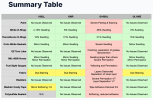
The summary chart at the end is pretty ugly:
1785156976440.png

So again, when you say "All the issues I've seen," have you seen all that?
 
George really needs to respond to Luvara's report, preferably by replicating his tests and either confirming or contradicting the results. George's frequent comments about "aging" materials that have already deteriorated are not supported, as Luvara was using new o-rings, gaskets, hoses, sealant, etc., in his tests.
 
George really needs to respond to Luvara's report, preferably by replicating his tests and either confirming or contradicting the results. George's frequent comments about "aging" materials that have already deteriorated are not supported, as Luvara was using new o-rings, gaskets, hoses, sealant, etc., in his tests.
I agree. I spent about 45 mins talking with George on the phone a while back about the ASTM spec he should go after, and the materials compatibility testing. Tried to convince him he needs to address the issues that Luvara identifies with a full summary report of independent testing of his fuel. There is enough skepticism at this point that he is fighting a loosing battle unless he addresses it.

What I don’t get is that G100UL went through the FAA compatibility testing and passed. I am not sure about the difference in testing between that and Luvara testing or test setups.
 
Last edited:
FAA testing was probably bench top controlled environment, not real world use test.
 
With his refusal to address the concerns that have been identified, he's pizzing off potential customers (like me), too, and he needs those, too.
With news they're going to seek an ASTM, does that make you feel any better?
 
Which is why diesel cycle was the obvious choice for piston-power ICEs -- everyone from the trainers to the bizjets can burn some flavor of kerosene. If we're talking about Cape Air 402s in Part 121 service, then there has been more than enough time to plan for and execute capital upgrades (and they have, to Tecnam P2012s, others to PT6-powered ships like Pilatus PC-12s and Grand Caravans). If we're talking aout Joe and his pretty yellow cub, well, sorry for the inconvenience, Joe, but you're gonna have to carry mogas out to the field -- you really don't burn all that much anyway.
Don’t the cape air P2012s have lycoming teo540s which require 100ll?
 
I agree. I spent about 45 mins talking with George on the phone a while back about the ASTM spec he should go after, and the materials compatibility testing. Tried to convince him he needs to address the issues that Luvara identifies with a full summary report of independent testing of his fuel. There is enough skepticism at this point that he is fighting a loosing battle unless he addresses it.

What I don’t get is that G100UL went through the FAA compatibility testing and passed. I am not sure about the difference in testing between that and Luvara testing or test setups.

From what I had read previously, I was left with impression GAMI did minimal material testing. e.g. The material testing was mostly along the lines of see: we have had no issues in the Cirrus.
The FAA's focus was mostly on the engine itself, the whole fuel system seemed like an afterthought.

Tim
 
An ASTM spec, by itself, doesn't do anything. It simply defines characteristics that a fuel (or paint stripper, or anything else) must meet, but it doesn't make it allowable for any particular use. Then the aircraft manufacturer / engine manufacturer / FAA has to update their guidance allowing the use of a fuel meeting ASTM spec #xxxx.

None of the current UL fuels meet the current ASTM spec for avgas, which is why they all have to go the STC route.
 
None of the current UL fuels meet the current ASTM spec for avgas, which is why they all have to go the STC route.
I seem to recall that none of them meet the ASTM for 100LL because the ASTM specifies the presence of lead, which of course the unleaded fuels don't have. I recall George Braly saying that G100UL otherwise met the entire ASTM.
 
I recall George Braly saying that G100UL otherwise met the entire ASTM.
I believe that is incorrect also. G100UL fails on density for just one example. The ATSM specification for 100LL was developed after the fuel was a standard. As such it includes many specifications/aspects that could never be met; basically any know metric at the time they used. e.g. It goes as far as stating the range of TEL in the fuel, energy density, mass density, octane, some compressibility metrics... Some of the odd ones (to me) I recall being posted but never had a way to check, was the ATSM included specific heat (how quickly it absorbs heat) and how quicly the flame propigation speed was on the fuel and the vapor front.

George had some previous bad experiences with the ATSM process. As such he has tried to stay away from it.

There are two separate approvals needed for any fuel to win in the current market.
1. FAA/Regulatory
2. ATSM

What ATSM provides or not technically is not material. A number of FBOs have stated they need an ATSM fuel to meet insurance requirements. Some have called BS on this, others have state no, this is actually in the insurance contracts.
Therefore, at this point, ATSM is effectively a market requirement. And this is likely why George has changed his mind.

The regulatory should be obvious.

Tim
 
I recall George Braly saying that G100UL otherwise met the entire ASTM.
I believe that is incorrect also. G100UL fails on density for just one example. The ATSM specification for 100LL was developed after the fuel was a standard. As such it includes many specifications/aspects that could never be met;
I recall hearing George saying that G100UL met all "relevant" ASTM specs. Obviously, it doesn't meet the lead requirement, nor does it meet specs that were tailored around the existing 100ll product, but have no ohter bearing on the fuel.
 
Quoted for emphasis.

Every time you hear about a needless aviation regulation, imagine what might happen if the same came from the "Federal Automobile Administration". Our parking lots would look like Havana in the 90's -- which is to say America in the 50's.
Yeah, but an engine shutting down, or even coming apart, in a land yacht is generally survivable.
 
Is there an aromatic compound limit in the ASTM spec? Or a regulatory limit for aromatics? I’m talking benzene, xylenes, toluene, and ethylbenzene.
 
Last edited:
Is there an aromatic compound limit in the ASTM spec? Or a regulatory limit for aromatics? I’m talking benzene, xylenes, toluene, and ethylbenzene.
Here's a link to the spec.
ASTM Spec
There's nothing about specific aromatic content of the base stock fuel. The only mention of aromatics I could find is what's below

6.2.1.1 If mutually agreed upon by the fuel producer and additive vendor, tetraethyl lead antiknock mixture may be diluted with 20 mass percent of a mixed aromatic solvent having a minimum flash point of 60 °C according to Test Methods D93 when the product is to be handled in cold climates. The TEL content of the dilute product is reduced to 49 mass percent, so that the amount of antiknock additive must be adjusted to achieve the necessary lead level. The dilute product still delivers two bromine atoms per atom of lead.

There does appear to be a significant difference in the aromatic content of the base stock fuel. I can't find the reference right now, but I recall a thread that mentioned between single digit to over 30% aromatic content based on time of year, source refinery and other factors.

Here's what AI says, but not very well referenced

"Standard product analyses often list baseline total aromatics around 16%, but field sampling of commercial batches at fixed-base operators (FBOs) frequently reveals higher concentrations up to 33%"
 
An ASTM spec isn't something a new fuel has to meet up front; the spec will be developed around a fuel that works and then used as a manufacturing control and testing standards to ensure consistency regardless of who manufactures it.
 
An ASTM spec isn't something a new fuel has to meet up front; the spec will be developed around a fuel that works and then used as a manufacturing control and testing standards to ensure consistency regardless of who manufactures it.
:yeahthat:

An ASTM spec could be written for G100UL that requires the fuel to soften paint and destroy o-rings, and it would simply mean all fuels to that ASTM have to do the same destructive things. An ASTM spec does not itself make a fuel acceptable for use.
 
which is why the 100LL ATSM is moot in this discussion. It's not a show stopper at all. UL100e already has an ATSM (D8631-25), this is all yesterday's news.

I appreciate GAMI's effort. But the STC path is a dead-end, he knows it. Perhaps it's ego; I'm more charitable and think it's probably money (the EAGLE path is meant to be prohibitive, in order to bias for industry capital-rich players). In any event, absent the EAGLE blessing, his brew ain't going anywhere, paint thinner accusations or not.

Breathe into a brown paper bag, and learn to spell it: U-L-100-E. .....That's E for Everyone. That's E for embrace the new mag timing if you can't make power on 91/96 octane spec. that's E for....
1785184404948.png
:biggrin:
 
Yeah, but an engine shutting down, or even coming apart, in a land yacht is generally survivable.
According to the 2025 ASI McSpadden Report, fully 85% of non-commercial fixed wing accidents involve no fatalities -- I say again -- no fatalities. It will take additional time I don't have at the moment to filter out loss of power from other causes, but at first glance, even a loss of power in flight is hardly a death sentence.
 
According to the 2025 ASF McSpadden Report, fully 85% of non-commercial fixed wing accidents involve no fatalities -- I say again -- no fatalities. It will take additional time I don't have at the moment to filter out loss of power from other causes, but at first glance, even a loss of power in flight is hardly a death sentence.

True, but I can't help being struck by the irony of it being the McSpadden Report.....
 
An ASTM spec isn't something a new fuel has to meet up front; the spec will be developed around a fuel that works and then used as a manufacturing control and testing standards to ensure consistency regardless of who manufactures it.
Ding….ding….ding…. We have a winner!
 
Here's a link to the spec.
ASTM Spec
There's nothing about specific aromatic content of the base stock fuel. The only mention of aromatics I could find is what's below

6.2.1.1 If mutually agreed upon by the fuel producer and additive vendor, tetraethyl lead antiknock mixture may be diluted with 20 mass percent of a mixed aromatic solvent having a minimum flash point of 60 °C according to Test Methods D93 when the product is to be handled in cold climates. The TEL content of the dilute product is reduced to 49 mass percent, so that the amount of antiknock additive must be adjusted to achieve the necessary lead level. The dilute product still delivers two bromine atoms per atom of lead.

There does appear to be a significant difference in the aromatic content of the base stock fuel. I can't find the reference right now, but I recall a thread that mentioned between single digit to over 30% aromatic content based on time of year, source refinery and other factors.

Here's what AI says, but not very well referenced

"Standard product analyses often list baseline total aromatics around 16%, but field sampling of commercial batches at fixed-base operators (FBOs) frequently reveals higher concentrations up to 33%"

Thanks. I wondered if there was a paper/administrative limitation that prevented increasing some of the aromatic compounds in a fuel to achieve the Octane Number rating. Softening elastomers I get.
 
Thanks. I wondered if there was a paper/administrative limitation that prevented increasing some of the aromatic compounds in a fuel to achieve the Octane Number rating. Softening elastomers I get.
If it's not in the 100LL spec it's because it's wasn't anticipated that anybody would ever need to, because TEL works so well. But there's nothing to prevent the writers of a new spec to add something like "fuel meeting this specification shall not cause degradation of [list of materials]". Which is good, if it prevents paint stripper from being sold as aviation fuel... but OTOH a spec can be written with unnecessary requirements that freeze out a competing product in favor of another, if the maker of the latter is buddy-buddy with the spec writer.
 
With news they're going to seek an ASTM, does that make you feel any better?
As others have already explained: Not really. He needs to address the concerns that have been raised about materials compatibility instead of ignoring them. The fuel needs to not be a paint stripper / rubber destroyer first, and then get the ASTM. Defining a spec for a fuel with side effects that people are concerned about does nothing to address the side effect concerns.
 
ASTM sets standards not "specs." They are generally consensus standards meaning they will come out of a committee. More importantly, they often are created to codify and provide uniformity to existing or nascent materials and testing methods. That's why of course the existing 100LL standard has lead in it and why there's a range of allowable constituents, given the need for all the manufacturers of the product to be able to fit within the umbrella of the standard even though there are different processing plants and feedstocks involved. Test method standards, in addition to garnering committee and voting member approval, are often subjected to round-robin laboratory testing and reporting to insure repeatability and usability of the standard.

As another example, MOSAIC principally consists of a set of ASTM standards agreed upon by the committee which define the requirements for an aircraft to show acceptability by testing to the standards, and thereby become MOSAIC eligible.
 
Back
Top