When do spark plugs get changed?

AggieMike88

Touchdown! Greaser!
Joined
Jan 13, 2010
Messages
20,803
Location
Denton, TX
Display Name
The original "I don't know it all" of aviation.
Home Airfield
KDTO (Denton Enterprise)
Never thought to ask this question until today...

When are spark plugs changed on an aviation engine? Is it a tach time item? Annual item, or an IRAN item?

Are they changed as a set or individually?
 
They are normally changed as a set when they are worn out using a wear gauge. Some owners is a set number of hours. Individual plugs are replaced when they go bad. Plugs last different intervals in different engines.
 
Usually the a an p will look at all plugs during the annual, you can read the plug condition to tell you much about how that cylinder is working. Then clean them as needed, carefully with the abrasive, or just solvent, and test them by firing under air pressure, before reinstalling. You may find a plug that the electrodes are worn out, but plugs will go for hundreds of hours before wearing out.
Now if you came in with any problems running , it may be traceble to a particular cylinder or plug, so may need to replace that one. I have never heard of any tbo in hours or calendar listed for a plug. I have had platinum fine wire ones last 1000 hours.
Now if the engine was running fine,you can service and continue to use the plugs, good idea to rotate top to bottom etc.
Or, if the engine was running fine, but you have Champion plugs, and you are easily marketed to, you may buy a whole new set of other brand plugs to install. By the way fine wires cost twice as much and last twice as long esp for turbo engines up high.
 
Last edited:
Never thought to ask this question until today...

When are spark plugs changed on an aviation engine? Is it a tach time item? Annual item, or an IRAN item?

Are they changed as a set or individually?

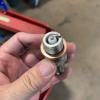
I run only massive electrodes and use an erosion gauge to judge that individually. Cheap to buy and keep in the toolbox:

12-00791.jpg
 
Agree with what others said above. Also check for physical damage and measure the resistance tip to electrode. There are lots on online video demonstrating how to do this and normal resistance ranges.
 
Mike Busch recommends "on condition" replacement.

https://www.aopa.org/news-and-media/all-news/2018/july/pilot/savvy-fire-in-the-hole

Apart from replacement, there's also cleaning, gapping, and rotation. Those things, according to that article, are traditionally done based on time (100 hour), but he would do that on condition as well, using a lean-of-peak mag check while in flight. (Maybe he's thinking of a plane that flies a lot more than 100 hours per year; he didn't mention that the plugs come out in an annual inspection, so they might as well be cleaned and gapped then.)


He has a video also, kinda long, so 1.5X playback speed might be good:

 
Last edited:
I'm replacing all of mine now, to get a baseline. I have a 182H (1965) that I bought in the spring. I recently came in with some rough running issues, particularly on one mag that I couldn't clear @ run-up, thought might be fouled plug. A/P dug into it and evidently I have one mag with loose capacitor, and one coil was close to spec. Both mags were just overhauled at my annual (a different A/P) only 18 hours ago. Also my wiring harness is clearly very old with more than one frayed spots. My spark plugs were clearly a mix of brands, age, and condition. Decided to replace my wiring harness, and also replace all plugs to have a good base line starting point (while the old plugs were already all out). Did I have to replace them all, well no not really. but in my case I felt like it would be a good idea given "fresh mags", and new wiring harness.
 
I clean my plugs using a dental pick or similar to pick pout the lead balls but would never use an abrasive. Fine wire plugs are the only way to go and cost less in several ways on a per hour basis. First you never need to waste time re-gapping as the gap will barely increase over the life of the plug which is essentially until TBO and time must have some value. Second some dyno tests say fines increse BHP by 3% which should equal a 3% reduction in fuel consumption at the same power output. Do the math and the fines come out free compared to massives. If your fuel costs $60/hour in 2000 hours you will have saved $3600.
 
If you are running massives, Go-NoGo erosion gauge hole is 0.260" in diameter. If it fits over the electrodes when properly gapped the plugs are beyond acceptable wear.

Get a gapping tool too.
 
I clean my plugs using a dental pick or similar to pick pout the lead balls but would never use an abrasive. Fine wire plugs are the only way to go and cost less in several ways on a per hour basis. First you never need to waste time re-gapping as the gap will barely increase over the life of the plug which is essentially until TBO and time must have some value. Second some dyno tests say fines increse BHP by 3% which should equal a 3% reduction in fuel consumption at the same power output. Do the math and the fines come out free compared to massives. If your fuel costs $60/hour in 2000 hours you will have saved $3600.
If you need to rationalize using fine wire plugs as a gas saving method you're delusional. If you have plug fouling issues with massive plugs, then fine wires would help. You will spend three to four times the cost of massive plugs. Drop one fine wire plug and your "savings" will take many many hours before you ever break even. You will never notice a 3% increase in power even if there is one of which I am skeptical. Abrasives are fine with massive plugs as long as you don't go crazy and are meticulous about ensuring the plugs are clean of contaminants before installing. I, too, would avoid abrasive blasting fine wires.
 
Not having to re-gap fines pays for the additional cost since I am a very highly priced, brilliant engineer. I did not do the dyno test but if you can get more power by changing plugs then efficiency must rise. I had many boxes serviceable massives i threw away. I guess being delusional is a sign of my high intelligence since by placing a pad under my engine when removing and installing plugs prevents breakage. I have never broken a plug in almost 70 years of cleaning.
 
Not having to re-gap fines pays for the additional cost since I am a very highly priced, brilliant engineer. I did not do the dyno test but if you can get more power by changing plugs then efficiency must rise. I had many boxes serviceable massives i threw away. I guess being delusional is a sign of my high intelligence since by placing a pad under my engine when removing and installing plugs prevents breakage. I have never broken a plug in almost 70 years of cleaning.

Well, if you started your career removing and installing plugs at the age of 12, you'd be "almost" 82 years old now, so who's going to argue with that. :p

And the time savings not having to re-gap any plugs since you installed those first fine-wires in 1949 must surely have added up, I will agree. :rolleyes:
 
I recently talked to my mechanic about this and he said they just replace them on an as-needed basis when they are damaged/worn out.
 
I've been going through my engine logs in prep for swapping the engine out.
Embry-Riddle owned the plane for the first 5,000 hours.
They put in new plugs at overhaul and then every 350 hours.
They sold the plane with roughly 1,000 hours SMOH on the engine.
The plane went through at least one owner before it got to me. They didn't change the plugs.
After flying about 130 hours, I changed the plugs from Massive to Fine Wire at 850 hours. I don't remember there being any huge problem, but something must have motivated me to pony up for the fine wires.
The fine wires have been in there for 300 hours and will probably be moving to the new engine.
 
I was lucky to have had fine wires in my first two planes when I purchased them - cleaned and tested them at annual. The latest plane uses automotive plugs, so cheap even needing 18 of them I just replace with new every annual. < $75, it's just not worth the time to mess with reusing them at that price.
 
My plugs last about 125 hours until I have to clean and re gap them.
I have 2 sets and I am approaching 500 hours on both sets.
Still check out good so far. I swap them about twice a year.
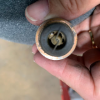
Fun, ok not really! Notice the pile of lead I picked out. Glass top makes it possible and helps to be able to tap the lead out on the glass. This was after light bead blasting.
e0859849-eb8f-4616-97c5-1785bd84268a.jpg
 
Last edited:
The latest plane uses automotive plugs, so cheap even needing 18 of them I just replace with new every annual. < $75, it's just not worth the time to mess with reusing them at that price.

I have an auto conversion (Corvair) that uses Denso iridium plugs. I was changing them every year because, as you noted, they are inexpensive in airplane terms. A couple of years ago I went to changing them every other year so it got a new set this month as part of the condition inspection. Old ones still looked great ...
 
Champion has a very good technical white paper on plugs. Source of all knowledge you seek.

But otherwise, clean and gap every 50-100 hours, or at annual. Toss when fail the Champion gage or when obviously footballed. Rotation delays the football. Lifetime is 300-500 hours on massives.
 
asked my IA once, who loves replacing things, he just shrugged and said probably tbo / overhaul
 
changing one or two plugs of a set that are of the same age seems foolish. If one or two are worn out, the rest are soon to follow. Replace them in sets. I have a new set ready to go in at annual, old ones are creeping up on 500 hours, last year the electrode was starting to get foot ball shaped.
 
There was 1110 hours on the bottom plugs which are fine wire and the center electrode was pretty worn. I decided to replace the four bottom fine wire plugs with the Tempest UREM38S at $145 each.
1761480950487.png1761480968164.png
 
Old school here I guess?
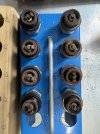
This is my latest set of plugs that came out of my engine a month or so ago. 123 hours on them since last cleaning. Total about 450 hours. Right about 125 hours the mag check tells me that the plugs need cleaning and regaping.


IMG_5933.jpegYou can see some of the lead down in there. Still enjoy doing it, lucky to fly.
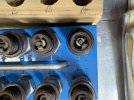
I will see if they are still serviceable after a course glass bead blasting and then I'll check the resistance and go from there. Might have one or two go through the gauge this time?

IMG_5934.jpeg
 
Last edited:
Old school here I guess?
This is my latest set of plugs that came out of my engine a month or so ago. 123 hours on them since last cleaning. Total about 450 hours. Right about 125 hours the mag check tells me that the plugs need cleaning and regaping.


You can see some of the lead down in there. Still enjoy doing it, lucky to fly.
I will see if they are still serviceable after a course glass bead blasting and then I'll check the resistance and go from there. Might have one or two go through the gauge this time?
Not bad for their TT. Several are fairly footballed, as expected for their time, and may or may not pass a visual "it's time" or the Champion gauge. Generally 500 hours seems to be the point in my experience where it's no longer worth keeping them going, but that number has ranged from as little as 300 to as much as 650 hours. To be fair, I change them in sets, not individually.
 
I also change them in sets, except one of those must have been changed out since it’s still mostly round from looking at my pictures. Edit Maybe not.
I haven’t cleaned them yet so I haven’t looked real close yet.
I don't like to clean them too soon before I swap them in. Because they will rust sitting around the hangar during some parts of the year.
Last couple set's I have been keeping them in a sealed container with damp rid to keep them "fresh" after cleaning and inspection.
 
Last edited:
Got an O-540 in annual right now. The mechanic called, the spark plugs pass, but barely. OK on resistance checks, but the metal on the massive are at minimum. Replace 'em. I checked the books, they have 10yrs and over 1000hrs on them. We did 120hrs last season.
 
Back
Top