Vietnam Airlines VN34, WTH?

To your second question, of course it wouldn't accelerate as fast but that isn't the same as decelerate. They'd have certainly felt it. Planes have crashed taking off with frozen brakes before, some may have been able to get airborne and not made the 6 o'clock news. Once the rubber melts off, it's just skidding on rims.

Hydraulics can malfunction causing this by pressure getting trapped in the line, like happened to my van last year. Something like that is probably going to be the smoking gun.
Well, that was what I was wondering -- just how much friction against the runway can the brakes/tires create? Would that be enough to overcome engine thrust and reduce the ground speed, or would it just cause less acceleration. I know that's not tested may not have ever happened -- which would make it just an academic question.

I didn't mean to suggest anything about what the actual cause was -- just asking that out of curiosity.

Regarding hydraulics, I think the 787-9 brakes are electric, and electric stuff never malfunctions, right?
 
Aren't you the one who posted how unqualified some Asian crews are?
Yep.
If someone had their feet up on the pedals, which in my experience flying a Turbo Commander I was taught to do to make use of the hydraulic steering through the toe brakes, if the wind pushed the rudder, the pedal would come back on one side and cause me to unintentionally apply brake due the geometry of my foot.
That’s a twin commander. Different pedals. Look at the picture I posted.
It didn't take long to figure it out, though, and from then on I only used one foot at a time on the pedals. I never could taxi it the way the checkout pilot advised with both feet up on the rudder pedals.
Taxiing a Boeing doesn’t require rudder input. If the brakes are used the feet go up and toe brakes engaged. Doesn’t take much pressure at taxi speeds.

On the TO roll there is some right/left steering (about 6 degrees give or take) through the pedals. The emphasis is heels on floor.
 
Regarding hydraulics, I think the 787-9 brakes are electric, and electric stuff never malfunctions, right?
No Shlitz!? I didn't know that and never would have guessed. I bet that system is the focus of attention now.
 
No Shlitz!? I didn't know that and never would have guessed. I bet that system is the focus of attention now.
Airbus uses electric brakes. So did Gulfstream. The Gulfstream brakes were crap, but the Airbus brakes are seamless.

Electric brakes have been used extensively for decades.

The 787 uses a pure electric system versus a fly by wire type system of Airbus.

Not sure how you guys are determining electric would be the problem.
 
Last edited:
Not sure how you guys are determining electric would be the problem.

Are the pilots in direct command of the electric brakes or do brake requests go through a computer to decide what braking should take place?
 
Airbus uses electric brakes. So did Gulfstream.

Electric brakes have been used extensively for decades.

Not sure how you guys are determining electric would be the problem.
Nobody determining anything "would" be the problem. Anybody here can only conjecture what "could" be the problem and is appealing for information to rule it out. In my case, foot geometry is something I experienced, maybe that causes someone to think about it who hadn't before and might make them a better pilot. On the other hand, I'm being schooled about electric brakes, which is all new to me, so I'm better off too. It's a good thing.
 
Are the pilots in direct command of the electric brakes or do brake requests go through a computer to decide what braking should take place?

Airbus uses fly by wire, so a brake computer gets its input from the brake actuation in the cockpit and sends the signal to the brake.

My understanding is the 787 uses a pure electric system, no hydraulics. But the “controls” would be similar in nature to the Airbus (fly by wire)
 
Airbus uses fly by wire, so a brake computer gets its input from the brake actuation in the cockpit and sends the signal to the brake.

My understanding is the 787 uses a pure electric system, no hydraulics. But the “controls” would be similar in nature to the Airbus (fly by wire)

Ok, so there’s a chance, which I’d consider very small, but a chance that the computer could have added brakes during the takeoff roll.

EDIT: Or a chance that faulty wiring, faulty sensors, etc. could have commanded the computer to brake during the roll. Again probably very small, but then again 747 belly tank.

Without going back and digging through manuals, most brake systems are fail safe with back up brake configurations.
 
Last edited:
It was human factor. Captain had both brake pedals depressed during takeoff.
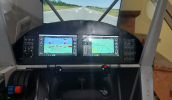
My new EAA chapter has a flight simulator built into a Bearhawk LSA fuselage that we set up for kids to run. One eight-year-old had a habit of standing on the brake pedals when she was trying to take off. We were able to train her not to do that. Maybe that Captain should come to her for training....
1790617402895.png
Ron Wanttaja
 
My new EAA chapter has a flight simulator built into a Bearhawk LSA fuselage that we set up for kids to run. One eight-year-old had a habit of standing on the brake pedals when she was trying to take off. We were able to train her not to do that. Maybe that Captain should come to her for training....
View attachment 155370
Ron Wanttaja
... or she should just replace that Captain.
 
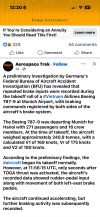
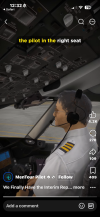
Petter says both pilots were shown by recorded data to be on the brakes, and a mechanical fault is quite unlikely.


I could be misinterpreting the data, but I don’t read it as being left and right seats, but instead left and right inboard and outboard brake controllers, all actuated from the left seat (right seat rudder is shown, but not right seat brake data).

Interestingly, it also correlates fairly strongly with the left seat rudder pressure - left rudder increases, left brake increases, right brake increases with right rudder, and vice versa.

Edit: I see on a subsequent page where it indicates right brake pedal position, but it is almost exactly the same values as the left. I find it hard to believe that both pilots were applying the same amount of brake pressure. It’s more likely that the pedals are synchronous.
 
Last edited:
Does this mean both brakes, on one side?
Or both pilots?
 

Attachments

  • IMG_7456.png
    IMG_7456.png
    616.2 KB · Views: 15
Does this mean both brakes, on one side?
Or both pilots?
I have no idea what data "Aerospace Trek" has available, but according to the German Federal Bureau of Aircraft Accident Investigation interim report linked a few posts upstream, inputs from both pedals at the left pilot station were recorded.

Nauga,
slightly depressed
 
Strange that Petter would get it wrong then:
 

Attachments

  • IMG_7457.png
    IMG_7457.png
    1.5 MB · Views: 8
  • IMG_7458.png
    IMG_7458.png
    2 MB · Views: 8
  • IMG_7459.png
    IMG_7459.png
    740.8 KB · Views: 8
  • IMG_7460.png
    IMG_7460.png
    719.1 KB · Views: 8
Back
Top