Vg for Initial Climb Out

TCABM

Final Approach
Joined
Apr 23, 2013
Messages
8,989
Display Name
3G
Did some searching and didn’t find anything recent on this topic. Did my FR yesterday with a new to me CFI that was broadly excellent and tailored most of the FR to the things I needed work on.

One thing we discussed in ground was doing the initial climb out at Vg. Now, in the 172M, Vg is only a couple knots above Vx and about twice that below Vy. Theory was if the engine crapped out and you’re already trimmed for Vg, it’s one less configuration change to worry about.

We stepped to the plane and briefed /executed a Vg climb out. Outside of a different sight picture and giving up some altitude per minute, it was a nothing burger and not something I had considered in the past.

Having thought about it, I see it as another tool in the toolbox, but I’m curious how many of you have considered or perform a Vg climb out.

The second question I have is what are the downfalls other than climb rate?
Never thought of doing that before. Being at Vg gives you more glide distance, but if having been climbing at Vx, you would have started out higher when the engine crapped out. Might be a push. For the second question, wouldn’t climb angle, not rate, be the issue here?
 
I'd prefer to know my Vg pitch angle for the plane I'm flying so I can push the nose down immediately instead of letting trim try to find an eventual trimmed equilibrium.

Isn't the spread under Vy in a 172 we're discussing like 4 kts or so? been a minute since I've flown one :)
 
Did you test out the theory? Go to whatever altitude you use for practice maneuvers. Establish a straight ahead Vg trimmed climb. To the extent you have you touch the stick at all, lateral only. Bring power to idle rapidly (but smoothly).
 
I'd prefer to know my Vg pitch angle for the plane I'm flying so I can push the nose down immediately instead of letting trim try to find an eventual trimmed equilibrium.
Fortunately, normal level cruise pitch will bring you close.

I learned that years ago while giving a 172 checkout to a retired airline pilot. I pulled the power. He looked out the window, pitched to level cruise while turning toward a landing spot. Pretty much at best glide and heading there within 6 seconds.

I don't know if it will work in every single, and I haven't tried it in all of the 30 or so types I've flown, but it has in all the ones I've tried it in.
 
Last edited:
In the November 2025 issue of AOPA Pilot, Catherine Cavagnaro has a great article on best-glide airspeeds and the associated minimum-sink airspeed. The math is eye-opening. She discusses that best-glide focuses on distance and is there to get you to a better landing spot if you're over unsuitable terrain. In contrast, minimum-sink keeps you in the air longest, so it gives you time to prepare and/or troubleshoot depending on how much altitude you have. The take-home lesson, which I find compelling, is that if we're over or near a suitable airfield or landing site with landing assured, it may actually be better to pitch to minimum-sink airspeed rather than best-glide if we want time to troubleshoot or otherwise prepare for the landing.

Considering OP's scenario, I think the salient point is that Vg gives us the optimal horizontal glide distance for a given altitude, while Vy lets us gain altitude at the fastest rate. It follows that if we're trying to maximize glide distance, it is better to climb out at Vy and then authoritatively pitch to Vg and trim out the pressures if the engine is lost. You would start at a higher altitude and have a correspondingly longer glide distance available than you would taking off and climbing at Vg.

Climbing out at Vg seems to give away altitude for likely no discernable advantage, especially when we consider startle-factor delay. I don't buy argument of one less configuration change. With the engine stopped, we would still need to positively control airspeed and I don't see relying on trim to get us there as the way to do it.
 
Did you test out the theory? Go to whatever altitude you use for practice maneuvers. Establish a straight ahead Vg trimmed climb. To the extent you have you touch the stick at all, lateral only. Bring power to idle rapidly (but smoothly).

No, that’ll be the next flight. I’m also going to run the numbers to see how much of a delta we’re talking about in altitude and the time it takes to get there.
 
In the November 2025 issue of AOPA Pilot, Catherine Cavagnaro has a great article on best-glide airspeeds and the associated minimum-sink airspeed. The math is eye-opening. She discusses that best-glide focuses on distance and is there to get you to a better landing spot if you're over unsuitable terrain. In contrast, minimum-sink keeps you in the air longest, so it gives you time to prepare and/or troubleshoot depending on how much altitude you have. The take-home lesson, which I find compelling, is that if we're over or near a suitable airfield or landing site with landing assured, it may actually be better to pitch to minimum-sink airspeed rather than best-glide if we want time to troubleshoot or otherwise prepare for the landing.
All of that is correct in theory, but not very applicable in practice. Try flying your plane at min sink. Trust me, the loss of control authority doesn't make up for the minimal difference in sink rate. In my Archer, the difference is about 100fpm and it's barely controllable.
The polar in the article does not reference a specific airframe, but it's for sure not representative of a basic bug smasher. Way too much difference between best glide and min sink
So much focus on cardinal speeds and so little focus on what to do when you have an engine out. +/- 10 Kts ain't going to be the difference between a safe landing or not.
Do you have a landing field in sight? Can you reach it? If not, what are you going to do? Having a trimmed and stable plane is a critical part of it, but looking outside and having a plan is way more important than a precise speed the ASI.
 
Having a trimmed and stable plane is a critical part of it, but looking outside and having a plan is way more important than a precise speed the ASI.
Sure, and completely agree that from a practical standpoint we're going to be lucky to maintain Vg and get it to a reasonable landing site in most instances. I don't think the author would disagree with that. It was more just a "all else being equal" thing, I suspect.

I fly a hershey-bar Cherokee 180C, so any difference in my glide ratio is going to be between "safe" and "slightly heavier model of safe". Next time I go fly, I'll see if I can figure out what its minimum sink speed is.
 
So much focus on cardinal speeds and so little focus on what to do when you have an engine out. +/- 10 Kts ain't going to be the difference between a safe landing or not.
That's pretty much standard for engine-out discussions. We talk about such things as pre-trimming, zoom climbs, stopping the prop, best glide vs min sink, adjustment for wind direction, and, of course, adjusting for weight at the precise time of engine failure. Great academic discussions, but little practical application
 
Did some searching and didn’t find anything recent on this topic. Did my FR yesterday with a new to me CFI that was broadly excellent and tailored most of the FR to the things I needed work on.

One thing we discussed in ground was doing the initial climb out at Vg. Now, in the 172M, Vg is only a couple knots above Vx and about twice that below Vy. Theory was if the engine crapped out and you’re already trimmed for Vg, it’s one less configuration change to worry about.

We stepped to the plane and briefed /executed a Vg climb out. Outside of a different sight picture and giving up some altitude per minute, it was a nothing burger and not something I had considered in the past.

Having thought about it, I see it as another tool in the toolbox, but I’m curious how many of you have considered or perform a Vg climb out.

The second question I have is what are the downfalls other than climb rate?

It’s unlikely that the trim setting with power is the same as the one needed with power off. In nearly all cases, maintaining the same airspeed with power will require more nose-down trim. It’s also worth remembering that all these speeds vary with weight - so unless you’ve calculated Vg for your specific weight, being off by a few knots won’t make much difference. Math is interesting to do on the ground, but in a real emergency, it’s not the math that saves you - it’s keeping a cool head and avoiding overreactions.

Something an old instructor told me years ago has always stuck with me: in most light airplanes, full-nose-up trim brings you close to the best-glide speed (with the engine at idle, of course). I haven’t tested it in every airplane, but in the ones I have, it seems to hold roughly true.
 
….Something an old instructor told me years ago has always stuck with me: in most light airplanes, full-nose-up trim brings you close to the best-glide speed (with the engine at idle, of course).
So having done a simulated engine out trimmed to the Vg bug from 3,500MSL during my flight review, we were pretty close what a normal cruise trim would be. I had more trim dialed in for steep turns than for the sim engine out.

This was at 2300ish lbs, which is pretty much my standard takeoff weight.

As an aside, I had picked a large field off my nose for my target landing area. Once I completed the fuel/mix/throttle/carb heat/attempted restart, I hit nearest on the GTN and found a private strip that a small heading change put me headed towards. It was surprising to both me and my CFI to find that strip, so I changed my mind and headed towards it while also picking a closer alternate. We crossed the threshold at 200’ AGL before going around.

My lesson learned from that was to continue using all available resources in the time given to find a suitable landing spot.
 
Never thought of doing that before. Being at Vg gives you more glide distance, but if having been climbing at Vx, you would have started out higher when the engine crapped out. Might be a push. For the second question, wouldn’t climb angle, not rate, be the issue here?
You'd be highest at Vy actually. Vx just puts you closer to the field.
 
So having done a simulated engine out trimmed to the Vg bug from 3,500MSL during my flight review, we were pretty close what a normal cruise trim would be. I had more trim dialed in for steep turns than for the sim engine out.
While people say that, it's not universally true.

And I'm not sure why I'd trim for Vg anyhow? Am I expecting to lose the engine and be incapacitated at the same time? I'd rather trim for the normal climb not for some speed I might want to fly later on. Retrimming is pretty easy.
 
While people say that, it's not universally true.

And I'm not sure why I'd trim for Vg anyhow? Am I expecting to lose the engine and be incapacitated at the same time? I'd rather trim for the normal climb not for some speed I might want to fly later on. Retrimming is pretty easy.
The other piece is that, while we think in terms of complete engine failure, I understand the stats indicate we are more likely to have a partial where Vg might or might not be the best choice.
 
It's not my plan in an engine out to let go of the yoke and let the trim do to work. Not to mention, the trim for a given speed at full power versus no power isn't the same in any airplane I've ever flown. Climb at Vy.
 
Last edited:
Punch "Nearest" first, then work on the visible choices. This is not to suggest the impossible turn. Departure speed should focus on max altitude as soon as possible, unless you have a 2 mile long runway. I learned at a short runway with the classic tall trees at the end. Max altitude was essential if the engine quit.
 
All of these discussions seem to ignore the insite that Tom Hanks brought to the table in the movie The Miracle on the Hudson. My primary CFI harped on that, "the moment of confusion", right from the first engine out drill we did, although the most time I remember adding was three seconds between engine out, and recovery. His point is valid: If you are climbing at Vx you have little time to be confused! Have a plan prior to pushing the throttle in. If your Vg is lower than Vx, might your zone of confusion put you into a stall very close to the ground?

Altitude is your friend. So is speed!

Thoughts?

-Skip
 
Because at VY you'll have more energy in the bank. You'll have more altitude and airspeed after 5, 10, 30 seconds than at VG or VX. So you'll reduce your exposure window.
 
All of these discussions seem to ignore the insite that Tom Hanks brought to the table in the movie The Miracle on the Hudson. My primary CFI harped on that, "the moment of confusion", right from the first engine out drill we did, although the most time I remember adding was three seconds between engine out, and recovery. His point is valid: If you are climbing at Vx you have little time to be confused! Have a plan prior to pushing the throttle in. If your Vg is lower than Vx, might your zone of confusion put you into a stall very close to the ground?

Altitude is your friend. So is speed!

Thoughts?

-Skip

My view is that if your only viable option after an engine failure is to return to the runway, then you should climb at Vx - that keeps you as close as possible to the field. However, that’s a rare scenario, typically limited to airports in dense urban areas or those surrounded by challenging terrain. In most cases, it’s better to climb at Vy, which gives you the greatest total energy and therefore the widest range of options. That said, the pilot’s reaction to an engine failure probably has a much greater influence on the outcome than whether the climb was at Vx, Vy, or something else.
 
Did some searching and didn’t find anything recent on this topic. Did my FR yesterday with a new to me CFI that was broadly excellent and tailored most of the FR to the things I needed work on.

One thing we discussed in ground was doing the initial climb out at Vg. Now, in the 172M, Vg is only a couple knots above Vx and about twice that below Vy. Theory was if the engine crapped out and you’re already trimmed for Vg, it’s one less configuration change to worry about.
I don't buy that at all. I've been lucky enough to not have an actual engine out, but everything I've ever heard is that the first reaction for most people is to pull. I'd rather not be pulling from Vg to something below Vg, and then having to push the nose down and waste precious altitude.

Also, if you were climbing at Vy instead of Vg, you would already be higher up to start with. Then, that natural pull will be bringing you closer to Vg. Trim, and move on from there.

This is one of those things that some people will spread around because it sounds like a good idea until you actually think about it.

The second question I have is what are the downfalls other than climb rate?
If your engine fails, you'll be lower. If you don't PUSH right away on failure, you'll be well below Vg and you'll need to use precious potential energy (altitude) to get back up to Vg and away from the region of reverse command. Your nose will be higher, making it more difficult to see traffic on climbout. Your cylinder head temperatures will be hotter, affecting engine longevity.

I can't think of many pros to this technique at all, and there are a ton of cons.

Because you'll have more altitude available.

My view is that if your only viable option after an engine failure is to return to the runway, then you should climb at Vx - that keeps you as close as possible to the field.
This greatly depends on a lot of other variables. For example, with a brisk headwind on takeoff and a Vx climb, you may find that after making your 180, you're too high to land on the remaining runway! Every takeoff needs to be evaluated individually, and briefed appropriately.
 
This greatly depends on a lot of other variables. For example, with a brisk headwind on takeoff and a Vx climb, you may find that after making your 180, you're too high to land on the remaining runway! Every takeoff needs to be evaluated individually, and briefed appropriately.
I've posted about this incident before, but the short version
engine failed just after takeoff. Probably 200ft to 300ft up more or less..... power went to basically idle, like it was running on one cylinder. After what seemed like an eternity, it came back.
By the time it came back up I was already pushing the nose down, and it stumbled again after a fraction of a second
Fortunately it was a very long runway for a Cessna 172. Plenty straight ahead. I chopped the power in case it came back online in the flare or touchdown, and landed straight ahead.
Engine never actually died cold & I was able to taxi back to the ramp like nothing happened

After that incident, I decided to generally default to a VX climb until I have some altitude to make alternate landing sites (or until there's no runway or landing space remaining)
That runway is 8,016 ft today. I reckon is was pretty much the same back in the day. It seems to me that if it instead has been on a shorter but still long runway, say 6,000 ft maybe...and I'm climbing VY or even higher speed if I have sloppy technique and the engine died a similar time after takeoff, that I could easily not have runway or airport overrun areas available but still not be high enough for options outside the fence

I know there are risks with Vx, and it's not a perfect solution for every scenario...but that was my preference unless something else made better sense based on location.
Like I said, every takeoff needs to be evaluated individually. If you have a long runway in front of you, Vx will leave the most runway in front of you in the case of an early failure.

However, once you've climbed through the path where a glide back down to the runway is feasible, now you need to evaluate what's off the end of the runway, and with much additional climb, now you're looking at a potential 180 scenario. If you have a long runway in front of you and you climb at Vx but now you need to do a 180, you can have a giant runway right under you and be completely unable to land on it. Even Vy might leave you in the same scenario if there's enough headwind.

There is a LOT to consider: Not only length of runway, but also wind, obstacles, additional runways and their relative placement, other suitable landing areas in the vicinity, your particular aircraft's climb performance at not just Vx and Vy but all speeds and weights... Like I said, it needs to be evaluated on a case by case basis.
 
I would rather be a little fast than slow. It's very likely you will need to maneuver rather than just gliding straight. The best way to die in an engine out situation is to stall, so being trimmed a bit fast strikes me as better. So that's a vote for Vy.
 
This is one of those things that some people will spread around because it sounds like a good idea until you actually think about it.

Yeah, like the "Blue Line Mania" — instead of using a takeoff reference speed for landing it's using a landing speed for takeoff.
 
Did some searching and didn’t find anything recent on this topic. Did my FR yesterday with a new to me CFI that was broadly excellent and tailored most of the FR to the things I needed work on.

One thing we discussed in ground was doing the initial climb out at Vg. Now, in the 172M, Vg is only a couple knots above Vx and about twice that below Vy. Theory was if the engine crapped out and you’re already trimmed for Vg, it’s one less configuration change to worry about.

We stepped to the plane and briefed /executed a Vg climb out. Outside of a different sight picture and giving up some altitude per minute, it was a nothing burger and not something I had considered in the past.

Having thought about it, I see it as another tool in the toolbox, but I’m curious how many of you have considered or perform a Vg climb out.

The second question I have is what are the downfalls other than climb rate?
Sort of agree with climb out around Vg, But your description and numbers for the 172M don't match up. Vg is closer to Vy than Vx.
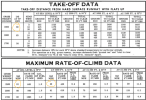
Vx is shown as 68mph
Vy is shown as between 91 and 85 for most elevations.
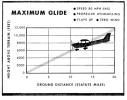
Vg is shown as 80mph.

I find that 80 to 85mph works well at the 2500MSL airport I fly out of for the 1st 1000' feet of climb, that is a good compromise between best rate and best angle it gets you to altitude still relatively close to the airport with a good engine cooling and transition to Vg if needed. After reaching pattern altitude I will switch to a cruise climb using the Vy numbers.

I have flown with pilots that climb out at Vx using the justification that altitude is your friend. This really isn't correct, Airspeed is much friendlier than altitude. If you don't' believe this grab your favorite instructor and warn him about what you are going to try. Take off and climb at Vx, simulate a power failure at 50ft or less. be prepared to add power, because you will likely find that you won't have enough airspeed to stop the descent back to the runway without hitting very hard.
At a Vx climb when you lose power the airplane slows down so quickly that you will be very slow or will have to almost negative G the airplane to lower the nose quick enough to maintain flying speed. Above 50ft is somewhat better but you will still likely get quite slow before you get the nose down enough to maintain Vg.

I also think we tend to overemphasize Vg in emergencies. Most emergencies don't require Vg, but just require maintaining control of the airplane. I like to teach trim for your normal approach. After all an emergency landing shouldn't be much different than any other normal landing.

Brian
CFIIIG/ASEL


1761666290460.png1761666389048.png
 
This thread has generated a number of excellent insights from smart people. Sometimes CFIs can be guilty of overthinking, without thinking-things-through.

One point that I don't recall anyone making is that, in many (if not most) light singles, Vx, Vg, and Vy represent a fairly narrow range of speeds, all of which lie relatively close to L/Dmax on the L/D curve. Therefore, if the engine were to fail at a given height during "initial climb" (which wasn't defined but I assume to be below pattern altitude) there would be virtually zero difference in gliding range regardless of which of those speeds one trimmed the aircraft to maintain. So if one were to climb at Vy, with the airplane trimmed for Vy, the sink rate in an engine-out glide at Vy would be very close to Vg and the airplane would be so close to the ground that any difference in gliding distance would be negligible, assuming that the height at which the engine failed were the same in both cases. As others have pointed-out, Climbing at Vy instead of Vg should result in more air between you and your immediate destination at the moment that the engine failure occurs, which seems to tip the scale against the CFI's recommendation.

Having said that, I suggest that some experimentation in the actual airplane would be worth far more than reading this post.
 
Agree with post above, but the pedantic me has to mention that Vg and L/Dmax are the same thing.
 
After that incident, I decided to generally default to a VX climb until I have some altitude to make alternate landing sites (or until there's no runway or landing space remaining)
That runway is 8,016 ft today. I reckon is was pretty much the same back in the day. It seems to me that if it instead has been on a shorter but still long runway, say 6,000 ft maybe...and I'm climbing VY or even higher speed if I have sloppy technique and the engine died a similar time after takeoff, that I could easily not have runway or airport overrun areas available but still not be high enough for options outside the fence
Hell at 8000' (at reasonable density altitude), I can hit pattern altitude, chop the power and still get down before the end of the runway going straight ahead.
 
Agree with post above, but the pedantic me has to mention that Vg and L/Dmax are the same thing.
Practically speaking, this is correct for the aircraft under consideration. Nonetheless, some other pedant might mention that Vg and L/Dmax are not actually the same thing, but occur at the same point on the L/D curve. They might go on to add that L/D is also applicable to other aircraft performance topics, and if we are unlucky, they will start speaking in math.
 
Where do CFIs get this kind of crap?

At lift off the approximate pitch attitude should allow the aircraft to accelerate to Vy. Page 6-5 of Airplane Flying Handbook. The goal is to gain the most altitude in the shortest period of time.

While an argument could be made to include the Vg as part of the takeoff brief, a climb at Vg would immediately decay to <Vg upon engine failure.
 
Last edited:
Back
Top