Transition to UL Fuel

I'm not aware of anything that actually prohibits the manufacture of leaded avgas in 2030. The supply of TEL is very likely to be the determining factor in the near term.
…
It’s done in a backwards manner. See FAA Reauthorization Act of 2024.

Sec. 770) This section requires (for the purposes of receiving an AIP grant) airports that offered 100-octane low lead aviation gasoline during calendar year 2022 to continue offering such gasoline until the earlier of (1) December 31, 2030; or (2) the date on which an unleaded aviation gasoline is available at the airport that meets certain standards. A person in violation of this provision is subject to civil penalties.

(Sec. 771) This section prohibits the FAA and the EPA from restricting the continued use or availability of 100-octane low lead aviation gasoline in Alaska until the earlier of (1) December 31, 2032; or (2) six months after the FAA finds that an unleaded aviation fuel that meets certain requirements is widely commercially available at airports throughout Alaska. The GAO must conduct an evaluation on transitioning to unleaded aviation fuel in Alaska and submit a report to Congress.

The mandate to require availability is entirely different than Innospec having to keep the factory open though. Since both sections state “the earlier of”,, it’s entirely reasonable to believe some airports may choose (or have chosen for them) to end availability of 100LL effective 1 Jan 2031 in 49 states and two years later in Alaska.
 
There are still radials in commercial service though out the world but in specific markets. For example, Everts Air in AK. And in some cases those radials ops have no modern replacement airframes that can perform the same job. However, the biggest impact will be at the museum level that operate flying aircraft which require 100LL. Talking to a friend in the UK, its a point of concern with those that still operate those type aircraft.
Kenmore Air in and around Washington state run a number of radial de Havilland Beavers and otters. Elsewhere Beavers and Otters are common float planes.
 
There are still radials in commercial service though out the world but in specific markets. For example, Everts Air in AK. And in some cases those radials ops have no modern replacement airframes that can perform the same job. However, the biggest impact will be at the museum level that operate flying aircraft which require 100LL. Talking to a friend in the UK, it’s a point of concern with those that still operate those type aircraft.
Right. WWII aircraft are out of service except boutique usages. Most legacy engines have power charts that allow them to operate on lower octane fuels including 90 octane which was the standard right up to WWII. Pull the boost back and you’re good. You lose a little power, but that doesn’t really matter for museum aircraft which are flown at far lower weights than when in service. Everts is the edge case and they could convert to turbine DC-3’s if the financials work. THE (yes, 1) C-46? Well…
 
Kenmore Air in and around Washington state run a number of radial de Havilland Beavers and otters. Elsewhere Beavers and Otters are common float planes.
Which can run on lower octane. The 985 was certified on 80 octane. The compression ratio on radials and other WWII engines is low. You use boost to adjust for different fuels.
 
Everts is the edge case and they could convert to turbine DC-3’s if the financials work. THE (yes, 1) C-46? Well…
Well in GA that might seem the case, but Everetts 46 and DC6 deliver the majority of critical services and supplies in remote areas along with a number of other providers flying radials. And while you can operate at lower power settings depending on fuel you also lose payload capability which is a big issue especially when flying fuel bladders. Same with the Beavers so its not really a solution same as a turbine conversion. And with 100s of other commercial radial ops in the world that provide similar critical needs it is an issue to those people. Even the museum aircraft will suffer as a lot of the operating expenses are paid through air shows, etc. and if the alternative fuels are double the price then more aircraft will become static displays or worse. It is what it is. Regardless, my bet there will be viable 100LL solution before 2030 in some fashion.
 
The airplane manufacturers need an engine to supply the demand for their airplane. What certified engine more than 300hp would you recommend cirrus install?
Good question. I don't have an answer to that. Cirrus, however, will have to accommodate whatever situation exists after 2030. I hope that the end result is a decent unleaded fuel. Swift 100R might prevail with retarded ignition timing on some engines. The resulting higher EGTs could be a concern. Time will tell. I bet there are some interesting meetings going on at the affected engine and airframe manufacturers.
A diesel-burning 300hp turboprop would be just nifty at this point. Rotax seems to be the big player in the lower horsepower category these days.
Retarded timing imo is not a solution unless theres a massive 100ll buyback and every tank is drained.
 
Delaying ignition by a few degrees won't affect the ability to run 100LL, and probably won't affect power output much. These are slow-turning engines.
 
What keeps manufacturers from developing engines that will run on automotive pump gas, e.g. Rotax?
 
What keeps manufacturers from developing engines that will run on automotive pump gas, e.g. Rotax?
Mostly the fact that the market isn’t big enough to support the development of such engines. In particular, there’s not a big enough market to support developing the10(?) different engine that would be required to replace the majority of the installed Lyc/cont fleet.
 
Funny thing, those engines were developed a long time ago. I've owned four planes that ran on 87 octane unleaded. Higher octane fuel allows more power to be extracted from the same displacement, so that has been the trend for a long time. I think 1976 was the last year for low compression engines in the Cessna fleet.
 
Just out of curiosity, I looked up the (80 octane) Continental O-470R that I had in my C-180. You can still order a new one, but I'd hate to see what the wait time is!
We might be all electric before that one goes out the door.
 
What keeps manufacturers from developing engines that will run on automotive pump gas, e.g. Rotax?

In some cases, it has more to do with the fuel system than the engine. Lycoming O-360s run just fine on ethanol-free pump gas, but low-wing Pipers and Musketeers have problems with vapor lock preventing the fuel pumps from getting fuel to the engine.

Also, there are many variations in pump gas. A "summer blend" sold in Florida, for example, might not work well at altitude.
 
low-wing Pipers and Musketeers have problems with vapor lock preventing the fuel pumps from getting fuel to the engine
Yeah, you'd need to pressurize the tanks or put a submerged fuel pump inside the tank.
 
The PA-28-140, -150, -151, and -235 seem to function fine without modification. Same with all the Bonanzas with E-series engines and IO-470 J and K versions.
I know that Peterson markets an improved fuel pump system for the Archer -181s. Kind of expensive, but good to know that it's available.
 
The PA-28-140, -150, -151, and -235 seem to function fine without modification. Same with all the Bonanzas with E-series engines and IO-470 J and K versions.
I know that Peterson markets an improved fuel pump system for the Archer -181s. Kind of expensive, but good to know that it's available.
Available for 181s and 161s.
 
Higher octane fuel allows more power to be extracted from the same displacement,

I think we need to be clear here for the sake of education. Higher octane doesn’t do that. Higher compression (along with timing advance and AF ratio) are what contribute to power, so a fuel that has more detonation resistance (octane) is necessary vs an engine that has less compression. I’m not saying you didn’t understand that, just saying we need to be clear.
 
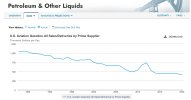
Here is an interesting graph. I believe this in part reflects that to a first order, there are no longer many aircraft in commercial use that require 100LL - they've all gone to Jet-A. That was not the case in 1985 when Navajos and 421s still plied the skies. Basically a greater than 50% decline in daily consumption over 40 years. For comparison, car gasoline is a little under 400,000,000 gallons per day. That's a 800x difference, or alternatively stated, by noon each day about as much car gas has been delivered as is delivered avgas in a year.
IMG_0734.jpeg
 
I think we need to be clear here for the sake of education. Higher octane doesn’t do that. Higher compression (along with timing advance and AF ratio) are what contribute to power, so a fuel that has more detonation resistance (octane) is necessary vs an engine that has less compression. I’m not saying you didn’t understand that, just saying we need to be clear.
You expressed that much more clearly than I did. There are so many misconceptions about fuel octane rating - burns faster, burns slower, has more energy/gallon etc.
I should have been a bit more careful in my wording! Thanks. It's an interesting topic that merits accurate comment.
 
I think we need to be clear here for the sake of education. Higher octane doesn’t do that. Higher compression (along with timing advance and AF ratio) are what contribute to power, so a fuel that has more detonation resistance (octane) is necessary vs an engine that has less compression. I’m not saying you didn’t understand that, just saying we need to be clear.

But higher octane allows the higher compression, timing advance etc.
 
But higher octane allows the higher compression, timing advance etc.

What part of “…so a fuel that has more detonation resistance (octane) is necessary vs an engine that has less compression…” was unclear? Is my writing style that bad?
 

Where you can look up which engines & airframe combinations are allowed to use the auto fuel STC.
 

Where you can look up which engines & airframe combinations are allowed to use the auto fuel STC.
Problem is, that STC was created long ago. Today's gasoline is very different. Doesn't void the STC, but it is a very different landscape today - winter/summer blends, ethanol, no lead, etc.
 

I sat through the presentation at the FAA building at Oshkosh last year. My big takeaway was there were 3 categories of users with different needs and the unleaded coming on the market met the needs of 85% of the market. I guess it’d suck to have a super high compression engine

The link above will take you to spotify and Mike Bush’s interview with the guy who got the unleaded blend through the ASTM process.

Well worth the listen

Follow up discussion that addresses derating the engines and some of the legal issues
 

Follow up discussion that addresses derating the engines and some of the legal issues
George brings up an interesting point in single engine scenario with these fuels raising cht's potentially to limits.

I'll also add that retarded timing generally raises egts. And while not really an issue for naturally aspirated engines. What about the turbo'd engines?
 
George brings up an interesting point in single engine scenario with these fuels raising cht's potentially to limits.

I'll also add that retarded timing generally raises egts. And while not really an issue for naturally aspirated engines. What about the turbo'd engines?
If you listen to the previous podcast. They did a deep dive into what that fuel was capable of. At the end of the testing cycle they ‘gave her the works’ and tried to break it. He asked for 40 inches of manifold pressure. The waste gate was already all the way closed and it maxed out at like 37 and still wouldn’t break.

Far beyond what it was designed to do
That was with g100ul where timing didn't need to be changed.

What I'm saying is with swift 100r and vp100 they're proposing a need for timing changes to improve detonation margins. When you retard the timing you increase egt. And while we don't have to really worry about egt on naturally aspirated engines. Folks with turbo engines do need to be aware of egts. So folks with turbo engines that need to retard timing to with 100r and 100e, theyd need to be even more cognicent of their egt's due to the retarded timing.
They also covered the liability concerns for aircraft and engine manufacturers if they change any of the numbers published in the TCDS’s.
 
When I watched the second video with Busch and Braly, I found the discussion about gaskets and bladder seals to be interesting...

I'm not a chemist, fuel expert, or engine expert, but based on the conversation in the video, should 100LL go away, I would rather deal with replacing old gaskets and fuel bladder/tank seals with ones compatible with G100UL (which, I agree, will likely be a painful and expensive task) rather than using an unleaded fuel that requires engine modifications and/or engine power reduction. Maybe this is just me. I'm not a turbo engine owner (my Dakota has a Lycoming 235hp O-540), so I can't speak to the turbo issues that they mentioned.

I was disappointed that they didn't discuss the paint stripping and/or paint staining issues reported with G100UL. Has Braly/GAMI discussed the paint issue and what can be done by airplane owners to mitigate this issue? I seem to remember Braly saying to wipe up spills when filling the tanks, but I don't remember any discussions about dealing with unexpected fuel leaks removing paint, or paint staining around fuel vents.
Last I heard, they were testing some ceramic paint treatments that seemed to prevent staining, but that was a year ago. I'm disappointed they didn't address it.

I'm also in the camp that I'd rather deal with the paint issues than performance loss. If it makes you feel any better, that parallel valve 540 in your dakota shouldn't have any issue. It's so understressed/underrated in that application it could probably run fine on mogas.
 
If it makes you feel any better, that parallel valve 540 in your dakota shouldn't have any issue. It's so understressed/underrated in that application it could probably run fine on mogas.
Yeah, I count myself lucky that my O-540-J3A5D will likely be OK even with a less performant fuel.

If G100UL didn't have the paint issues, I bet way more aircraft owners would be OK with it. Hopefully Braly and team will put out information to mitigate the paint issue.
 
The FAA seems to be on a path that abandons the original goal of a "drop-in replacement" in favor of two oxygenated fuels that don't meet the antiknock requirements of the entire GA fleet. Their path forward, according to Braly's comments, is to investigate the engine or operating changes that would allow the lower octane fuels' use. Meanwhile, what appears to be a drop-in replacement, G100UL, is relegated to the sidelines. The 100LL replacement effort is in bad need of leadership. Has AOPA given up and become part of the problem?
 
Last I heard, they were testing some ceramic paint treatments that seemed to prevent staining, but that was a year ago. I'm disappointed they didn't address it.

I'm also in the camp that I'd rather deal with the paint issues than performance loss. If it makes you feel any better, that parallel valve 540 in your dakota shouldn't have any issue. It's so understressed/underrated in that application it could probably run fine on mogas.
I thought I heard they or someone put some clear tape around the fill port and it discolored the tape but didnt touch the paint.

Im not thrilled with the prospect with replacing all the seals, hoses, and especially resealing tanks. But I'd much rather be forced to do that once than a timing change.
Scott Perdue had leading edge tape that got discolored...somehow. He explains it in a video...something about doing aerobatics. Anyway, he peeled it off, expecting the paint to be discolored and to try polishing it. When he pulled the tape off, it was brown, but the paint was fine.

Seems like certain pain chemistries are fine and others are susceptible. Braly seems to be able to leave parts submerged in g100UL for months with no ill effects, then others have complete paint failure from being in the same county.
 
Seems like certain pain chemistries are fine and others are susceptible. Braly seems to be able to leave parts submerged in g100UL for months with no ill effects, then others have complete paint failure from being in the same county.
LOL!

It would be great if GAMI would update their information (https://www.g100ul.com/news/g100ul-unleaded-avgas-the-facts/) about the issues many folks are concerned about. Here are three issues I seem to be seeing, but only #1 is super worrisome to me. What am I missing?

1. Gaskets and sealants fail with G100UL. So, what gasket materials and/or age of gaskets are problems? Also, what materials should we use that will behave well with G100UL? From what I've heard Braly talk about, some of these issues are just due to older parts using old material technologies that are wearing out. Maybe G100UL speeds up the failure of older materials, compared to 100LL. If we knew what materials work and what don't work, the scariness of gasket/seal failure can be dealt with.

2. Paint is permanently stained or dissolved by G100UL. What paints are bad, and is there a way that we can protect currently-existing problematic paint? What paints aren't affected by G100UL, so we can use that paint in the future?

3. G100UL is going to be more expensive than 100LL. Yep, it is. We will always complain about the cost of any fuel. That said, it sounds like pricing will add about US$1 per gallon to fuel costs. It's a bummer, but it's not a deal breaker for me, especially if I can get improved engine longevity from using it.

From what I have seen in various videos, I feel confident that G100UL is a fine substitution for 100LL as far as running our engines is concerned. We really just need to know what issues it may cause in our fuel systems. We still have 4 years to prepare for the 100LL phase out, so we can at least start to prepare for a 100UL future. Right?
Viton are good. Buna n, not so much.
 
Back
Top