Training for IFR in non-IFR aircraft

Ed Haywood

Final Approach
Joined
Jul 12, 2020
Messages
7,624
Location
Tampa FL
Display Name
Ed
Home Airfield
FD77
Is it legal to log IFR training time in an aircraft equipped but not certified for IFR flight? What about taking a checkride?

I'm in the mood to spend a few AMU on my Decathlon. I'm going to be doing more XC in the next year or two. I want to make VFR XC more convenient, and be better equipped for possible IMC encounters.

Right now I have an AV-30 as an AHI. I would like to add another AV-30 DG and an Aera 760. The Area can push course lines to the DG to act as an HSI, and waypoint data to the engine monitor for fuel burn calcs. The Area 760 can also load and sequence approaches.

I could also add a cheap used IFR GPS like the Garmin 155XL. uAvionix is coming out with an AV-30 adapter called AV-HSI to display CDI and glide slope from an IFR GPS.

At that point I would have everything needed to fly GPS approaches. However, the Decathlon is not certified for IFR.

I've been talking about getting my IFR rating since I got my PPL 35 years ago. How much progress could I make in my Super D if sufficiently equipped?
 
Last edited:
Is it legal to log IFR training time in an aircraft equipped but not certified for IFR flight?
Yes, if your airplane is equipped per 91.205(d). Owing to the Thierault 2010 legal interpretation, you can even file IFR in a non-IFR-equipped aircraft for the cross country flight that must be flown under IFR per 61.65(d)(2)(ii). You, the pilot, retain the responsibility for remaining in VMC and coordinating with ATC as necessary to not exceed the legal limitations of your aircraft.

What about taking a checkride?
IAW the Instrument Airplane ACS, page 33, the aircraft must meet the requirements of 61.45 and if there is any inoperative equipment, 91.213. But the short answer is "yes".

Right now I have an AV-30 as an AHI. I would like to add another AV-30 DG and an Aera 760. The Area can push course lines to the DG to act as an HSI, and waypoint data to the engine monitor for fuel burn calcs. The Area 760 can also load and sequence approaches.
The Aera, as a portable device, does not count as the aircraft being "equipped" for approaches. You need something in the panel.

Do you have a nav radio at all? ILS capability? If so, you could go without a GPS, though practically speaking, in today's world everyone expects you to have a GPS and you'll constantly be refusing direct clearances if you're not so equipped.

If you do not have ILS capability, you'll want to install a WAAS GPS so that you have vertical guidance capability (this counts as a "precision approach" for the checkride now), or you'll need to install a nav radio. A Garmin 175 is the cheap way to go here and gives you a lot of capability at a reasonable price.

I've been talking about getting my IFR rating since I got my PPL 35 years ago. How much progress could I make in my Super D if sufficiently equipped?
All the way, though I must admit I'm not sure about what you need to supply to the examiner when you're in a tandem seating configuration.

You might want to find yourself a CFII and a DPE right off the bat and ask them about equipment for the other seat...
 
I don’t have a legit technical answer to your questions. But, a couple of (personal) thoughts: Not at all worth it to install a certified IFR gps in your plane (I wouldn’t install a 155 in any plane, way too obsolete now, even though it would qualify). Not worth the bang, for a plane that’s limited to VFR according to type certificate. As a CFII I would probably decline to train in your aircraft equipped as you say, just my opinion. That said, nothing wrong with logging some hood time with a safety pilot, and prepping for an emergency, where you would use whatever tools you had to land safely.
I guess, bottom line for me, I’d recommend getting the rating in another aircraft, then do some focused training in your plane, again, strictly my opinion.
 
Last edited:
The Theriault letter @flyingcheesehead mentioned has been incorporated into FAA Order 8900.1 so, yes you can train for the rating subject to limitations like not entering the clouds. Look for paragraph 5-439 here.

Overall, though, I tend to agree with @Jim Carpenter on its limited value to a pilot who owns an aircraft not authorized for IFR flight.

As a CFII, I do IPCs for a friend in his IFR-certified Husky. But that’s only because he’s a friend and I’ve flown with him enough to trust his abilities. Even then, when he upgraded to a GTN 650xi and dual G5s, we moved to a similarly equipped rental Cherokee until he achievedva basic level of competence because trying to teach it from the back seat was way too limiting. I would not do training for the rating in one, but I would not be surprised to learn there are those who do.
 
Get your IFR rating in a 172 then transition to your aircraft. My check ride was an actual IFR flight plan in actual IFR conditions. Don’t over think it.
 
... Do you have a nav radio at all? ILS capability? If so, you could go without a GPS, though practically speaking, in today's world everyone expects you to have a GPS and you'll constantly be refusing direct clearances if you're not so equipped. ...
In this case wouldn't you be filing ICAO /O or /OD, so ATC already knows you don't have GPS?
 
In this case wouldn't you be filing ICAO /O or /OD, so ATC already knows you don't have GPS?

My experience is that in the US, ATC pays no attention to much of anything other than the route you are on. I’m not even sure there’s even a place for it on the tag.

Even in the pre-ICAO days, I’ve received “direct destination” while /U.

There is so little from our filed flight plans that ATC sees or even cares to know. Good example is lost comm. ATC has no idea of our filed ETA, our originally filed flight plan, or our alternate, yet we go crazy over all that in lost comm discussions.
 
Last edited:
In this case wouldn't you be filing ICAO /O or /OD, so ATC already knows you don't have GPS?
There's a person who I haven't seen post here in a while that used to fly Beech 1900s for some tiny regional back when he was posting here. His signature tagline was "Sorry sir, we're slant alpha." ATC these days pretty much assumes everyone has GPS.
 
I know of a decathlon rated for IFR. The owner took it to factory and they did it for him.
 
The Theriault letter @flyingcheesehead mentioned has been incorporated into FAA Order 8900.1 so, yes you can train for the rating subject to limitations like not entering the clouds. Look for paragraph 5-439 here.
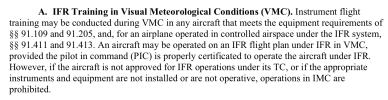
Here is an excerpt from 5-439:
1744122516373.png

Can you provide instrument flight training in an airplane that doesn’t have an attitude indicator or directional gyro? The first sentence in this paragraph seems to indicate that you can’t, but the last sentence seems to indicate that you can, as long as you’re not operating “in the system” or in IMC.

I’d assume (and we all know what happens when you assume) that because this paragraph is primarily about operating in the system and/or in IMC, that’s really all it’s referring to in the first sentence.
 

Attachments

  • 1744122489141.png
    1744122489141.png
    113.2 KB · Views: 10
Here is an excerpt from 5-439:


Can you provide instrument flight training in an airplane that doesn’t have an attitude indicator or directional gyro? The first sentence in this paragraph seems to indicate that you can’t, but the last sentence seems to indicate that you can, as long as you’re not operating “in the system” or in IMC.

I’d assume (and we all know what happens when you assume) that because this paragraph is primarily about operating in the system and/or in IMC, that’s really all it’s referring to in the first sentence.
I recall when this first came up. The issue was the DA20, the 2-seat Diamond which was better equipped than most trainers for IFR flight. But because it did not have adequate static protection, it is KOEL is VFR only. The solution: yes, so long as it has the minimum Part 91 equipment required for IFR, you can file and fly under IFR, so long as you remain outside the clouds.

I don't think the issue was ever about instrument training under VFR. Although it applies to more than that, the problem was that the requirements for the rating include a cross country flight under IFR. All about operating in the system. IOW, a Part 91 problem, not a Part 61 problem.

There's a bit of loose language in there, the usual: do they mean "in VMC" or just "clear of clouds?" I doubt if anyone really care, with the biggest issue probably still being that IFR cross country when you ask ATC to divert because three's a bit of stratus in your path.
 
Here is an excerpt from 5-439:
View attachment 139665

Can you provide instrument flight training in an airplane that doesn’t have an attitude indicator or directional gyro? The first sentence in this paragraph seems to indicate that you can’t, but the last sentence seems to indicate that you can, as long as you’re not operating “in the system” or in IMC.

I’d assume (and we all know what happens when you assume) that because this paragraph is primarily about operating in the system and/or in IMC, that’s really all it’s referring to in the first sentence.

The way I read that, if my Decathlon is so equipped, I can train under foggles all day long, including in the system, I just can't go in the soup. Correct?
 
The way I read that, if my Decathlon is so equipped, I can train under foggles all day long, including in the system, I just can't go in the soup. Correct?
I read 91.205(d) as equipment required for operating under instrument flight rules, not IMC, so I would say that no, you can’t accept an IFR clearance with a T&B as your only gyro, even in VMC.
 
The way I read that, if my Decathlon is so equipped, I can train under foggles all day long, including in the system, I just can't go in the soup. Correct?
I agree with @MauleSkinner on this. The permissive operation under IFR of an aircraft not authorized for IFR by it's type certificate and limitations, does not overcome the Part 91 regulatory requirements for the equipment required to operate under IFR. You must be equipped with the minimum equipment for IFR flight to operate under IFR.

Let's try a different example. Following you logic, you don't need a 24-month altimeter or transponder check any more than that AI or DG. Perfectly OK to cause a loss of IFR separation because your altimeter off, right?

Be wary of seeing only the trunk and thinking it's the whole elephant.
 
Is it legal to train? Yes, but you can ONLY FLY VFR IN VMC. So you will never get any actual time and you can never file and IFR Flight Plan.

Can you do the check ride... Probably not. You MIGHT find a DPE that will give you a Check Ride, but my guess is most will not. And it's been too long, but pretty sure I had to file an IFR Flight Plan... which you can't in a non IFR aircraft.

So you can train with your CFI, but you should plan on renting whenever there is a chance to get some Actual. And again when you go to take the Check Ride.
 
I know of a decathlon rated for IFR. The owner took it to factory and they did it for him.

I know of two. One was a one-time STC approved by Houston FSDO in 2005. The applicant was Ken Bowersox. That seemed like a good omen until I looked him up. Ken (pictured below) probably has more pull at the FAA than I do, especially in Houston.


bowersox.jpg


There is another one out there that was advertised and sold a few years ago. Nobody I've met seems to know the process by which it was done.

The factory says they are unable to do it, and they regularly decline requests. When the Decathlon was originally certificated in the early 70's, the operating limitations stated "day and night VFR". To produce an 8KCAB legal for IFR, the factory would have to get FAA approval to amend the certification. That would take years and cost $$.

Everyone knows a guy who knows a guy who had it done. Those always turn out to be Scouts or Citabrias. The Scout was certified for IFR and is available from the factory in that configuration, so converting a VFR one is an easy process. Just equip per TC specs and amend the AFM. The Citabria was originally certified under CAR, which has less restrictive certification rules. The factory can apparently modify the aircraft to meet the CAR required equipment list for IFR and that is sufficient.

Once a year, someone on the American Champion Facebook group run by the factory declares they are going to do it with their local FSDO. It never goes anywhere.
 
Only required once, for the IFR dual cross country.
I forgot about that one. I was thinking about the Check Ride and I'm pretty sure he had me file. So that would be two if the DPE asks you to do it.
 
Is it legal to train? Yes, but you can ONLY FLY VFR IN VMC. So you will never get any actual time and you can never file and IFR Flight Plan.

Can you do the check ride... Probably not. You MIGHT find a DPE that will give you a Check Ride, but my guess is most will not. And it's been too long, but pretty sure I had to file an IFR Flight Plan... which you can't in a non IFR aircraft.

So you can train with your CFI, but you should plan on renting whenever there is a chance to get some Actual. And again when you go to take the Check Ride.

I have no intention of operating in IMC. I plan to keep my Decathlon. I just want the ticket to hang on the wall. If I change my mind 5 or 10 years from now, I can always get refresher training.

Seems silly to get a ticket I don't plan to use, but it's no different than the seaplane rating at Jack Brown. If I can accomplish 90% of the training with a CFII buddy in my Decathlon at no cost, and then rent or borrow another plane for the last 10% and checkride, why not? Or maybe it's 75/25.

Point being, what can I legally do in my Decathlon to further that goal?
 
Last edited:
I read 91.205(d) as equipment required for operating under instrument flight rules, not IMC, so I would say that no, you can’t accept an IFR clearance with a T&B as your only gyro, even in VMC.

Who said anything about only having a T&B? I will have a pair of AV-30C's for AI and DG.
 
I forgot about that one. I was thinking about the Check Ride and I'm pretty sure he had me file. So that would be two if the DPE asks you to do it.
I did not have to file for my check ride. It was done in VMC under the hood, which I'm guessing is how most are done. That said in training, we filed on every flight (base was in the DC SFRA so you had to file regardless), so I had lots of practice.
 
I’m starting to think about this for my Nanchang. I’m just about done upgrading it for ifr, but I’ve lost my currency so an ipc will be in order, but my back seat will only have the vfr gps data in view, so I’m wondering how an instructor will feel about it.

I think I’ll be able to show glideslope on the cdi on the pfd, but I’m not certain. I think if the cdi in the back is driving from the ifr gps then I’m legal.
 
I’m wondering how an instructor will feel about it.

That's obviously a big factor. I had a good buddy who was a CFII and he was game for just about anything. He was teaching me formation flying. Unfortunately he died suddenly last fall.

The GIB has zero instruments, but the cockpit is roomy enough that he can just lean forward and look over my shoulder if his eyesight is decent. Maybe he sits on an extra cushion. Actual IMC is not an option, but I don't see why he would have a problem with me on foggles in VMC.
 
I forgot about that one. I was thinking about the Check Ride and I'm pretty sure he had me file. So that would be two if the DPE asks you to do it.
True. It's a bit unusual though. Not filing an IFR flight plan so much as opening it. Opening it requires the DPE to act as PIC since the applicant doesn't have the rating. Most DPEs are hesitant to do that.
 
That's obviously a big factor. I had a good buddy who was a CFII and he was game for just about anything. He was teaching me formation flying. Unfortunately he died suddenly last fall.

The GIB has zero instruments, but the cockpit is roomy enough that he can just lean forward and look over my shoulder if his eyesight is decent. Maybe he sits on an extra cushion. Actual IMC is not an option, but I don't see why he would have a problem with me on foggles in VMC.
If we're not talking about getting the rating, I don't see much problem with you being under the hood flying around maintaining or increasing the minimal set of skills associated with the tasks covered by the private pilot requirements about "control and maneuvering of an airplane solely by reference to instruments, including straight and level flight, constant airspeed climbs and descents, turns to a heading, recovery from unusual flight attitudes, radio communications, and the use of navigation systems/facilities and radar services appropriate to instrument flight;. But based on my experience, even with a full set of IFR instrumentation, the back seat sucks as a teaching environment."

But for teaching the rating, which is only 10-15% about the ability to fly without visual reference, the back seat sucks as a training environment even with a full complement of IFR equipment and certification.
 
I agree with @MauleSkinner on this. The permissive operation under IFR of an aircraft not authorized for IFR by it's type certificate and limitations, does not overcome the Part 91 regulatory requirements for the equipment required to operate under IFR. You must be equipped with the minimum equipment for IFR flight to operate under IFR.

My aircraft will meet all equipment requirements listed in 91.205(d).
 
My aircraft will meet all equipment requirements listed in 91.205(d).
That solves the "filing IFR" problem.

But you mentioned "CDI and glide slope from an IFR GPS." The 155XL (17 year olf tech) will not give you a glideslope. In the GPS world you'd be limited to 2D approaches - LNAV minimums only. I don't think you mentioned what other NAV capability you have, but you'd at least need a receiver capable of doing an ILS to cover the required precision approach task and even to do the three types of approaches required for the dual cross country.

Not wedded to the 155XL, that was just an initial brain fart. My major constraint is panel space, and in particular stack height. A 430 or 530 will not fit. GPS 175 would fit, but I was looking for a cheaper used option. Any suggestions?

I suppose I could sell my GTR-225 radio and buy a used 255 Nav/Com for relatively minimal net cost.
 
Last edited:
But for teaching the rating, which is only 10-15% about the ability to fly without visual reference, the back seat sucks as a training environment even with a full complement of IFR equipment and certification.

What is the bulk of training? I was under the impression it was mostly approaches and holds. If I could knock that out in my plane for the cost of gas and CFII, the rental savings would offset the cost of upgrading my panel. Even if I didn't get the rating, it would be time well spent if I ever got in a VFR pickle.
 
What is the bulk of training? I was under the impression it was mostly approaches and holds. If I could knock that out in my plane for the cost of gas and CFII, the rental savings would offset the cost of upgrading my panel. Even if I didn't get the rating, it would be time well spent if I ever got in a VFR pickle.
The ability to fly without visual reference for a sustained period is an essential skill that's absolutely necessary for everything else. The best instrument instructors don't go near an approach until you have that. But most of instrument training is about understanding and applying rules and procedures and juggling them in the context of flight rather than stick and rudder. Checkride failures and IMO, even IFR LOC fatalities, are from those rather than ability to fly.

I used to say 80/20% before modern avionics. With modern avionics, it's more like 90/10%.
 
Ed, that capability is one that I had a long time ago.

Back when I was a brand new PPL, my instructor CFI with an instrument rating, but not CFII gave me dual in a non IFR 150, to KADW, precision radar approaches. They went smoothly to about 20 feet before we did the missed. We had
DG, T&B, Horizon, but not certified altitude.

The point he made was that if I ever got caught on top, I was to call ATC, confess, and get vectors to the nearest military field with that capability.

Next year, on my annual flight review, we did ILS approaches for the same reason. The plane now had a nav radio.

I was comfortable in turbulent night flight under the hood, and the idea of flying for a short time in IFR conditions did not scare me, so confessing and flying to a suitable field beat all other options.

I never actually did that, but did get my IFR rating, and certified or not, in a gyro equipped plane, I would still have confessed the non certified nature of my plane (to get more cleared airspace around me) and proceeded to a suitable field and landed.

It is cheap to pay on the ground with the loss of flying privilege's, if you are standing there alive and well. :)
 
Sorry, I have to interject here, and expand on midlifeflyer’s spot-on (and others) comments. IMHO, your training should perhaps be 90/10 other trainer/your Decathalon, not the other way around. Aside from the all-important attitude flying, much of instrument training is about getting very used to the plane in use, by continued use of radios, GPS, controls, etc. Within reasonable timeframes, students that use one plane are just barely getting into a smooth rhythm that will allow checkride passage after 40 hours. I can’t really picture success for any student (not personal), with only a handful of hours for checkride prep in an unfamiliar platform. So, say you log 30-35 hrs in your plane, then transition, hoping for 5 hrs, but, oops, not up to speed, so now you need another 10-15 to be checkride ready (numbers are made up example.). Not saving much, and adding to frustration. OK, soapbox off. (Disclaimer, all comments above are strictly Internet forum opinion.)
 
Not wedded to the 155XL, that was just an initial brain fart. My major constraint is panel space, and in particular stack height. A 430 or 530 will not fit. GPS 175 would fit, but I was looking for a cheaper used option. Any suggestions?

I suppose I could sell my GTR-225 radio and buy a used 255 Nav/Com for relatively minimal net cost.
Maybe look at the GNC355 and eliminate a device. Same footprint as the 175 and adds comm.
 
Is it legal to train? Yes, but you can ONLY FLY VFR IN VMC.
VMC, yes. VFR, no.

So you will never get any actual time
True.

and you can never file and IFR Flight Plan.
False. You can file and fly IFR, but you must remain in VMC and negotiate with ATC accordingly.

Can you do the check ride... Probably not. You MIGHT find a DPE that will give you a Check Ride, but my guess is most will not. And it's been too long, but pretty sure I had to file an IFR Flight Plan... which you can't in a non IFR aircraft.
It's rare to file on a checkride because the DPE has to be the PIC and thus becomes responsible for any errors you make. I did look into this for my own instrument ride and the DPE said, "I'll do it, but you don't just have to fly to PTS standards, you have to fly to MY standards."

So you can train with your CFI, but you should plan on renting whenever there is a chance to get some Actual. And again when you go to take the Check Ride.
I would not recommend taking a checkride in a relatively unfamiliar plane. No reason you can't do the checkride in the properly equipped VFR only bird.

I do recommend getting as much actual as possible, though, and that is definitely worth renting for.

Not wedded to the 155XL, that was just an initial brain fart. My major constraint is panel space, and in particular stack height. A 430 or 530 will not fit. GPS 175 would fit, but I was looking for a cheaper used option. Any suggestions?

I suppose I could sell my GTR-225 radio and buy a used 255 Nav/Com for relatively minimal net cost.
I'm not sure that'd be "relatively minimal" though if they're the same size and the existing wiring and connector can be used, and you get a good amount for selling the 225 maybe it'd be reasonable.

You could also get a 355 which is like a 175 with a com, but that might swing you back toward the more expensive zone. I'm not sure what used GTR-225s are going for these days.
 
False. You can file and fly IFR, but you must remain in VMC and negotiate with ATC accordingly.
Can you show me the Reg?

And maybe it is a terminology thing... Sure, I could file a FP. But I cannot accept an IFR Clearance in a plane that is not capable of IFR flight. At least that's the way I was taught and I can't find anything that says I can accept an IFR Clearance... Instrument Flight RULES, not Wx in an non IFR aircraft. But if you have one of those funny Regs that was written with a loop hole, I'm all ears!
 
Last edited:
It's already discussed earlier in this thread. See posts 2, 4, and 10.
Unless the posts have moved with other replies... 2, 4 & 10 have to do with Logging instrument time in VMC. Nothing to do with filing or accepting an Instrument Clearance in a VFR Only Aircraft.

I stand by what I said unless you have a Reg to show I'm wrong. You cannot fly IFR in an VFR Only aircraft, regardless of the Wx (flying under the hood in VMC is not flying IFR). Sure, you can TRAIN under the hood in VMC conditions and it all counts towards your rating. But that's not filing and flying IFR.
Prior to the Thierault interpretation, you would have been correct.

However, read the quoted piece in post 10 carefully:

1744122516373-png.139665

Specifically, starting on line 2, "Any aircraft that meets the equipment requirements..."
Then in the middle, "An aircraft may be operated on an IFR flight plan under IFR in VMC..."

And while the last sentence appears to contradict those, note that it says you can't operate *in IMC* if the aircraft isn't approved for IFR operations. It doesn't prohibit IFR in VMC, and the earlier portions specifically allow it.
 
I stand by what I said unless you have a Reg to show I'm wrong.
Do you have a reg to support your position? Or even a reg that says you can accept an IFR clearance in an IFR aircraft?
 
Last edited:
Back
Top