Tire Pressure Monitor Valves

Alex Batista

Pre-takeoff checklist
Joined
Nov 20, 2018
Messages
103
Display Name
Runway25
I’d like the opinion of Arrow owners (or any aircraft owner for that matter) regarding Tire Pressure Monitor Valves / Stem Caps Sensor Indicators.

These are sold on Amazon and many other websites for cars. Basically they give you a visual reference (green, yellow, or red) if your tire pressure is low. They sell them for all kinds of different pressures.

My question is; do any of you use these on your aircraft? I’ve been thinking about getting them once we purchase our Arrow as a quick visual reference. They seem to be simple (and small) enough to be used on aircrafts but I don’t know anyone who’ve used them.
 
I learned the hard way on my RV. Be very very careful. In fact, I would not use them at all, here’s why…

In order to detect the pressure, they constantly push down on your schrader valve pin, and bring the pressure into the cap itself. That means, if the quality of the caps is poor, or the plastic breaks for any reason, a leak will be opened directly to the outside.

I had one on my RV, plastic cap shattered on the highway, tire lost all air and disintegrated quickly.

In an aircraft, there is the potential for a lot more damage.

Now if the pressure sensor is INSIDE the tire, that can be reasonably safe…
 
Two issues:

1. That would be an alteration to the type design. Would require A&P log entry at minimum.

2. How will you determine parts eligibility?
 
1. Would it, really? I wasn’t aware of that. Thanks for pointing that out.

2. I din’t know this would be considered a part requiring eligibility. Future new owner here. Thanks!
 
1. Would it, really? I wasn’t aware of that. Thanks for pointing that out.

2. I din’t know this would be considered a part requiring eligibility. Future new owner here. Thanks!
Can't even go from 6 to 8 ply tire if it's not on the type certificate or have an stc. At least and still be airworthy.
 
Help me understand this...

1. A valve stem cap is an alteration to a type design? How so? If I lose a valve stem cap then the plane is now unairworthy?

2. I checked all 3 of my airplane's TCDS and there are zero references to tires. The parts manual calls for a tire ply size though, which is regulatory unless there is an STC.
 
Let us consider the likely failure sources.

1. Stick or limb on the grass or pavement that breaks the clear plastic, venting the air.

2. Rocks thrown up by passing vehicles.

3. Rocks other hard object in deep mud you are traversing.

4. Rocks picked up and thrown by airport mower.

There are others, this is not definitive, feel free to add others.

1. Airport grass runways are well maintained, have few nearby trees to be sources of debris. If you are flying from such, walk the runway prior to flight.

2. No passing vehicles on airport runways.

3. Nobody attempts to take of from deep mud.

4. If the cap is damaged by the airport mower, it will be apparent IF you do a preflight.

Someone else can give us the source of inflight damage.

I have never used them on my vehicles, mainly because I am too cheap, and regularly check my tire pressure, both visually, and with a guage. I have guages in each of my vehicles, and that has been true for decades.

Friends use them and are happy with them, as far as I know.

Would I put them on an airplane that I owned? Good question. Very likely yes, if it had wheel fairings, as checking pressure on most of them is difficult, but a retractable, such as an Arrow has no fairings.

Any low wing is simply a pain to get to, and that would be a strong incentive to go with an indicator cap. :)

One landing with a strong crosswind and an underinflated tire, which rolled over and failed on a concrete runway, ruining a wheel, would be a failure mode that could cause a decision to use the caps.:mad:

Especially if you had fairings, and one was destroyed...

So, just my opinion, and how I got there. Both plusses and minuses.

There were no specifications for the Cessna caps on the ones that I flew.
 
A valve stem cap is an alteration to a type design? How so?
Yes. If one replaces a part that is different than the certified configuration it no longer conforms to its type design, ie., its an alteration.

If I lose a valve stem cap then the plane is now unairworthy?
Technically, yes. The first part of the definition of airworthy is that it conforms to its type design. So missing any item changes that conformity unless properly removed and documented.

I checked all 3 of my airplane's TCDS and there are zero references to tires.
The TCDS is not the type design. It is a listing of conditions and limitations applicable to the type certificate. The type design is a separate listing of drawings, materials, specifications, etc. that defines the product configuration. In most cases, the aircraft parts manual is representative of the type design part requirements.

There were no specifications for the Cessna caps on the ones that I flew.
Aircraft parts come in different flavors. And one of the most common flavors on aircraft are standard parts which those caps tend to fall under. However, the IPC or other guidance should still be referenced as some applications require metal air stem caps vs plastic.
 
Do I use them? No, not on the plane or the motorcycle. My truck has them inside the tires.

My experimental plane lives in a hangar with an air compressor nearby. I removed the wheel pants for turf flying. During the preflight it takes a second or two to pull the air hose over and top off the tires when needed. I do understand that having a slow leak in a tire away from home would be good to know before the landing attempt, especially in a taildragger, but in the few years I've been flying I've only had one flat on a tricycle gear airplane (right side main) and I felt it almost immediately upon touchdown. Wasn't an issue ...
 
I didn’t know this would be considered a part requiring eligibility. Future new owner here. Thanks!

Every part installed on a certificated aircraft must be eligible. Read AC 20-62E for an overview.

There are various paths to determine eligibility. For more complex or critical components, FAA approved parts such as TSO and PMA may be needed. For instance, your tires must meet TSO-C62.

For other purposes, you can often use standard parts. These are parts that conform to a published industry or government specification. For instance, hardware will normally be AN or MS, not Home Depot chinesium. Wire is M22759/16. The aircraft parts manual and AC 43.13-1b are primary sources of these specifications.

A little Googling shows that inner tubes should meet SAE AS50141. Valve core stems should meet ISO 9475 or MIL-V-27317. Most aircraft parts stores sell Dill 402AH, which meets the ISO spec.


When you buy stuff from Amazon, you have two problems. First, how do know the product was manufactured to a relevant specification? Second, how do you know the manufacturer has acceptable quality assurance processes such as ISO 9001? Buying from an aircraft parts vendor such as Aircraft Spruce usually addresses both of those questions.

Until you have learned the basics of aircraft preventative maintenance, my advice is find an A&P willing to supervise you. If you want to throw whatever crap you want in your airplane, buy an EAB.
 
Last edited:
Every part installed on a certificated aircraft must be eligible. Read AC 20-62E for an overview.

There are various paths to determine eligibility. For more complex or critical components, FAA approved parts such as TSO and PMA may be needed. For instance, your tires must meet TSO-C62.

For basic parts, you can often use standard parts. These are parts that have been manufactured to conform to a published industry or government specification. For instance, hardware will normally be AN or MS, not Home Depot chinesium. Wire is M22759/16.

A little Googling shows that valve core stems should meet ISO 9475 or MIL-V-27317. Most aircraft parts stores sell Dill 402AH, which meets the ISO spec.


When you buy stuff from Amazon, you have two problems. First, how do know the product was manufactured to a relevant specification? Second, how do you know the manufacturer has acceptable quality assurance processes such as ISO 9001? Buying from an aircraft parts vendor such as Aircraft Spruce usually addresses both of those questions.

Until you have learned the basics of aircraft preventative maintenance, my advice is find an A&P willing to supervise you. If you want to throw whatever crap you want in your airplane, buy an EAB.

But we are speaking about a cap on the valve stem. The valve stem is attached to the tube, not the tire.
 
To add to @geezer, don’t just consider failure as an impact incident. Think of the clear plastic that is used. Think about how brittle it might be. Think about how that brittleness might get worse when exposed to temperature and pressure fluctuations (if it’s made for 30-50psi, that’s indicating differential - what happens at 7000 ft). Think about UV exposure and related accelerated oxidation. Think how it is fused to the base and how temp and pressure fluctuation might affect it. Think about something we haven’t thought about because we’re not experts. Think about the risk-reward because it IS an inconvenience to check pressures manually.
 
Hmmmm. All my valve caps are metal, with a rubber ring inside to slow any leakage should the valve slip.
1768856235241.png
Not sure I'd want to give up that redundancy.

The end of one of my caps actually has the fittings for removing the valve, should you be trying to fix the tire away from home.

Ron Wanttaja
 
1. A valve stem cap is an alteration to a type design?

Certainly changing to a pressure monitoring cap would be, because it's altering the manner of performing the function. Instead of air being held in the tube by a schrader valve with an o-ring for backup in the valve cap, it would be held by an o-ring alone. Also, the schrader valve is constantly depressed with the monitoring cap, which is not how the valve was designed to function.
 
Hmmmm. All my valve caps are metal, with a rubber ring inside to slow any leakage should the valve slip.
View attachment 149099
Not sure I'd want to give up that redundancy.

The end of one of my caps actually has the fittings for removing the valve, should you be trying to fix the tire away from home.

Ron Wanttaja
Better make sure that valve cap conforms to SAE AS50141..........
 
But we are speaking about a cap on the valve stem. The valve stem is attached to the tube, not the tire.

The inner tube is an integral part of the tire assembly for purposes of meeting TSO-C62. The tire manufacturer determines tube specifications required to meet TSO performance. Goodyear specifies SAE AS50141.

The cap, core, and stem each have a mil spec. The cap is MS20813-1, commonly sold as p/n VC5.

I would bet the SAE tube spec incorporates equivalent industry specs for stem, valve core, and cap. But I'm not willing to pay $85 to buy the spec to find out. So I'll just keep buying my airplane parts from an airplane part vendor, not Auto Zone or Amazon.
 
Last edited:
The inner tube is an integral part of the tire assembly for purposes of meeting TSO-C62. The tire manufacturer determines inner tube specifications required to meet TSO performance. Goodyear specifies SAE AS50141.

The cap, core, and stem each have a mil spec. The cap is MS20813-1, commonly sold as p/n VC5.

I would bet the SAE tube spec incorporates equivalent industry specs for stem, valve core, and cap. But I'm not willing to pay $85 to buy the spec to find out. So I'll just keep buying my airplane parts from an airplane part vendor, not Auto Zone or Amazon.

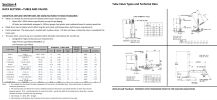
Your plane, your money, do as you please. Here's a better view:

1768860723051.png

That metal cap is for high pressure, which the majority of light GA planes don't use. Plastic is fine, just like you would find in any automotive application.

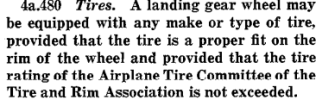
Then again, many of us have CAR 3 aircraft. CAR 3.362 refers back to the Tire and Rim Association for the tire, nothing with regards to the tube.

CAR 4a.480

1768867017354.png
 
Last edited:
That metal cap is for high pressure, which the majority of light GA planes don't use.
Hmmmm....I'm guessing the 10-15 PSI I run in my Fly Baby's tires doesn't qualify.

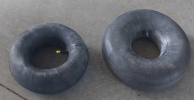
Had a tube develop a pinhole leak a couple of months back. Ordered new tubes and tires. Was amused comparing the size of the replacement tube (left) with the one I'd taken from the tire.
1768863844575.png
Those suckers DO stretch quite a bit....

This shows the pinhole leak, with a wide enough angle to show the tiny size of the hole and its location. No damage in the tire itself at that location; apparently just a manufacturing or installation flaw that eventually gave up.
1768863974302.png
Ron "My airplane is now re-tired" Wanttaja
 
Hmmmm....I'm guessing the 10-15 PSI I run in my Fly Baby's tires doesn't qualify.

Had a tube develop a pinhole leak a couple of months back. Ordered new tubes and tires. Was amused comparing the size of the replacement tube (left) with the one I'd taken from the tire.
View attachment 149101
Those suckers DO stretch quite a bit....

This shows the pinhole leak, with a wide enough angle to show the tiny size of the hole and its location. No damage in the tire itself at that location; apparently just a manufacturing or installation flaw that eventually gave up.
View attachment 149102
Ron "My airplane is now re-tired" Wanttaja

I run 18 psi in mine. The metal cap isn't a bad idea for a low pressure tube, just not a requirement.

Your old tube looks like chaffing damage. It's been working inside the tire over time and working thinner and thinner.
 
Worst part, is you'll have to rebalance the tire/wheel assembly. This things are NOT weightless.
 
I had them on our experimental during flight test program, and they worked great....got on Amazon for about 60 bucks, and are now on my SUV and working fine. they also have temp reading which we referenced during land performance data..... temp reading not all that helpful as it was way lower than wheel and brakes which would be most helpful. obviously. They are larger than caps, but don't recall having to rebalance wheel.

but plane is experimental category so wider range of trying new things than certified. I can't imagine any legal issue with being called out for them, but they are, at least ours, was noticable due to size. personally, if your tires show good pres on preflight whether by kicking or on display, the odds of pressure going bad before landing is scarce and at least you would know it before landing with monitor.

We didn't see much use for them after testing and went back to cap....we changed a lot of tires during that time frame and the monitor worked perfectly each time. they do add additional points of potential failure in that the schrader valve is pressed open and could possibly leak if sender was damaged, but we did a lot of intentional hard landings without issue without issue.
 
I put these on my RV8A about a year ago, and they have been great. https://www.amazon.com/dp/B0822G39VV
We may put those on the RV-12 this year. It's a real PITA to check the tire pressure. We've got holes in the pants to allow access to the valve stem, if the tire is in the right position, but of course you need a 3/8 socket and extension to get the cap off, then an extended stem to fill it. As a result, I can guarantee the tire pressures don't get checked as often as they should. Before going with those, though, I'd have to figure out how we're going to remove and re-install them through a 1" hole in the wheel pant. If we can't do that, then checking tire pressure is easier but topping of is an order of magnitude worse. How do you deal with that on the -8? Do you have to de-pant to fill the tires?
 
I just remove the front half of the pant and have sufficient access. Only takes a couple of minutes per tire.
 
Worst part, is you'll have to rebalance the tire/wheel assembly. This things are NOT weightless.

What speed are you rotating at and landing at that you notice?

I have the yellow brass caps on my planes and there is no notable difference with or when one went awol

I have also flown jets for work, ref around 130kts or so, noticed one the cap didn’t get put on, no notable difference
 
Eh.. I just check the tire pressure every few weeks, more if it get's cold. Not that much more work as I'm already doing a pre flight.

Must be over $100.
If it's for an airplane, ANYTHING is over $100 :D
 
Back
Top