
- Joined
- Oct 18, 2023
- Messages
- 171
- Display Name
- Princesspilot
How would I find it? The checklist says 85mph, but I don’t see anything about that in the POH. I see online there are various Vg speeds talked about for this make and model.


For all of the piston singles I've flown, best glide turns out to be the same as Vy. The FAA says it falls somewhere between Vx and Vy:How would I find it? The checklist says 85mph, but I don’t see anything about that in the POH. I see online there are various Vg speeds talked about for this make and model.

For all of the piston singles I've flown, best glide turns out to be the same as Vy.


In a Grumman Tiger Vx is 70kts, best glide is 72kts and Vy is 90kts so there be exceptions.For all of the piston singles I've flown, best glide turns out to be the same as Vy.
This part still holds true, though.The FAA says it falls somewhere between Vx and Vy

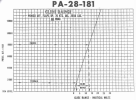
The chart from an Archer "I" POH will get you closer:The early Pipers (I've got a 180D also) did not have a POH, but a crappy AFH. So I bought the generic 180E "Owners Handbook" from Piper. Here are the specs. As a rule, a cherokee is a brick when it comes to glide. You'll notice there's no best glide:
Take-off Run (maximum effort, 25° flap) (ft) 720
Take-off over 50-ft barrier (maximum effort, 25° flap) (ft) 1625
Best Rate of Climb Speed (mph) 85
Rate of Climb (ft per min) 725
Service Ceiling (ft) 13,000
Absolute Ceiling (ft) 15,000
Top Speed (mph) 152
Optimum Cruising Speed (75% power, optimum altitude) (mph) 143
Cruising Range (75% power, optimum altitude) (mi) 725
Optimum Cruising Range (55% power, optimum altitude) (mi) 845
Stalling Speed (flaps down) (mph) 57
Stalling Speed (flaps up) (mph) 67
Landing Roll (flaps down) (ft) 600
Landing Roll over 50-ft barrier (ft) 1150
To make matters even more interesting, the Archer II POH has a Glide Range chart, assuming Power off, flaps up, 76 kts, and max 2550# (which is more than the 180D 2400# max). 76 KTS is 87 mph, by the way, so the 85 mph glide is about right. But remember glide is affected by weight, and the archer is heavier than the cherokee.

Not exactly lol but it is a lot of stressful then a 172.Isn’t the power-off 180 in a Cherokee 180 basically,
1. Toss brick out of window.
2. Follow it down.
?

I've flown about 30 different types of singles and I think that's generally true of the Piper singles. Either Vy or within just a few knots. But in others, there can be a wider margin. Cessna single Vgs tend to be in that range between Vy and Vx. OTOH, in a Bonanza 3g or Mooney Ovation, Vg is more than 10 KIAS faster than Vy.For all of the piston singles I've flown, best glide turns out to be the same as Vy. The FAA says it falls somewhere between Vx and Vy:
https://www.faa.gov/sites/faa.gov/files/2022-01/Best Glide Speed and Distance.pdf

This is partly true. You can't be tested on it during a checkride. But you may be tested on it somewhat more directly when the engine quits.If it's not in the POH you can't be tested on it.
The comment about Archers is not true. The Hershey bar wing was still on the first generation Archer, which was re-named from the Challenger. It was the Archer II (1976) that got the semi-tapered wing.This is partly true. You can't be tested on it during a checkride. But you may be tested on it somewhat more directly when the engine quits.
As far as the Archer comparisons go, I think that all Cherokee 180s had Hershey bar wings while all Archers had tapered wings. I don't know how much that affects gliding.
As far as Vbg = Vy goes, it's worth experimenting. I determined Vbg in my RV-14 to be 75 KIAS, which is closer to the 70 KIAS Vx than to the 95 KIAS Vy. I would suggest to look for information about how to determine your Vbg, go and fly a bunch, and let us know what you find out.

Actually, they called it the "Owners Handbook." Just like a car of the same era.The early Pipers (I've got a 180D also) did not have a POH, but a crappy AFH.
Minimum sink speed is lower than best glide speedIt’s about 80 in ours when just me and instructor and utility weight.
Try it out. We worked with 85 too and found rate of descent to be worse than about 80. Still going to be a lot more difficult to nail a forced approach practice then typical Cessna.
IIRC, that is true of every glider I have flown.Minimum sink speed is lower than best glide speed

Aerodynamics are funny that way.IIRC, that is true of every glider I have flown.


Well if I can do OEI at night my first time in a twin - why not? Man it's been 20 years since that happened!....go out and test....you mean....stop the engine and then let it windmill....uhhh.....what could possibly go wrong....?
Where does the checklist come from?How would I find it? The checklist says 85mph

For me, Vg is 91.5 KIAS and Vy is 105. Vx is 85, so Vg is closer to Vx in my case - Sounds like that's similar to the Grumman and RV numbers posted above. Maybe efficient wings are closer to Vx and "pig wings" are closer to Vy?For all of the piston singles I've flown, best glide turns out to be the same as Vy. The FAA says it falls somewhere between Vx and Vy:

Non-broken link: https://www.faa.gov/sites/faa.gov/files/2022-01/Best Glide Speed and Distance.pdfhttps://www.faa.gov/sites/faa.gov/files/2022-01/Best Glide Speed and Distance.pdf
Best glide speed is *not* the minimum descent rate - That's minimum sink speed, which usually isn't published and is slower than Vg. Minimum sink gives you more time in the air, but Vg will get you more distance.Try it out. We worked with 85 too and found rate of descent to be worse than about 80.
Other way around. Vg in the Ovation is nearly 15 knots slower than Vy; and just a handful faster than Vx.I've flown about 30 different types of singles and I think that's generally true of the Piper singles. Either Vy or within just a few knots. But in others, there can be a wider margin. Cessna single Vgs tend to be in that range between Vy and Vx. OTOH, in a Bonanza 3g or Mooney Ovation, Vg is more than 10 KIAS faster than Vy.
Vx is time/altitude and Vy is distance/altitude, so if you can eliminate drag from (feather) your prop, Vx should be your Vmin-sink and Vy your Vg.Best glide speed is *not* the minimum descent rate - That's minimum sink speed, which usually isn't published and is slower than Vg. Minimum sink gives you more time in the air, but Vg will get you more distance.
You're forgetting the effects of the vertical component of thrust on Vx and Vy... So I don't think your last statement is true. My Vy is significantly faster than my Vg. But, I can't feather my prop to test it.Vx is time/altitude and Vy is distance/altitude, so if you can eliminate drag from (feather) your prop, Vx should be your Vmin-sink and Vy your Vg.


The better . . . and this is something of a tautology . . . manuals contain a set of performance charts that show the variable nature of all of those book numbers based on weight and density atmosphere.Don't forget that the book Vbg is specified at max weight. At lower weights, best glide will be slower (it's a square root relationship). So while knowing the book number is good, don't think of it as an absolute firm number. In practical application, flying a little slower than the published Vbg will probably work better, since you probably won't be at max weight.
More on that in a thread @Hang 4 spun off from this one. The speed change with weight variations is easy enough to calculate. The performance hit you take by flying off optimum is not as simple but good to know for those who choose to use book Vg. I contend that it might be better to also publish the speed and performance at max zero-fuel gross weight but no traction as of yet.Don't forget that the book Vbg is specified at max weight. At lower weights, best glide will be slower (it's a square root relationship). So while knowing the book number is good, don't think of it as an absolute firm number. In practical application, flying a little slower than the published Vbg will probably work better, since you probably won't be at max weight.

Perhaps, right now I am rigging up a fish scale to measure the Apache's horizontal component of thrust.You're forgetting the effects of the vertical component of thrust on Vx and Vy... So I don't think your last statement is true. My Vy is significantly faster than my Vg. But, I can't feather my prop to test it.

Yep. I was reading my own stuff backwards.Other way around. Vg in the Ovation is nearly 15 knots slower than Vy; and just a handful faster than Vx.
Well, if you idle at the "right" speed your small amount of thrust can equal the drag of the turning prop resulting in equilibrium.What is the difference in Vg when a prop is stopped vs windmilling, vs at idle?
Anyone got number for any airplane on that? I would think that for a 180D the difference wouldn't be enough to worry about testing it with the engine out.
How does one feather a fixed pitch prop?Well, if you idle at the "right" speed your small amount of thrust can equal the drag of the turning prop resulting in equilibrium.
A windmilling prop produces drag without contributing thrust. Feathering the prop minimizes drag. And that contributes to a flatter glide angle and increased gliding distance. The only place that I have seen this in print is a motor glider's POH. It offers the same 59 mph IAS for Vg and best L/D. But specifies an L/D of 27 with a windmilling prop and and L/D of 29 feathered.
When we flew the 1-26 sans canopy in summer, we just accepted the small impact on aerodynamics as the price to pay for comfort.
Interesting that Vg right around the approach speed. And in the Comanche it is as well, even though it's a gear up/down situation in the latter.It works out to be 85 mph 900 fpm sink, 80mph 800fpm. Or similar. Math wise 80 seems to work out as maximum distance no?
Can try again but it is somewhere in the 80-85 mph range.
Well . . . maybe there is an STC to install an IO-360-B1E and a Hartzell HC-yada-yada . . . maybe one for retractable gear too . . .How does one feather a fixed pitch prop?

