
- Joined
- Oct 16, 2019
- Messages
- 8,855
- Location
- Atlanta / Marietta
- Display Name
- Vintage Snazzy (so my adult children say)
- Home Airfield
- KPUJ
Didn’t the 737 MAX crash because of software?


Call CubCrafters . . . the ComancheCrafters Carbon Comanche has a nice ring to it.Just need Piper to bring the Comanche back into production!


How many does it take."A report by French investigators into the Germanwings plane crash in the French Alps in March says co-pilot Andreas Lubitz may have practised for a rapid descent on a previous flight. It also highlights six other accidents since 1980 that were possibly "caused by intentional manoeuvres by one of the flight crew members". "Insurancejournal.com Jun 15, 2022 · Surveys of airline pilots have shown that about 4% to 8% have contemplated suicide."
1) Namibia, 29 November 2013, 33 died
2) North Atlantic Ocean, 31 October 1999, 217 died
3) Botswana, 11 January 1999, one died
4) Indonesia, 19 December 1997, 104 died
5) Morocco, 21 August 1994, 44 died
6) Japan, 9 February 1982, 24 died
To be more precise, it crashed because incompetent pilots failed to properly handle an MCAS system failure. The MCAS system was flawed and pencil whipped into certification, but its failure shouldn't have caused a fatal accident.Didn’t the 737 MAX crash because of software?


There were apparently cases during WWII where fighter pilots unbuckled their seat harness to bail out, but automatically unbuckled their parachutes as well. So used to the process on the ground, after they landed.2000 SE hrs accumulated over 50 years in mostly hi wings and I still recall having without thinking, cranked my 172M trim wheel the wrong way - several times. Mental control reversal?
It's been a few years since I flew in an AT-6 or a P-51, but as I recall, the buckles are right next to each other. I was surprised at that, due to how easy it might be to mistake one for the other. That was part of the pre-flight instruction "don't do that!".There were apparently cases during WWII where fighter pilots unbuckled their seat harness to bail out, but automatically unbuckled their parachutes as well. So used to the process on the ground, after they landed.

That was never going to go into production - It's a homebuilt.Somebody tried - not sure if still available though: https://en.m.wikipedia.org/wiki/Ravin_500

My T-6 has different colored straps for the parachute and seat belts; the buckles are different types as well. I always make a big point to stop after putting them in the parachute and explaining "this is how you should look if you need to get out and use the parachute; only take off the BLUE straps".It's been a few years since I flew in an AT-6 or a P-51, but as I recall, the buckles are right next to each other. I was surprised at that, due to how easy it might be to mistake one for the other. That was part of the pre-flight instruction "don't do that!".

I don't put much faith in anyone's chances that isn't practicing that particular emergency egress often.

"Ideal airline crew of the future will be one pilot and one dog: the dog to bite the pilot if she tries to touch anything."How do you feel about a team of software engineers, none of whom are pilots and won’t be riding on the plane, and who may have downed a few beers at Joe’s retirement luncheon?
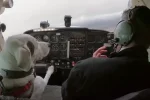

THIS ^^^^^Seems like if someone wants to conceal being suicidal it would be nearly impossible to find out with any kind of screening/testing. What some people are coming around to is a change in culture around mental health. For a long time we've effectively had a system that encouraged pilots to conceal any issues they're having, it might be time to encourage pilots to get help before they become suicidal.

Muscle memory/training scars are real. In one high-profile shootout (I believe the FBI Miami one with the serial robbers, but not positive), it was found that the agents carrying revolvers had stopped during the gunfight to empty their spent cartridges into their hand, then pocket, before reloading and getting back in the game…just as they had done numerous times at the range.There were apparently cases during WWII where fighter pilots unbuckled their seat harness to bail out, but automatically unbuckled their parachutes as well. So used to the process on the ground, after they landed.
Ron Wanttaja
That was a myth. It was the California Highway Patrol incident at Newhall in the late 60s. Every law enforcement officer hired after that heard about it in the academy,but 15 or 20 years ago back, it was confirmed to be untrue. No brass was found in any of the officers’ pockets.Muscle memory/training scars are real. In one high-profile shootout (I believe the FBI Miami one with the serial robbers, but not positive), it was found that the agents carrying revolvers had stopped during the gunfight to empty their spent cartridges into their hand, then pocket, before reloading and getting back in the game…just as they had done numerous times at the range.
Thanks for the correction-add me to the list of folks who were taught that (apparently incorrect) account in the academy.That was a myth. It was the California Highway Patrol incident at Newhall in the late 60s. Every law enforcement officer hired after that heard about it in the academy,but 15 or 20 years ago back, it was confirmed to be untrue. No brass was found in any of the officers’ pockets.
The best reason anyone seems to able to figure for the story is that shortly after the incident, range training was changed to have officers dump their brass instead of pocket it, although that was coincidental with Newhall and not because of it.
ateamer,
Retired law enforcement firearms instructor
I have known two people who took their own lives. As to what I consider to be your main point. That suicide is intensely self-focused. I completely agree. Neither of the people I knew would have wished to harm anyone else.Suicide is a tragic thing, and I don't know of anyone that hasn't been directly or indirectly affected by someone that's taken their own life. It's sad, and it's far too common. Mass murder, though, is far less common.
That was a myth. It was the California Highway Patrol incident at Newhall in the late 60s. Every law enforcement officer hired after that heard about it in the academy,but 15 or 20 years ago back, it was confirmed to be untrue. No brass was found in any of the officers’ pockets.
The best reason anyone seems to able to figure for the story is that shortly after the incident, range training was changed to have officers dump their brass instead of pocket it, although that was coincidental with Newhall and not because of it.
ateamer,
Retired law enforcement firearms instructor
The North Hollywood bank was a different one. Newhall happened in 1969 or 1970.Are we also talking about Northridge? Cause I remember watching that insanity on live TV. I don't remember if that happened before Heat (the movie), but I think they modeled it after the movie right? What a warning of darker societal things to come. 9/11 of course overshadowed little stuff like that

Thank you for sharing.At the end, suicidal people become subject to constricted thinking. They no longer see solving their problems as possible, and do not see living as an option. They also become unable to see the impact of their actions on others. They have tunnel vision, fixated solely on ending their life. They are also strangely calm and purposeful about it, not hysterical like you might imagine.
Thanks for that, it provides an insight I didn't have, in the sense of how it at least sometimes progresses. If it was the path of my surviving friend, then she must have been in that stage where recovery is possible, because she's fortunately been around for 20 years since then, and has started a family and is doing great. My point being that while it may be true that there's a progression where it's not recoverable, there is absolutely a point where it's both possible and recoverable. That doesn't mean anyone can see it, or help it, though.Unfortunately I know more than I ever wanted to about Suicide. One of the people I love most died that way, and it shattered our family in a way that will never heal. I hate talking about it, but I have vowed to make myself talk about it, because that is the only way to prevent others from taking that path.
There is not a lot of objective information out there on the psychology of suicide. The most useful and plausible thing I have read is that suicide is a disease of internal dialog, that little voice we all have in our head that we carry on conversations with.
Everyone thinks about suicide sometimes. 99.9% of us quickly dismiss the thought when it pops up. With a deeply depressed person, the thought keeps popping up. Over time, the thought gradually becomes harder to dismiss. With many suicidal people, there is a long period of internal struggle. Eventually it becomes stronger than the thought to keep living.
At the end, suicidal people become subject to constricted thinking. They no longer see solving their problems as possible, and do not see living as an option. They also become unable to see the impact of their actions on others. They have tunnel vision, fixated solely on ending their life. They are also strangely calm and purposeful about it, not hysterical like you might imagine.
Once that happens, it comes down to luck. They are not going to seek help. They have to be caught in the act or in preparation, in such a way that causes decisive intervention.
So if you want to prevent suicide, it has to happen before the final stage, during the long descent when they are wrestling internally with the thought.
If that is going on in your head, if the thought of suicide seems a little more acceptable than it used to, I am writing this for you. You need to know the incredible wreckage and pain you are going to inflict. You are going to destroy everyone who loves you, and everyone you love. They will not recover. They will carry crushing anguish and despair for the rest of their lives. For their sake, do not let your thoughts drag you further down that path. Please seek help for the issues that trouble you. Every problem is solvable. Don't try and fix it yourself. Get help.

Would autonomous planes be more at risk from hacking than piloted planes would be from suicides?It's not if it's when, somehow the fuel cutoff switch shut off the fuel on Air india 787 Crash, if this turns out to be another Suicide by pilot deliberately crashed or attempted to crash an aircraft as a suicide act people are going to except autonomous aircraft over suicidal pilots. "Both Airbus and Boeing are actively researching and developing autonomous aircraft technologies. While Airbus is focusing on incorporating autonomous features into larger commercial aircraft and exploring the potential of autonomous air taxis, Boeing is also involved in autonomous systems for various applications". If you are one of those who would never get on a autonomous aircraft Greyhound Bus will still be around, not sure about Amtrack.
I'm uncertain how state-sponsors, or criminal organizations can induce pilot suicides. I am quite clear on how state-sponsors and criminal organizations can employ thousands to hack . . . well just about anything connected to the web.Would autonomous planes be more at risk from hacking than piloted planes would be from suicides?

Al Qaeda figured that out on 9/11I'm uncertain how state-sponsors, or criminal organizations can induce pilot suicides. I am quite clear on how state-sponsors and criminal organizations can employ thousands to hack . . . well just about anything connected to the web.

We know their is a problem with suicide, most people would probably think less risk with autonomous planes. This is not going to be the last pilot to takes all of us in the back of the bus with him, how many more till public opinion demands major change to those flying the planes, or except autonomous airliners. As to hacking we are their now, trains, ATC, airline computers, the power grid, hospitals, just about all modern life is subject to computer hacking now, and all could kill many.Would autonomous planes be more at risk from hacking than piloted planes would be from suicides?