Runway turnouts

but I recall a YouTuber who got busted for announcing clear of the runway when he wasn't
Premier1Driver.

He had begun his turn off the runway but was not past the hold line, when he announced “clear of…” (I guess instead of announcing “clearing”). Some overzealous student pilot thought this was a regulatory violation and made a complaint to the FAA. The FAA investigated. (Kind of like what happened to @SixPapaCharlie. No, he didn’t get busted. It was ridiculous, but the annoyance led him to stop YouTubing (at least for a period).
 
Runway is owned by CITY OF ELIZABETHTON
I don’t disagree with the result, but why is that relevant? LAX is owned by the City of Los Angeles. JFK by the City of New York. I’m not sure what that means in terms of the application of runway occupation and safety procedures.
 
Interesting, you sent me down a small rabbit hole with the reference.

91.126
(c) Flap settings. Except when necessary for training or certification, the pilot in command of a civil turbojet-powered aircraft must use, as a final flap setting, the minimum certificated landing flap setting set forth in the approved performance information in the Airplane Flight Manual for the applicable conditions. However, each pilot in command has the final authority and responsibility for the safe operation of the pilot's airplane, and may use a different flap setting for that airplane if the pilot determines that it is necessary in the interest of safety.


So a jet pilot must use the minimum flap setting setting approved in the AFM, unless for training or certification, or if the PIC determines it isn't safe to do so.

I wonder which accident spurred the need for that paragraph.
That one always had me scratching my head. I think I maybe might kinda remember finding out it was about noise abatement. I guess they must have been noisier with more flaps back then. Maybe still are, I dunno
 
I don’t disagree with the result, but why is that relevant? LAX is owned by the City of Los Angeles. JFK by the City of New York. I’m not sure what that means in terms of the application of runway occupation and safety procedures.
You run into guys that say they "own" the runway once they are on it and are entitled to exclusive use. So, just a bit of smartassery.
 
Reading through the FAR sections mentioned in this thread (and a few other sections) I am unable to answer this question.
Exactly my point. People are imagining restrictions that don't exist.

All I have is 91.111 a No person may operate an aircraft so close to another aircraft as to create a collision hazard.
That's it. It's the pilot's judgement as to what is safe and what creates a collision hazard.

That's not to say that it is wrong if a pilot decides to go around because of the airplane in the hammerhead. He made a judgement, IAW 91.111, and operated his airplane accordingly. It's also not wrong if he decides to land.

I guess they must have been noisier with more flaps back then. Maybe still are
They are noisier with the flaps down because you it requires more thrust to maintain speed with the extra drag.

The older DC8s and DC9s I used to fly had the last notch of flaps blocked in order to comply with Stage II noise requirements back in the 1990s.

Jets are flown by the numbers, not by the seat of your pants. The regulation requires jets to use a flap setting that is specified by the manufacturer. If you don't go by the numbers it's a lot easier to find out, too late, that you don't have enough runway.
 
I'm wondering how the surface markings make much difference in this, b/c I doubt they can accurately be seen many times. They can't at all, at night* unless you go down there - then it's too late in some of these scenarios.
I see nothing on FF provided airport diagrams although the pavement in question is shaded differently.
No mention in FF>Runway>Runway Details or the A/FD.

*I see the Daylight Ops Only for this airport but probably the issue is the same for many airports that are not daylight ops only.
 
Exactly my point. People are imagining restrictions that don't exist.


That's it. It's the pilot's judgement as to what is safe and what creates a collision hazard.

That's not to say that it is wrong if a pilot decides to go around because of the airplane in the hammerhead. He made a judgement, IAW 91.111, and operated his airplane accordingly. It's also not wrong if he decides to land.


They are noisier with the flaps down because you it requires more thrust to maintain speed with the extra drag.

The older DC8s and DC9s I used to fly had the last notch of flaps blocked in order to comply with Stage II noise requirements back in the 1990s.

Jets are flown by the numbers, not by the seat of your pants. The regulation requires jets to use a flap setting that is specified by the manufacturer. If you don't go by the numbers it's a lot easier to find out, too late, that you don't have enough runway.
Seems excessive to actually block the last notch. Would be a shame to get in a situation where having that last notch might have saved the day but it wasn’t available.
 
Seems excessive to actually block the last notch. Would be a shame to get in a situation where having that last notch might have saved the day but it wasn’t available.
You could remove, or break, the gate in an emergency. In practice, it would be pretty rare to have an emergency that required a Flaps 50 landing.
 
You could remove, or break, the gate in an emergency. In practice, it would be pretty rare to have an emergency that required a Flaps 50 landing.
Ah, so you can override. I was thinking engine out situations where getting down fast could help to pick a particular spot to land/crash it. Like the Gimli Glider. Or that guy who landed on a dike in New Orleans.
 
Interesting, you sent me down a small rabbit hole with the reference.

91.126
(c) Flap settings. Except when necessary for training or certification, the pilot in command of a civil turbojet-powered aircraft must use, as a final flap setting, the minimum certificated landing flap setting set forth in the approved performance information in the Airplane Flight Manual for the applicable conditions. However, each pilot in command has the final authority and responsibility for the safe operation of the pilot's airplane, and may use a different flap setting for that airplane if the pilot determines that it is necessary in the interest of safety.


So a jet pilot must use the minimum flap setting setting approved in the AFM, unless for training or certification, or if the PIC determines it isn't safe to do so.

I wonder which accident spurred the need for that paragraph.
Thurman Munson, I believe.
 
Ah, so you can override. I was thinking engine out situations where getting down fast could help to pick a particular spot to land/crash it. Like the Gimli Glider. Or that guy who landed on a dike in New Orleans.
You would never select any of the normal landing flap settings, forget about the blocked full setting, with an engine out.

For example, on my current airplane, full flaps is Flaps 40. Normal landing setting is Flaps 30. Flaps 40 is only used on short or wet or contaminated runways. The setting for an engine-out landing is Flaps 15. Final flaps will normally be set when descending through approximately 2,000' above touchdown--lower if you are going to level off again at a lower altitude.

Descending with an engine-out is not a rushed procedure. The airplane flies just fine on one engine. You do normal descents, normal turns, and configure in a normal manner except you use the reduced final flap setting.
Yeah, I was talking about both/all engines nips up. At first I suppose you configure for best glide. But once you get down low, pick a spot, find yourself high on ‘final’ wouldn’t you throw out more flap to get down? Or just get a little slower to lessen impact?
 
Yeah, I was talking about both/all engines nips up. At first I suppose you configure for best glide. But once you get down low, pick a spot, find yourself high on ‘final’ wouldn’t you throw out more flap to get down? Or just get a little slower to lessen impact?
You'd have a very steep angle of descent with both engines out and full flaps. You wouldn't select them until landing is assured.
 
Google satellite has the old runway prior to the extension addition. Or at least that's what I see now looking on my phone.
The turnout does have a line painted at the side of the runway between the runway and the turnout. I don't recall if it is a single or double line.
That is a runway edge line, not a hold short line.

Generally speaking, I'll sit in the turnout if it's big enough that there's a hold short line I can cross, otherwise I'll wait. But if I'm landing, I'm probably not going around for someone in a turnout with a displaced threshold either.
 
Premier1Driver.

He had begun his turn off the runway but was not past the hold line, when he announced “clear of…” (I guess instead of announcing “clearing”). Some overzealous student pilot thought this was a regulatory violation and made a complaint to the FAA. The FAA investigated. (Kind of like what happened to @SixPapaCharlie. No, he didn’t get busted. It was ridiculous, but the annoyance led him to stop YouTubing (at least for a period).
That's right. Anyway, AIM 4-2-21(b) says, "An aircraft is considered clear of the runway when all parts of the aircraft are past the runway edge and there are no restrictions to its continued movement beyond the runway holding position markings."

So I'd say the OP is "clear of the runway" once he's taxied into the hammerhead beyond the runway edge. Not to mention being 450' short of the threshold.
 
Yeah, I was talking about both/all engines nips up. At first I suppose you configure for best glide. But once you get down low, pick a spot, find yourself high on ‘final’ wouldn’t you throw out more flap to get down? Or just get a little slower to lessen impact?
On a lot of larger aircraft, no engines=no hydraulics=no way to move flaps. The Falcon 20 did have a way to hand crank the trailing edge ones, it was in the back of the cabin and 8 turns per degree. 40 degrees times 8 turns = 320 turns. On the Citation I fly there is not a way.
 
That's right. Anyway, AIM 4-2-21(b) says, "An aircraft is considered clear of the runway when all parts of the aircraft are past the runway edge and there are no restrictions to its continued movement beyond the runway holding position markings."

So I'd say the OP is "clear of the runway" once he's taxied into the hammerhead beyond the runway edge. Not to mention being 450' short of the threshold.
Actually, it is 4-3-21(b). This is based on the assumption that the aircraft will continue to exit past the holding position markings. Since there aren't any holding position markings in the OP's example (the entire turnout lies within the runway safety area), this wouldn't apply.
 
Actually, it is 4-3-21(b). This is based on the assumption that the aircraft will continue to exit past the holding position markings. Since there aren't any holding position markings in the OP's example (the entire turnout lies within the runway safety area), this wouldn't apply.
So if there are no holding position markings, it's impossible to be clear of the runway?
 
Last edited:
The ones I'm more familiar with are a bit larger, and full run-up areas. There may not be any markings, but there is room to be completely clear of the runway no matter which way you're pointed. With those, if I have radio confirmation that the person is going to stay put I have no trouble landing. And I'll add that even with an aircraft behind a hold-short line at an un-towered field, I'll get confirmation that the plane is going to stay there. I wouldn't land if I've got to fly over somebody, even with a displaced thresh. Stuff happens, and I'm not going to land on another aircraft because I got a downdraft and didn't react properly. I'm basing all of this on avoidance of bending metal.
 
So if there are no holding position markings, it's impossible to be clear of the runway?
It pretty obvious you can. There are plenty of runways which don’t meet design standards. Others where you turn off onto the grass where there is no taxiway at all. Then grass fields themselves. But with all those I’ve seen, you are going somewhere other than sitting at the edge of a runway that from all appearances, does meet design standards, so I don’t think any of that is relevant.

Is it relevant to the regulatory question how the pilot sitting in the turnabout “feels” or whether the airplane is a light sport that fits well as opposed to an 8 seat that doesn’t fit?
 
Last edited:
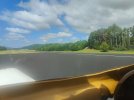
Circling back to post a picture of me in the turnout. It huge. The taxiway hold short line is closer than I am in this picture. If you look closely you might see the touchdown location.
IMG20250729104326.jpg
 
It pretty obvious you can. There are plenty of runways which don’t meet design standards. Others where you turn off onto the grass where there is no taxiway at all. Then grass fields themselves. But with all those I’ve seen, you are going somewhere other than sitting at the edge of a runway that from all appearances, does meet design standards, so I don’t think any of that is relevant.
I was responding to a specific comment that implied you could not clear the runway without hold-position markings in your path. I have sat in a plane in the grass next to the pavement while a plane landed or took off probably hundreds of times. Maybe a couple of pilots were skittish and couldn't handle it. Fair enough, but that's on them.
Is it relevant to the regulatory question how the pilot sitting in the turnabout “feels” or whether the airplane is a light sport that fits well as opposed to an 8 seat that doesn’t fit?
Is there actually a regulatory question here? The turnaround in question is off the side of the runway and hundreds of feet from the threshold.
 
Is there actually a regulatory question here? The turnaround in question is off the side of the runway and hundreds of feet from the threshold.
I don't know. But this is not a grass runway, but a standard runway which has markings separating runways from taxiways and ramps.
 
Yeah, the question is if there is a regulatory concern here and if so upon whom? What regulation? Landing traffic or guy who taxi's into this position with traffic say on downwind?
 
Back
Top