Random Q. Why not diesel?

What about diesel engines running on widely available Jet-A? Jet-A isn't diesel fuel per se, but presumably it's close enough. I'm not sure how much weight the emissions systems adds, but wouldn't a diesel engine could generate enough power to raise the gross weight on many airframes.
SMA (Safran, France) spent a billion dollars developing a 230-HP horizontally-opposed direct-drive four-cylinder diesel engine, aimed at airplanes like the Cessna 182. It weighed more than the O-470 it replaced, and while it burns less Jet-A than the O-470 did of 100LL, Jet-A weighs more. You lose useful load.

You cannot just increase gross weight with more power, either. The airframe itself has strength limitations, and increasing gross eats into safety margins. Legal limitations there.

That SMA conversion for a 182 is somewhere north of $100K. There aren't many flying. I did some work on one.
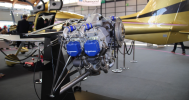
1756958985660.png
 
To remark on original post...from the engineering view, diesels have their own challenges. Not to say they cant be made to work. Existing 2 certified diesels are car engines conversions, which lower cost due to mass production scale, and they are simple and with fewer moving parts than gas. But due to higher compression and heat, they are typically significantly heavier than gas counterpart. Also, the shaft combustion pusles cause far more stresses, especially on gear boxes. We looked at diesel conversion for our C172 test aircraft but decided to stick with an aluminum V8 conversion due to cost, weight, and other factors. The pulse stress was a significant factor.

Our goal was not only to make a cleaner burning and less expensive engine that was software controlled so it could be installed on many different legacy airframes with only changes in software and gearbox ratios.... but primary objective was to eliminate need for leaded gas and substantially lowering cost of acquisition and operation. Our price point objective was to sell a complete firewall forward conversion kit for about same as factory overhaul of original engine (about $28k at the time), which made practical sense considering age of existing piston fleet. This was about 1/4 of Continental certified diesel C172 conversion of $110K; which didn't make economic sense for repowering most legacy aircraft.

So, as much as diesel seem perfect for small aircraft due to burning jet fuel and simplicity, the challenges made it a far more expensive solution from our standpoint. Liquid cooling did not play much of a part in decision, as it's far better for engine stresses and prolongs engine life to further offset long term costs, even though diesels run hotter than gas and need larger cooling components.

Our 220HP C172 cost about $21/hour total to fly using cheap car gas, whereas Continental's C172 diesel more than 3X that. Speaking to Red Hawk at OSH this year who is trying to certify a diesel C172 kit, was told cost would be about same as Continental's conversion. So, diesels are not yet a practical solution for older GA fleet, at least not yet. We flew our V8 C172 from Denver to Oshkosh this year and calculated cost was about 60% less compared to with original O-340 engine ..... since Continental's diesel is within about 10% of O-340 cost if I recall correctly, it would take a significant amount of hours to recoup savings swapping to diesel... like never.

But materials are getting lighter and less expensive manufacturing procedures are developing, so wouldn't be surprised if a suitable diesel comes to market in next 5 years for converting older aircraft.
 
Delta Hawk has been one year away from production since 1998.

Ah, but now they are certified, have several STCs/fire-wall forward kits in development, and will be in production...next year!

Joking aside, I'll be near the front of the line for their C182 package.
 
while it burns less Jet-A than the O-470 did of 100LL, Jet-A weighs more.
Jet-A vs 100LL is 6.7 pounds per gallon vs 6.0 pounds per gallon. I hopped from a DA40XL to a DA40NG and 75% power for each was 10gph vs 6.6gph. This works out to be 60 pounds per hour burning AVGAS versus 45 pounds per hour burning Jet-A, a significant net savings. It needed every bit of it, though. While the useful load was about the same between the two, the DA40NG gross weight was 110 kg higher.
 
Complex question.

Why not diesel? 100-years ago the answer was weight. Even low octane gasoline powered engines of that day delivered more power per calorie. Of course, Nazi Germany and the Stalinist USSR. having limited resources and refining capability used compression distillate engines 90 or so years ago.

Today? Well we have a well established infrastructure that uses gasoline rather than diesel. And we have millions of minimally and superficially "educated" people who equate diesel with dirty (and coal produced electric as "clean").

Rules, set forth to protect the public . . . but rigidly adored to to serve as an effective barrier to entry . . . make changes onerous.

In a minority opinion, I think that every argument for change should live or die on its own merits. Does the OP (or anyone else) wish to offer specific suggestions for positive change?
 
Existing 2 certified diesels are car engines conversions, which lower cost due to mass production scale, and they are simple and with fewer moving parts than gas.
The SMA diesel is not a converted car engine. It is a clean-sheet design.

Moreover, which parts are left out of a diesel to make it simpler? A diesel needs either a complex high-pressure fuel pump, or injectors that are mechanically or hydraulically-driven. It also needs the entire crankcase, crankshaft, accessory gearing, camshaft and valve train, oil pump and so forth. It is not simpler.

Modern gas auto engines don't even have distributors.

The SMA is a FADEC engine, controlled by computers, with a mechanical emergency backup control in case of electronics failure. No simplicity there, either.
But materials are getting lighter and less expensive manufacturing procedures are developing, so wouldn't be surprised if a suitable diesel comes to market in next 5 years for converting older aircraft.
Lighter, stronger materials are only part of the problem. The diesel is a compression-ignition affair, meaning that the heat of compression is what ignites the fuel. Compressing air concentrates its latent heat and raises the temperature of the charge. But in cold weather, starting a diesel becomes difficult because the air contains too little heat. Even with glow plugs it's harder. SMA has a minimum starting temperature and it's far above anything recommended by the gasoline aircraft engine manufacturers. I don't remember the temp, but it was around freezing. The engine needs serious turbocharging to operate at altitudes, as well.
 
hmm wouldn't have to be a drop in replacement for me, id exchange a bit of weight for hp and liquid cooling. also since most are turbodiesels you're very likely to go much faster at altitude.
CAR 3 / Part 23 certification is for a specific HP at a specific weight and options. Otherwise you'd need new W&B data, takeoff/climb/fuel/performance charts.

Someone is gonna have to take on that liability. I'm sure Piper/Cessna et al are happy to be done with the liability of 50-70+ year old airframes.
 
Even with glow plugs it's harder.
I'm gonna have to say that cold weather diesel starting has been solved. Glow pugs/heaters are a thing.

Diesels would most likely need watercooling.... that's a significant heat mass that won't drop that quickly, meaning your engine is still warm when you try to do an air start.
 
No, "modern" cars use the same 118-year old tech as Ford's model T
That old fable again. Yes, the Model T had pistons in cylinders and a crankshaft and camshaft and valves. And that's about where it ends. Modern engines have forged aluminum, steel-strutted pistons. I think the Model T had cast-iron pistons. The modern engine has a forged crank instead of cast. Roller lifters are common now, and the valves and seats are typically stellite or another high-level alloy, with sodium cooling. Bearings are steel shells with precisely babbitted surfaces as opposed to babbit melted and poured into the rod and cap and then machined. Electronic fuel injection and distributorless electronic ignition. Starters instead of hand cranks. Alternators instead of generators, making twice or three times the power with half or a third of the weight. The modern engine lasts for 200,000+ miles instead of the T's 10,000 or 20,000 miles.

Edit: And it can run at two or three times the T's redline, making far more power. Much higher compression ratios.

Not the same thing at all. And as far as aircraft engines go, a new one is nothing like the ones from the 1940s. They might look the same, but the metallurgy is much improved. Stuff lasts much longer. Longer TBOs reflect this.
 
Last edited:
I'm sure Piper/Cessna et al are happy to be done with the liability of 50-70+ year old airframes.
Since 1995 liability for the aircraft or its replacement parts or its engine is limited to 18 years. They aren't much worried about really old ones. If they were they'd refuse to sell parts for them.
I'm gonna have to say that cold weather diesel starting has been solved. Glow pugs/heaters are a thing.
The SMA people, as I said, spent one billion dollars designing, developing and testing their diesel. I think they learned something about cold-weather operation, and even with glow plugs the starting temp lower limit is near freezing. It has a compression ratio of only 15:1, meaning lower compression temps, but even at that ratio the vibration at idle is awesome. It is a light engine for flight, after all. It doesn't have a lot of mass to damp the shaking.
Diesels would most likely need watercooling.... that's a significant heat mass that won't drop that quickly, meaning your engine is still warm when you try to do an air start.
The SMA is air and oil-cooled. Oil in the heads, air on the cylinders. There is a huge oil cooler in the installation. Even then, it's light weight means little mass to hold heat.


It's real easy to say that problems are solved and that it's easy to bring a new design to market. SMA has a billion dollars' worth of receipts to prove it ain't so. There have been hundreds of failed attempts over the years. Continental bought the SMA technology but they never built it. They have several other diesels that aren't selling that well, too. The costs are far too high. From their website:

1757040509678.png


It's not as if nobody is trying. Lycoming is also involved and has been for some time: https://avweb.com/news/lycoming-diesel-details/

From that article:

As rough cost predictor, Kraft says a certified civil diesel engine would cost more than twice as much as an equivalent gasoline engine, which more or less mirrors Centurion pricing. Lycoming expects to release more information on the DEL-120 and other engines later in the year.

"Later in the year."
And how much have we heard since that article appeared in March of 2014??
 
Last edited:
It seems to me that the problem isn't that there aren't many alternative engine types/designs that would work. It's that we're trying to retrofit them into airplanes that were designed for a different setup.

If we built new airframes designed for new diesel or any other type of engine I'm sure they could be some great airplanes that most of us here wouldn't be able to afford until they depreciate for 30-40 years.
 
The SMA diesel is not a converted car engine. It is a clean-sheet design.

Moreover, which parts are left out of a diesel to make it simpler? A diesel needs either a complex high-pressure fuel pump, or injectors that are mechanically or hydraulically-driven. It also needs the entire crankcase, crankshaft, accessory gearing, camshaft and valve train, oil pump and so forth. It is not simpler.

Modern gas auto engines don't even have distributors.

The SMA is a FADEC engine, controlled by computers, with a mechanical emergency backup control in case of electronics failure. No simplicity there, either.

Lighter, stronger materials are only part of the problem. The diesel is a compression-ignition affair, meaning that the heat of compression is what ignites the fuel. Compressing air concentrates its latent heat and raises the temperature of the charge. But in cold weather, starting a diesel becomes difficult because the air contains too little heat. Even with glow plugs it's harder. SMA has a minimum starting temperature and it's far above anything recommended by the gasoline aircraft engine manufacturers. I don't remember the temp, but it was around freezing. The engine needs serious turbocharging to operate at altitudes, as well.
Thank you Dan for poignantly correcting me, but I'll agree to disagree. I stated 2 existing certified diesels are car engines, Continental (formally Thielert that continental bought in BK) and Austro (although now I believe is replicating more MB parts in house). Another diesel start up, EPS, also went BK. As far as diesels being being more or as complex as gas, simple diesel designs as Redhawk's are far more simple than a modern gas counterpart or diesel, and, thus, cheaper to make and maintain except for the non-mass-produced/proprietary parts..... either way, I clearly stated the challenges of diesels from a start-up prospective and proposition of value to potential refit market of old planes, as the original post focused. Cold wx ops for diesels have been well developed and cold is not anywhere near the problem of yesteryear....even simple 2 stroke diesels have figured it out. My point was simply diesels have challenges for small aircraft but they are slowly being mitigated... but cost will likely remain the biggest obstacle in refitting legacy planes, thus the reason I believe gas engines will continue to be dominate in the GA fleet.
 
Since 1995 liability for the aircraft or its replacement parts or its engine is limited to 18 years. They aren't much worried about really old ones. If they were they'd refuse to sell parts for them.
Issuing a new TCDS or even a STC would restart the clock.

"Furthermore, when a part is installed as addition, modification or replacement, exemption for claims of liability arising out of this part kicks in 18 years after installation of that part. So a 20-year-old aircraft may still be the object of a successful suit against a manufacturer in regards of manufacturer modifications or parts installed within the last 18 years."

Not the same thing at all. And as far as aircraft engines go, a new one is nothing like the ones from the 1940s. They might look the same, but the metallurgy is much improved. Stuff lasts much longer. Longer TBOs reflect this.
Yes it IS the same thing. Stuff doesn't last much longer. Lycomings still rot out camshafts because of a 60+year design choice that still persists. The solution would be to add some sort of oiler system to spray the cam with an external motor but there is no way on god's green earth that Lycoming is going to go through the process of certificating an engine to fix a problem that the OWNER must pay for. One simple hole in the case and the entire camshaft issue is solved. Who wants that liability???

Let also not for get the bad cams, cranks and cylinders that plauged the 1990's and 2000's. How many recurrent ADs are required on engines that will never be fixed with a 'rev B' part number? Lycoming still hasn't fixed the crank timing gear issue requiring a partial tear down on a prop strike manditaing an AD. Contintental doesn't. Hmmmm..... The plastic timing gear on a magneto is a good idea? REALLY? Where is your modern replacement for that problem? Bendix don't care. Its your money. Even if they had a 2000 hour solution on the shelf do you think they want the cost and liability of certificating?

I'm gonna put a car motor in my EAB. It will cost $3000 and its backed up with ACTUAL new technology that you claim is in current dinosaur motors. REAL port fuel injection, variable ignition timing, state of the art metals and literally MILLIONS of hours of R&D.
 
Last edited:
That old fable again. Yes, the Model T had pistons in cylinders and a crankshaft and camshaft and valves. And that's about where it ends. Modern engines have forged aluminum, steel-strutted pistons. I think the Model T had cast-iron pistons. The modern engine has a forged crank instead of cast. Roller lifters are common now, and the valves and seats are typically stellite or another high-level alloy, with sodium cooling. Bearings are steel shells with precisely babbitted surfaces as opposed to babbit melted and poured into the rod and cap and then machined. Electronic fuel injection and distributorless electronic ignition. Starters instead of hand cranks. Alternators instead of generators, making twice or three times the power with half or a third of the weight. The modern engine lasts for 200,000+ miles instead of the T's 10,000 or 20,000 miles.

Not the same thing at all. And as far as aircraft engines go, a new one is nothing like the ones from the 1940s. They might look the same, but the metallurgy is much improved. Stuff lasts much longer. Longer TBOs reflect this.
Actually, I was referring to the ignition system.
 
Someone is gonna have to take on that liability.
Or the owner could simply install a diesel under Exp/Exh on his own and keep the liability to himself? Been done for other type installs for years. No need to wait for someone else to do it.

I'm gonna put a car motor in my EAB. It will cost $3000 and its backed up with ACTUAL new technology that you claim is in current dinosaur motors.
Then why do you suppose car motor powered E/ABs have a higher failure rate than those dinosaur engines?
 
Actually, I was referring to the ignition system.
I don't think the Model T ignition bears any resemblance to a modern ignition system, other than the (sort of) lack of a distributor. I mean, taken to that extreme, an Airbus uses "the same 118-year old tech" as a Blériot V just because it's a monoplane. A current ignition system has essentially none of the characteristics of a Model T system. A computer uses sensors to determine crankshaft position, then calculates when to fire plugs based on numerous factors - temperature, speed, load, even the type of fuel. Plugs are fired electronically, usually by pulsing the primary of individual coils. No capacitors (condensers) to store charge, no contact closures, no fixed or manually adjusted timing.

Maybe you could explain where you see the similarity. I'm not seeing it.

Then why do you suppose car motor powered E/ABs have a higher failure rate than those dinosaur engines?
Poor execution, poor fuel systems, poor electrical systems, and most often an inadequate or poorly designed PSRU. From what I've read, it's generally not the engine itself that fails. We're seeing more recently developed systems that seem to have much improved reliability and longevity. I'm not aware of any of those in the $3K range, but they are a fraction of the cost of a Lycoming/Continental. In the smaller E/AB space (under, say, 200 HP) Aeromomentum and Viking seem to be doing well. On the lower end of the spectrum there are also an awful lot of VW-based and Corvair conversions flying; it's pretty well plowed ground.

All that aside, there's something to be said for the dead simplicity of an O-235 or something like it, they're just punitively expensive to buy, operate, and overhaul compared to some other solutions.
 
I don't think the Model T ignition bears any resemblance to a modern ignition system, other than the (sort of) lack of a distributor. I mean, taken to that extreme, an Airbus uses "the same 118-year old tech" as a Blériot V just because it's a monoplane. A current ignition system has essentially none of the characteristics of a Model T system. A computer uses sensors to determine crankshaft position, then calculates when to fire plugs based on numerous factors - temperature, speed, load, even the type of fuel. Plugs are fired electronically, usually by pulsing the primary of individual coils. No capacitors (condensers) to store charge, no contact closures, no fixed or manually adjusted timing.

Maybe you could explain where you see the similarity. I'm not seeing it.
Disclaimer: as a teenager my neighbor rebuilt a model-T. And while I am not a mechanic, I think that I am handy and have worked on BMC-As, 4-cycle VW diesels, Subi Os, and modern two-cycles.

IiRC, the Ford had one circuit per cylinder. Four coils which were fired by the spinning magnets on the driveshaft collapsing an electrical circuit

The same as today, it benefitted from being contactless and easy to troubleshoot.

If you say it is "different" because a few electronic sensors provide a "theoretically more perfect" (actually more "normalized" until the first premature hicup) regulator than a human driver I agree.

Distributors (the item in the post I was responding to) were introduced to Fords post 1908. They relieved the driver of advancing and regarding the spark. Good for poor divers, not so much for good ones . . . but 70 octane was $0.29 a gallon.

PS: I have not seen anything that is as technologically perfect as a late 1970s Bosch electromechanical fuel injection system. IMHO most of "engineering" is devoted to reducing production (no overall) costs. That devoted to innovation may well be zero within the margin for error
 
From my quick googling, the Diesel engine was invented in 1893, and the 4 cycle gas engine in 1876. Discussions about which one is higher tech is a bit like arguing over whether Coke or Pepsi is healthier for you.

If you have to burn kerosene, because av gas isn't available where you want to go, and might not be as available in the future, then why not use an actual turbine engine? My question is how inexpensive could a turbine engine around 200HP be made, that had roughly the same TBO and reliability as a piston engine, if the design were optimized primarily for low volume production cost. If cheaper materials and manufacturing methods can be used than the giant ones, this doesn't sound too crazy to me.

And along those lines - https://www.kitplanes.com/turbaero-announces-new-turbine-engine/

No affiliation at all, just found the above w/ a quick search on small turbines.
 
Issuing a new TCDS or even a STC would restart the clock.

"Furthermore, when a part is installed as addition, modification or replacement, exemption for claims of liability arising out of this part kicks in 18 years after installation of that part. So a 20-year-old aircraft may still be the object of a successful suit against a manufacturer in regards of manufacturer modifications or parts installed within the last 18 years."


Yes it IS the same thing. Stuff doesn't last much longer. Lycomings still rot out camshafts because of a 60+year design choice that still persists. The solution would be to add some sort of oiler system to spray the cam with an external motor but there is no way on god's green earth that Lycoming is going to go through the process of certificating an engine to fix a problem that the OWNER must pay for. One simple hole in the case and the entire camshaft issue is solved. Who wants that liability???

Let also not for get the bad cams, cranks and cylinders that plauged the 1990's and 2000's. How many recurrent ADs are required on engines that will never be fixed with a 'rev B' part number? Lycoming still hasn't fixed the crank timing gear issue requiring a partial tear down on a prop strike manditaing an AD. Contintental doesn't. Hmmmm..... The plastic timing gear on a magneto is a good idea? REALLY? Where is your modern replacement for that problem? Bendix don't care. Its your money. Even if they had a 2000 hour solution on the shelf do you think they want the cost and liability of certificating?

I'm gonna put a car motor in my EAB. It will cost $3000 and its backed up with ACTUAL new technology that you claim is in current dinosaur motors. REAL port fuel injection, variable ignition timing, state of the art metals and literally MILLIONS of hours of R&D.
Regarding resetting the clock on the 18 year clause of the GA revitalization act that was supposed to limit aircraft manufacturers from liability in crashes (on simple assumption that if no one else crashed that airplane for past 18 years but you, you must be the cause of the crash….not the manufacturer). Excellent point, pfarber, as trial attorneys fought hard to water it down and getting the 18 year limits reset each time a manufacturer updated something in the design even if just a procedure or something unrelated to cause of a crash….in one incident, lawyers successfully reset the clock due to a unrelated change to POH (POH is part of type design). So, with any manufacturer issued advisory, white paper, ECT… the clock is reset leaving the act worthless. Many argued that this would manufacturers less likely to make any changes to legacy fleet regardless of its safety merits, which is likely.

Thus, manufacturers want the GA fleet parted out, or better yet scrapped if they had their way. They sold most of their products 40 years ago with little reoccurring revenues, yet they get sued every time one crashes costing them significantly regardless of crashes cause. We found this out when going through STC cert with our firewall forward engine kit. …regardless of the benefits it brings, their deep pockets remained a target for litigation….so anything that kept the old fleet flying was a liability for them.

When I was a test pilot, we often worked on older designs that experienced a safety concern and looked for better methods (procedures, design changes, engineering issues, ECT) that would mitigate a risk. It would be inconceivable finding a safer way of flying it could be denied simply due to threat of adding another 18 years of liability to your own company. Ironic, when you think of it.
 
Last edited:
I don't think the Model T ignition bears any resemblance to a modern ignition system, other than the (sort of) lack of a distributor. I mean, taken to that extreme, an Airbus uses "the same 118-year old tech" as a Blériot V just because it's a monoplane. A current ignition system has essentially none of the characteristics of a Model T system. A computer uses sensors to determine crankshaft position, then calculates when to fire plugs based on numerous factors - temperature, speed, load, even the type of fuel. Plugs are fired electronically, usually by pulsing the primary of individual coils. No capacitors (condensers) to store charge, no contact closures, no fixed or manually adjusted timing.

Maybe you could explain where you see the similarity. I'm not seeing it.

Admittedly the similarities do have 100+ years for technical advances. But his statement comes from the fact that it goes back to low voltage distribution system and individual coils the model T used are now standard again on modern cars vs how they were built for the 75 years or so in between. The computer that does all that fancy calculations of when to advance and retard spark is obviously much more high tech verses the Model T's Analog Computer (timer) that did that over 100 years ago.

The one I find interesting is from my understanding of the Prius Drive Train the Electrical Motor system design is of similar design to the Model T generator. While it would be an exact match if you upgraded an model T Generator with better magnets and windings added some electronics and a Battery it could function much like the Prius Hybrid drive system. In practice this would not be practical as it would require a new engine/transmission case (integrated on the model T) to fit the large magnets and coils required.

Another interesting thing about the Model T, Design in a few Hydraulic valves into transmission and I would mimic the power glide transmission from 60's.
It was basically an automatic transmission, the logic just hadn't been developed yet for the automatic shifting yet. But this did make shifting gear very easy which was big selling point for Model T's.

Brian
1926 T Pickup.
 
Issuing a new TCDS or even a STC would restart the clock.
Nope. New TCDS only affects the new airplanes built under it. An STC affects the parts installed, not the whole airplane. What would be fair about someone installing the Robertson STOL kit on their 40-yeaar-old 185, then crashing and suing Cessna?
Yes it IS the same thing. Stuff doesn't last much longer. Lycomings still rot out camshafts because of a 60+year design choice that still persists.
You are behind. Lycoming incorporated roller lifters nearly 20 years ago. I bought a lot of Lyc factory overhauls with those lifters and matching cam, and we had NO cam or lifter issues at any time, going clear to TBO with no problems at all. Even with the old design we had NO problems. The owners that have problems are making short flights, or ground-running the engine, and getting combustion-produced moisture pumped past the rings into the case where it mixes with the oil and forms acids that eat stuff like cams and lifters. Engine rebuilders like Ram Aircraft have videos on it. The engine manufacturers issue service letters on such operations.

Aside from that, there is an aftermarket Lycoming camshaft that is rifle-drilled to carry oil from the camshaft bearings out to each lobe, squirting the oil out so it strikes the lifter face. Lyc could have bought the patent, but opted for roller lifters instead.

Cars don't suffer that so much because they have PCV systems. PCV needs low manifold pressures to work, which means airplane engines can't use it. MPs are high almost all the time.
Thus, manufacturers want the GA fleet parted out, or better yet scrapped if they had their way.
If that was true, Cessna would not still be building and selling 172s, 182s and 206s. Piper would not be building and selling Warriors and Archers.
 
Existing 2 certified diesels are car engines conversions, which lower cost due to mass production scale, and they are simple and with fewer moving parts than gas.
That, above, is what you said. So what you corrected me with (below) isn't right. SMA is an existing certified diesel, not based on any auto engine.
Thank you Dan for poignantly correcting me, but I'll agree to disagree. I stated 2 existing certified diesels are car engines, Continental (formally Thielert that continental bought in BK) and Austro (although now I believe is replicating more MB parts in house).
 
Semantics, I suppose, as more grammatically correct would have been, “2 of the existing….” or likewise. My overall intent was to opine on original post based on my related certification experience.
 
Poor execution, poor fuel systems, poor electrical systems, and most often an inadequate or poorly designed PSRU. From what I've read, it's generally not the engine itself that fails.
Except most of those issues could apply to Lycoming, TCM or Rotax engine installs as well. Its been my understanding that the reason car engine based E/AB installations fail more was directly due to the install requirements for that type of engine. Maybe Ron W has some data that can shed more light on this specific subject?

Thus, manufacturers want the GA fleet parted out, or better yet scrapped if they had their way.
That has not been my experience. The OEMs have always had the power to “cancel” a specific model line if they choose. And some have. But some don’t and in some cases even upgrade and produce more of the same or new.

As to the GARA 18 year clock its also been my experience that it still requires a high bar to reset. I asked a similar question a few years back where the original airframe and engine OEMs were listed on a court filing for an accident involving a 25+ year old aircraft. Was simply told it was SOP to list them but short of a miracle it was the 2nd or 3rd tier providers that would get hammered. And one did with the original OEMs dismissed from the suit.
 
Except most of those issues could apply to Lycoming, TCM or Rotax engine installs as well. Its been my understanding that the reason car engine based E/AB installations fail more was directly due to the install requirements for that type of engine. Maybe Ron W has some data that can shed more light on this specific subject?
Not clear what you mean by "install requirements". Things like a proper electrical system, proper fuel system, and so on? Or something else?

I mean, I don't really have a dog in this fight, since I don't have any solid plans to use an auto conversion in my plane - though I'm not ruling much out at this point. The horror stories I've read and heard, though, haven't been engines self-destructing because they're fundamentally incapable; it's been reduction drive issues, mounts, fuel and electrical and the like. And of course the occasional result of just a butt-ugly airplane that no one wants, so it eventually gets lopped off at the firewall and a proper airplane engine installed.
 
I mean, I don't really have a dog in this fight, since I don't have any solid plans to use an auto conversion in my plane - though I'm not ruling much out at this point. The horror stories I've read and heard, though, haven't been engines self-destructing because they're fundamentally incapable; it's been reduction drive issues, mounts, fuel and electrical and the like. And of course the occasional result of just a butt-ugly airplane that no one wants, so it eventually gets lopped off at the firewall and a proper airplane engine installed.
"...it's been reduction drive issues, mounts, fuel and electrical and the like."

In other words, the same failure factors for Lycs and Continentals. Those engines very seldom blow up without some good reason such as defective cranks or piston pins or rod bushings. Ignition fails because the OEM-mandated periodic internal inspections aren't being done on the magnetos. Fuel fails because the system isn't maintained and crud accumulates in lines and filters, water accumulates in tanks because the cap gaskets are shot, bladders disintegrate when they're decades past their best-before date. Alternators and vacuum pumps fail since, like magnetos, the periodic inspections aren't done and they quit at a bad time like at night or in IMC and the pilot loses nav/approach instruments and equipment. Engine mounts get old and hard and deformed and disintegrated.

The auto conversions mostly rely on the ship's electrical system for ignition or EFI. If that system fails and you have no backup, the game is over. And electrical system failures in airplanes even with Lyc/Con legacy engines is distressingly common, with failed alternators, corroded cable connections, failing contactors and so on. At least the engine keeps running with its system-independent mags and carb or mechanical fuel injection.
 
Last edited:
We were at Oshkosh a few years back and walking by the Continental group and I say "No way!". Margy goes what? I say look at the N Number on this plane. It was the plane she had learned to fly in. N73ER was an original Embry-Riddle plane that was renumbered N73FR when the university sold it. It was on lease to our the flying club at IAD and Margy got her private in it. The owners sold it to Stan Fetter who ran a traffic reporting operation over at Hyde. Stan put a Thielert diesel in it as it gave him cheaper long and slow operations. Apparently, it made its way down to some Florida flight school, still with the diesel, and Continental bought the Thielert line, so they put it on display.
N73FR is still around? With the diesel? Wow.

I flew it with Stan's operation, both before the Thielert conversion and after. This was back in 2005-2008. It was pretty clapped out and had like 15k hours on it when he did the conversion. The flight school must have done a pretty significant cosmetic overhaul.
 
Or something else?
To add to the above, it goes down to the basic design of your average car engine. For example, even if you install the engine using the same car mount points, the native engine vibration signature changes due to the aircraft structure which in turn can lead to premature failures on several levels.

As I’ve said before, if you want a car engine put in a derated NASCAR/Indy engine which is designed much closer to an aircraft environment to include its vibration signature, but at a significant more price point.
 
N73FR is still around? With the diesel? Wow.

I flew it with Stan's operation, both before the Thielert conversion and after. This was back in 2005-2008. It was pretty clapped out and had like 15k hours on it when he did the conversion. The flight school must have done a pretty significant cosmetic overhaul.
Yeah, but they took the roof windows out, which I always thought was cool. They redid the avionics as well. Margy learned to fly in that plane and we took it ourselves to Oshkosh twice before we had the Navion. Margy's instructor forbid the use of GPS so I taught her how to use the old clunky RNAV in the plane. When her instructor caught her punching in the coordinates for MRB one day, he made the rule more general: NO RNAV.

Amusingly, because of the way the flying club it was in (Armel Aviation), I had keys to that plane. When the sold it to Stan (we were based at VKX by then), I asked him if he wanted the ones that I had. He said, "Keep them, you might end up needing them." When he hired Michelle to fly for him, she was over at our house the day before she started. I gave her my keys so she showed up to fly without needing to get them from Stan.
 
You can.

The problem is that they are still less efficient than equivalent GA piston engines. But close. They do close the gap between your typical Garret/Honeywell 1000+ hp turbines you find in your Caravans and PC24s.
This is the same product as in your link-
It seems fairly close to a GA piston engine. 141 HP at 10 GPH or less. A C172 engine also burns 10 GPH but is 180 HP if I remember correctly.
 
the FF/HP ratios in that range (diesel has more energy in terms of weight, so will always have a lower BSFC rate) are not all that significant when considering overall cost and value proposition. But a buyer of a factory new C172 may pay upgrade for a diesel, but owner of a 1970's vintage likely not considering acquisition and like operating cost when figuring break even points. So, even though jet A fuel cost will likely be lower (especially as leaded alternatives take over), the delta would still not make financial sense if paying for the upgrade, especially if the initial conversion cost is over $100K as it is now. During our market research about 4 years ago, we spoke with operators that converted their C172 to the continental diesel. All cited their motivation was due to cost and availability of AVGAS in their region....many had to buy it in barrels, or paid more than 3-4X what it was costing here in the US. At that cost delta it made sense for fleet operators that were flying significant hours in short periods. BTW, almost all expressed their less than happy experience with the conversion.

So, to more directly answer the initial question..... I think we will see more diesels in GA, likely some from the drone/unmanned world, that will lower costs as designs are developed for larger drones that are being required to adapt some cert basis (manufacturers could submit alternative cert basis from that segment). But for most of us with old planes looking for alternatives at TBO or rebuild for other reason, there will be few options that make sense based on aircraft value.

Recreational GA will likely become more of a rich man's sport, especially for certified aircraft. Even with regulatory restrictions on my experimental C172 a bit more than home builts, it's still far less restrictive than standard AWC and far less expensive to upgrade and fly. As such, I think EXP will continue being the dominant segment in terms of growth for the recreational segment as a result. Hopefully, FAA policy makers change their minds about allowing older legacy aircraft transition to EXP that will allow recreational owners to use less expensive solutions, such as exp/non-certified propulsion solutions, from a well design and tested conversion kit. This would likely open up segway to installing affordable and practical diesel on you old but reliable aircraft.

It's a great question.... as Pi1lotguy pointed out, diesels would correct many of the issues FAA has claimed they want to fix for decades. In my real experience with this subject, The lower levels of FAA want new tech, but the executive policy makers do not and are more than content to see GA's continued demise.

Sorry for long post
 
Then some group of folks will demand that diesel powered airplanes run Diesel Exhaust Fluid to to reduce the amount of air pollution created by the diesel exhaust...
 
Back
Top