Piper cherokee engine roughness??

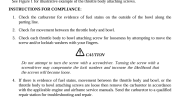
Found it myself. Yep, I just tightened the screws back up snug
Anyone happen to have a diagram or something g of the carb I can reference while trying to look at it? I’m not sure which one I have as I’m away now. It’s a lycoming 0-320 if that helps.
 
Anyone happen to have a diagram or something g of the carb I can reference while trying to look at it? I’m not sure which one I have as I’m away now. It’s a lycoming 0-320 if that helps.
Just look at it...look for blue staining.
Do you know how to take the cowl off?
Do you know where the carb is located?
5d25c88c-3c3d-49ef-8ab5-41b8c2739bfe.heic
 
Last edited:
Anyone happen to have a diagram or something g of the carb I can reference while trying to look at it? I’m not sure which one I have as I’m away now. It’s a lycoming 0-320 if that helps.
My carb was like the picture Dan Thomas posted
 
Did you all read the document that @Dan Thomas posted?


View attachment 153813
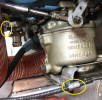
I did...The carb in my picture above is a avstar that came on my factory rebuilt 0-320. I posted it so the OP could see what the carb looked like without the exhaust in the way. They don't leak like the old marvel carbs do. There's no fuel bowl gasket.
 
Last edited:
My guess is you have a Marvel-Schebler/MA-4-SPA.
Here is everything you ever wanted to know about Marvel-Schebler aircraft carbs:

I found my Warrior II's carb bowl loose some years ago.
 
Last edited:
Just look at it...look for blue staining.
Do know how to take the cowl off?
Do you know where the carb is located?
5d25c88c-3c3d-49ef-8ab5-41b8c2739bfe.heic
I like seeing photos of your engine. It reflects a racer's mentality.
 
1785439952754.png

Those clamps holding the carb heat and mixture cable housings are famous for stretching a bit and letting the housing slip. I used to use a bit of .031" lockwire, wrapping it 1-1/2 turns around the housing up against the clamp, the wire resting in the grooves of the housing, then twist the ends for about 1/2", bend the twisted section down along the clamp, then wrap the wires in opposite directions around the housing against the other end of the clamp, then twist those ends and trim them. The housing can't slip now. I can't find any pictures of it on the 'net.
 
View attachment 153878

Those clamps holding the carb heat and mixture cable housings are famous for stretching a bit and letting the housing slip. I used to use a bit of .031" lockwire, wrapping it 1-1/2 turns around the housing up against the clamp, the wire resting in the grooves of the housing, then twist the ends for about 1/2", bend the twisted section down along the clamp, then wrap the wires in opposite directions around the housing against the other end of the clamp, then twist those ends and trim them. The housing can't slip now. I can't find any pictures of it on the 'net.
I did something similar that with that carb heat cable, it has a little piece of safety wire under the clamp. Next time I will try it your way. Thanks for that.
The new McFarlane cable I installed fit a little better but I still used a small piece of wire under clamp
 
I’ll add my own fuel to this fire……now thinking about, my fuel pressure is always running g high also for some reason. No one can determine an a seer on that.

So yesterday I received my invoice when the mechanic checked the plan over after my complaint. Did a through check: carburetor, primer, spark plugs, magnetos, compression check etc. only thing found was a loose primer line which was corrected.

My invoice was for nearly $1300. I had to take a second look at it. Called and spoke with the mechanic. He said that’s correct. The hourly rate is $140 an hour. I said the math doesn’t add up to $1300. I was then told it does become he assigned two mechanics to look at my plane and they each have a $140 rate so the cost was $280 per hour.

This has to be one of the craziest things I’ve ever heard. So if I get an oil change and 5 mechanics work on it I’m paying $700 an hour, unbeknownst to me??

I’ve been flying for 10 years. Was always, the hourly labor rate is the hourLy labor rate…same as a vehicle mechanic.

Any thoughts or anyone see this before?
 
If two mechanics worked on it and did it in half the time that a single mechanic did, then it's a wash. A better way to look at it is the total effective hours billed and decide if that seems reasonable.

As much as some folks on here like to beat up on Mike Busch, this is another one of his (in my opinion) excellent pieces of advice for owners: don't hand your aircraft to any mechanic and just verbally ask them to fix something. That's a blank check and you may get burned (as you are finding out). Better to a) have something in writing such as email and b) put a reasonable limit such as "You are authorized to perform up to five billable hours of review and investigation for this issue, and up to $500 in parts. Written authorization is required for work or parts costs in excess of this amount."

I like this because it protects the mechanic with a clear authorization for what the owner wants and precludes any argument about a reasonable bill. It also protects the owner from an unexpected high bill. I do this with my shop and it works very well. We have a great relationship.
 
My invoice was for nearly $1300. I had to take a second look at it. Called and spoke with the mechanic. He said that’s correct. The hourly rate is $140 an hour. I said the math doesn’t add up to $1300. I was then told it does become he assigned two mechanics to look at my plane and they each have a $140 rate so the cost was $280 per hour.

This has to be one of the craziest things I’ve ever heard. So if I get an oil change and 5 mechanics work on it I’m paying $700 an hour, unbeknownst to me??

I’ve been flying for 10 years. Was always, the hourly labor rate is the hourLy labor rate…same as a vehicle mechanic.

Any thoughts or anyone see this before?

Agree with AvNavCom. The real question is does total work performed line up with the hours, not how many people they used to do it. If the tasks performed don't reasonably add up to ~9.5hrs single man hours, fair to challenge it. Otherwise, probably not.

Your hyperbole oil change example "5 mechanics doing an oil change, and I'm paying $700 hr" probably isn't the best example. That work can't scale to 5 people (unless it's a government job, then it's easily a 10-12 man job). You just can't have 3 people screwing on an oil filter together, and safety-wiring it together.

Your situation is different. It sounds like you handed them the keys to the plane, told them the symptoms and asked them to find+fix a problem. That's a pretty open-ended task and you didn't time-box it with any kind of budget. In that case, two sets of eyes, two sets of flash lights, two people examining two different components (thoroughly) is entirely reasonable. None the less, the $1300 bill is a bummer of a surprise.

I'm not sure how much detail they gave you in the writeup, but I would want quite a bit on the diagnostics (especially because it sounds like they didn't find a glaring problem?). I'd want that detail not just for cost rationalization, but so you know what was checked and how extensively, so if it happens again you know what likely ISNT the culprit. In short, that detail can save another $1300 diagnostic expense.

 
Last edited:
I’ve been flying for 10 years. Was always, the hourly labor rate is the hourLy labor rate…same as a vehicle mechanic. Any thoughts or anyone see this before?
It really depends on how the shop charges labor: straight hours or flat rate. Most vehicle mechanics charge a flat rate based on a standard industry job guide. For example, if the guide states 3 hours that is what you'll be charged regardless if it involves 5 mechanics or a single mechanic finishes in 2 hours. However, most vehicle mechanics will also have a separate diagnostic rate with is always a straight labor rate based on actual hours worked.

Aviation mx has no job guides so most mechanics bill straight labor. But as mentioned, it usually works out if two mechanics work a job it ends up taking half the time which equals the same labor cost if one mechanic did the job solo in double that time. However, few jobs require two mechanics but troubleshooting can definitely be one of them in my experience. Regardless, one thing I always recommend especially with an open ended mx request like finding a problem, is to get a written work scope estimate up front to keep these type of surprises at a minimum.
 
Only thing found was a loose primer line which was corrected.
Hmmm :p
This has to be one of the craziest things I’ve ever heard. So if I get an oil change and 5 mechanics work on it I’m paying $700 an hour, unbeknownst to me??
On routine stuff, like an oil or tire change, we usually get charged a mechanics helper rate for the task and a full rate for the A&P/IA to do the QA of the work so that cuts down on the bill a little. What you got seems excessive given there are only so many bodies that can fit working in the space that they had to work on.
 
Just a follow up to this from a bit in the past. Took the plane up today, first time since the issue. 6,000 feet no issues at all today. Applied the carbheat and rpm dropped 600 approximately and ran really rough. Did this multiple times and same occurrence each time. Any thoughts?
 
We took a video of it. Upon viewing the video my last statement was incorrect. I had the engine leaned out at 6000 then applied the carb heat. We are guessing that’s the cause of today’s roughness. We were trying different configurations to simulate it. Luckily we shot a video and it was leaned out at 6000 feet and applied the carb heat. Caused a drop of like 600 rpm
 
Pulling carb heat makes the mixture richer, so it should not have brought on roughness. Unless you didn't really have it leaned out, and it was still pretty rich.

Or the SCAT hose that feeds the warm air to the carb airbox is collapsing...
 
Or it's SCEET hose that's delaminated.

For the difference between SCAT and SCEET:
 
Your hyperbole oil change example "5 mechanics doing an oil change, and I'm paying $700 hr" probably isn't the best example. That work can't scale to 5 people (unless it's a government job, then it's easily a 10-12 man job).
Ah yes, the old "I need a baby next month! Get me nine women..."
 
Could also be momentary plug fouling. Sometimes they foul and i just comes out. Sometimes you have to lean it out. Sometimes you have to pull the plugs and find the bad boy.
 
This is an intermittent problem, always difficult.

Checking carb heat is gonna be reach in and see if the flapper can move when not actuated, etc.

If leaning helps you either got too much gas or not enough air… air obstructions are relatively easy, but you gotta be thorough, literally finger inspect every inch of everything.

Too much fuel reeks of something loose inside the carb. It’s happened before…

It’s severe enough that there’s a smoking gun SOMEWHERE, get in the mindset to find it before moving forward.

It’s gonna be a weird one. A piece of scat tubing flapping, a carb heat plate loose on its shaft, the jet loose inside the carb, some bit of debris in the carb.… SOMETHING. Don’t stop till ya find it.
 
Back
Top