Carb ice has caused a lot of accidents. By some estimates, it is the most common cause of power failures. It is not well understood by some pilots, and their instructors are sometimes no smarter. Carb ice can happen on a 100-degree day, too. The temperature of the air passing though the carb drops by as much as 70°F as its pressure is reduced in the venturi or around the edge of the throttle plate (pressure drop causes a temperature drop, basic physics) and fuel evaporating in the airflow drops the temperature further as the fuel converts from liquid to vapor, absorbing heat from the air in the process.
So it's not just a wintertime thing. And if the engine starts losing power, pull that carb heat immediately, since if the engine keeps dying, the exhaust system cools off and now you haven't got the heat to clear the ice. The carb heat will increase the RPM drop and roughness as the ice melts, and then it will clear up. Too many guys push the carb heat off when things get worse, and that, too, causes accidents.
When you're going flying, you should know the atmospheric properties in play at the time, right? Two of the things in a METAR are the temp/dewpoint numbers, and when they are close together, carb ice is a real possibility. One should not be caught unawares. The closest airport to me has this METAR at the moment:
View attachment 153578
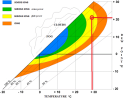
In the red we see that the temperature is 29°C and the dewpoint is 21. That is unusually close for this country; it's been very humid for weeks now. Let's check a carb ice chart:
View attachment 153579
I've drawn in the lines for the temp and dewpoint. We find ourselves at risk of serious icing especially at descent power. The partially-closed throttle plate causes the air to accelerate tremendously between the plate's edge and the carb bore wall, and that's where the ice will form. It starts to choke off the airflow and the engine starts to lose power.
Some engine/airframe installations are worse than others. Some engines are worse than others. Use the chart in your POH, as it will be made for your airplane and might be somewhat different than this one.
There are some dangerous myths out there. One is "Cherokees don't get carb ice." Another is "Lycomings don't ice up much." Both are dangerous. I have had carb ice in both cases. If you have a carb, you can get carb ice. Period.