[NA] Student Loan refinancing

Let'sgoflying!

Touchdown! Greaser!
Joined
Feb 23, 2005
Messages
21,872
Location
west Texas
Display Name
Dave Taylor
Home Airfield
KMRF
Is it possible to have another lender pay off your note, you make payments to new lender?
I have no idea how student loans were constructed, asking for a (an ex-) student friend.
I presume it’s the typical student loan that most students were getting 10 years ago.
-were the loans open ended; could be paid off anytime (or, paid off with penalty)?
-is it unlikely to find a more favorable rate (I’ve asked what the current loan rate is at).
 
You have a friend who obtained a student loan about 10 years ago, and their education or retention of that education, is so bad that they can not figure this out for themselves?

As a student that earned every dollar of the cost of college, I made sure that I took what I needed, learned it well, and put it to use.

A student who did this, even with borrowed money should have paid the loan long ago, and still had sufficient to live on.

My Grandfather taught me not to borrow except for a house.

My Father did borrow money for food in the depression, and paid it off as soon as he had work that paid more than we ate.
 
You have a friend who obtained a student loan about 10 years ago, and their education or retention of that education, is so bad that they can not figure this out for themselves?
You might put it that way, but they are really nice,…so I see no particular need to be so ugly to them.
As a semi-anonymous sgoti, I suppose you reserve that right…. however I daresay if you meet them in person you might be a tad less harshly judgmental.
 
[mention]Ryan B [/mention] is essentially correct. The type of original student loan does matter to some lenders and may be the difference between a re-fi and a consolidation.

Each path has its own benefits and drawbacks. Sometimes there’s a deeper problem that needs to be resolved independent of the original terms of the loans, but without more understanding, it’s hard to present options.
 
I will not equate poor mental skills as not nice.

My sister was a nice person, and had a college degree. She never figured out the difference between having money, and having income.

The kid should be figuring out the answer to his question himself, so he firsthand knows the rules of the game in the future, or he will be inclined to repeat his past mistakes.

Visiting banks to discuss options is the first non internet step in this process. Taking a copy of his student loan contract is needed to get real answers. The original should be left at home.
 
I agree that a lot of people have ended up with what appears on the surface to be stupid student load debt. I also recall that there was, and probably still is, a large industry focused on convincing college students - and their parents - that it’s a perfectly normal, even desirable, route to an absolutely indispensable and totally necessary college degree (rolls eyes hard enough to cause a migraine). Like so many things, it’s easy to look back in retrospect well after the fact and with the benefit of experience and say, “Well, that’s a terrible idea, how could anyone possibly be that stupid?”
 
I will not equate poor mental skills as not nice.

My sister was a nice person, and had a college degree. She never figured out the difference between having money, and having income.

The kid should be figuring out the answer to his question himself, so he firsthand knows the rules of the game in the future, or he will be inclined to repeat his past mistakes.

Visiting banks to discuss options is the first non internet step in this process. Taking a copy of his student loan contract is needed to get real answers. The original should be left at home.

otoh - perhaps the friend recognizes his/her limitations or ignorance (not being mean, no negative connotation intended) but knows enough to ask for advice.
 
I agree that a lot of people have ended up with what appears on the surface to be stupid student load debt. I also recall that there was, and probably still is, a large industry focused on convincing college students - and their parents - that it’s a perfectly normal, even desirable, route to an absolutely indispensable and totally necessary college degree (rolls eyes hard enough to cause a migraine). Like so many things, it’s easy to look back in retrospect well after the fact and with the benefit of experience and say, “Well, that’s a terrible idea, how could anyone possibly be that stupid?”

I recall many many MANY years ago I was told that refusing a (small) student loan would prevent future options for student loans. And, this was key, I could always pay off the loan immediately after graduation (which I did).

Of course, this was sooooo long ago that the debt wasn't crushing. IIRC, my student loan principal was $7500, might have been less.
 
As a student that earned every dollar of the cost of college, I made sure that I took what I needed, learned it well, and put it to use.

My Father did borrow money for food in the depression, and paid it off as soon as he had work that paid more than we ate.
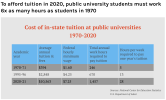
My dude. Your father borrowed money for food in the great depression and you're comparing your college experience to modern times? When you went to school you could pay for college with low skill/no skill summer + part time jobs. Today you need to work nearly a full time job, and that's assuming someone else is still paying your rent, food, medical, car, etc.

1748001409542.png
 
Both of my daughters are in careers (one's a teacher, one's a nurse) that require a Masters degree within some number of years after starting work. The Masters in education had to be done in state and incurred significant debt, while the Masters in nursing could be done online at much lower cost. Both agree that the required advanced degree contributes nothing to their ability to do the job.
 
Both of my daughters are in careers (one's a teacher, one's a nurse) that require a Masters degree within some number of years after starting work. The Masters in education had to be done in state and incurred significant debt, while the Masters in nursing could be done online at much lower cost. Both agree that the required advanced degree contributes nothing to their ability to do the job.
That's interesting that they "require" it. My daughter's school definitely wants masters and highly encourages it, including paying for the tuition, but this is the first I've heard of someplace requiring it. Daughter definitely thinks she's a better teacher now, but that might be a personality thing. She's always been good about optimizing things. And she's a high school business teacher, for which being current and having a deeper understanding might be more useful than, say, a primary school teacher. Which my mom was. Who also got a masters, to get to a higher pay band, and might report less of an advantage in terms of teaching skills for having done so. I'll have to ask her over the weekend.
 
I will not equate poor mental skills as not nice.

My sister was a nice person, and had a college degree. She never figured out the difference between having money, and having income.

The kid should be figuring out the answer to his question himself, so he firsthand knows the rules of the game in the future, or he will be inclined to repeat his past mistakes.

Visiting banks to discuss options is the first non internet step in this process. Taking a copy of his student loan contract is needed to get real answers. The original should be left at home.


There is nothing wrong with asking trusted elders for advice in anything. You never asked a more experienced person a question.

The way you talk, you get out of college and should have everything figured out. You shouldn't need to hire a mechanic to diagnose your car, you went to college. You don't need a plumber, you went to college. You don't need and electrician, you went to college. You don't need a doctor, you went to college. You don't need a financial advisor, you went to college.

Schools should focus on teaching better financial skills.
 
Last edited:
Is it possible to have another lender pay off your note, you make payments to new lender?
I have no idea how student loans were constructed, asking for a (an ex-) student friend.
I presume it’s the typical student loan that most students were getting 10 years ago.
-were the loans open ended; could be paid off anytime (or, paid off with penalty)?
-is it unlikely to find a more favorable rate (I’ve asked what the current loan rate is at).

Yes - it's a regular loan in the financial sense. The challenge to evaluate the benefit depends on what type of loan they started with. If it's a federal load, there are fixed rate and variable rate loans - the fixed rate may be better than what you can refi at today. Assuming they had multiple semesters of loans, each semester should show up as a separate 'loan', though they all roll up to one account. When you make a monthly payment, the payment gets peanut-butter-spread across all the individual loans on your account. Some semesters' loans may be locked into a better rate than others, so evaluate and choose which ones to pay off accordingly. The other 'benefit' of maintaining a federal loan is that they are available for forbearance opportunities (a la COVID) where private loans typically don't get that. Once you roll it over from a federal loan to a private loan, it's just a regular 'personal loan' (as far as I can remember - that may have changed), so you don't get any overarching "the sky is falling" gov't step-in type actions.

I'm not as perfect as some other people - and apparently a lesser 'man' for doing so, but my wife and I both are still paying off our student loans (hers will finish up this year and mine next year). Hindsight 20/20, we probably shouldn't have borrowed to the extent that we did, but live and learn, and we're dealing with it.
 
You can pay off student loans or consolidate them, but I would keep them as student loans as those loans allow you to defer payments should you lose a job, COVID, etc. Yes that interest payments would still add up, but these are relatively safe loans. You can also do income based repayment so that you pay what you can afford to pay. After 20 years(?) of “payments”, your loan balance can be forgiven, or less if you work in certain industries.
 
I think there's significant uncertainty with student loans right now, but in general, repayment of student loans may be more favorable than private loans. Depending on the friend's situation, he might look at different repayment, forgiveness, and forbearance options. You never know when a president might come along an forgive trillions of $ in loans. In that regard, consolidating might be more attractive than refinancing.
 
Last edited:
When you went to school you could pay for college with low skill/no skill summer + part time jobs. Today you need to work nearly a full time job, and that's assuming someone else is still paying your rent, food, medical, car, etc.

View attachment 141312
And why do we think this is the case? Could it possibly have something to do with the government guaranteeing repayment of student loans in the event of borrower default? That started in 1965 through the FFEL. Let's see, if the lenders are guaranteed repayment they might be willing to lend increasing amounts no? If the schools know increasing amounts are accessible to students what's the incentive to limit tuition increases?

Perhaps making loans available for all started out of good intentions, but there appear to be unintended consequences.
 
And why do we think this is the case? Could it possibly have something to do with the government guaranteeing repayment of student loans in the event of borrower default?
That's a small part of it. And it would be nice if there was such a simple answer. But, mostly no, that's not the cause. The world is far bigger and more complicated than that.


And, don't forget, the states have steadily reduced public funding for college, so that price now gets passed on to students. I would bet that's the single biggest piece of the tuition increases. The fact that it's become harder and harder to support a family without a college education has also created demand and, you know, capitalism. Supply and demand. That helps also. Colleges provide a wider range of services now, and more expensive ones. That adds up.

It all adds up. It's definitely not "get rid of secured loans and the problem goes away". That would only solve a small part of the problem at best.
 
Last edited:
I will not equate poor mental skills as not nice.

My sister was a nice person, and had a college degree. She never figured out the difference between having money, and having income.

The kid should be figuring out the answer to his question himself, so he firsthand knows the rules of the game in the future, or he will be inclined to repeat his past mistakes.

Visiting banks to discuss options is the first non internet step in this process. Taking a copy of his student loan contract is needed to get real answers. The original should be left at home.
That stop could also result in being taken advantage-of when the person is unfamiliar with terminology and various financial options. Going into a bank and getting sold whatever product they happen to have won't necessarily result in them getting the best solution for their situation. Will make the banker happy though. Asking some knowledgeable people before walking into the lion's den is certainly a solid first step when they realize they are out of their element.
 
That stop could also result in being taken advantage-of when the person is unfamiliar with terminology and various financial options. Going into a bank and getting sold whatever product they happen to have won't necessarily result in them getting the best solution for their situation. Will make the banker happy though. Asking some knowledgeable people before walking into the lion's den is certainly a solid first step when they realize they are out of their element.
Not to mention that we're literally talking about people with only a high school education, very little life experience and little to no work experience.

Tons of them are making these decisions before they are even at the age of being an adult from a justice system standpoint.

To expect them as a population to somehow just be able to muster the smarts to navigate this effectively is not rational. Turns out most of them navigate all this fine. Some take on debt they probably shouldn't. Some find it quite ruinous. About what you might expect from a population like that. But, in any case, not one where the rational response is "The kid(s) should be figuring out the answer to his question himself"
 
As a semi-anonymous sgoti, I suppose you reserve that right…. however I daresay if you meet them in person you might be a tad less harshly judgmental.
He also reserves the right to treat people online exactly as he does in person, but as a semi-anonymous sgoti, I suppose you reserve the right to assume a behavior fits into the cubbyhole that you like.
 
The thread is asking about refinancing options - but I certainly agree with those who say that an 18-yo hardly has the intellectual wherewithal to make enormous financial decisions that will adversely affect them much later in life - and for years of debt repayment.
That is not saying I think someone else should be shouldering the responsibility of what they decided.
But it would be great if we had a better system.

I knew a Dr. that was living for years in a small city, and after tiny apartment rent/insurance/food/utilities/gas/living "very small" / an ancient tiny car/ minimum loan payments - there was nothing left over.
Some taking professional routes have a half million student loan to service. 20 years, 6% on 500,000 is over $3K/mo (yes, $100/day).
And you can go to pretty much any fly-in and find a doctor who doesn't like their job, but is stuck with it because they made a decision at 18 that locked them in for life.
 
Not to mention that we're literally talking about people with only a high school education, very little life experience and little to no work experience.

Tons of them are making these decisions before they are even at the age of being an adult from a justice system standpoint.

To expect them as a population to somehow just be able to muster the smarts to navigate this effectively is not rational. Turns out most of them navigate all this fine. Some take on debt they probably shouldn't. Some find it quite ruinous. About what you might expect from a population like that. But, in any case, not one where the rational response is "The kid(s) should be figuring out the answer to his question himself"
Geezer is also relying heavily on his self-admitted background of having father/grandfather who instilled certain financial lessons into them at a young age. Many people didn't have that upbringing so they often make poor financial decisions until they (hopefully) learn from their mistakes. It's surprisingly difficult for the human brain to comprehend compound interest and the toll that interest takes on future earnings.
 
One unstated function of PoA is to give commenters the opportunity to feel superior.

There is nothing inherently wrong with student loans. They do take a balancing of risk vs reward that is probably beyond the maturity and experience of many high school seniors. It is possible to make a bad decision, eg going into heavy debt for a profession with a poor financial return.

I think talk of loan forgiveness has done a grave disservice by tempting borrowers to avoid paying off their debt or even letting it grow in the hopes it will one day be forgiven.

We financed my wife's law school tuition. When she graduated, she went into JAG and all our disposable income went into paying those loans off in a couple of years.
 
There is nothing inherently wrong with student loans. They do take a balancing of risk vs reward that is probably beyond the maturity and experience of many high school seniors. It is possible to make a bad decision, eg going into heavy debt for a profession with a poor financial return.
And I suspect most people who have been around aviation for a while have seen at least as many people in debt up to their eyeballs over this as in any other profession, so many of us default (pardon the pun) to “student loans are bad.”

Having said that, all 3 of my daughters had some student loans, but they worked really hard to minimize them. The one that dug herself into debt the worst actually did it by stress-spending with a credit card when she had a job that turned out to be really bad for her.
 
And you can go to pretty much any fly-in and find a doctor who doesn't like their job, but is stuck with it because they made a decision at 18 that locked them in for life.
Thankful everyday I didn’t go to medical school.
 
That's interesting that they "require" it. My daughter's school definitely wants masters and highly encourages it, including paying for the tuition, but this is the first I've heard of someplace requiring it.
It's a Connecticut state requirement for both a teaching certificate as well as a nursing license.
 
It's a Connecticut state requirement for both a teaching certificate as well as a nursing license.

Open to stand corrected but as far I can see, that's just not true in CT or anywhere in the US. APRNs aka Nurse Practicioners of course require a master, as that is the educational level of that certification. There is the doctoral program as well for those who wish to pursue academia as nurse educators in research/grant positions, either as RNs or APRNs. But most people in the know would not attempt to blur the educational requirement distinctions between RNs and Nurse Practicioners, even though the latter are RNs by pre-requisite definition. Perhaps your RN daughter is pursuing some nursing educator position or an APRN pivot? It's a somewhat common pivot for RNs, either for a little more money or better schedules (for my wife, the motivation is the latter).

CT still accepts ADNs in order to become a registered nurse. That's an associate's degree btw. Sure, employment prospects are market driven and these days pretty much de facto require a BSN as a competitive discriminator.
 
Yes you can. I know several who refinanced Sally Mae loans with Sofi at a lower rate.

Keyword - don’t get student loans.
So you recommend no one go to med school unless they can get grants or pay cash? Hope you never need medical care.
 
Tangentially related: My daughter just graduated from pharmacy school. I loaned her what she required the last 4 years so the loan is sizable. I'm not charging her interest but told her I'm expecting a "reasonable" repayment rate. It seems in the time after making this commitment to her, the financial challenges facing young people just starting out has deteriorated considerably. Given this, and since we left it so loose, I expect our interpretations of "reasonable" probably differ. My youngest was just accepted into a masters program and is now expecting the same deal. We'll see if this was a bad idea. I don't think I can garnish wages, social security or seize tax refunds from lack of repayment :-)
 
Mahneuvers, what did your two daughters do to earn college money before the entered college?

Both my sons had work permits in high school, and did interns after starting college. They were not spenders, so were well off on their own.

A habit of earning and saving is a help for future choices. Good luck
 
CT still accepts ADNs in order to become a registered nurse. That's an associate's degree btw. Sure, employment prospects are market driven and these days pretty much de facto require a BSN as a competitive discriminator.
Well, maybe it was a BS. She did start with the associates degree but I know at least the BS was required within a certain timeframe. But now she's living and working in NY.
 
Rather than dump on the student I will dump on the university. It’s a literal crime that they took someone’s money and did not provide sufficient education to prepare the student for this.
 
Rather than dump on the student I will dump on the university. It’s a literal crime that they took someone’s money and did not provide sufficient education to prepare the student for this.

why the university? why so late in the education process?

Of course, it would be nice if the parents would teach the children as they were growing up. (yes, I realize way too many parents don't have a clue)
 
Well, maybe it was a BS. She did start with the associates degree but I know at least the BS was required within a certain timeframe. But now she's living and working in NY.
could it be a nurse practitioner? Often, master's degrees can be online. I have no real knowledge of the medical system though.
 
Back
Top