Mooney M20J crash in Union, SC. Four dead.

I know you all hate DG but his latest is engine out pick a wide open field or area and land.
Screw trying to make the runway. I agree. I've seen way to many crashes where the pilots
tried to "Save" the aircraft and perished.
Except he picked a runway when he was put in that same situation last year. Do as I say not as I do.

Besides, sometimes there's nothing but trees or buildings.
 
but a wide open field might of worked better.
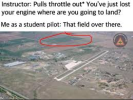
This is not funny but that comment remind me of this picture I've been seeing. It even looks a bit like that first pass over the runway in the ADS-B feed might have looked. Personally, I'd choose the runway.

1776700377825.png
 
He does say some common sense ideas once in awhile. Having many hours myself in a 201, the pilot should of handled it but a wide open field might of worked better.

Considering the amount of fatals following stall/spins, impacting wires, trees, highway dividers, vehicles, etc., happening while flying towards an airport, versus the amount of non-fatals from light aircraft sitting in the middle of farmers' fields with the pilot chatting with Police, I believe Gryder has a strong and valid point.

If I'm faced with a "not so sure I'll make a runway" decision and the intended airport to hopefully reach (with some altitude remaining) is not surrounded with any open areas, putting it down on the way there in an open field is a no-brainer. It's tough to believe there should be any opposing views about it.

Even AOPA's anointed "safest pilot in the world" (on the controls or not) died impacting just short of a runway, after overflying many survivable locations.
 
Last edited:
I don’t recall ever being taught to flare over the grass, even when I was training at an 1800’ runway. I teach it now during recurrent training and only rarely come across a pilot who has done it before.

Perhaps obviously, I was not taught to touch down halfway down the runway there, but most engine out exercises were based on having room at both ends to account for stress related technique errors. Short fields were make believe and I only recall being instructed to land on the numbers once.

I've been in many flight reviews where I pull the power and the pilot starts aiming for the numbers, as if it's a contest on spot landing, on a 5000-ft runway. On instrument approaches, I frequently see pilots reducing power to land on the numbers instead of keeping the same power and letting the airplane continue the same glidepath and touchdown a 1000 ft later. Why this is so, I don't know.
 
I wonder why he did not stay right over the runway? During a flight review with my 210M my new instructor asked if I could make it to a open area with engine failure, I had plenty of altitude so I showed him what a rock the 210 was with the gear down
 
Oh No! If the ADS-B tracks are accurate, it looks they got to the diversion airport with lots of extra altitude and instead of losing it and coming straight in, flew a big pattern and lost too much of it. Perhaps they just didn't see the runway until they overflew it, but the airspeed numbers also indicate coming it pretty hot, which would also account for the big circle. It does look odd so it might mean something else.

View attachment 151557
I believe this ADS-B track was the approach to landing of the plane at Union County. The crash apparently occurred on takeoff after refueling, and no ADS-B information was recorded.

I found this statement on the website of a local Huntsville, AL TV station, which is where the decedants were from.

The National Transportation Safety Board said the plane was on its way to Gilmer, Georgia from Raleigh, but stopped to refuel in Union County. When taking off after filling up, the plane reportedly hit a heavily wooded area about 1200 feet away from the runway. Fire consumed most of the wreckage, and all four passengers died.

All crashes resulting in death are tragic, but those that take multiple members of a family are especially so. My condolences to the family and friends of those lost.

 
It's really tragic. From the track above, it looks to me like he was doing a circle to land, like in practice but for real, but turned base too late and ran out of altitude. Also that he was either a bit too close on downwind or didn't turn tight enough, I can't tell from the scale. It's tragic because if he had control of the aircraft..and it seems like he did, and visibility, that should have been just a power off landing.

This is the practice maneuver that isn't required for PPL, but I had to demonstrate before my first CFI would sign me off for solo for sport pilot. And again when I had a sign off on a different aircraft. I'm not saying that with that practice in whatever aircraft I'm flying I'd be able to do this in a real emergency, but after that practice I'm confident that it greatly improves my chances of success. The short version of the lesson is stay at best glide until you know you have the field made, then adjust your descent rate to land where you want. Flaps, slow down, and slip if you can do it safely.

Edit - The TV report above says the crash was after takeoff. The linked story on aviation-safety says the crash was on final, vectored there by ATC on reporting engine issues. My comments are based on the latter story being the right one...but I have no idea which is right, or if either is.
 
Last edited:
On my PP check ride at TIW, an airport that reminds one of an aircraft carrier, I came from Eastern Montana. I was pretty good at making the numbers, engine out. The check pilot, a well known and respected gentleman, pulled the engine to idle on base leg. I put down flaps on final over Puget Sound and touched down on the numbers. He chewed me out about winds, flaps and what if decisions. I tried to defend myself as we climbed out and then realized that I was debating with the gentleman who was going to give me my license to learn. His final comment was to aim for midfield and when you have that made you can back it up. Fast forward 43 years. Carb ice on an evening takeoff with long ground running - with a rpm dropping 300 rpm as I went crossing the threshold on climb out and recovering- did it a a couple of times. Thought about turning downwind, but decided I had an engine and no time like the present. Turned back to a baseleg at 400 feet and aimed for midfield. Best landing ever. Thank you Chuck Gross for a lesson that took 43 years to prove useful. Mid-field with good energy management made it an interesting non-issue.
 
Last edited:
Edit - The TV report above says the crash was after takeoff. The linked story on aviation-safety says the crash was on final, vectored there by ATC on reporting engine issues. My comments are based on the latter story being the right one...but I have no idea which is right, or if either is.
I did some investigation, the pilot was retired military, had attended the US Navy Test Pilot School, and had flown almost 3 dozen types in his career. That kind of experience doesn't jibe with crashing a good aircraft while on final approach as the above flight track shows. Having some sort of occurrence on takeoff seems more likely.

All of the linked news stories on the Aviation Safety site mention refueling and the crash on takeoff.

We shall see.
 
I saw the hulk of this wreck on a trailer driving home yesterday. The prop and spinner looked mostly undamaged. The one main gear that I could see was retracted.
 
I saw the hulk of this wreck on a trailer driving home yesterday. The prop and spinner looked mostly undamaged. The one main gear that I could see was retracted.
Was it burned?
 
Looked up Foreflight pilot comments (and AI generated summary) at Union County SC airport (35A). No active NOTAMS.

Supposed to be runway construction occurring in April/May ending sometime in June. Three weeks ago there were deer reported on the runway. The self-serve fuel pump was reported finicky, and a recommendation was to call prior to landing to check on fuel availability.

Today's fuel price is $4.90 per gal, almost $3 cheaper per gallon than my home base.

Possible low pass to over the runway to check for deer and construction? Followed by landing, fueling up, and contaminated fuel? There's more to this story yet untold... RIP.
 
I believe this ADS-B track was the approach to landing of the plane at Union County. The crash apparently occurred on takeoff after refueling, and no ADS-B information was recorded.

I think you are right. This track originates in Raleigh.

Looking at the flight path, it appears the fuel stop in Union might have been unplanned.
 
I believe this ADS-B track was the approach to landing of the plane at Union County. The crash apparently occurred on takeoff after refueling, and no ADS-B information was recorded.
I think you are right. This track originates in Raleigh.

Looking at the flight path, it appears the fuel stop in Union might have been unplanned.
There's a clear, significant deviation from the planned flight path just prior to the landing/crash. I was trying to figure out if they had called ATC with engine trouble and gotten vectors like I heard (in which case they probably crashed prior to landing), or whether it was after takeoff.

Four adults in an M20J isn't going to allow for full fuel. 1050-1100 useful on most Js, minus 384 pounds of fuel leaves you about 690±25 pounds for payload. Not sure what they weighed, but one of the sons had been a football player so presumably not below average. But, it could be a situation where full fuel wouldn't have put them ridiculously over gross, so it's possible they decided to top off anyway and didn't have the performance they thought they would.

If it was on landing, the sudden deviation would make sense. The deviation was close to the field, so even partial or intermittent power could have lulled them into a false sense of security and had the pilot keep a higher energy state instead of slowing to best glide. It looks like they had plenty of energy until the steep turn to final, that combined with dropping gear/flaps could have caused a "we're gonna make it" into a crash.

Until we know for sure whether they were landing or taking off, there could be a wide variety of causes. We'll have to wait and see what the security videos, fuel pump log, credit cards, and final position of the wreckage tell us.

Of course, the DTSB has already issued their final report. :rolleyes:

Screenshot 2026-04-21 at 12.32.59 PM.png

Yes, I think I saw the steel cage that people refer to on these, but I did not see much for any fuselage sheet metal around that cage.
Mooneys have the same sheet metal that any other bird has. It's a "Tube-and-metal" airplane and people have survived some absolutely insane crashes in Mooneys thanks to that steel cage - For example, one that crashed into the side of a mountain in cruise and everyone survived. :eek2: They're tough little birds, the drawback is that their empty weights are fairly heavy and payload suffers.

 
Also, just so that we have this for later discussion:

METAR K35A 172255Z AUTO 00000KT 10SM CLR 30/08 A2999 RMK A02 T02970085
METAR K35A 172235Z AUTO 00000KT 10SM CLR 30/08 A3000 RMK A02 T02990080
METAR K35A 172215Z AUTO 00000KT 10SM CLR 30/09 A3000 RMK A02 T03000090
METAR K35A 172155Z AUTO 00000KT 10SM CLR 30/09 A3000 RMK A02 T03010086
METAR K35A 172135Z AUTO 30006KT 10SM CLR 30/09 A3000 RMK A02 T03020089
METAR K35A 172115Z AUTO 34006KT 10SM CLR 31/09 A3000 RMK A02 T03050086
METAR K35A 172055Z AUTO 02004KT 10SM CLR 30/09 A3001 RMK A02 T03030085
METAR K35A 172035Z AUTO 34008KT 10SM CLR 30/08 A3001 RMK A02 T03020081
METAR K35A 172015Z AUTO 28003KT 10SM CLR 30/09 A3002 RMK A02 T03030092
METAR K35A 171955Z AUTO 27006KT 10SM CLR 31/09 A3002 RMK A02 T03060092
 
I think you are right. This track originates in Raleigh.
According to the ASN report originally linked, the flight originated at my home base, KTTA with an original destination of 49A. The airport where the crash occurred is 35A, which, if you look at a chart, is about half way to the original destination on a straight line, as is consistent with the ADS-B track.

AFAIK it's not a based aircraft at KTTA, so I'm guessing we were the fuel stop being referred to.
Nah, they're based at HSV. You were the destination that they were returning home from.
 
Four adults in an M20J isn't going to allow for full fuel. 1050-1100 useful on most Js, minus 384 pounds of fuel leaves you about 690±25 pounds for payload. Not sure what they weighed, but one of the sons had been a football player so presumably not below average.
The overall average American weight is 181#, times four is 724#. Sure, they could have all been bigger. Or smaller. But it's close enough that I wouldn't assume they had to leave a whole lot of fuel behind.
 
The overall average American weight is 181#, times four is 724#. Sure, they could have all been bigger. Or smaller. But it's close enough that I wouldn't assume they had to leave a whole lot of fuel behind.
That includes all Americans, though, including children. Right now, the standard weights are 199 pounds for men and 172 for women, which would put them at 769#.
 
That includes all Americans, though, including children. Right now, the standard weights are 199 pounds for men and 172 for women, which would put them at 769#.
Standard weights are great for airliners with hundreds of passengers. With four seats, not so much. I was merely responding to the declarative statement, "Four adults in an M20J isn't going to allow for full fuel." Four adults my size would be fine. And my 18-year-old daughter who's under a buck thirty is an adult, too.
 
Photos of the family show they were of slight to medium build. Based upon the pilot's flying career, I want to believe it unlikely that gross weight and CG limits were ignored.
 
The Mooney's filed route was KTTA GMINI T258 RICHE 49A. This was a fairly substantial diversion to the southeast of a direct route which kept the aircraft south southeast of high terrain and outside of most of Charlotte's busy Class B airspace. This route provided a good distance away from the mountains, probably in an effort to keep the passengers more comfortable.

Flying with only half a fuel load would provide plenty of range for this short trip. Unless loaded up with a lot of baggage and heavy passengers, the load with half tanks should have been legal. Even if overloaded (or so I've been told) as long as a M20J's CG remains within limits and the plane lifts off and climbs, it should fly just fine.

Looking at the Flightaware info, there were a lot of ground speed fluctuations and an altitude change, which probably is indicative expecting a better ride that wasn't happening. Flying IFR, we're always asked why do we need a diversion to a different destination. Engine trouble is what was allegedly reported to ATC (and not a sick passenger or something else), so ultimately we'll hear what was said.

The need for the spin around the airport before the crash is a big unanswered question. If the crash did in fact occur before the diversion to 35A, hopefully ATC communication tapes will also help fill in some of those blanks.
 
If you make a habit of flying bomber patterns with power, and never practice cutting power abeam the numbers, you won't have the skill set when the situation demands it.
Very true. And I bet if you fly at big airports, you may find yourself extending your DW because that's the norm you do every day at your home Apt. :cool:
 
I did see where this accident seemed to be on takeoff, after fueling. With that they made it just a bit, along extended centerline, into the trees. Going with the Occam’s razor explanation, could be a performance issue? It was 30C or so on top of it.

A few things, operating at the edge of performance isn’t a sharp line, often gray. Some seemingly small techniques can help with the maneuver or takeoff. That could be a few extra knots for rotation, then a gentle attitude change rate. Of course you have to have runway available, realizing you can’t get blood out of a stone.

I don’t know what all the experience of the pilot, but just because someone has the airline or military flight hours, it’s certainly not a direct transfer to G.A. flying. Yes it sounds troubling in the news article, besides lack of direct transfer, a confidence level can be misplaced.

Just general comments, not saying what happened.
 
If it was on takeoff there's a good size field with gentle rolling terrain off the end of runway 5 but pretty tall trees at the end of the field. I've barely cleared the trees going out of runway 5 before.
 
So how close is 3500 feet with obstacles to performance spec for M20J at gross?
 
So how close is 3500 feet with obstacles to performance spec for M20J at gross?

An M20J loaded close to gross with a strong and healthy engine takes off quite well in higher than standard density altitudes. I've discovered the condition of the camshaft can negatively affect takeoff distances, same as operating near gross weight and/or taking off at higher density altitudes.

Like white wall paint on sheetrock slowly fading over the years, it's not so noticeable until you put on a fresh coat. Same principle with an aging IO-360. Infrequently flown, the overhead camshaft and lifters slowly wear and continue to rob power at an imperceptible amount per year.

This progressive loss of power output finally gets your attention while taking off hot and heavy on a shorter runway than usual. Only then comes the stark memory of the way it used to be. After installing a freshly overhauled engine there can be a noticeable and welcome increase in takeoff and climb performance.

Unfortunately performance charts can't take this type of gradual power reduction into account.
 
That includes all Americans, though, including children. Right now, the standard weights are 199 pounds for men and 172 for women, which would put them at 769#.

They must be assuming carry on luggage included.

Also, this may work for the airlines with 100 passengers, but for small planes you need to do the math. Pictures show them being well under this “average”.
 
If you think that, you need to look around you more when you are out. This is just the averages. Worse in some regions than others. Luggage? This is not even their clothing!

View attachment 151628

173 is probably average for a southeast Tennessee woman. 199 is nowhere near enough for the average male in this area. These bubbas are 250+ if they’re a pound.
 
Following up from a camshaft related POA post in this thread (#70 above), the POA link below is shared from August 2025 and relates to a poor performing take off in a Mooney C model (O-360, 20 less horsepower than the M20J engine in this recent tragic accident aircraft).

The M20C takeoff incident aircraft in the link had about 1000 TT on a rebuilt engine from a well known and respected overhaul shop. Allegedly, it wasn't making any metal during the most recent oil change. It occurred during a hot late afternoon (~85 F degrees) light wind day from a 4100' unobstructed runway loaded about 150 lbs under gross weight:

 
If you think that, you need to look around you more when you are out. This is just the averages. Worse in some regions than others. Luggage? This is not even their clothing!

View attachment 151628

I’m thinking median would probably be better indicator, I have a friend who’s around 400lbs, he would skew the average and it would take a lot of lightweights to balance him out.
 
  • Love
Reactions: MFE
Multiple people have given me lightweight grief on here for not trusting the book performance numbers for climb over obstacle, specifically in PA28s. And I know how to fly out of a short field, I trained in one from the start, and I know how to calculate DA. I view those charts from the 70s as "best case new engine". Not marketing hype, but not something an engine with some wear on it and an airplane that isn't rigged perfectly is promised to do. If I don't know for certain - that is I've done it - that a particular aircraft with a particular load and ambient temp and airport is good, I'm adding the greater of 15% or 1000' to the charts. Maybe I'm being a baby here, but I don't care.

Again, no idea if that's the case here...and I'm not suggesting to pad numbers to compensate for improper maintenance, just for what I see as a potential discrepancy between "new" and "normal use/average wear" for an aircraft and engine.
 
173 is probably average for a southeast Tennessee woman. 199 is nowhere near enough for the average male in this area. These bubbas are 250+ if they’re a pound.
Consider that Tennessee's is only in the top 5 or 6 in terms of overall obesity rate, although well above average. Alabama, Mississippi, and West Virginia score higher.
 
“The crash happened in Union City near the Everett-Stewart Regional Airport where the plane took off from. The plane crashed into a solar farm called Skyhawk Solar, which is owned by Origis Energy, a company based in Florida.D”

That makes a difference. Solar farms are panels that are anchored to steel stantions that are anchored in concrete. Here in Florida any way. Probably one of the worst landing spots available.

That would explain the fire. When making contact (and under control) during an off-field emergency landing a Mooney is not prone to explode and burn.
 
Back
Top